


18 May What is sustainability in ESS: The IB student’s guide
TL;DR:
- Sustainability in IB ESS is a core, integrated concept focused on balancing environmental, social, and ethical factors within systems thinking. Students must analyze trade-offs, incorporate multiple perspectives, and apply critical decision-making frameworks rather than seeking single “correct” solutions. Developing environmental literacy and viewing sustainability as a lens rather than an answer enhances exam performance and understanding.
Sustainability in IB ESS trips up a lot of students. Most come in thinking it means protecting rainforests or reducing plastic waste, and while those topics are part of the picture, they are nowhere near the full story. In IB ESS, sustainability is a unifying concept woven through the entire course, not a single unit you study and move on from. Understanding what sustainability really means in this context, and why it matters for your assessments, is one of the most powerful things you can do to raise your scores.
Table of Contents
- Defining sustainability within IB Environmental Systems and Societies
- Education for sustainable development and its relation to IB ESS
- Common misconceptions and how to approach sustainability in IB ESS assessments
- Applying systems thinking and decision-making in sustainability: frameworks for ESS students
- Integrating social, ethical, and economic perspectives for balanced sustainability answers
- My take: sustainability is not an answer, it’s a lens
- Ready to master sustainability in IB ESS?
- Frequently asked questions
Key Takeaways
| Point | Details |
|---|---|
| Sustainability as a core IB ESS concept | Sustainability is one of three key concepts central to IB ESS and must be integrated with systems and perspectives. |
| Beyond environmental focus | Strong sustainability answers include social, ethical, and economic dimensions alongside environmental science. |
| Systems thinking framework | Use systems thinking to connect resource limits and management strategies for viable sustainability analysis. |
| Education empowers action | UNESCO’s ESD framework highlights the importance of learner agency and values in sustainability education. |
| Perspective integration boosts scores | Analyzing competing social and political perspectives shows mastery in ESS assessments. |
Defining sustainability within IB Environmental Systems and Societies
Now that we have introduced sustainability as central to IB ESS, let’s define it exactly within the course framework.
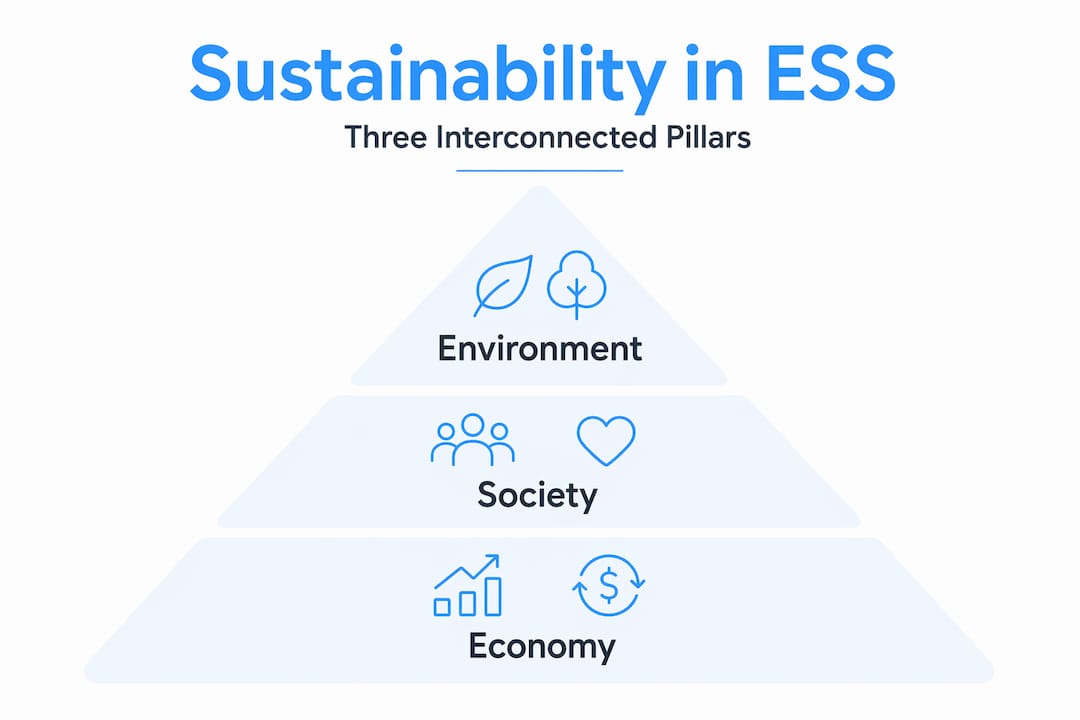
Sustainability in IB ESS is not a standalone topic. It sits alongside systems and perspectives as one of the course’s three unifying concepts. This means every major topic you study, from biodiversity to pollution to food production, connects back to sustainability in some way. Think of it as the thread that holds everything together.
At its core, sustainability in ESS asks: Can we meet current human needs without compromising the ability of future generations to meet theirs? But the course goes deeper than that classic definition. ESS is a complex course requiring skills from different disciplines, with sustainability central and resource management pivotal. That means you are not just describing environmental damage. You are analyzing systems, weighing decisions, and evaluating trade-offs.
Here are the key elements that define sustainability in the IB ESS framework:
- Systems perspective: Sustainability requires understanding how components of environmental and social systems interact and influence each other over time.
- Resource management: How societies use natural resources, whether responsibly or not, is at the heart of most sustainability discussions in ESS.
- Multiple perspectives: Sustainability is not a single scientific answer. It involves social, cultural, economic, and ethical viewpoints.
- Long-term thinking: ESS consistently asks you to consider how decisions today affect future environmental and societal outcomes.
Getting comfortable with key environmental system concepts and systems thinking in IB ESS will help you build a solid foundation for sustainability discussions throughout the course.
Education for sustainable development and its relation to IB ESS
Having defined sustainability within ESS, let’s explore the global educational framework that supports this approach.
UNESCO’s Education for Sustainable Development, commonly called ESD, is a global framework that shapes how sustainability is taught in schools worldwide, including within the IB. It goes beyond knowledge transfer. ESD aims to build agency, meaning the ability and motivation to actually act on what you know.
This framing directly mirrors what IB ESS expects from you. The course does not ask you to memorize sustainability facts. It asks you to analyze, evaluate, and apply knowledge across real contexts. ESD reinforces that sustainability education is active, not passive.
Here is why this matters for your ESS work:
- Knowledge alone is not enough. ESS assessments reward you for showing you understand the implications of sustainability decisions, not just the facts.
- Values are examinable. When ESS exam questions ask you to “evaluate” or “discuss,” they want you to consider different ethical and social values, not just give an environmental answer.
- Agency shows in your writing. Strong ESS responses demonstrate that you understand how decisions are made and by whom, and what the consequences are.
Environmental literacy in IB ESS builds the foundation you need to engage with these ideas critically. If you are new to the course, the guide to IB ESS is a great place to start.
Common misconceptions and how to approach sustainability in IB ESS assessments
With context on broad educational goals and course framing, let’s tackle common student misunderstandings and assessment strategies.
The most common mistake students make is treating sustainability as a purely environmental or technical problem. They write about carbon emissions, deforestation, or species loss, which are all relevant, but they stop there. They forget that IB ESS integrates social, cultural, economic, political, and ethical contexts into every sustainability issue.
Here is what that looks like in practice. A question about sustainable fisheries management is not just about fish populations and trawling methods. It is also about fishing communities’ livelihoods, government policy, international trade agreements, indigenous rights, and the ethics of who gets to decide how resources are used. A student who only covers the ecological side will score significantly lower than one who integrates all of these dimensions.
Common misconceptions to avoid:
- Thinking sustainability equals conservation. Conservation is one strategy. Sustainability is a broader goal.
- Assuming there is always one correct or “most sustainable” answer. Context always matters.
- Ignoring trade-offs. Every sustainability decision involves winners and losers. Acknowledge them.
- Using vague language like “we should protect the environment” without explaining how, for whom, and at what cost.
Pro Tip: When you see a command term like “evaluate” or “discuss” in an ESS exam question, treat it as a signal to bring in multiple perspectives, not just environmental ones. Examiners reward nuance.
Use IB ESS evidence-based strategies to sharpen how you structure your answers, and revisit environmental concepts for IB ESS to make sure your foundational knowledge is solid.
Applying systems thinking and decision-making in sustainability: frameworks for ESS students
Understanding misconceptions leads naturally to practical frameworks that help you analyze sustainability effectively.
Systems thinking is your most useful tool for sustainability analysis in ESS. It helps you see sustainability not as a fixed state to achieve but as a dynamic balance to manage. Linking management strategies to resource constraints using systems thinking is exactly what the ESS course rewards in high-scoring responses.
Here is a four-step framework to apply when tackling any sustainability question:
- Identify the system. What are the key components? What are the boundaries of the system? (Example: a river basin including upstream agricultural land, towns, wetlands, and coastal fisheries.)
- Identify feedback loops and limits. What happens when a resource is overused? What natural feedbacks exist? What are the carrying capacity constraints?
- Map the stakeholders. Who benefits from current resource use? Who bears the costs? Whose values and interests are in conflict?
- Evaluate management options. What interventions are possible? What are the trade-offs in ecological, economic, and social terms?
| Decision factor | Environmental focus | Economic focus | Social/ethical focus |
|---|---|---|---|
| Water use in agriculture | Aquifer depletion, ecosystem services | Crop yield, export revenue | Food security, indigenous water rights |
| Urban forest clearing | Biodiversity loss, carbon storage | Land value, development income | Community health, cultural significance |
| Marine protected areas | Fish stock recovery, habitat protection | Short-term fishing losses | Livelihoods of fishing communities |
| Renewable energy transition | Reduced emissions, land use change | Installation costs, energy independence | Energy access in developing regions |
Pro Tip: In your essays and extended responses, use this framework to structure your argument. Start with the system, then work through the feedback loops and trade-offs. It signals to the examiner that you are applying the systems approach in IB ESS with real depth. Check out evidence-based strategies for more ways to strengthen your written responses.
Integrating social, ethical, and economic perspectives for balanced sustainability answers
Equipped with systems frameworks, let’s now deepen your understanding by weaving in critical social and economic contexts.
One of the things that separates a strong ESS student from an average one is the ability to genuinely integrate perspectives, not just list them. It is not enough to write “some people think the economy is more important than the environment.” You need to explain why those values exist, what evidence supports them, and what the consequences are.
ESS expects students to analyze why sustainability solutions differ across societies due to politics, economics, and ethics, rather than identifying a single best ecological option. This is a key distinction. The course is not asking you to pick a winner. It is asking you to understand the landscape of disagreement.
Here are best practice steps to incorporate social and ethical perspectives in your sustainability discussions:
- Name and explain each perspective. Do not just say “economic perspective.” Say whose economic interests, why they matter, and what the specific concern is (e.g., loss of employment in a coal-dependent town).
- Use specific case studies. Connecting to real examples, such as the Amazon deforestation debate or Pacific Island climate adaptation, makes your answers far more convincing and specific.
- Show the trade-off, not just the conflict. A trade-off analysis explains what is gained and lost with each choice, rather than simply listing who agrees and who disagrees.
- Reference ethical frameworks when relevant. Does this situation involve intergenerational equity? Environmental justice? The rights of non-human species? These concepts, when used accurately, signal real depth of understanding.
- Avoid moral judgments without evidence. ESS responses are analytical, not argumentative. Present perspectives fairly before drawing any conclusions.
Understanding why studying environmental systems builds this kind of critical thinking is worth reflecting on. Building your environmental literacy means you can draw on concepts like ecological footprint, carrying capacity, and ecosystem services when linking these perspectives together.
My take: sustainability is not an answer, it’s a lens
After working with IB ESS students for over 13 years, I notice a pattern. The students who struggle most with sustainability questions are the ones looking for the right answer. The students who thrive are the ones who treat sustainability as a way of seeing.
Here is what I mean. When you approach a question about deforestation or renewable energy by asking “what is the sustainable solution?”, you are already framing it incorrectly. ESS examiners are not looking for a solution. They are looking for evidence that you can analyze a situation from multiple directions, weigh real trade-offs, and recognize that what counts as sustainable depends on who you are, where you live, and what you value.
The conventional advice is to “include multiple perspectives.” But many students do this mechanically, adding a quick sentence about economics or ethics without really integrating it. The shift happens when you stop listing perspectives and start using them as genuine analytical tools. Ask yourself: How does this economic constraint change what is actually possible? How does this ethical value shift which outcomes we should prioritize?
That shift, from listing to analyzing, is what moves a student from a 4 to a 6 or 7. And in my experience, it usually takes a few structured practice sessions with targeted feedback to get there. Sustainability in ESS is genuinely fascinating once you stop trying to simplify it and start engaging with its real complexity.
Ready to master sustainability in IB ESS?
If sustainability in ESS still feels like a lot to hold together, you are not alone. It genuinely is a complex concept, and tying together systems thinking, perspectives, resource management, and ethical trade-offs takes practice.
That is exactly where personalized tutoring makes a difference. As an IB examiner with over 13 years of experience teaching ESS, I work with students one-on-one to build the specific skills that push scores higher. Whether you need help with essay structure, Internal Assessment support, or exam technique for sustainability questions, I can show you exactly what examiners are looking for. Book a trial lesson at esstutor.net and let’s work on this together.
Frequently asked questions
What does sustainability mean in the IB ESS course?
In IB ESS, sustainability is one of three unifying concepts and focuses on the responsible management of natural resources, taking into account environmental, social, and ethical factors within a systems perspective.
How is UNESCO’s Education for Sustainable Development related to IB ESS?
UNESCO’s ESD aligns closely with IB ESS by empowering students to act responsibly through knowledge, skills, values, and agency, which mirrors what the IB ESS course asks students to develop and demonstrate in their assessments.
Why should I include social and ethical perspectives in sustainability discussions?
Including social and ethical perspectives reflects how sustainability actually works in the real world, showing how cultural, economic, and political values shape environmental decisions and trade-offs, which is exactly what IB ESS examiners reward.
How can systems thinking improve my sustainability essays in IB ESS?
Systems thinking helps you analyze how environmental and social components interact, and how management decisions influence sustainability outcomes over time, which gives your essays structure, depth, and analytical strength.
No Comments