


27 May ESS Assessment Objectives Workflow: Your IB Guide
TL;DR:
- Mastering the ESS assessment objectives workflow enables students and educators to connect knowledge systematically to IB criteria, improving performance.
- A structured evaluation process, incorporating planning, evidence gathering, feedback, and verification, ensures assessments are reliable and aligned with learning objectives.
Mastering the ESS assessment objectives workflow is one of the most practical skills you can develop as an IB Environmental Systems and Societies student or educator. Many students understand the content well but still underperform because they do not know how to connect their knowledge to specific assessment criteria and execute their work in a logical order. This guide breaks down exactly what ESS assessment objectives mean, how to plan and run a structured evaluation process workflow, and how to verify your results for continuous improvement. Whether you are working on your internal assessment or preparing for exams, these strategies will give you a clear path forward.
Table of Contents
- Key Takeaways
- Understanding the ESS assessment objectives workflow
- Planning your ESS assessment workflow
- Executing the ESS assessment workflow step by step
- Verifying and improving ESS assessment outcomes
- My honest take on workflow and assessment in ESS
- Get expert support for your ESS assessments
- FAQ
Key Takeaways
| Point | Details |
|---|---|
| Know your objectives first | ESS assessment objectives directly map to IB IA criteria and must guide every decision in your workflow. |
| Use a structured workflow | A stepwise evaluation process workflow reduces errors and keeps your assessment on track from start to finish. |
| Mix formative and summative | Combining both assessment types gives you real-time feedback and a clear measure of mastery at the end. |
| Verify with human review | Checking scores and criteria against documented standards prevents bias and improves scoring fairness. |
| Iterate and improve | Using feedback to refine rubrics and adjust teaching makes each assessment cycle stronger than the last. |
Understanding the ESS assessment objectives workflow
Before you can execute any workflow effectively, you need to understand what ESS assessment objectives actually are. In IB ESS, assessment objectives define the specific skills and knowledge students are expected to demonstrate. They are not just content topics. They describe observable behaviors such as analyzing environmental data, evaluating the reliability of sources, and constructing arguments about sustainability trade-offs.
The IB organizes these objectives into four main levels: knowing and understanding, applying and analyzing, synthesizing and evaluating, and then reflecting and communicating. Each level demands progressively deeper thinking. A student who only recalls definitions will struggle at the higher bands.
The connection to IA criteria is direct and non-negotiable. Every criterion in your ESS IA criteria maps onto one or more of these objectives. If you do not know which objective a criterion targets, you cannot write to it confidently. This is where many students lose marks they absolutely earned through effort but misdirected execution.
Clear communication of weighting and priorities in evaluation criteria helps students focus their efforts on what matters most, directly maximizing their scores within any given assessment cycle.
Standardized evaluation frameworks that use expert-validated criteria show mean agreement levels of 89.3% and Content Validity Indices of 0.92, confirming that structured, criteria-driven assessment produces genuinely reliable results. For you as a student or educator, this means the IB’s framework is not arbitrary. It is built to be valid and consistent when applied correctly.
Why objective assessment strategies matter
Students often treat their ESS coursework as a content exercise. The real task is much more targeted. You are demonstrating specific competencies within a defined set of objectives. Objective assessment strategies shift your focus from “did I write enough” to “did I address what was actually asked.” That shift alone can add several marks to an internal assessment.

Developing fair assessment criteria requires stakeholder engagement, criteria weighting, and systematic documentation. For educators, this means co-developing rubrics with clear descriptors at each band. For students, it means reading those descriptors before writing, not after.
Planning your ESS assessment workflow
Good planning is the foundation of any successful ESS objectives analysis. The preparation stage is where most workflow improvement for assessments actually happens. Getting this right means fewer corrections later and a much smoother execution phase.
A useful framework for the evaluation process workflow comes from a standard 7-step performance evaluation model: planning, self-evaluation, evidence gathering, secondary review, conversation, acknowledgment, and closing. Adapted for ESS, these steps translate directly into how you structure your IA or exam preparation.
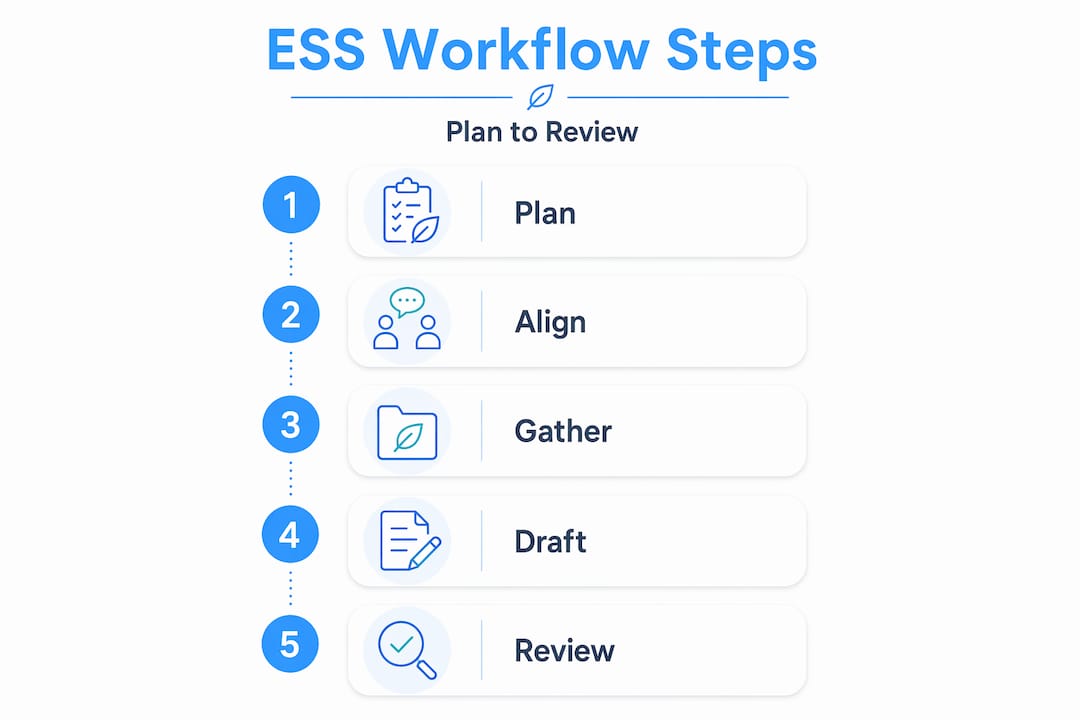
Here is what a preparation checklist looks like in practice for ESS:
| Preparation step | What to do | Why it matters |
|---|---|---|
| Align to objectives | Map your IA topic to specific assessment objectives | Prevents misdirected effort |
| Build your rubric | Use IB band descriptors before writing | Gives you a scoring target from day one |
| Gather materials | Collect primary and secondary data sources early | Avoids last-minute gaps in evidence |
| Set clear goals | Write measurable targets for each criterion | Keeps your workflow focused |
| Identify reviewers | Plan for peer or teacher feedback at set stages | Builds in quality checks before submission |
Setting documented performance standards before any evaluation begins prevents surprise results and promotes fairness. This applies just as much to an ESS IA as it does to a workplace review.
Pro Tip: Before you write a single word of your IA, open the IB ESS rubric and highlight the exact phrases in each criterion that describe a top-band response. Use those phrases as a checklist as you draft each section.
Multi-stakeholder input at the planning stage also improves outcomes significantly. Inclusive evaluation with weighted scoring reduces bias and reflects a fuller picture of what quality work looks like. In ESS, that means involving your teacher for feedback on your research question, a peer for readability review, and yourself for honest self-assessment of gaps.
Executing the ESS assessment workflow step by step
Once your plan is in place, execution becomes much less stressful. Here is a numbered walkthrough of how to implement your ESS assessment workflow from start to finish.
- Begin with a self-evaluation. Before submitting any draft, assess your own work against each IA criterion. Use the band descriptors, not your general sense of whether it “reads well.”
- Gather and organize your evidence. For ESS, this means compiling your field data, secondary sources, and annotated references. Each piece of evidence should connect to a specific objective.
- Write your first draft with criteria in mind. Do not write freely and then retrofit criteria. Write deliberately toward each criterion from the first sentence.
- Submit for formative feedback. Give your draft to your teacher or a peer reviewer. Ask them to comment specifically against the rubric, not just on content.
- Revise based on feedback. Translate every comment into a concrete change. Vague critique like “needs more analysis” should become “add a paragraph evaluating the limitations of your sampling method in criterion C.”
- Run a secondary review. After revision, have a second reviewer check your changes specifically. This confirms you addressed the feedback rather than just rewriting sentences.
- Close and finalize. Complete your bibliography, format check, and word count, then submit. Document what you changed and why for your own learning.
Formative assessment strategies such as checklists and pulse checks help gauge learning in real time, with educators in 2026 using over 27 proven techniques categorized by reflection, metacognition, and visible thinking. In the ESS workflow, formative steps like peer review and draft feedback are your most powerful tools for improvement before a grade is ever assigned.
Understanding the difference between formative and summative assessment matters here. Formative and summative assessments serve distinct but complementary roles. Formative work is frequent and feedback-oriented, while summative work confirms mastery at the end of a learning cycle. Your IB ESS IA is ultimately a summative product, but every draft review and self-check along the way is formative. Treat those intermediate steps as seriously as the final submission.
Pro Tip: After each draft revision, write two sentences summarizing what you changed and why. This reflection habit builds metacognitive awareness and prepares you to explain your choices if asked by your teacher or examiner.
You should also use the IB ESS rubric actively throughout execution, not just at the end. Students who reference the rubric at the planning and drafting stages consistently produce stronger work because they never lose sight of the actual scoring target.
Verifying and improving ESS assessment outcomes
Verification is the step most students skip entirely. After submitting, they move on. But reviewing your outcomes objectively is how you actually improve across multiple assessments, not just within one.
Here are key strategies for verifying ESS assessment results effectively:
- Check scores against documented criteria. Do not accept a mark without understanding exactly which descriptors applied. Ask your teacher to walk you through any criterion where you scored below the top band.
- Identify patterns across criteria. If you consistently lose marks in “evaluation” criteria, that is a signal to work on your analytical writing, not just your content knowledge.
- Minimize scoring bias. A standardized scoring matrix aligned to learning objectives makes assessments auditable and transparent, replacing “gut feeling” scoring with objective comparison.
- Use formative data to adjust teaching. Frequent low-stakes assessments measure the “stickiness” of teaching and provide specific insights rather than just grades, helping educators adjust their approach in real time.
- Apply human review to any AI-assisted grading. Faculty review of AI-generated scores improves inter-rater reliability and rubric refinement. If your school uses automated feedback tools, always verify those outputs against the actual IB descriptors.
Documentation matters at this stage. Every review cycle you complete should be recorded. Note what changed, what improved, and what still needs work. This creates a feedback loop that strengthens both teaching and learning across the entire ESS assessment cycle.
Comparing your self-assessment score to your teacher’s score is one of the most revealing exercises you can do. Where the gap is large, your understanding of the objectives is likely misaligned. Where you agree, your calibration is strong.
My honest take on workflow and assessment in ESS
I have worked with IB ESS students and educators for over a decade, and I see the same pattern repeat itself constantly. Students who struggle with assessments are almost never lacking content knowledge. They are lacking a deliberate workflow.
When I first started designing ESS assessment support, I was surprised by how much a simple, structured process changed student outcomes. Students who mapped their IA work against objectives from day one routinely outperformed students with stronger subject knowledge but no clear structure. That is not a small effect. We are talking about two or three band differences in criteria that make the difference between a 5 and a 7.
I have also learned to respect the tension between structured criteria and student creativity. The IB ESS assessment objectives are specific, but they do not demand robotic writing. The best student work I have seen combines rigorous adherence to criteria with genuine curiosity about the environmental question being investigated. You can be systematic and still have a voice.
One thing I feel strongly about: do not outsource judgment to any tool, including AI feedback platforms. These tools can be genuinely useful for catching formatting issues or flagging underdeveloped sections. But rubric interpretation requires human understanding of context. Your teacher’s annotation of your draft is worth more than any algorithm’s score, and the human-in-the-loop approach to assessment quality remains the gold standard for good reason.
Embrace the workflow. Use the criteria. Stay curious. That combination produces the best work I have ever seen from ESS students.
— Marija
Get expert support for your ESS assessments
Understanding the ESS assessment objectives workflow is one thing. Applying it confidently to your own IA or exam preparation is another challenge entirely. That is exactly where Esstutor can help.
At Esstutor, every tutoring session is built around your specific assessment needs. Whether you are just starting your IB ESS course and need foundational clarity, or you are deep in your IA and need targeted feedback on criteria alignment, the sessions are tailored to where you are right now. With over 13 years of experience as an IB examiner and educator, Esstutor offers the kind of guidance that connects directly to what examiners actually reward. Explore how top IB ESS tutors can help you move from uncertain to confident before your next submission.
FAQ
What are ESS assessment objectives in IB?
ESS assessment objectives define the specific skills and knowledge levels IB students must demonstrate, organized from basic recall through analysis, evaluation, and communication. They directly determine how IA criteria are written and scored.
How do I structure an ESS evaluation process workflow?
Follow a clear sequence: align your work to objectives, gather evidence, draft with criteria in mind, collect formative feedback, revise deliberately, and verify your final score against documented band descriptors.
What is the difference between formative and summative ESS assessments?
Formative assessments are frequent, feedback-focused checks during the learning process, while summative assessments confirm mastery at the end of a unit or course. Both are part of a strong ESS assessment workflow.
How can I reduce bias in ESS scoring?
Using a standardized scoring matrix aligned to IB learning objectives makes your assessment process transparent and auditable, replacing subjective judgment with objective criteria comparison.
How does human review improve ESS assessment outcomes?
Human oversight of any scored work, including AI-assisted feedback, ensures rubric interpretation is accurate and context-sensitive. Faculty or teacher review significantly improves inter-rater reliability and the quality of iterative rubric refinement.
No Comments