


10 Mar ESS exam preparation steps for IB Diploma success 2026
The interdisciplinary nature of IB Environmental Systems and Societies often leaves students struggling with data analysis, essay structure, and applying systems thinking under exam pressure. Success demands more than memorization; it requires targeted strategies for the 2026 exam format, mastering command terms, and personalized study approaches. This guide delivers clear, actionable preparation steps to build your confidence, sharpen exam skills, and elevate your ESS grades.
Table of Contents
- Prerequisites And Exam Format Overview
- Step 1: Understand And Master Command Terms
- Step 2: Create A Personalized Study Schedule And Timeline
- Step 3: Focused Case Study Review
- Step 4: Internal Assessment (IA) Preparation
- Step 5: Practice Exams And Timed Question Work
- Common Mistakes And Troubleshooting
- Expected Outcomes And Success Metrics
- Boost Your ESS Exam Scores With Personalized Tutoring
Key takeaways
| Point | Details |
|---|---|
| Exam structure mastery | Understanding the 2026 Paper 1 and Paper 2 formats, timing, and grading scheme is essential for targeted revision. |
| Command term fluency | Correctly interpreting terms like analyze, evaluate, and discuss can improve marks by up to 40%. |
| Balanced study timeline | A 4-6 month personalized schedule balances content review, IA work, and timed practice to reduce cramming. |
| Case study depth | Memorizing 5-7 key case studies with causes, impacts, and solutions enables strong extended responses. |
| Regular timed practice | Weekly mock exams under realistic conditions build exam confidence and refine time management skills. |
Prerequisites and exam format overview
Before diving into preparation steps, understanding the 2026 IB ESS syllabus structure and exam requirements is critical. The minimum passing grade is 4, and exam performance accounts for 75-80% of your final mark depending on SL or HL level, making focused exam preparation non-negotiable. The ESS exam consists of two papers: Paper 1 tests data-based questions using unseen case studies and requires interpreting graphs, charts, and diagrams, while Paper 2 features structured short-answer questions and extended essay responses that demand systems thinking and sustainability analysis.
For 2026, the syllabus emphasizes sustainability frameworks and interconnected environmental systems, pushing students to demonstrate holistic problem solving rather than isolated fact recall. SL students face 1 hour 30 minutes for Paper 1 and 2 hours for Paper 2, while HL students tackle the same Paper 1 duration but a longer 2 hour 15 minute Paper 2 with additional depth questions. You need access to the official IB ESS exam format guide, past papers aligned to 2026 syllabus changes, detailed case study materials covering at least five global examples, and a structured revision plan.
Knowing the exam structure allows you to allocate study time efficiently: prioritize data interpretation skills for Paper 1, practice extended essay writing for Paper 2, and understand how mark schemes reward depth and command term accuracy. Without this foundation, your revision efforts scatter across topics without strategic focus, wasting precious preparation months.
Step 1: Understand and master command terms
Command terms define what examiners expect in your answers, yet many students lose up to 40% of available marks by misinterpreting these directives. Terms like analyze require breaking down data or arguments into components and explaining relationships, while evaluate demands weighing evidence to form reasoned judgments. Describe asks for detailed accounts without analysis, discuss expects balanced arguments with multiple perspectives, and explain requires justifying causes or mechanisms behind phenomena.
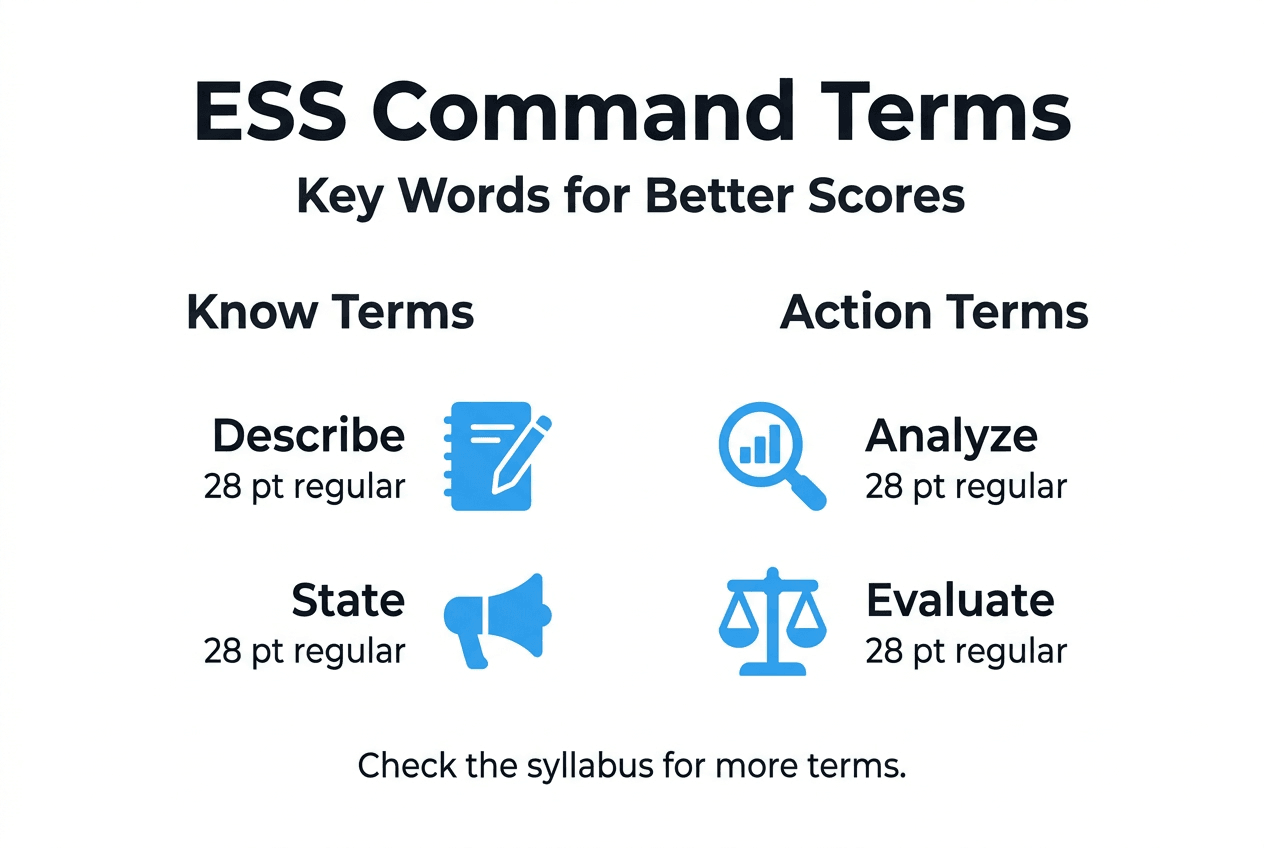
Misreading a command term transforms a potentially high-scoring response into one that misses the question entirely. If a prompt asks you to evaluate a conservation strategy but you only describe it, you forfeit marks for critical thinking and judgment. Command term fluency directly impacts answer depth, structure, and examiner perception of your understanding.
To master these terms:
- Create flashcards with each command term on one side and its definition plus a sample question on the reverse.
- Practice rewriting past paper questions by swapping command terms to see how required responses shift.
- Review mark schemes to identify how examiners reward term-specific answers.
- Quiz yourself weekly using randomized command term prompts applied to different syllabus topics.
Pro Tip: Build a one-page glossary of all ESS command terms with color-coded examples showing weak versus strong responses, and review it before every practice session to internalize expectations.
Step 2: Create a personalized study schedule and timeline
Starting preparation 4-6 months ahead prevents last-minute panic and allows steady content absorption, IA refinement, and skill building. A balanced schedule integrates content revision, Internal Assessment progress, and weekly timed exam practice, ensuring no component gets neglected. Without structure, students over-focus on comfortable topics while neglecting weaker areas or IA deadlines.
Follow these steps to build your schedule:
- Map your exam dates and IA submission deadline, then count backward to establish your preparation start date.
- Divide syllabus content into weekly themes, allocating two weeks for complex topics like energy systems and biodiversity.
- Reserve one day weekly for timed practice using past papers matching the 2026 ESS exam timeline.
- Schedule biweekly IA work sessions covering data collection, analysis drafts, and revision based on feedback.
- Build in buffer weeks before exams for intensive review and weaker topic reinforcement.
| Day | Activity | Duration |
|---|---|---|
| Monday | Content review using IB ESS notes | 90 minutes |
| Wednesday | Case study memorization and application practice | 60 minutes |
| Friday | Command term drills and short-answer practice | 60 minutes |
| Saturday | Timed full Paper 1 or Paper 2 practice | 2 hours |
| Sunday | IA progress work or feedback integration | 90 minutes |
Adapt your schedule based on progress checks every two weeks. If data interpretation questions consistently challenge you, add extra Wednesday sessions targeting graph analysis. Track your confidence and accuracy per topic to redirect effort where needed.
Pro Tip: Use calendar alerts and study apps to maintain consistency, treating study blocks as non-negotiable appointments to build discipline and routine.
Step 3: Focused case study review
Case studies anchor your extended responses and data interpretation, making thorough memorization of 5-7 examples essential. Each case should demonstrate clear environmental impacts, underlying causes, human responses, and sustainability outcomes. Strong case study knowledge lets you support arguments with concrete evidence, transforming generic answers into compelling, high-scoring responses.
Approach case study review systematically:
- Select diverse cases covering energy transitions, biodiversity loss, pollution management, climate adaptation, and resource depletion.
- For each case, document the environmental problem, scale and geographic location, primary causes, ecological and social impacts, mitigation or adaptation strategies, and effectiveness evaluation.
- Practice writing 200-word summaries from memory to reinforce retention without notes.
- Apply each case to different exam-style prompts, showing how the same example supports varied arguments.
| Case Study | Environmental Issue | Key Impact | Effective Response |
|---|---|---|---|
| Costa Rica reforestation | Deforestation reversal | Biodiversity recovery, carbon sequestration | Payment for ecosystem services program |
| Iceland geothermal energy | Fossil fuel dependency | Reduced emissions, energy security | Investment in renewable infrastructure |
| Great Barrier Reef bleaching | Climate change, warming oceans | Coral mortality, ecosystem collapse | Marine protected areas, emission reduction pledges |
| Bangladesh flood adaptation | Sea level rise, extreme weather | Displacement, agricultural loss | Floating gardens, early warning systems |
| California water management | Drought, over-extraction | Aquifer depletion, crop failure | Drip irrigation, water pricing reform |
To deepen retention, create visual mind maps linking cases to syllabus themes like sustainability, resilience, and systems thinking. Use mnemonic devices to recall statistics or dates. Practice answering questions that require comparing two cases or evaluating the transferability of solutions across contexts.
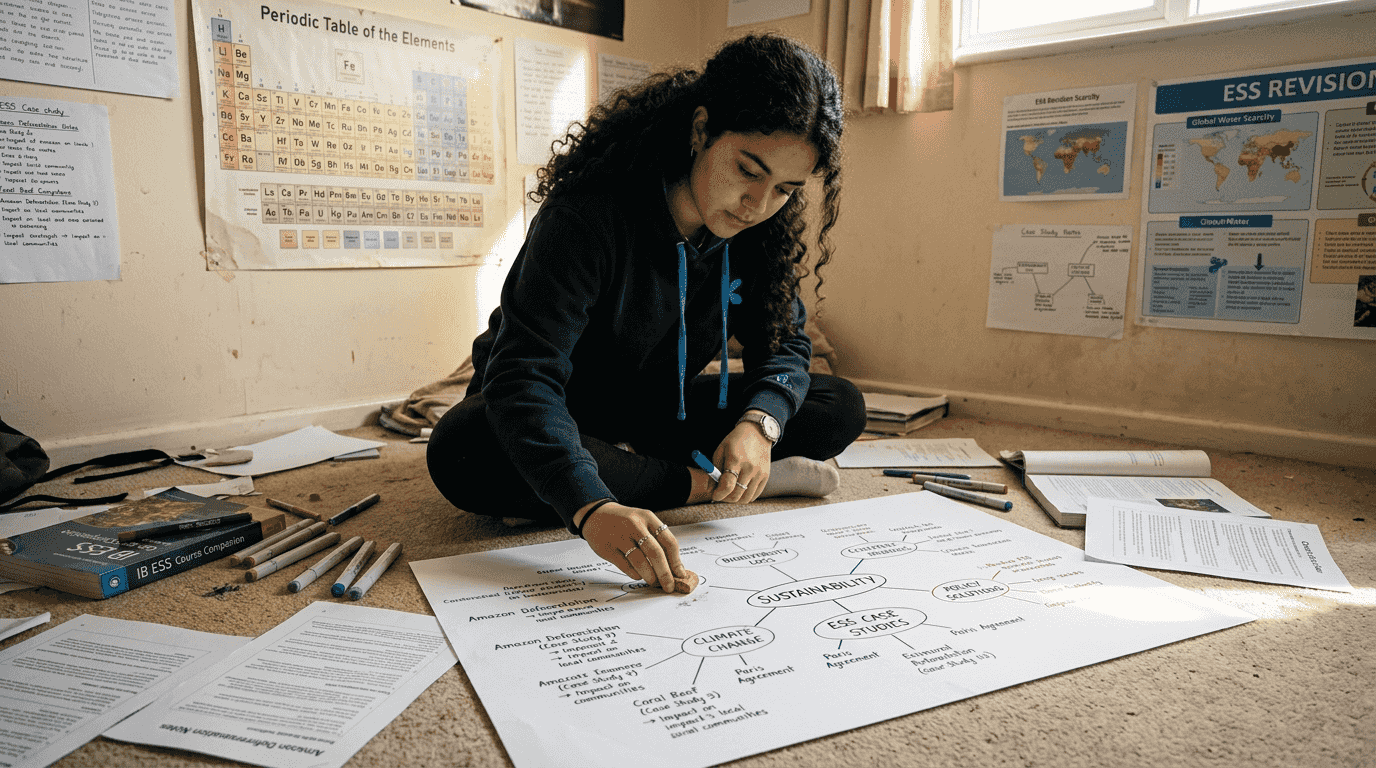
Pro Tip: After memorizing facts, practice applying your cases to unfamiliar data sets in past papers, showing examiners your ability to synthesize information rather than regurgitate memorized content.
Step 4: Internal assessment (IA) preparation
Your ESS internal assessment contributes 20-25% of your final grade, making early, strategic IA preparation critical. A strong IA demonstrates independent research, rigorous data collection, critical analysis, and clear links to syllabus concepts like sustainability and systems thinking. Rushed or poorly planned IAs limit your ability to collect quality data, analyze patterns, and evaluate limitations effectively.
Follow these steps for IA success:
- Choose a focused, unique research question that investigates a measurable environmental variable, avoiding overly broad topics that dilute analysis depth.
- Design a data collection method yielding at least 25 primary data points to enable statistical analysis and pattern identification.
- Collect data systematically, documenting environmental conditions, measurement tools, and potential sources of error.
- Analyze results using appropriate graphs, statistical tests, and clear interpretation linking findings to ecological principles.
- Evaluate your methodology’s strengths, limitations, and improvements, showing examiner awareness of research validity.
IA topics work best when they connect to local environments you can access repeatedly for consistent sampling. Examples include comparing water quality upstream and downstream of urban areas, measuring biodiversity in restored versus unmanaged habitats, or evaluating the carbon footprint of different school energy sources. Link your findings to broader sustainability themes like resource management, pollution control, or ecosystem resilience.
Pro Tip: Start your IA at least four months before the deadline and seek regular feedback from tutors or teachers after each draft, allowing time to refine data analysis and strengthen evaluation sections without last-minute stress.
Step 5: Practice exams and timed question work
Consistent weekly timed practice using IB ESS Paper 1 and Paper 2 past papers builds exam confidence, refines time management, and exposes knowledge gaps before the actual exam. Practice under realistic conditions trains your brain to perform under pressure, reduces anxiety, and helps you internalize pacing strategies. Without regular timed work, even well-prepared students struggle with time allocation and incomplete answers on exam day.
Set up effective practice sessions:
- Schedule one full paper every week, alternating between Paper 1 and Paper 2 formats.
- Simulate exam conditions completely: silence, no internet, strict timing, and only allowed materials like calculators.
- Immediately after finishing, mark your work using official mark schemes and identify recurring errors or weak topics.
- Dedicate follow-up study sessions to addressing mistakes, reviewing relevant notes, and practicing similar question types.
Regular practice delivers multiple benefits:
- Enhanced command term interpretation and answer structuring.
- Familiarity with exam pressure and time constraints, reducing freeze-ups.
- Identification of weak topics requiring additional revision before exams.
- Confidence building through repeated exposure to question formats and difficulty levels.
Review your errors critically rather than passively. If you consistently lose marks on graph interpretation questions, dedicate extra sessions to data analysis drills using ESS practice tests. Track your improvement over weeks to see progress and adjust study focus dynamically.
Pro Tip: Fully replicate exam conditions including no breaks and silence to train mental stamina, preparing your brain to sustain focus for the full exam duration without external support.
Common mistakes and troubleshooting
Many IB ESS students sabotage their preparation through avoidable errors that undermine exam performance. Recognizing these pitfalls early and implementing fixes keeps your preparation on track and maximizes score potential.
Frequent mistakes include:
- Misunderstanding command terms, leading to off-target answers that lose marks despite correct content knowledge.
- Starting IA work too late, forcing rushed data collection and shallow analysis that limits grade potential.
- Relying on passive revision methods like rereading notes rather than active recall and application to exam questions.
- Cramming all content in the final weeks, overwhelming memory capacity and reducing long-term retention.
- Neglecting Paper 1 data interpretation skills in favor of memorizing Paper 2 essay content.
Each mistake directly harms performance. Passive revision creates familiarity illusions where you recognize content but cannot apply it under exam pressure. Last-minute IA work prevents iterative improvement through feedback cycles. Misreading command terms transforms strong knowledge into weak responses that examiners cannot reward.
Active revision strategies like self-testing, concept mapping, and applying knowledge to varied contexts boost retention by over 50% compared to passive rereading, making study time far more effective.
Implement these fixes immediately:
- Drill command terms weekly using flashcards and practice questions to build automatic recognition.
- Start IA planning and data collection at least four months before deadlines, allowing time for revisions.
- Replace passive reading with active methods like teaching concepts aloud, creating practice questions, or drawing system diagrams from memory.
- Distribute study across months using spaced repetition to move content into long-term memory.
Pro Tip: Regularly self-test your command term understanding by writing practice answers under timed conditions, then comparing your responses to mark scheme expectations to identify interpretation gaps.
Expected outcomes and success metrics
Following this preparation framework positions you to achieve measurable improvements in ESS exam performance and confidence. Realistic goals help you track progress and adjust strategies as needed.
Expected outcomes from comprehensive preparation:
- Achieving at least the minimum passing grade of 4, with strong preparation pushing many students toward grades 5 to 7.
- Improving answer quality and marks by 20-30% through mastering command term interpretation and response structuring.
- Building exam confidence and reducing anxiety through consistent timed practice under realistic conditions.
- Completing a high-quality IA that demonstrates rigorous methodology, critical analysis, and clear syllabus connections.
- Developing thorough understanding of syllabus concepts, enabling flexible application to unfamiliar exam scenarios.
Personalized ESS tutoring accelerates these outcomes, with students typically experiencing 1.5 to 2 grade increases when working with expert tutors who tailor strategies to individual weaknesses. Tutors provide targeted feedback on practice answers, IA drafts, and study plans, ensuring your effort translates into measurable score improvements.
Track your progress using practice exam scores, command term accuracy rates, case study recall speed, and IA draft quality. Adjust your schedule and focus areas based on these metrics every two weeks, redirecting time toward persistent weak spots. Consistent effort paired with strategic adjustments ensures you enter exam day prepared, confident, and equipped to demonstrate your full ESS knowledge.
Boost your ESS exam scores with personalized tutoring
Struggling to master command terms, organize case studies, or structure IA analysis on your own? Personalized online ESS tutoring can elevate your preparation and boost grades by 1.5 to 2 levels. Expert tutors with IB examiner experience design tailored study plans targeting your specific weaknesses, from data interpretation drills to essay structuring.
Access comprehensive IB ESS notes and textbook resources alongside guided practice using ESS IB exam materials aligned to 2026 syllabus changes. Tutors provide real-time feedback on practice answers, refine your IA methodology, and teach proven exam techniques that maximize marks. Whether you need command term mastery, case study application strategies, or timed practice coaching, personalized tutoring accelerates your path to ESS success.
FAQ
How early should I start preparing for the IB ESS exam?
Starting 4-6 months before exams allows thorough content revision, IA completion, and regular timed practice without overwhelming cramming. Balanced preparation distributes learning over time, improving long-term retention and reducing exam anxiety. Early starts also accommodate unexpected challenges like IA revisions or weak topic remediation.
What are the most important command terms to know for ESS?
Key command terms include analyze, evaluate, discuss, describe, and explain, each requiring distinct response approaches. Understanding these terms shapes answer structure and depth, directly impacting marks. Misinterpreting command terms can cost you up to 40% of available points, making fluency essential.
How can I effectively memorize and apply case studies for the exam?
Focus on memorizing 5-7 diverse case studies covering different environmental issues, impacts, and responses. Practice writing summaries from memory and apply cases to varied exam-style questions to deepen understanding. Use visual aids like comparison tables or mind maps to reinforce retention and connections between cases.
What is the best way to prepare for the Internal Assessment?
Choose a focused, unique research question early and design data collection yielding at least 25 primary data points. Critically analyze results, evaluate methodology limitations, and link findings to syllabus themes like sustainability and systems thinking. Start your ESS internal assessment at least four months before the deadline to allow iterative improvement through feedback.
No Comments