


02 May ESS past paper steps: a proven guide for IB exam success
TL;DR:
- Practicing IB ESS past papers with a structured approach builds exam skills and confidence effectively.
- Preparing the right materials and environment enhances learning, leading to better performance on exam day.
Staring at a stack of ESS past papers and feeling your confidence drain is something a lot of IB students know well. You open the paper, see a question about ecosystem services or carbon cycling, and suddenly your mind goes blank. The good news is that this feeling is completely fixable. With a clear, step-by-step method for solving and reviewing past papers, you can move from anxious guessing to scoring with real purpose. This guide walks you through exactly how to do that, from gathering your materials to tracking your progress over time.
Table of Contents
- What you need before you start solving past papers
- Step-by-step guide to solving ESS past papers
- Common mistakes and troubleshooting tips
- How to review and verify your solutions
- Why method matters more than memory in ESS exam success
- Level up your ESS exam prep with expert resources
- Frequently asked questions
Key Takeaways
| Point | Details |
|---|---|
| Preparation is key | Gathering all necessary materials and creating a study plan boosts efficiency. |
| Follow a proven process | Solving past papers step-by-step helps you tackle any exam format with confidence. |
| Avoid common pitfalls | Learning from frequent mistakes saves valuable marks in the real exam. |
| Systematic review matters | Checking your solutions against the markscheme maximizes learning and improvement. |
| Progress over perfection | Consistent practice leads to better outcomes, not just rote memorization. |
What you need before you start solving past papers
Now that you know why past papers matter, let us set you up for effective practice. The biggest mistake students make is jumping straight into a past paper without the right tools or mindset. Being prepared before you even pick up a pen makes an enormous difference in how much you actually learn from the exercise.
Here is what you need to gather before you start:
- The current IB ESS syllabus (printed or bookmarked) so you can cross-reference topics
- Marking schemes for every paper you plan to practice with
- At least 3 years’ worth of past papers, covering both Paper 1 and Paper 2
- A timer or stopwatch for simulated exam conditions
- Highlighters and pens in different colors for annotating answers
- A notebook dedicated to error tracking and reflection
Creating a distraction-free workspace is equally important. Switch your phone to silent, close unnecessary browser tabs, and tell people around you that you are studying. Even 60 minutes of focused work in a quiet space beats three hours of distracted paper-flipping. Using past papers effectively means giving them your full attention, not squeezing them in between social media scrolling.
You also need to schedule your past paper sessions. Do not just do them whenever you feel like it. Block out specific times in your weekly study plan. Treat them like real exams. Having the right materials and a quiet environment increases study session effectiveness in measurable ways, so setting the stage properly is not optional.
Here is a quick overview of how to distribute your past paper practice across your available prep time:
| Weeks before exam | Recommended focus | Papers per week |
|---|---|---|
| 8+ weeks out | Topic-by-topic targeted questions | 1 partial paper |
| 5 to 7 weeks out | Full timed papers, mixed topics | 1 full paper |
| 3 to 4 weeks out | Review heavy: mark, annotate, revise | 2 full papers |
| 1 to 2 weeks out | Light timed practice and confidence building | 1 paper max |
Pro Tip: Print your papers out on paper whenever you can. Writing by hand in exam conditions mimics the actual test experience far better than typing on a laptop. It also helps you notice pacing issues sooner. Try proven exam prep strategies to supplement your paper-based sessions.
Step-by-step guide to solving ESS past papers
With your materials ready, follow these steps to maximize your past paper practice. Having a structured approach means you are not just completing papers for the sake of it. You are building genuine exam skills every single time.
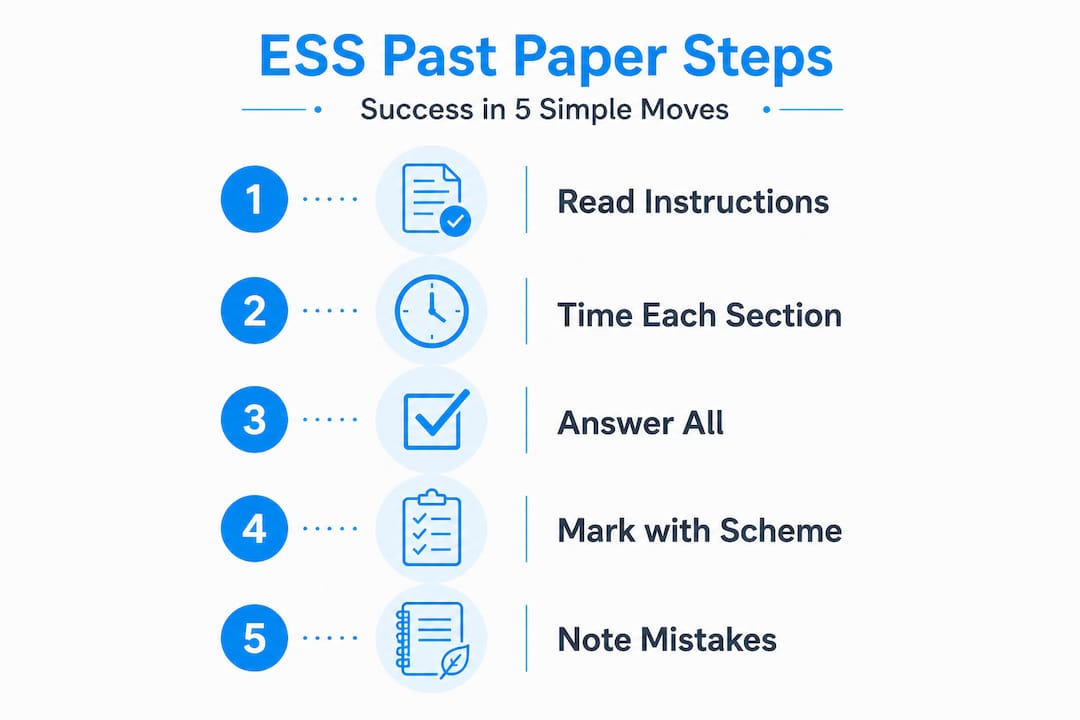
Step 1: Read the instructions and scan the whole paper first.
Before answering anything, take two to three minutes to read through all the questions. This gives you a mental map of what is ahead. Note which questions look straightforward and which ones may need more time.
Step 2: Start with Section A and time yourself by section.
Work through each section without skipping around. Use a timer to match the real exam pacing. For ESS Paper 1, you have 1 hour and 15 minutes. For Paper 2, you have 2 hours and 15 minutes. Divide your time accordingly.
Step 3: Attempt every question without checking the markscheme.
This is critical. Do not peek at the answers mid-paper. Push through even when you are unsure. Write something for every question, because partial answers often earn marks.
Step 4: Mark your paper using the official markscheme.
Once your timer goes off, close the paper and take a short break. Then, using a different colored pen, mark each answer against the scheme. Be honest with yourself. Giving yourself extra credit does not help you improve.
Step 5: Annotate your mistakes and note the learning outcome.
For every wrong or incomplete answer, write a brief note explaining what you missed. Reference the specific ESS learning outcome it relates to. This connects your errors directly to content you need to revisit.
The role of past papers is not just about exposure to question types. Working through papers step-by-step boosts high-scoring performance because it builds automatic responses to question command terms like “evaluate,” “discuss,” and “explain.”
Here is a comparison of two solving approaches to help you choose what fits your current stage:
| Approach | Best for | Time needed | Outcome |
|---|---|---|---|
| Quick solve (no timer) | Early topic review | 30 to 45 minutes | Identifies knowledge gaps quickly |
| Full timed solve | Late-stage exam simulation | Full exam time | Builds pacing, stamina, and confidence |
Pro Tip: Study the examiner pro tips before your timed sessions. Knowing what examiners look for in a strong answer helps you write with purpose rather than just filling space.
Common mistakes and troubleshooting tips
Even with a solid method, mistakes are common. Here is how to avoid the most frequent ones and recover when things go sideways.

Rushing without timing or planning. Many students sit down and just start writing without thinking about pacing. This leads to spending 20 minutes on a 2-mark question while running out of time on a 10-marker. Always allocate your minutes according to the mark allocation.
Copying your previous answers when questions look similar. Just because a question looks familiar does not mean it is identical. Read every question carefully, word by word. The command term alone, whether it says “outline” versus “evaluate,” changes everything about what a full-mark answer looks like.
Skipping the markscheme review. This is probably the most common mistake of all. Students complete the paper, feel okay about it, and move on without actually checking their work. The markscheme is not just an answer key. It tells you exactly what an examiner expects to see, and that information is gold.
“Learning from common mistakes can make the difference between an average score and a top grade.” — Top ESS scores: examiner insights 2026
Not targeting weak areas with specific follow-up. When you spot a pattern in your mistakes, say you keep losing marks on questions about biodiversity indices or pollution management, make a note and revisit that topic before your next paper session. Use ESS Paper 2 strategies to sharpen your skills in the longer, more complex answer questions.
Pro Tip: Keep a dedicated error log in your notebook. After every paper, write down the topic, the type of question, and what went wrong. After a few papers, you will see clear patterns. These patterns are your personal revision priority list. Also explore ESS exam tips to develop stronger general exam awareness.
What to do if you are stuck on a question. Break the question into its keywords. Identify the command term, the topic, and the context. Then ask yourself which ESS learning outcome it maps to. If you still cannot figure it out after a reasonable attempt, make a note and ask your teacher or tutor at your next session rather than spending your whole practice time on one item.
How to review and verify your solutions
After completing your paper, the most important work is in how you review. This is where real learning happens, and it is also the step most students skip or rush through.
Here is a structured review process you can follow after every paper:
- Self-mark using the official markscheme. Go through each question carefully. Give yourself a mark only when your answer genuinely matches what the scheme expects, not just when it sounds similar.
- Record your section scores. Write down your marks for Section A and Section B separately. This shows you where your marks are actually coming from.
- Identify patterns in your errors. Are you losing marks on certain topics? Are you missing command term expectations? Are you running out of time on specific sections? Write down the category of each mistake.
- Map errors to syllabus learning outcomes. Each IB ESS question links to a specific learning outcome. Finding those links turns mistakes into a targeted revision list.
- Review content for every missed question. Look up your class notes, your textbook, or online resources for each topic you lost marks on. Do not move on until you understand why the correct answer is correct.
Systematic review helps lock in learning and prepares you for unfamiliar questions on exam day. Students who review their past papers this thoroughly improve their scores by at least 10% across successive attempts. That kind of gain is very realistic when you track your progress honestly.
Use a simple tracking table like this after each paper:
| Paper date | Total score (%) | Section A score | Section B score | Main topics to revise |
|---|---|---|---|---|
| January 2026 | 54% | 18/30 | 24/45 | Pollution, food systems |
| February 2026 | 63% | 22/30 | 29/45 | Water management |
| March 2026 | 71% | 25/30 | 36/45 | Mostly solid, review energy |
This kind of table gives you an instant visual of your improvement over time. Use a step-by-step revision guide alongside your tracking to make sure your content review stays organized. Also check out curated ESS learning resources for targeted topic support.
Why method matters more than memory in ESS exam success
Here is something I see over and over again with students: they spend weeks memorizing facts about the nitrogen cycle, ecological footprints, and ecosystem resilience, and then they still underperform on the actual exam. Why? Because knowing the content is only half the job. The other half is knowing how to use it under exam conditions.
Many students believe that more content knowledge automatically equals higher marks. That belief leads them to add more notes, more revision cards, more reading. But what they actually need is more practice applying what they know through structured, time-pressured problem solving. Process matters more than recall in the IB ESS exam room.
When you practice past papers with a method, something shifts. You stop fearing command terms. You start recognizing question patterns. You get faster at structuring answers. These are skills, not facts, and they only develop through deliberate practice. This is why I always tell students: do not just read the markscheme. Study it. Notice how points are phrased, what level of detail earns full marks, and what examiners consistently reward.
Making mistakes during practice is not a failure. It is literally where the learning is. Every error tells you something specific about a gap in your understanding or your exam technique. The students who improve the most are the ones who sit with their mistakes, figure out what went wrong, and come back stronger next session. Exam prep focus is a skill you build, and past papers are the training ground.
Confidence on exam day is not something that appears out of nowhere. It is built through repetition, reflection, and honest self-assessment. Follow the steps in this guide consistently and that confidence will come.
Level up your ESS exam prep with expert resources
If you want to deepen your skills, here is how you can take advantage of expert help and top-quality resources from esstutor.net.
Working with a specialist tutor can fast-track your progress in a way that self-study alone rarely achieves. Our IB ESS IA tutors provide personalized feedback on your answers, help you decode tricky command terms, and guide you through the exact techniques that earn top marks. With over 13 years of experience as an IB examiner and educator, I know precisely what examiners look for and I share that knowledge directly with each student I work with. You can also access curated ESS notes and textbook materials to support your topic review alongside past paper practice. For targeted help on the longer-answer section, the IB ESS Paper 2 resource is a focused tool designed to build exactly the skills that make a difference on exam day.
Frequently asked questions
How many ESS past papers should I solve before the IB exams?
Aim for at least 4 to 6 complete papers to cover different question types and develop your timing. Completing more papers improves exam performance through greater exposure to question styles and pacing demands.
What should I do if I can’t understand a past paper question?
Break the question into its keywords and identify the command term, then ask a teacher or tutor for clarification. Seeking expert help accelerates your understanding and prevents you from building on a flawed interpretation.
Are the markschemes always available online?
Most official markschemes are available through IB resources or your teacher, though some recent years may be harder to access. Markschemes are released officially for exam preparation, but availability can vary depending on the session year.
Can I use past papers to predict actual exam questions?
Past papers expose recurring themes and question patterns but do not guarantee the same questions will appear. Practicing with past papers reveals trends, but IB exams do update and rotate questions from year to year.
Is it useful to work in groups on ESS past papers?
Group work can help clarify concepts and spark discussion, but you still need to practice alone under timed conditions. Balancing individual and group practice gives you both content clarity and the independent exam stamina you need on the real day.
No Comments