

07 Jul Explain Waste Management Strategies for Students
TL;DR:
- Waste management strategies prioritize waste reduction, reuse, recycling, recovery, and disposal to protect the environment and conserve resources. Integrated systems combine multiple technologies to divert nearly 100% of waste from landfills, relying on circular economy principles to treat waste as a resource. Successful strategy selection depends on local context, policies, and balancing technology, policy, and behavioral change efforts.
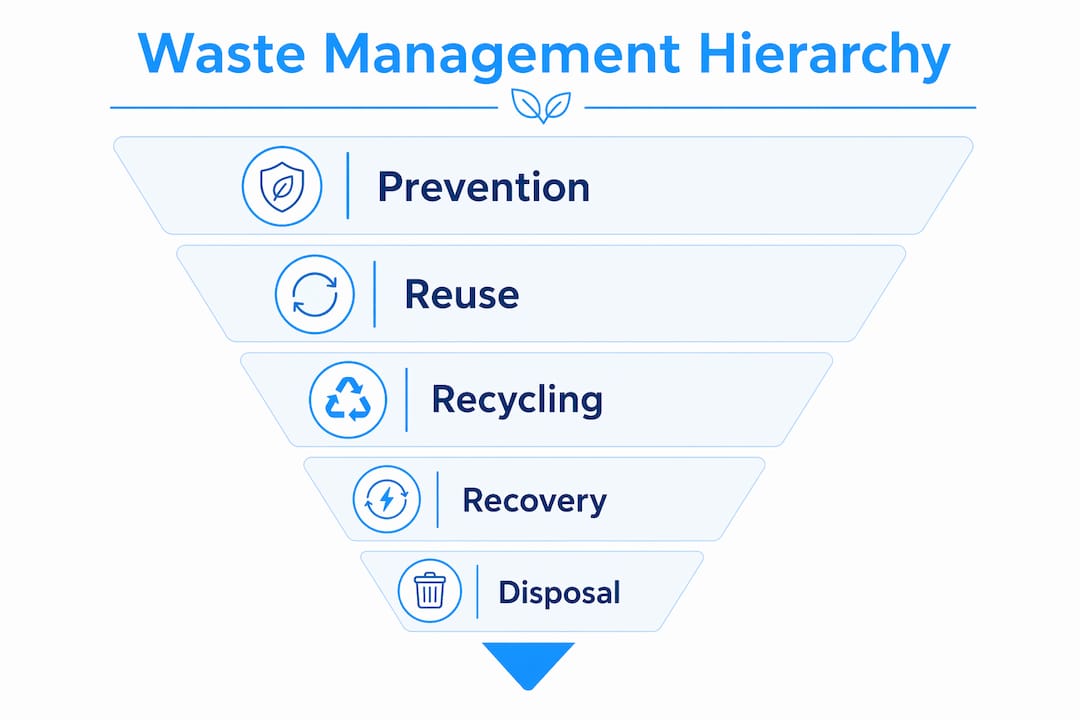
Waste management strategies are defined as prioritized methods for handling, reducing, and disposing of waste in ways that protect the environment and conserve resources. The globally recognized waste hierarchy ranks five tiers in order of preference: prevention, reuse, recycling, recovery, and disposal. This framework guides environmental policy, municipal planning, and sustainability education worldwide. For IB Environmental Systems and Societies (ESS) students and sustainability professionals, understanding how to explain waste management strategies is the foundation for analyzing real-world environmental challenges and designing effective solutions.
What are the core waste management strategies and how do they function?
Waste reduction at the source offers the greatest environmental and economic benefits of any strategy. Prevention eliminates waste before it is generated through process redesign, smarter procurement, and operational changes. A manufacturer switching from single-use packaging to reusable containers practices prevention at the industrial scale.
The second tier, reuse, extends a product’s life without reprocessing it. Refurbishing electronics, donating clothing, and repurposing glass jars all count as reuse. This tier avoids the energy costs of manufacturing new items.
Recycling converts waste materials into new raw materials. It includes:
- Material recycling: Paper, glass, metals, and plastics are sorted and reprocessed into new products.
- Composting: Organic waste decomposes into nutrient-rich soil amendment, closing the biological loop.
- Chemical recycling: Polymers are broken down into monomers for reuse in manufacturing.
Recovery extracts value from waste that cannot be recycled. Waste-to-energy (WTE) plants burn non-recyclable waste to generate electricity or heat. Anaerobic digestion converts food waste and organic matter into biogas, a renewable fuel. These technologies reduce landfill volume while generating usable energy.
Disposal is the last resort. Controlled landfill and incineration without energy recovery represent the lowest tier of the hierarchy. Responsible disposal includes engineered containment, leachate management, and landfill gas capture to limit environmental harm.
Pro Tip: When writing an ESS internal assessment on waste, always map your case study against the five-tier hierarchy. Examiners reward students who can identify which tier a system operates in and explain why.
How do integrated waste systems apply these strategies in practice?
Integrated municipal waste systems combine multiple strategies to divert nearly 100% of solid waste from landfills. This is not a theoretical goal. Real systems combine Material Recovery Facilities (MRFs), pyrolysis units, landfill gas recovery, and anaerobic digestion to manage thousands of tons of urban waste daily. Each technology handles a different fraction of the waste stream, so the system as a whole performs far better than any single method.
The circular economy model sits at the heart of modern integrated systems. Rather than treating waste as a cost to dispose of, circular economy principles treat materials as resources that cycle continuously through the economy. A product’s end of life becomes the input for another product’s beginning.
Technology is accelerating this shift. Businesses are adopting AI and robotics to automate sorting and processing, enabling incremental circularity without requiring a full infrastructure overhaul. This matters for students analyzing real-world systems: you do not need a perfect circular economy to make progress. Incremental adoption of closed-loop practices still generates measurable resource savings.
Sustainable Landfill Reclamation projects illustrate how existing landfills can become resource recovery sites. These projects use IoT-enabled emissions monitoring and phased scaling, starting with several hundred tons per day and expanding to thousands. Real-time data allows operators to track compliance and fine-tune processes continuously.
The table below summarizes the key technologies used in integrated waste systems and their primary function:
| Technology | Primary function | Waste stream handled |
|---|---|---|
| Material Recovery Facility (MRF) | Sorts recyclables for reprocessing | Dry recyclables (paper, plastic, metal) |
| Anaerobic digestion | Converts organics to biogas and digestate | Food waste, agricultural waste |
| Pyrolysis | Thermally decomposes waste into fuel oil and char | Non-recyclable plastics, biomass |
| Landfill gas recovery | Captures methane for energy use | Legacy landfill sites |
| Waste-to-energy (WTE) plant | Burns residual waste to generate electricity | Non-recyclable mixed waste |
Pro Tip: For ESS extended essays, integrated systems make excellent case studies because they let you evaluate multiple strategies simultaneously. Look for municipal systems that publish annual waste diversion reports. These give you real data for your analysis.
What environmental, economic, and policy factors shape strategy selection?
Effective waste management depends on strong regulatory frameworks, emission controls, and life-cycle assessments. A strategy that works well in one context can cause unintended harm in another. Life-cycle assessment (LCA) is the tool professionals use to measure a strategy’s full environmental footprint, from raw material extraction through end-of-life processing.
Carbon emissions are a key variable. Waste-to-energy benefits vary based on the carbon intensity of the local electrical grid. In regions powered largely by renewable energy, WTE plants may produce more emissions per kilowatt-hour than the grid average. In those contexts, material recycling outperforms energy recovery on a net emissions basis. This is a nuance that many introductory discussions miss.
Policy and economic incentives shape which strategies communities actually adopt. Key factors include:
- Landfill taxes: Higher costs for disposal push municipalities toward recycling and recovery.
- Extended producer responsibility (EPR) laws: Manufacturers bear the cost of end-of-life management, incentivizing product design for recyclability.
- Carbon pricing: A price on greenhouse gas emissions makes WTE and landfill gas recovery more economically attractive.
- Infrastructure investment: Rural and lower-income regions often lack MRFs or composting facilities, making prevention and reuse the most practical strategies.
Geography and local waste composition also determine what works. Policy enforcement and local context critically shape strategy effectiveness. A biogas plant designed for food-rich urban waste will underperform in a region where the waste stream is predominantly dry and inorganic. Solutions must be customized to local conditions, not copied wholesale from other regions.
How can students and professionals apply these strategies in education and projects?
Applying waste management knowledge moves from theory to practice through structured activities. Whether you are an ESS student designing an internal assessment or a sustainability professional proposing a community program, the following steps build a solid foundation:
- Conduct a waste audit. Measure and categorize the waste generated at your school, home, or workplace over one week. Quantifying the waste stream reveals which fractions are largest and which strategies apply.
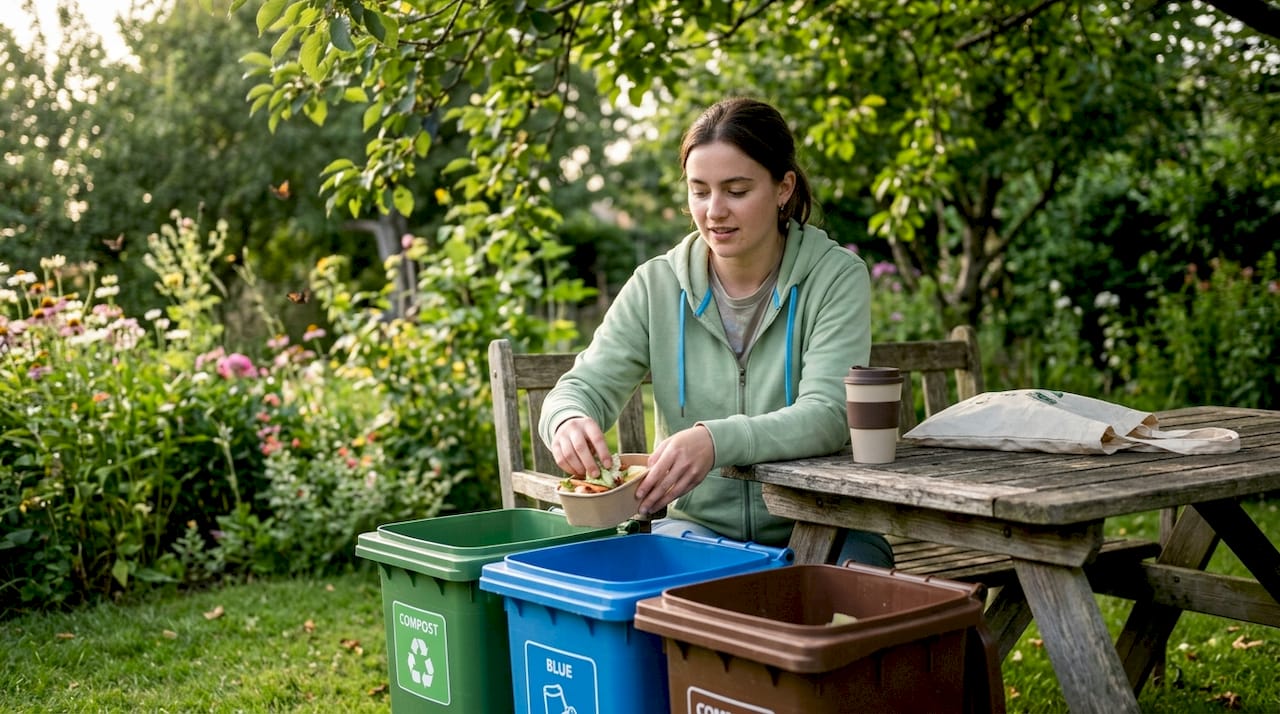
- Practice source separation. Set up clearly labeled bins for organics, recyclables, and residual waste. This simple step is the physical expression of the waste hierarchy in daily life.
- Apply the 3Rs framework. Reduce consumption first, reuse items where possible, and recycle only what cannot be reduced or reused. The order matters. Recycling is not a substitute for reduction.
- Analyze a real integrated system. Select a city or municipality that publishes waste diversion data. Map its system against the five-tier hierarchy and identify gaps. This is exactly the kind of analysis that earns top marks in ESS internal assessments.
- Evaluate emerging technologies. Research how anaerobic digestion or pyrolysis is being applied in your region. Assess the technology against local grid carbon intensity and waste composition data.
- Propose a policy recommendation. Use your audit data and system analysis to draft a realistic policy proposal. Effective proposals cite specific barriers (infrastructure gaps, behavioral habits, regulatory voids) and address each one directly.
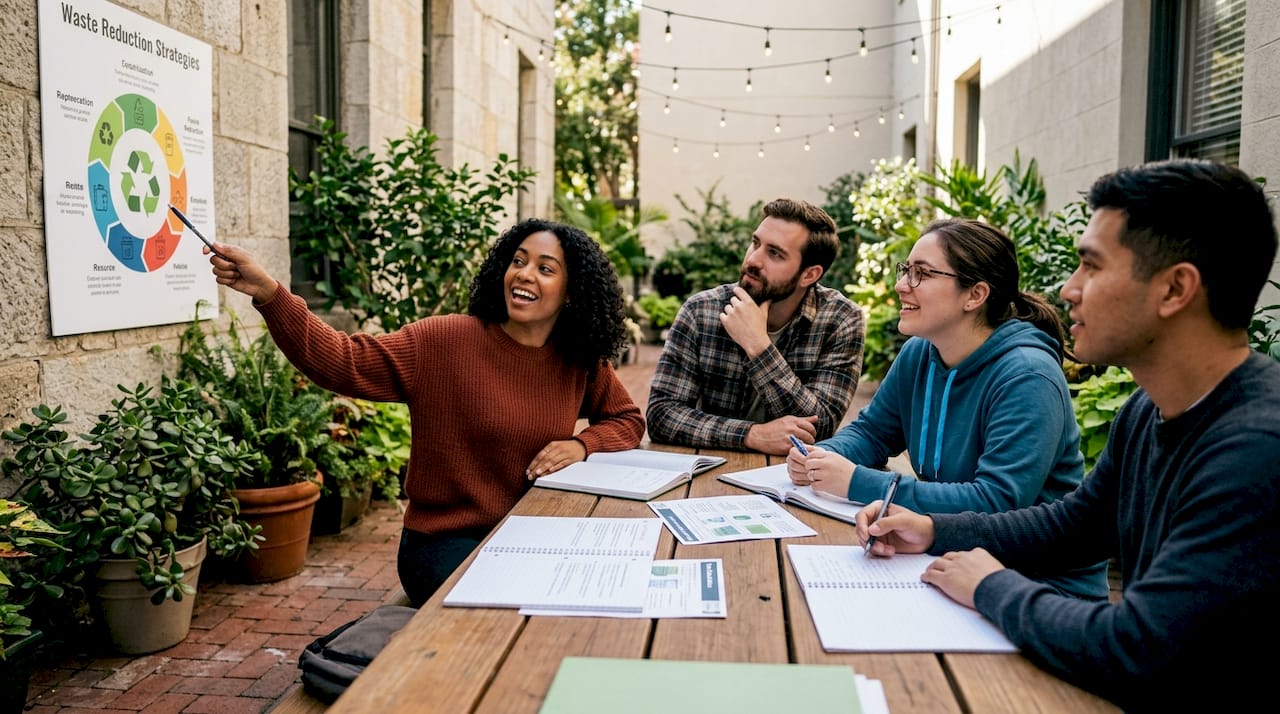
Education plays a central role in shifting waste behaviors at the community level. Students who understand integrated systems are better equipped to design projects that go beyond surface-level recycling campaigns. Systemic thinking, the ability to see how prevention, recovery, and policy interact, is the skill that distinguishes strong ESS candidates from average ones.
Key Takeaways
Effective waste management requires combining prevention, reuse, recycling, recovery, and disposal within integrated systems guided by life-cycle assessment, local context, and strong policy frameworks.
| Point | Details |
|---|---|
| Hierarchy order matters | Prevention delivers greater environmental benefit than recycling; always apply higher tiers first. |
| Integrated systems outperform single methods | Combining MRFs, anaerobic digestion, and WTE diverts far more waste than any one technology alone. |
| Context determines strategy | Grid carbon intensity and local waste composition decide whether WTE or recycling performs better. |
| Policy drives adoption | Landfill taxes, EPR laws, and carbon pricing are the levers that make sustainable strategies economically viable. |
| Education builds systemic thinkers | Students who can map real systems against the waste hierarchy produce stronger assessments and proposals. |
Why technology alone will not solve the waste problem
I have worked with IB ESS students long enough to notice a recurring pattern. When asked to evaluate a waste management system, most students reach immediately for the most impressive technology they can find. Pyrolysis, AI sorting robots, WTE plants. The technology is real and genuinely useful. But it is not the whole answer.
Sustainable waste management requires a balanced integration of technology, policy, economics, and behavioral change. No single dimension carries the full load. I have seen students write excellent essays about advanced anaerobic digestion systems in cities where basic source separation is not even practiced. The technology exists. The behavioral and regulatory infrastructure does not. The system fails.
The circular economy framework is the most promising shift in thinking I have encountered in environmental education. It reframes waste as a resource flow rather than a disposal problem. But circular economy principles only work when producers, consumers, and regulators all play their part. Technology enables the system. It does not replace the human decisions that drive it.
My advice to students and educators: start with the hierarchy, understand the local context, and resist the temptation to treat any single technology as a complete solution. The most effective waste management strategies are the ones designed with all four dimensions in mind.
— Marija
How Esstutor helps you master waste management for ESS success
Waste management is one of the most frequently examined topics in IB ESS, appearing in paper questions, internal assessments, and extended essays. Getting the concepts right, and being able to explain them clearly under exam conditions, takes more than reading a textbook.

Esstutor offers personalized, one-on-one tutoring with an experienced IB examiner who has spent over 13 years helping students worldwide build exactly this kind of analytical depth. Whether you are working on your ESS extended essay on a waste management case study or preparing for a paper question on the waste hierarchy, Esstutor provides targeted guidance tailored to your specific needs. Book a trial lesson and see how focused support makes complex environmental topics click.
FAQ
What is the waste hierarchy in waste management?
The waste hierarchy is a five-tier framework ranking prevention, reuse, recycling, recovery, and disposal in order of environmental preference. Prevention is the most favored strategy because it eliminates waste before it is generated.
How does recycling differ from recovery in waste management?
Recycling converts waste materials into new raw materials, while recovery extracts energy from waste through processes like incineration or anaerobic digestion. Recycling is ranked higher in the waste hierarchy because it preserves material value rather than converting it to energy.
Why do waste-to-energy benefits vary by location?
Waste-to-energy environmental benefits depend on the carbon intensity of the local electrical grid. In regions with low-carbon electricity, material recycling often produces lower net emissions than burning waste for energy.
What is an integrated waste management system?
An integrated waste management system combines multiple technologies, such as MRFs, anaerobic digestion, pyrolysis, and landfill gas recovery, to handle different fractions of the waste stream and maximize diversion from landfills.
How can ESS students apply waste management strategies in their assessments?
ESS students can conduct waste audits, map local systems against the five-tier hierarchy, and analyze real municipal data to evaluate strategy effectiveness. This approach directly supports strong internal assessments and extended essay arguments.
No Comments