


23 May IB ESS Curriculum Highlights: 2026 Student Guide
TL;DR:
- IB Environmental Systems and Societies (ESS) uniquely blends science and social studies, emphasizing interconnected systems and sustainability. The 2024 syllabus introduces HL alongside SL, requiring deeper analysis of legal, economic, and ethical perspectives, with assessments including exams and an internal investigation. Choosing between SL and HL depends on your academic interests and future plans, but success hinges on engaging personally with real environmental issues and developing critical thinking skills.
If you are trying to understand the ESS curriculum highlights for the first time, the sheer breadth of this course can feel like a lot to take in. IB Environmental Systems and Societies (ESS) is unlike most IB subjects. It blends natural science with social studies, asking you to analyze ecosystems and the human systems that interact with them. With the 2024 syllabus update introducing a Higher Level option for the first time, there has never been a better moment to get a clear picture of what this course actually covers, and whether SL or HL is right for you.
Table of Contents
- Key takeaways
- 1. What makes ESS curriculum highlights different from other IB courses
- 2. The three foundational ideas that run through everything
- 3. Core topics covered in the ESS curriculum
- 4. How SL and HL differ in depth and expectations
- 5. Assessment highlights: what you will actually be graded on
- 6. Choosing the right ESS path for you
- My honest take on getting the most out of ESS
- Ready to strengthen your ESS performance?
- FAQ
Key takeaways
| Point | Details |
|---|---|
| ESS is now offered at SL and HL | The 2024 syllabus introduced HL for the first time, with first assessments taking place in 2026. |
| Three ideas unify the course | Perspectives, systems, and sustainability connect every topic across the curriculum. |
| HL goes deeper on three lenses | Environmental law, economics, and ethics are exclusive to HL students. |
| Assessment includes exams and an IA | Paper 1, Paper 2, and an individual investigation together make up your full grade. |
| ESS counts as Group 3 or Group 4 | Depending on your school, ESS can replace a humanities or a science subject. |
1. What makes ESS curriculum highlights different from other IB courses
ESS is counted as both Group 3 and Group 4 at many schools, meaning it can fulfill your requirement for either Individuals and Societies or Sciences. That flexibility is rare in the IB Diploma Programme and reflects the course’s genuinely interdisciplinary design.
Most science courses ask you to study a system in isolation. ESS asks you to study the connections. You examine how deforestation affects biodiversity, but you also look at the economic drivers behind logging and the political frameworks that either protect or fail forests. That dual lens is what makes the ESS program overview so distinct.
2. The three foundational ideas that run through everything
The ESS curriculum is built around three main ideas: perspectives, systems, and sustainability. Understanding these ideas early will help you see how every topic in the course connects.
Here is what each one means in practice:
- Perspectives means recognizing that different people view environmental issues differently. A farmer, an ecologist, and a policymaker may all see a wetland in different ways. ESS asks you to identify and evaluate those viewpoints rather than accept one as automatically correct.
- Systems means understanding how components interact. An ecosystem is a system. So is a city. So is the global economy. ESS teaches you to map inputs, outputs, storages, and flows so you can predict what happens when one part of a system changes.
- Sustainability means examining whether human activities can continue without depleting the resources and conditions that future generations will need. This shows up in topics from soil degradation to urban planning.
The 2026 pedagogy strongly encourages inquiry-based learning, using guiding questions to connect these ideas to real local and global issues students actually care about.
Pro Tip: When you encounter any new ESS topic, ask yourself: which perspective is being used here, what system is being described, and is this situation sustainable? That three-part habit will sharpen your analysis across every unit.
3. Core topics covered in the ESS curriculum
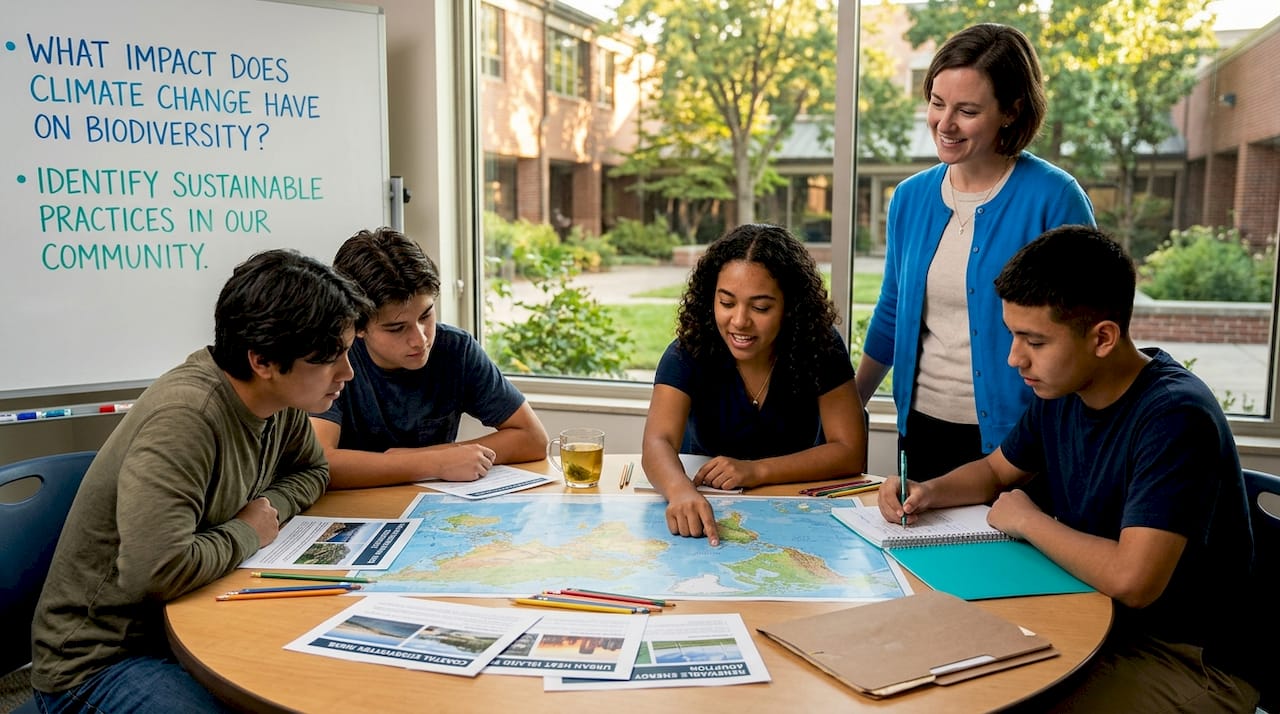
The key elements in ESS curriculum content span eight major topics. Here is a breakdown of what each one covers and why it matters:
- Foundations — Systems thinking, ecological footprints, and the nature of environmental value systems. This topic gives you the conceptual tools you will use throughout the entire course.
- Ecology — Energy flow, nutrient cycling, population dynamics, and species interactions. You will study real ecosystems and learn how disruptions cascade through food webs.
- Biodiversity and Conservation — Species diversity, habitat loss, invasive species, and conservation strategies ranging from seed banks to protected areas.
- Water — Freshwater systems, aquatic pollution, water scarcity, and the political dimensions of water access in regions like sub-Saharan Africa and Central Asia.
- Land — Soil health, land degradation, agriculture, and the tension between food production and ecological sustainability.
- Atmosphere and Climate Change — Greenhouse gases, the carbon cycle, climate models, and the science behind international agreements like the Paris Agreement.
- Natural Resources — Non-renewable and renewable energy sources, resource depletion, and the transition toward low-carbon economies.
- Human Populations and Urban Systems — Demographic change, urbanization, ecological footprints of cities, and case studies of both sustainable and unsustainable urban development.
Local and global case studies are woven through every topic, helping you appreciate how the same environmental challenge plays out differently in different social and political contexts.
| Topic area | Real-world example commonly used |
|---|---|
| Ecology | Yellowstone wolf reintroduction and trophic cascades |
| Biodiversity and Conservation | Great Barrier Reef bleaching and marine protected areas |
| Atmosphere and Climate Change | Arctic ice melt and sea level projections |
| Human Populations and Urban Systems | Singapore’s green urban planning model |
HL students go further with three specialized lenses: environmental law, environmental economics, and environmental ethics. These lenses require you to evaluate environmental problems using legal frameworks, economic cost-benefit analysis, and ethical reasoning, not just scientific data.
4. How SL and HL differ in depth and expectations
Both SL and HL share the same eight core topics, but the level of complexity and the time commitment are significantly different.
The SL course is approximately 150 teaching hours, while HL requires around 240 hours. That extra time is not just more content. It is deeper content, with a stronger demand for critical evaluation and synthesis.
| Feature | SL | HL |
|---|---|---|
| Teaching hours | ~150 hours | ~240 hours |
| Core topics | 8 topics | 8 topics + 3 lenses |
| Paper 1 duration | 1 hour (25% weighting) | 2 hours (30% weighting) |
| Paper 2 duration | 2 hours (50% weighting) | 2.5 hours (50% weighting) |
| IA weighting | 25% | 20% |
| Critical analysis demand | Moderate | High |
HL students must consistently apply social, economic, and legal perspectives when critiquing environmental problems. A question about ocean acidification at SL might ask you to explain causes and consequences. At HL, you would also be expected to evaluate international legal responses and assess economic trade-offs in fishing industries.
Key differences in what HL expects beyond SL:
- Integration of environmental law into case study analysis
- Economic cost-benefit thinking applied to conservation or energy policy
- Ethical frameworks such as anthropocentrism, ecocentrism, and technocentrism used to evaluate decisions
Pro Tip: If you are choosing HL, start building vocabulary around environmental law and economics early. Students who struggle at HL often know the science well but have not practiced applying legal or economic reasoning to environmental case studies.
5. Assessment highlights: what you will actually be graded on
The assessment structure for ESS includes two external exam papers and one internal assessment. Each component tests a different set of skills.
Paper 1 is a data-based case study. You receive an unseen set of resources including graphs, maps, photographs, and written data. You must analyze, synthesize, and evaluate that material under timed conditions. There is no multiple choice. Every question asks you to think, not just recall. SL students sit Paper 1 for one hour, while HL students sit it for two hours.
Paper 2 covers structured short-answer and extended-response questions drawn from across the syllabus. SL Paper 2 runs two hours and carries 50% of the final grade. HL Paper 2 runs two and a half hours, also at 50%.
The Internal Assessment (IA) is an individual investigation. The IA is weighted at 25% for SL and 20% for HL. You choose a relevant environmental question, collect or source real data, and analyze it through the lens of ESS concepts. The strategy criterion in particular requires nuanced consideration of environmental tensions and trade-offs, which means a strong IA goes beyond a standard science lab report.
Tips for strong performance across all three components:
- Practice reading and interpreting data sources you have never seen before, especially for Paper 1
- For Paper 2 extended responses, always link your argument to at least two perspectives
- For the IA, choose a topic that genuinely interests you, as the depth of your analysis will reflect your engagement
- Build exam preparation strategies around timed practice with past papers from the new syllabus
Pro Tip: Strong data analysis is the single most transferable skill in ESS exams. Practice extracting information from diverse data sources under timed conditions at least once a week from the start of your second year.
6. Choosing the right ESS path for you
Deciding between SL and HL is one of the most practical questions for this course. Here is honest guidance based on what actually works.
ESS SL is a strong choice if:
- You are interested in environmental science but plan to focus your HL subjects on humanities, languages, or mathematics
- You want to develop genuine environmental awareness without the added demand of three specialized lenses
- Your IB workload already includes two or three demanding HL subjects
ESS HL makes sense if:
- You want to pursue environmental science, environmental policy, ecology, or related fields at university
- You are strong in both scientific and social analysis and enjoy working across disciplinary lines
- You are willing to invest the extra time that 240 hours of content requires
One thing worth knowing: ESS can replace either a science or humanities subject depending on your school’s policy. That matters for students who want to keep their options open for university applications without committing to two full science subjects. Connecting ESS with other subjects like Geography, Economics, or Biology creates a genuinely interdisciplinary IB experience that stands out to university admissions teams.
My honest take on getting the most out of ESS
I have worked with IB ESS students for over 13 years, and the ones who thrive share one habit: they make the course personal. ESS asks you to think about real environmental problems, and the students who do best are the ones who connect those problems to places and communities they actually know.
In my experience, the biggest pitfall is treating ESS like a content-memorization subject. It is not. Paper 1 will give you data you have never seen before. The IA asks you to design an investigation, not repeat one from a textbook. The course rewards students who ask questions and who can think on their feet with real evidence.
What I tell every student I work with: do not wait until Year 2 to practice evaluating perspectives. Build that habit in Year 1. Pick up an environmental news story and ask which value system the writer is using. That exercise, done consistently, will pay off across every assessment. The students who follow the IB ESS syllabus 2026 strategies and apply them actively, rather than passively reading content, are the ones who reach Level 6 and 7.
ESS is one of the most genuinely useful courses in the IB Diploma Programme. The knowledge you build here connects directly to the most pressing issues of our time. Take it seriously, and it will serve you well beyond the exam.
— Marija
Ready to strengthen your ESS performance?
Understanding the ESS curriculum highlights is the first step. Putting them into practice with targeted support is what moves your grade.
At Esstutor, Marija brings over 13 years of IB ESS teaching and examining experience to every session. Whether you need help designing a strong ESS internal assessment that meets the new syllabus criteria or want to build real confidence for Paper 1 and Paper 2, the tutoring is tailored to exactly where you are right now. Sessions are flexible, online, and focused on results. You can also explore structured ESS notes and textbook resources to reinforce your learning between sessions. If you are serious about reaching Level 6 or 7, booking a trial lesson is the most direct step you can take.
FAQ
What is the ESS curriculum in the IB Diploma Programme?
IB ESS is an interdisciplinary course combining environmental science and social studies. It is organized around three main ideas: perspectives, systems, and sustainability, and covers eight core topics from ecology to climate change.
What are the key differences between ESS SL and ESS HL?
SL is approximately 150 teaching hours with a focus on core understanding, while HL is around 240 hours and adds three specialized lenses covering environmental law, economics, and ethics.
How is the ESS course assessed?
ESS assessment includes Paper 1 (a data-based case study), Paper 2 (structured and extended responses), and an individual IA investigation weighted at 25% for SL and 20% for HL.
When did the new ESS syllabus take effect?
The updated ESS syllabus was introduced in 2024, with HL offered for the first time. First assessments under the new syllabus take place in 2026.
Can ESS replace a science subject in the IB?
Yes. Depending on your school’s policy, ESS can count as either a Group 3 (Individuals and Societies) or Group 4 (Sciences) subject, giving students flexibility in their IB subject selection.
No Comments