


01 May Step-by-step IB ESS revision: a proven guide for top scores
TL;DR:
- Effective IB ESS revision emphasizes active learning and systems thinking over passive memorization.
- Using structured tools like flashcards, mind maps, and diagrams enhances understanding and recall.
- Regular practice with past papers and self-assessment ensures exam readiness and highlights areas for improvement.
IB Environmental Systems and Societies covers an enormous range of content, from biodiversity and pollution to ecological footprints and climate systems. Many students feel overwhelmed by the sheer breadth of the syllabus and fall back on passive reading that doesn’t stick. The good news is that a structured, active revision approach changes everything. This guide walks you through every stage of effective IB ESS revision, from gathering your tools to self-assessing your readiness, so you can build real confidence before exam day.
Table of Contents
- What you need to start your IB ESS revision
- Step-by-step IB ESS revision process
- Active learning strategies for ESS: flashcards, mind maps, and systems thinking
- Common revision mistakes in IB ESS and how to fix them
- Checking your progress: practice and self-assessment
- What most IB ESS guides miss: why systems thinking is your secret weapon
- Take your IB ESS revision further with expert support
- Frequently asked questions
Key Takeaways
| Point | Details |
|---|---|
| Gather the right resources | Start with your syllabus, past papers, and tools like flashcards and mind maps. |
| Follow a structured process | Break revision into logical steps, using active learning techniques for each IB ESS topic. |
| Prioritize systems thinking | Focus on connecting concepts, feedback loops, and holistic understanding for higher marks. |
| Practice, assess, improve | Regular testing and self-assessment reinforce learning and highlight areas for growth. |
| Avoid common mistakes | Don’t just memorize; always check for real understanding and application of concepts. |
What you need to start your IB ESS revision
With your motivation sparked, the next step is ensuring you have every essential tool at your fingertips. Before you write a single flashcard or draw your first systems diagram, you need to set yourself up properly. Jumping into revision without the right resources wastes time and creates gaps you’ll regret later.
Here are the core resources every IB ESS student needs:
- IB ESS syllabus guide: Your non-negotiable starting point. Every topic, subtopic, and assessment objective is listed here.
- Past papers and markschemes: These show you exactly what examiners want. Download at least five years’ worth.
- Textbook: Use it for explanations and case studies, but don’t read it passively.
- Flashcard system: Physical cards or a digital app like Anki for spaced repetition.
- Mind map materials: Large paper, colored pens, or a digital tool like MindMeister.
- Notebook for systems diagrams: Practice drawing feedback loops, food webs, and nutrient cycles from memory.
The table below shows how each resource connects to specific revision tasks:
| Resource | Primary use in IB ESS revision |
|---|---|
| Syllabus guide | Topic checklist and learning objective tracker |
| Past papers | Exam practice and command term familiarity |
| Markschemes | Self-assessment and understanding examiner expectations |
| Anki flashcards | Memorizing definitions, case studies, and key terms |
| Mind maps | Connecting concepts across topics and systems |
| Systems diagram notebook | Practicing feedback loops and environmental models |
Part of succeeding in IB ESS is treating revision as an ongoing process rather than a last-minute event. Schedule short, focused sessions across several weeks instead of cramming everything into a few days before exams.
Pro Tip: Spend 30 minutes organizing all your resources into clearly labeled folders (digital or physical) before you start. Knowing exactly where everything is removes friction and keeps your sessions focused.
Step-by-step IB ESS revision process
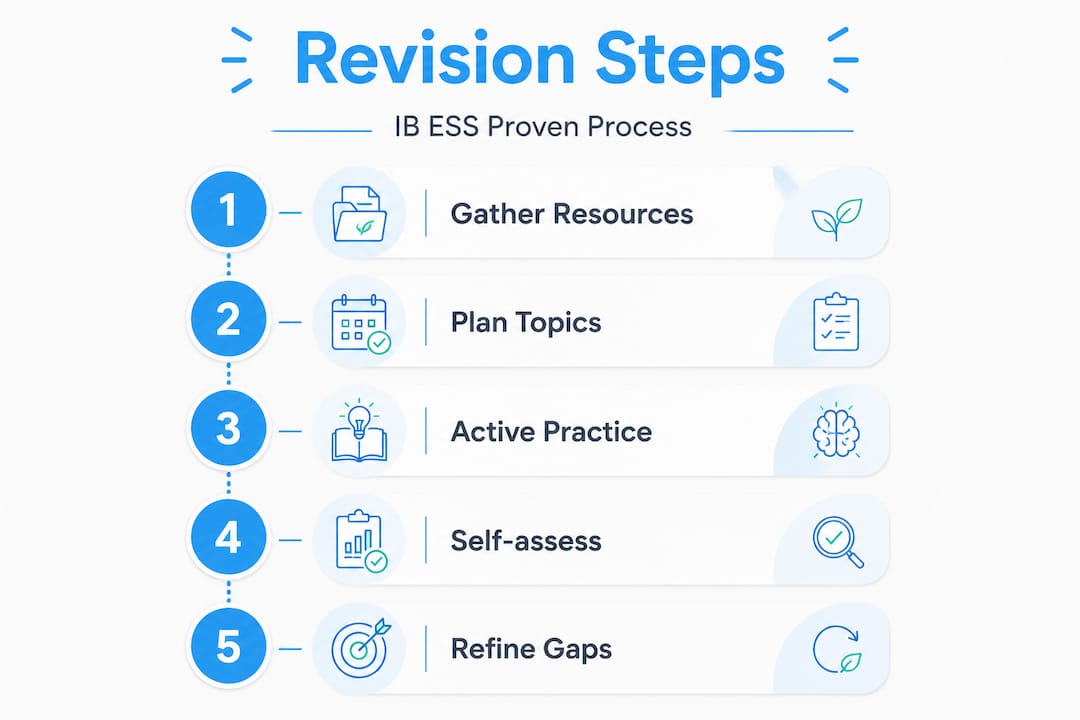
Once you have your resources ready, here’s how to use them for the most effective IB ESS revision, step by step.
-
Review the full syllabus. Read every topic and subtopic. Highlight anything you feel uncertain about. This gives you a clear map of what needs attention and what you already know well.
-
Chunk content by topic. Break the syllabus into manageable sections such as ecosystems, human populations, or climate change. Tackle one chunk per revision session rather than jumping between topics.
-
Build active learning resources. As the Save My Exams revision guide recommends, create flashcards and mind maps for definitions, case studies, and key terms, and draw systems diagrams from memory. This is where real learning happens.
-
Apply case studies. For every major topic, connect at least one real-world example. For instance, link eutrophication to the Baltic Sea, or deforestation to the Amazon. Examiners reward specific, accurate examples.
-
Practice exam questions. Use proven ESS exam strategies to work through past paper questions under timed conditions. Focus on command terms like “evaluate,” “discuss,” and “explain.”
-
Review and repeat. Return to topics you found difficult. Spaced repetition, where you revisit content at increasing intervals, is far more effective than one-off review.
“Consistent, spaced review beats last-minute cramming every single time. Your brain needs repeated exposure to move information into long-term memory.”
Pro Tip: After completing a mind map on a topic, close your notes and try to redraw it from memory. Compare it to the original and fill in any gaps. This single habit builds stronger recall than rereading notes three times over.
For a deeper look at how to approach each exam section, check out these exam tips for higher ESS scores and proven study strategies that experienced tutors recommend.
Active learning strategies for ESS: flashcards, mind maps, and systems thinking
With the revision process mapped out, it’s important to dive deeper into how your techniques can maximize memory and connections in ESS. Passive review, such as rereading notes or highlighting text, feels productive but rarely leads to strong exam performance. Active learning forces your brain to retrieve and apply information, which is exactly what the IB ESS exam demands.
Here are the most effective active learning techniques for IB ESS:
- Flashcards: Write the term or concept on one side, the definition or example on the other. Use Anki for spaced repetition so you review difficult cards more often.
- Mind maps: Start with a central concept like “biodiversity” and branch out to connect species diversity, ecosystem services, threats, and case studies.
- Systems diagrams: Draw feedback loops, energy flow diagrams, and biogeochemical cycles from scratch. Label inputs, outputs, and storages.
- Teaching peers: Explain a concept out loud to a classmate or study partner. If you can teach it clearly, you understand it.
- Practice questions: Answer exam-style questions without looking at your notes, then compare your response to the markscheme.
The table below shows the key difference between passive and active learning in IB ESS revision:
| Approach | Method | Exam outcome |
|---|---|---|
| Passive | Rereading notes, highlighting | Surface-level recall, struggles with application |
| Active | Flashcards, diagrams, practice questions | Deeper understanding, stronger exam performance |
One of the most important shifts you can make is prioritizing systems thinking in IB ESS. The IB ESS exam rewards students who can identify interconnections, trace feedback loops, and explain how changes in one part of a system affect others. This is far more valuable than memorizing isolated facts.
As noted in the IB ESS 2026 syllabus update, the exam now places greater emphasis on systems thinking and balanced perspectives across environmental, economic, and social dimensions. This means your revision needs to reflect all three viewpoints, not just the environmental angle.
Pro Tip: For every case study you revise, write three bullet points: one environmental impact, one economic impact, and one social impact. This habit trains you to think in the balanced way examiners reward.
Common revision mistakes in IB ESS and how to fix them
Even with great techniques, it’s easy to slip into old habits. Here’s what to watch out for and how to course-correct.
-
Mistake: Cramming facts instead of practicing application. Many students memorize definitions but freeze when asked to “evaluate” or “discuss.” Fix this by practicing past paper questions weekly, not just in the final week before exams.
-
Mistake: Ignoring systems thinking. Listing facts about pollution without explaining the feedback loops and interconnections involved will cost you marks. Fix this by adding a systems diagram to every topic you revise.
-
Mistake: Neglecting the balance of perspectives. The IB ESS exam expects you to consider environmental, social, and economic angles. The 2026 syllabus changes make balanced perspectives essential, not optional. Fix this by practicing multi-perspective responses for every major topic.
-
Mistake: Skipping markschemes. Many students complete past paper questions but never check them against the official markscheme. Fix this by self-assessing every answer you write, noting exactly where you lost marks and why.
-
Mistake: Passive revision close to exam time. Rereading notes the night before an exam is low-impact. Fix this by switching to active recall, using flashcards or writing out key points from memory.
Knowing how to structure your responses is just as important as knowing the content. Reviewing strategies for answering ESS exam questions will help you present your knowledge in the format examiners are looking for.
Checking your progress: practice and self-assessment
Having sidestepped common pitfalls, the final step is ensuring your revision actually translates into exam readiness. Self-assessment is not optional. It’s the feedback loop that tells you whether your revision is working.
Follow this process for effective progress checks:
- Complete a past paper question under timed conditions. No notes, no textbook. Treat it like the real exam.
- Mark your response using the official markscheme. Be honest. Award marks only where you genuinely meet the criteria.
- Identify your weak areas. Note which topics or question types cost you marks consistently.
- Revise those specific areas actively. Return to flashcards, redraw systems diagrams, or rewrite case study notes for the topics you struggled with.
- Repeat the cycle. Practice, assess, revise, and repeat until your scores improve consistently.
As active learning resources remind us, drawing systems diagrams from memory is one of the strongest indicators of genuine understanding. If you can reproduce a nutrient cycle or a feedback loop without prompts, you’re ready for that question on exam day.

The table below maps common self-assessment tools to what they measure:
| Tool | What it assesses |
|---|---|
| Past papers | Command term responses and topic coverage |
| Official markschemes | Accuracy of content and examiner expectations |
| Peer review | Clarity of explanation and argument structure |
| Timed practice | Exam pacing and time management |
If you’re also working on your internal assessment, the IB ESS IA guide provides a step-by-step breakdown of what examiners look for and how to structure your work effectively.
What most IB ESS guides miss: why systems thinking is your secret weapon
Now that you know how to self-assess, here’s a mindset shift most resources ignore. The majority of IB ESS revision guides focus heavily on content recall. They tell you to memorize definitions, learn case studies, and practice past papers. All of that matters. But the students who consistently earn top marks do something different: they think in systems.
Memorizing that eutrophication causes algal blooms is useful. But understanding why nutrient loading creates a positive feedback loop that depletes oxygen and collapses aquatic biodiversity is what earns a level 7. The IB ESS exam is designed to reward this kind of thinking. Questions that ask you to “evaluate” or “discuss” are explicitly testing whether you can trace cause and effect across interconnected systems.
The 2026 IB ESS syllabus update places systems thinking and feedback loops at the center of what students are expected to demonstrate. This is not a minor shift. It means that revision strategies built around content recall alone will leave you underprepared for higher-order questions.
My advice is to build systems thinking into every revision session, not just when you’re studying “systems” as a topic. When you revise climate change, map the feedback loops. When you revise fisheries management, trace the economic, social, and ecological interconnections. For a deeper dive on systems thinking and how to apply it across the syllabus, I’d encourage you to explore that resource before your next revision session.
Take your IB ESS revision further with expert support
Ready to optimize your revision? Here’s where you can find more help tailored for IB ESS success.
Working through a structured revision plan on your own is a strong start. But sometimes you need feedback from someone who knows exactly what IB examiners are looking for. That’s where personalized tutoring makes a real difference.
At ESS Tutor, I work with IB ESS students worldwide to sharpen their exam technique, strengthen their internal assessments, and build the systems thinking skills that lead to top scores. Whether you want to boost your IB ESS score on your IA or need targeted exam support, I offer tailored sessions that meet you exactly where you are. You can also explore a full range of IB ESS notes and textbooks to support your independent study. Book a trial lesson and see how focused, expert guidance can transform your revision results.
Frequently asked questions
How early should I start revising for IB ESS?
Start at least 2 to 3 months before your exams to allow enough time for active learning, spaced review, and multiple rounds of past paper practice.
Which is better for IB ESS revision: flashcards or mind maps?
Use both together: flashcards are best for memorizing definitions and case studies, while mind maps help you link concepts and systems across the syllabus.
What is systems thinking and why does it matter in IB ESS?
Systems thinking means understanding how components of an environment connect through feedbacks and interactions. The current IB ESS exam prioritizes these skills over isolated fact recall.
How can I check my progress when revising IB ESS?
Practice with past papers under timed conditions, self-mark using official markschemes, and identify which topics or question types consistently cost you marks.
What is the biggest revision mistake IB ESS students make?
Relying on rote memorization instead of understanding connections. The IB ESS exam rewards application and systems-level thinking far more than fact recall alone.
Recommended
- Top IB ESS exam tips for higher scores: strategies that work
- IB ESS internal assessment guide: Step-by-step for top scores
- How to prepare for ESS exams: proven strategies for IB success
- How To Score a 7 in Your IB ESS IA: Step-by-Step Guide
- AI Study Tools: Learn Faster with Spaced Repetition, Personalized Flashcards & AI Tutors | Coursefy.ai Blog
No Comments