


01 Apr Streamline your IB ESS coursework: top workflow tips
Managing IB ESS coursework can feel overwhelming, especially when you are juggling fieldwork, lab reports, and an Internal Assessment all at once. Many students start strong but lose momentum because they lack a clear system. The good news is that with the right workflow, you can move from confusion to confidence. This guide walks you through every stage, from understanding what is required to submitting a polished final draft. Whether you are just starting out or trying to recover lost ground, you will find practical steps, useful tools, and honest advice to help you complete your coursework efficiently and to a high standard.
Table of Contents
- Understand IB ESS coursework and internal assessment requirements
- Gather resources and plan your workflow
- Step-by-step process for completing your IB ESS coursework
- Avoiding common pitfalls and troubleshooting your progress
- Review, verification, and submission: securing your best outcome
- Why a systemized workflow beats the last-minute scramble
- Get personalized support for your IB ESS journey
- Frequently asked questions
Key Takeaways
| Point | Details |
|---|---|
| Know the requirements | Clarify all IB ESS assessment expectations to avoid missing key steps. |
| Plan before starting | Gather the right resources and create a workflow before you begin your IA. |
| Follow proven steps | Move through the coursework in a structured, logical order for best results. |
| Anticipate obstacles | Watch for and address common mistakes early to keep your project on track. |
| Thoroughly review before submission | A detailed final check improves your score and prevents last-minute issues. |
Understand IB ESS coursework and internal assessment requirements
Now that you know what’s at stake, it’s important to get crystal clear on the specific requirements and types of tasks you’ll encounter in IB ESS. The IB ESS course overview covers three main assessed components: the Internal Assessment (IA), fieldwork and lab investigations, and the final written exams. Each has its own criteria, word count, and weighting.
The IA is a research-based report where you design and carry out an environmental investigation. It is worth 20% of your final grade and is assessed against five criteria: personal engagement, exploration, analysis, evaluation, and communication. Understanding these criteria from day one is not optional. It is essential.
Here is a quick overview of the key components:
| Task | Approximate word count | Weighting | Key deadline |
|---|---|---|---|
| Internal Assessment (IA) | 1,500 to 2,250 words | 20% | Set by school |
| Fieldwork/lab reports | Varies | Part of IA | Ongoing |
| Final exams (Paper 1 and 2) | Exam-based | 80% | May exam session |
As clarified in the IB ESS internal assessments guide, many students confuse the IA with regular classwork. That is a costly mistake. The IA is formally moderated, meaning an external IB examiner reviews it alongside your teacher’s marks.
Common misconceptions to avoid:
- The IA is just a longer homework assignment (it is not; it follows strict scientific inquiry criteria)
- You can choose any topic freely without checking criteria alignment
- Fieldwork notes automatically count as your IA data
- Word count limits are suggestions rather than firm boundaries
Always read the official ESS guidelines before you begin. Knowing the rules upfront saves you from rewriting large sections later. You can also browse ESS IA examples to see what a well-structured submission looks like in practice.
Gather resources and plan your workflow
With requirements in hand, you can now maximize your effectiveness by gathering the right resources and setting up a workflow that works for you. Before writing a single word, build your resource toolkit. Reliable materials make planning faster and reduce guesswork.
Here is a checklist of what you need before you start:
- The IB ESS subject guide (from your teacher or the IBO website)
- ESS notes and textbooks for content support
- Past IA examples with examiner comments
- A feedback loop: teacher, tutor, or peer reviewer
- A project management tool such as Notion, Trello, or Google Calendar
Not all resources are equal. Here is a quick comparison to help you choose wisely:
| Resource type | Strengths | Weaknesses |
|---|---|---|
| Official IB materials | Accurate, examiner-approved | Can be dense and formal |
| Student-made guides | Easy to read, relatable | May contain errors or outdated info |
| Tutor or teacher feedback | Personalized, criteria-focused | Requires scheduling and preparation |
| Online IA examples | Visual, practical reference | Quality varies widely |
As highlighted in top ESS IA ideas, using curated and reliable resources during planning leads to more efficient drafting and fewer revisions. Pair this with a solid ESS extended essay workflow approach if you are also working on an EE in ESS.
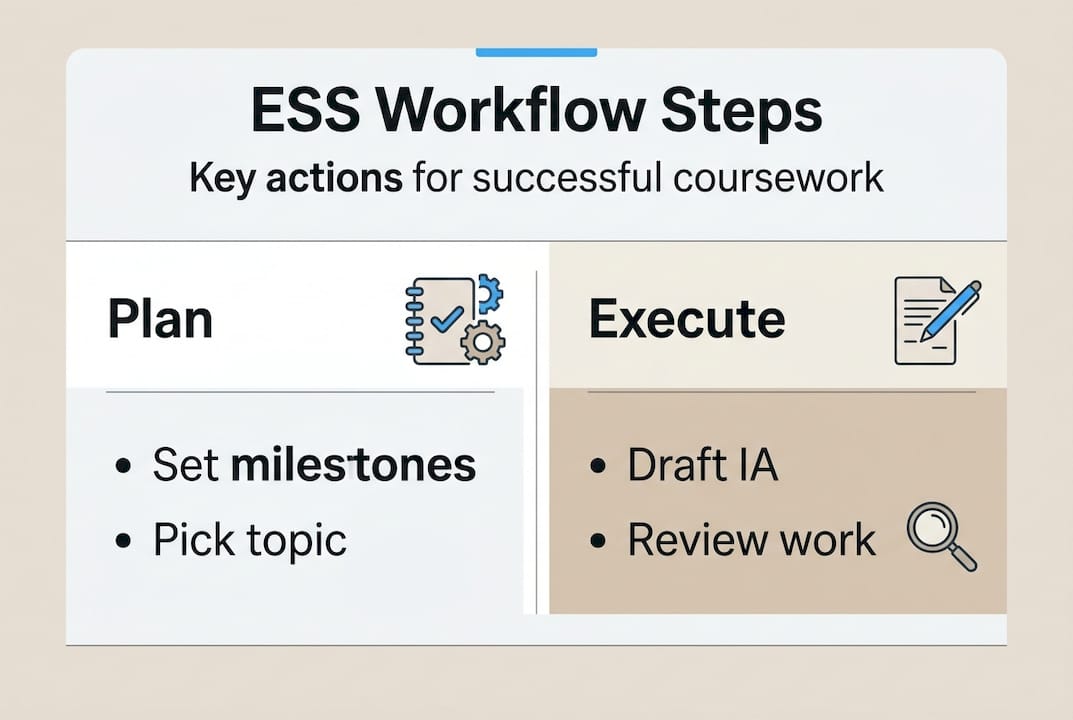
For resource planning essentials, set milestones at least three weeks apart: topic selection, first draft, peer review, teacher feedback, and final submission.
Pro Tip: Use a free digital calendar to block out two to three focused work sessions per week for your IA. Assign each session a specific task, such as data collection or writing the analysis section. This prevents the work from piling up and keeps your momentum steady.

Step-by-step process for completing your IB ESS coursework
Once your plan and resources are ready, you’re equipped to break the process into manageable steps for maximum confidence and efficiency. Follow this sequence to move from a blank page to a complete, polished submission:
- Select your topic. Choose a focused environmental question that connects to ESS themes such as biodiversity, pollution, or ecological footprints. Narrow is better than broad.
- Research background information. Use your ESS textbook, peer-reviewed articles, and class notes to build context for your investigation.
- Design your investigation. Write a clear research question, identify your variables, and plan your data collection method. Check that your design matches the exploration criterion.
- Collect your data. Record raw data in organized tables. Include units, uncertainties, and enough trials for statistical analysis.
- Analyze and conclude. Process your data using appropriate graphs and statistics. Link your findings back to your research question and relevant ESS concepts.
- Structure and polish. Use IA report writing tips to format each section correctly. Check word count and citation style.
- Submit on time. Confirm your school’s submission platform and deadline. Upload the final version and save a backup copy.
Matching your IA topic directly to the assessment criteria is the single most important factor in scoring well. A brilliant investigation on the wrong question will still lose marks.
For detailed guidance at each stage, the ESS IA guide and step-by-step IA help are excellent references. You can also review sample IA reports to check your structure against real examples.
As outlined in how to write an effective ESS IA, students who follow a structured writing process consistently produce cleaner, more focused reports.
Pro Tip: Work in 25-minute focused sessions with a 5-minute break between each. This keeps your concentration sharp and prevents burnout during longer writing days.
Avoiding common pitfalls and troubleshooting your progress
Even with the best plan, it’s normal to hit roadblocks, so let’s ensure your workflow includes strong troubleshooting and self-check practices. Knowing where students typically go wrong helps you avoid the same traps.
Here are the top five pitfalls to watch for:
- Topic too broad. A question like “How does pollution affect ecosystems?” is impossible to investigate properly. Narrow it to a specific pollutant, location, and measurable outcome.
- Poor or insufficient data. Collecting data from only one trial or one location weakens your analysis. Plan for at least five data points or trials.
- Ignoring the criteria. Writing a great report that does not address the five IA criteria will cost you marks. Keep the rubric open while you write.
- Late drafts. Submitting your first draft to your teacher too close to the deadline leaves no time for meaningful revisions.
- Plagiarism. Copying text from websites or other IAs, even accidentally, can result in serious consequences. Always paraphrase and cite your sources.
Students who act on teacher and tutor feedback consistently improve their IA scores, often by one to two grade boundaries. That is a significant difference when you are aiming for a 6 or 7.
To self-check your work before teacher review, go section by section and ask: Does this directly address the criterion? Is my data clearly presented? Have I explained my conclusions using ESS concepts? Use troubleshooting IA examples to compare your draft against stronger submissions.
For broader strategies, successful coursework strategies recommends building peer review into your timeline at least two weeks before the final deadline. A fresh set of eyes catches errors you have stopped seeing. Also review how to write a strong IA to reinforce good habits throughout the process.
Review, verification, and submission: securing your best outcome
After completing your coursework, your success hinges on a final review and submitting with care and confidence. Do not rush this stage. A structured final check can recover marks that careless errors would otherwise cost you.
Follow these steps before you submit:
- Proofread for language and clarity. Read your IA aloud to catch awkward phrasing, missing words, and grammar errors.
- Check against the rubric. Go through each criterion and confirm your report addresses every point. Use the final IA checklist to stay organized.
- Verify formatting. Check font size, heading styles, figure labels, and citation format. Consistency matters.
- Run a plagiarism scan. Use a tool like Turnitin or a free alternative to confirm your work is original.
- Confirm submission details. Check the platform, file format, and deadline one more time before uploading.
For file management, name your documents clearly, for example “ESS_IA_Final_v3_YourName.pdf,” and keep backup copies in at least two locations such as cloud storage and a local drive.
As explained in scoring high with IA tutor support, students who complete a structured final review before submission report feeling more confident and make fewer last-minute errors. Reflection after submission also helps you apply lessons to your next assessment cycle.
Here is a summary of essential submission tips:
| Action | Why it matters |
|---|---|
| Rubric check | Confirms all criteria are addressed |
| Plagiarism scan | Protects academic integrity |
| File naming and backup | Prevents loss and confusion |
| Deadline confirmation | Avoids late penalties |
| Final proofread | Catches language and formatting errors |
For a complete assessment submission checklist, review all requirements one final time before clicking submit.
Why a systemized workflow beats the last-minute scramble
Here is something I have observed working with IB ESS students over many years: the students who score highest are rarely the most naturally gifted. They are the most organized. A student with average content knowledge but a clear system will consistently outperform a talented student who works in bursts and submits rushed drafts.
When you build a workflow, you are not just managing time. You are building the habit of scientific thinking, which is exactly what IB ESS rewards. Students with systems recover faster when something goes wrong, because they have checkpoints built in. They notice early when their data is weak or their argument is unclear.
There is also an unexpected benefit. The reflection and review stages you build into your workflow develop real scientific literacy. You start reading your own work like an examiner. That skill carries far beyond the IB. Organizing for success is not just about marks. It is about becoming a more capable thinker.
Get personalized support for your IB ESS journey
If you want to put this workflow into action with expert support, there are targeted resources designed specifically for IB ESS success.
Working with experienced ESS IA tutors gives you structured, personalized feedback at every stage of your coursework. You get guidance from someone who understands the criteria deeply and knows exactly what examiners look for. Pair that with access to comprehensive ESS notes to strengthen your content knowledge. When you are ready to take your IA to the next level, explore the strategies available to boost your IA score and move closer to the grade you are aiming for.
Frequently asked questions
What are the key components of IB ESS coursework?
The main components are the Internal Assessment, fieldwork, and exams, each with specific requirements, word counts, and deadlines set by the IB.
How do I choose a strong ESS IA topic?
Pick a focused research question that aligns with ESS criteria, allows for measurable data collection, and addresses a specific environmental challenge. Strong IA topic tips can help you narrow your ideas effectively.
What is the best way to organize my workflow for IB ESS coursework?
Break your project into milestones with clear deadlines, use checklists for each stage, and review your progress regularly. Effective workflow organization keeps you on track and reduces last-minute stress.
How can I effectively self-check my IA before submission?
Review the scoring rubric section by section, scan for formatting errors, and ask a teacher or peer for feedback. Rubric-based self-review is one of the most reliable ways to catch weak sections before they cost you marks.
No Comments