

04 Jul The Role of Global Warming in Earth’s Climate Crisis
TL;DR:
- Global warming primarily results from human activities that increase greenhouse gases in the atmosphere. Earth is now 1.26°C warmer than pre-industrial times, with CO2 levels exceeding 420 ppm, causing widespread environmental and societal impacts. Feedback loops like ice melt and methane release accelerate warming, making understanding and education vital for effective action.
Global warming is the long-term rise in Earth’s average surface temperature caused by human activities that increase greenhouse gas concentrations in the atmosphere. As of 2026, Earth is 1.26°C warmer than pre-industrial levels, with atmospheric CO2 exceeding 420 ppm. NASA, NOAA, and the IPCC all confirm that this warming is primarily human-driven, not a natural cycle. Understanding the role of global warming means understanding why every fraction of a degree matters for ecosystems, food systems, and human health. This article gives you the clearest, most current picture of what is happening and why it matters for your studies and your future.
What causes global warming and how do greenhouse gases contribute?
The greenhouse effect is the mechanism at the center of global warming. Gases like carbon dioxide (CO2), methane, and nitrous oxide trap heat in the atmosphere that would otherwise escape into space. Without any greenhouse effect, Earth would be too cold to support life. The problem is that human activities have pushed these gases far beyond natural levels.
CO2 is the most important anthropogenic greenhouse gas, primarily released through fossil fuel combustion and deforestation. Methane comes largely from livestock, rice paddies, and landfills. Nitrous oxide is released by agricultural soils and fertilizers. Each gas has a different warming potential and atmospheric lifetime, which is why scientists track all three carefully.
The scale of the change is striking. Atmospheric CO2 has risen from 280 ppm before industrialization to over 420 ppm today. Natural processes took thousands of years to shift CO2 by similar amounts. Humans achieved this in roughly 60 years. That speed is what makes the current situation so different from past climate shifts.
Key human activities driving emissions include:
- Fossil fuel combustion (coal, oil, and natural gas for energy and transport)
- Deforestation (removing forests that absorb CO2)
- Industrial agriculture (livestock methane and fertilizer nitrous oxide)
- Cement and steel production (energy-intensive manufacturing processes)
- Land-use change (converting natural ecosystems to farmland or urban areas)
Pro Tip: A common misconception is that natural factors like volcanic eruptions or solar cycles explain current warming. Scientists have measured both, and neither accounts for the warming trend observed since 1950. The fingerprint of human-caused warming is distinct in the data.
How does global warming impact Earth’s environment and weather patterns?
Global warming reshapes Earth’s physical systems in ways that compound over time. Rising temperatures do not just make summers hotter. They alter precipitation patterns, accelerate glacier melt, raise sea levels, and stress ecosystems that evolved under stable conditions.
Heat stress is now the leading cause of weather-related mortality worldwide. Some regions now experience up to 50 additional heat stress days per year compared to pre-industrial baselines. That is not just uncomfortable. It is a direct threat to outdoor workers, elderly populations, and anyone without access to cooling.
The table below contrasts key climate indicators between pre-industrial times and current conditions:
| Climate Indicator | Pre-Industrial Baseline | Current Condition (2026) |
|---|---|---|
| Global average temperature | Reference point (1850–1900) | +1.26°C above baseline |
| Atmospheric CO2 | ~280 ppm | >420 ppm |
| Sea level trend | Relatively stable | Rising through thermal expansion and ice melt |
| Extreme heat events | Rare natural occurrences | Frequent, human-amplified events |
| Arctic ice extent | Historically stable | Declining significantly |
Oceans absorb over 90% of excess heat generated by human activities. This drives sea-level rise through thermal expansion, even before ice melt is factored in. Ocean warming also bleaches coral reefs, disrupts marine food webs, and increases ocean acidification, which harms shellfish and other calcifying organisms.
Altered precipitation patterns create a double problem. Some regions face more intense rainfall and flooding. Others face prolonged drought. Both extremes stress freshwater supplies, damage infrastructure, and reduce agricultural productivity. Biodiversity suffers as species struggle to migrate fast enough to track shifting climate zones.
What societal and health consequences arise from global warming?
The human costs of warming are not abstract. They show up in hospital admissions, crop failures, and economic losses that fall hardest on communities with the fewest resources to adapt.
Heat-related illness and death are rising globally. The spatial footprint of hazardous heat has expanded, exposing new regions to extreme heat stress that previously had no experience managing it. Urban heat islands amplify this effect in cities, where concrete and asphalt retain heat overnight.
Agriculture faces compounding pressures from climate change and agriculture interactions. Warmer temperatures shift growing seasons, increase pest and disease pressure, and reduce yields for staple crops like wheat, maize, and rice in tropical regions. Fisheries decline as ocean warming and acidification reduce fish populations that billions of people depend on for protein.
The societal consequences include:
- Food insecurity driven by crop yield losses in vulnerable regions
- Water stress as glaciers retreat and rainfall patterns shift
- Displacement and migration when communities lose habitability due to flooding or drought
- Economic losses from infrastructure damage, reduced labor productivity in heat, and disaster response costs
- Health system strain from increased respiratory illness, vector-borne diseases, and heat emergencies
Pro Tip: When writing an IB ESS essay on climate impacts, always connect environmental changes to specific socioeconomic vulnerabilities. Examiners reward students who show how the same warming event affects wealthy and low-income communities differently.
Climate change is a grand economic and social challenge affecting multiple sectors simultaneously. No single policy or technology fixes it alone. That interconnectedness is exactly why understanding the full picture matters so much for students and policymakers alike.
What are the feedback loops and nuanced patterns in global warming?
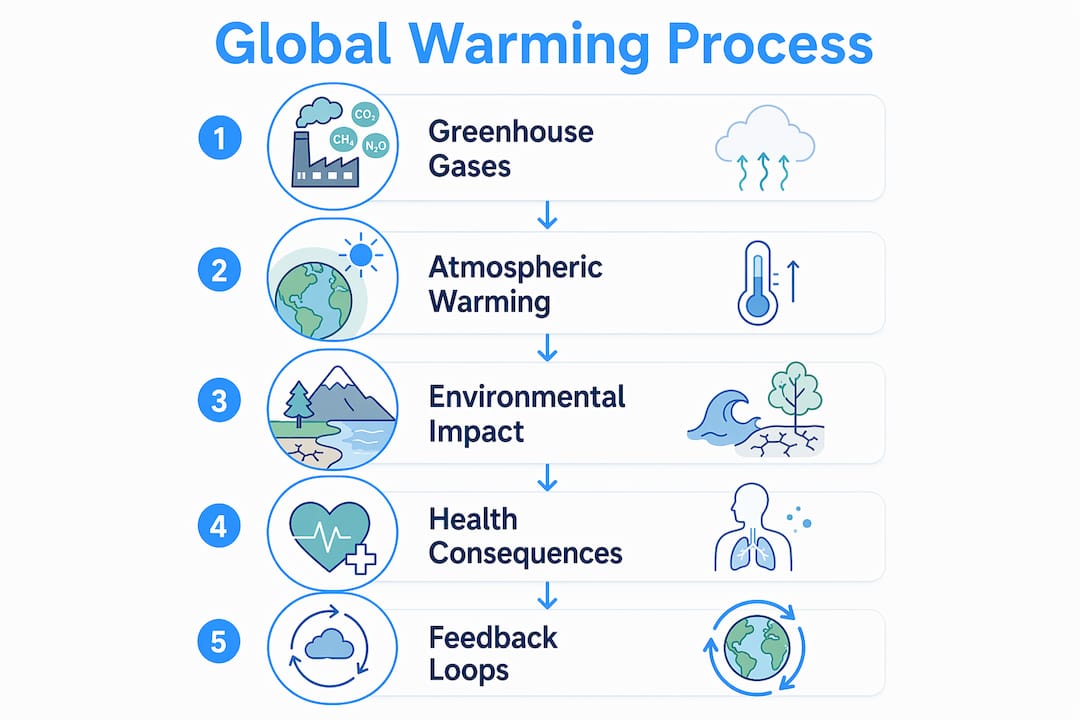
Feedback loops are the reason climate scientists treat warming with such urgency. A feedback loop occurs when warming triggers a change that causes even more warming. These mechanisms can push the climate past tipping points that are difficult or impossible to reverse.
The albedo effect is one of the clearest examples. Ice and snow reflect sunlight back into space. As melting ice reduces Earth’s albedo, darker ocean and land surfaces absorb more heat instead. This accelerates warming beyond what greenhouse gas increases alone would cause. Permafrost thaw adds another layer: as frozen Arctic soils warm, they release stored methane, a potent greenhouse gas that amplifies warming further.
Feedback loops such as albedo effects and methane release from thawing permafrost are accelerating warming faster than early climate models predicted. The 2020s are the pivotal decade for emission choices that determine whether irreversible tipping points are crossed.
Warming is also not uniform across the day or the globe. Nighttime temperatures are rising faster than daytime highs, at approximately 0.32°C per decade versus 0.27°C for daytime. This matters because nighttime cooling is when ecosystems and human bodies recover from daytime heat stress. When nights stay warm, that recovery window shrinks.
| Warming Pattern | Rate or Mechanism | Key Consequence |
|---|---|---|
| Daytime warming | ~0.27°C per decade | Increased heatwave frequency |
| Nighttime warming | ~0.32°C per decade | Reduced recovery from heat stress |
| Ocean heat uptake | >90% of excess heat absorbed | Sea-level rise via thermal expansion |
| Albedo feedback | Ice melt exposes dark surfaces | Accelerated warming cycle |
Impact attribution science now allows researchers to quantify how much more likely a specific extreme event was because of human-caused warming. This matters for legal accountability, insurance pricing, and disaster planning. It also gives educators a powerful tool: real events with measurable human fingerprints.
How can understanding the role of global warming guide education and action?
Science literacy is the foundation of effective climate action. Students and educators who understand the mechanisms of warming are better equipped to evaluate policy proposals, communicate risks, and make informed personal choices. Knowing the difference between weather and climate, or between natural variability and human-driven change, changes how you read the news and engage with public debate.
Current data directly informs both policy and behavior. When you understand that emission choices this decade determine whether tipping points are crossed, the urgency of mitigation becomes concrete rather than abstract. That understanding motivates action in a way that vague warnings about “the future” never can.
Here are practical steps for students and educators to engage with climate topics effectively:
- Use primary data sources. NASA, NOAA, and the IPCC publish accessible summaries of current climate indicators. Bookmark them and check updates regularly.
- Connect local to global. Find examples of climate impacts in your own region. Local case studies make abstract data tangible and memorable.
- Practice systems thinking. Map how one change (rising CO2) triggers others (warming, ice melt, sea-level rise, food insecurity). IB ESS rewards this kind of interconnected analysis.
- Engage with solutions, not just problems. Study sustainable ways to control climate change alongside the causes. Knowing what works builds confidence and agency.
- Communicate clearly. Practice explaining climate science to someone outside your class. If you can explain the greenhouse effect in plain language, you truly understand it.
Knowledge about global warming does not just help you pass exams. It prepares you to participate in one of the defining challenges of your generation. Education in sustainability builds the critical thinking skills that every sector needs right now.
Key Takeaways
Global warming is the primary driver of cascading climate disruptions, and understanding its causes, feedback loops, and human consequences is the foundation of effective environmental literacy and action.
| Point | Details |
|---|---|
| Current warming level | Earth is 1.26°C above pre-industrial levels, driven primarily by human greenhouse gas emissions. |
| CO2 concentration | Atmospheric CO2 has risen from 280 ppm to over 420 ppm, a change that took just 60 years. |
| Health and heat stress | Heat stress is the leading cause of weather-related mortality, with some regions gaining up to 50 extra heat stress days annually. |
| Feedback loops accelerate warming | Albedo loss and permafrost methane release push warming faster than greenhouse gases alone would cause. |
| Education drives action | Understanding warming mechanisms equips students to evaluate policy, communicate risks, and support solutions. |
Why I think climate education is the most urgent subject in school right now
I have been teaching IB ESS for over 13 years, and I have watched global warming shift from a future concern to a present reality within a single teaching career. The data students study today is not the same data I taught a decade ago. The warming rate, the CO2 concentration, the frequency of extreme events: all of it has moved in the wrong direction, and faster than most early projections suggested.
What strikes me most is not the science itself. It is how many students arrive in ESS with a vague sense that climate change is “bad” but no real framework for understanding why specific things happen or what drives them. That gap matters. A student who can explain the albedo feedback loop, or who understands why nighttime warming is particularly dangerous, thinks differently about climate news. They are harder to mislead and more capable of contributing to real solutions.
The students I work with who score highest on IB ESS exams are not necessarily the ones who memorized the most facts. They are the ones who built genuine understanding of how Earth’s systems connect. Global warming is the thread that runs through almost every ESS topic: ecosystems, biodiversity, food security, water resources, and human health. Master it, and the rest of the course clicks into place.
My honest advice: do not treat global warming as one topic among many. Treat it as the organizing framework for everything else you study in environmental science.
— Marija
How Esstutor helps IB ESS students master climate topics
IB ESS covers global warming across multiple units, and exam questions often require students to connect causes, mechanisms, and impacts in a single response. That is a skill that takes practice and expert feedback to develop.

Esstutor provides personalized tutoring for IB ESS students worldwide, with sessions tailored to your specific gaps, whether that is understanding feedback loops, writing strong internal assessment responses, or preparing for Paper 2 case study questions. With over 13 years of experience as an IB examiner and ESS educator, Esstutor brings the kind of insider knowledge that turns good students into high scorers. If you want to build real confidence in climate science and ESS exam technique, a trial lesson is the clearest next step you can take.
FAQ
What is the role of global warming in climate change?
Global warming is the primary driver of climate change. Rising temperatures caused by increased greenhouse gas emissions trigger cascading effects including extreme weather, sea-level rise, and ecosystem disruption.
How much has Earth warmed since pre-industrial times?
Earth has warmed approximately 1.26°C above 1850–1900 levels as of 2026, with a warming rate of 0.27°C per decade over the period 2016–2025.
What are the main causes of global warming?
Fossil fuel combustion, deforestation, and industrial agriculture are the primary causes. These activities release CO2, methane, and nitrous oxide, which trap heat in the atmosphere.
How does global warming affect human health?
Heat stress is the leading cause of weather-related mortality globally. Some regions now experience up to 50 additional heat stress days per year, increasing risks for outdoor workers and vulnerable populations.
What are feedback loops in global warming?
Feedback loops are processes where warming triggers changes that cause further warming. Key examples include the albedo effect from melting ice and methane release from thawing permafrost, both of which accelerate warming beyond initial projections.
No Comments