


13 Jul What Is Climate Change? A Clear Guide for Students
TL;DR:
- Climate change results from human activities raising atmospheric CO2 levels and altering Earth’s climate. It causes severe impacts such as sea level rise, extreme weather, and biodiversity loss, many of which are already observable. Understanding these causes and effects enables effective responses like mitigation and adaptation to reduce risks and promote sustainability.
Climate change is defined as the long-term shift in Earth’s average temperatures and weather patterns, driven primarily by human activities. The Intergovernmental Panel on Climate Change (IPCC) and NASA both confirm that burning fossil fuels, clearing forests, and industrial processes have pushed atmospheric CO2 to unprecedented concentrations not seen in millions of years. Earth’s atmosphere now holds about 50% more CO2 than pre-industrial levels. That single fact tells you how dramatically and rapidly humans have altered the planet’s chemistry. Understanding what is climate change, and why it matters, is the starting point for every student studying Environmental Systems and Societies (ESS).
What causes climate change and how do greenhouse gases drive it?
Greenhouse gases are the core mechanism behind climate change. They trap heat from the sun inside Earth’s atmosphere instead of letting it escape into space. The main greenhouse gases are carbon dioxide (CO2), methane (CH4), nitrous oxide (N2O), and water vapor. Each one has a different warming potential and comes from different sources.
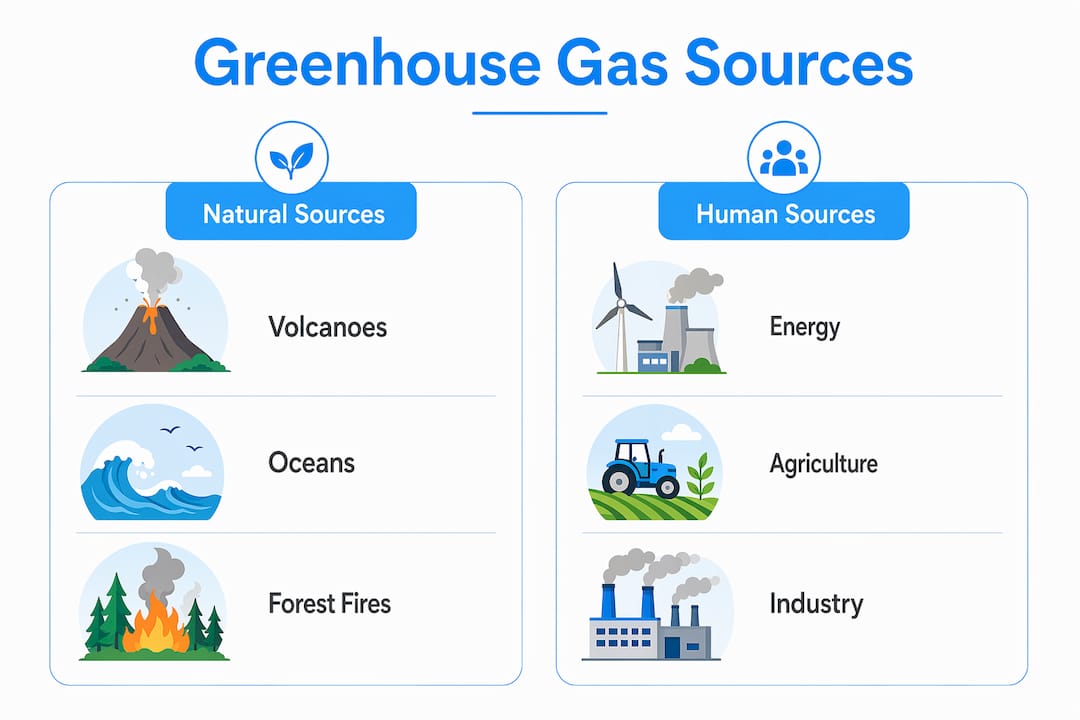
Human activities cause the majority of current climate change through three primary pathways:
- Fossil fuel combustion: Burning coal, oil, and natural gas for electricity, transportation, and heating releases massive amounts of CO2 and methane directly into the atmosphere.
- Deforestation: Trees absorb CO2. When forests are cleared for agriculture or development, that stored carbon releases back into the air, and the planet loses a critical carbon sink.
- Agriculture and industry: Livestock farming produces methane through digestion. Rice paddies, fertilizers, and cement production add nitrous oxide and CO2 to the mix.
Natural factors like volcanic eruptions and variations in solar output do influence Earth’s climate. However, scientists at the IPCC have established that natural forces alone cannot explain the speed or scale of warming observed since the Industrial Revolution. The human fingerprint is clear.
One complicating factor in early climate science was aerosol pollution. Before the 1980s, airborne particulates from industrial smokestacks actually cooled the atmosphere by reflecting sunlight. This effect, once called “inadvertent climate modification,” temporarily masked some warming. As air quality regulations reduced aerosol emissions, the full warming signal became visible. That history explains why some early climate projections underestimated the rate of change.

Pro Tip: When studying causes for your IB ESS exam, organize greenhouse gases by source category: energy, agriculture, land use, and industry. Examiners reward structured, categorized answers over long lists.
How does climate change differ from global warming?
Students often use “global warming” and “climate change” interchangeably. They are related but not identical, and the distinction matters for exam accuracy.
Global warming refers specifically to the rise in Earth’s average surface temperature caused by increased greenhouse gas concentrations. Climate change is the broader term. It includes global warming and also covers changes in precipitation patterns, ocean circulation, sea level, storm intensity, and ecosystem behavior.
Think of it this way:
- Global warming = the temperature signal
- Climate change = all the consequences that follow from that signal, including droughts, floods, coral bleaching, and shifting seasons
The terminology shift from “global warming” to “climate change” happened gradually in scientific literature during the late 20th century. Scientists recognized that focusing only on temperature missed the full picture. A region might not get hotter on average but could still experience severe climate disruption through altered rainfall or more intense hurricanes.
For students and educators, using the correct term in the correct context shows scientific literacy. Writing “global warming causes sea level rise” is technically imprecise. Sea level rise is an effect of climate change, driven partly by thermal expansion of warming oceans and partly by melting ice. The terminology distinction between global warming and climate change is a common exam point in IB ESS, and getting it right earns marks.
What are the observed effects of climate change on ecosystems and people?
The effects of climate change are already measurable across every major Earth system. They are not predictions for a distant future. They are documented observations happening now.
Rising temperatures and extreme weather
Small increases in Earth’s average temperature produce outsized disruptions to weather systems. A useful comparison: a fever of just 2°F impairs human body function significantly. The same principle applies to the planet. Heatwaves grow longer and more intense. Rainfall becomes more extreme in some regions and scarcer in others. Hurricanes draw more energy from warmer ocean surfaces.
Sea level rise and coastal populations
The ocean absorbs about 25% of human-caused CO2 emissions. That absorption causes two problems: ocean warming, which expands water volume, and ocean acidification, which threatens marine food webs. Sea levels are rising as a result of both thermal expansion and melting glaciers. Nearly 40% of the U.S. population lives in coastal counties that face growing flood risk from this rise. That is tens of millions of people whose homes, infrastructure, and livelihoods are directly threatened.
Biodiversity loss
If global warming reaches 2°C above pre-industrial levels, around 10% of land species face critical endangerment. Ecosystems in mountains, coral reefs, and the Arctic are among the most vulnerable. Species that cannot migrate fast enough or adapt to new temperature ranges face extinction. Coral reefs, which support roughly 25% of all marine species, bleach and die when ocean temperatures rise by even 1°C above their tolerance threshold.
| Climate change impact | Affected system | Key consequence |
|---|---|---|
| Rising average temperatures | Atmosphere and land | Longer heatwaves, crop failures |
| Ocean warming and acidification | Marine ecosystems | Coral bleaching, fishery collapse |
| Sea level rise | Coastal zones | Flooding, displacement of populations |
| Altered precipitation | Freshwater systems | Droughts, floods, water scarcity |
| Biodiversity loss | Terrestrial ecosystems | Species extinction, ecosystem collapse |
Tipping points and irreversible change
Tipping points are thresholds in the climate system where a small additional push triggers a self-sustaining, irreversible shift. The collapse of the West Antarctic Ice Sheet is one example. The dieback of the Amazon rainforest is another. Once crossed, these tipping points cannot be reversed on any human timescale, regardless of how aggressively emissions are cut afterward. This is why the urgency of climate action is not alarmism. It is physics.
Pro Tip: For your IB ESS internal assessment, choose a local ecosystem to study rather than a global one. Examiners value specific, measurable data. A local wetland, forest patch, or coastal area gives you concrete evidence to analyze.
How does understanding climate change inform real responses?
Understanding the science of climate change is not just academic. It directly shapes what individuals, governments, and communities can do about it.
The most important insight from current climate science is that every fraction of a degree matters. There is no single catastrophic threshold beyond which everything collapses. Instead, each additional increment of warming makes impacts progressively worse. This means every action that reduces emissions has genuine value, even if it does not “solve” climate change entirely.
Practical responses fall into two categories:
- Mitigation: Reducing the causes of climate change. This includes transitioning to renewable energy, protecting forests, improving energy efficiency, and shifting to plant-based diets. You can read more about sustainable control methods and how they apply in ESS contexts.
- Adaptation: Adjusting to the changes already underway. This includes building seawalls, developing drought-resistant crops, redesigning cities for heat resilience, and creating early warning systems for extreme weather.
For students, understanding how climate change affects sustainability is a core competency in IB ESS. The subject asks you to connect scientific data to human decision-making. That connection is exactly what climate literacy enables.
Clear knowledge of climate terms, causes, and effects also builds the critical thinking skills that IB examiners reward. Students who can distinguish between mitigation and adaptation, or between a tipping point and a feedback loop, write stronger essays and score higher on structured questions.
Key Takeaways
Climate change is a human-driven, long-term shift in Earth’s climate system that causes progressive, measurable harm to ecosystems, coastal populations, and biodiversity with every fraction of a degree of warming.
| Point | Details |
|---|---|
| Core definition | Climate change is the long-term shift in temperatures and weather patterns, primarily caused by human activities. |
| Greenhouse gas drivers | CO2, methane, and nitrous oxide from fossil fuels, deforestation, and agriculture are the main causes. |
| Global warming vs. climate change | Global warming refers to temperature rise only; climate change covers all resulting environmental shifts. |
| Scale of impacts | 40% of the U.S. population faces coastal flood risk; 10% of land species face endangerment at 2°C warming. |
| Tipping points | Irreversible climate thresholds like ice sheet collapse make early action more effective than delayed response. |
Why clarity about climate change is the most urgent lesson I teach
Teaching IB ESS for over 13 years has shown me one consistent pattern: students who understand climate change clearly act more confidently in exams and in life. The students who struggle are not the ones who lack intelligence. They are the ones who have absorbed a vague, emotionally charged version of the topic without a solid scientific foundation.
The data trends are not reassuring. Atmospheric CO2 keeps rising. Tipping points are moving closer. And yet, I find genuine reason for optimism in the students I work with. When a student finally grasps why incremental warming causes progressively worse damage rather than one sudden catastrophe, something shifts. They stop feeling paralyzed and start asking better questions.
My honest view is that the biggest barrier to climate action is not denial. It is vagueness. People who understand the mechanism, the causes, and the specific consequences are far more likely to support meaningful policy and make different personal choices. That is why I insist on precision in every lesson. Knowing the difference between global warming and climate change is not pedantry. It is the foundation of clear thinking.
— Marija
Esstutor can help you master climate change for IB ESS
Climate change is one of the most frequently examined topics in IB ESS, appearing in essays, data-response questions, and internal assessments. Getting the concepts right, and being able to apply them under exam pressure, requires more than reading articles.

Esstutor offers personalized, one-on-one online tutoring for IB ESS students worldwide. With over 13 years of experience as an IB examiner and educator, the sessions are built around what examiners actually look for. Whether you need help structuring your IB ESS internal assessment on a climate-related topic or want to sharpen your exam technique for Paper 2, Esstutor provides focused, expert support. Book a trial lesson and see the difference structured guidance makes.
FAQ
What is climate change in simple terms?
Climate change is the long-term shift in Earth’s average temperatures and weather patterns, caused mainly by human activities like burning fossil fuels and deforestation. It affects rainfall, sea levels, ecosystems, and extreme weather events worldwide.
How is climate change different from global warming?
Global warming refers specifically to the rise in Earth’s surface temperature. Climate change is the broader term that includes global warming plus changes in precipitation, ocean chemistry, sea level, and ecosystem behavior.
What are the biggest effects of climate change?
The major effects include rising sea levels threatening coastal populations, more frequent extreme weather events, ocean acidification, and accelerating biodiversity loss. At 2°C of warming, around 10% of land species face critical endangerment.
Can climate change be reversed?
Some effects, like reduced emissions and reforestation, can slow or partially reverse warming trends. However, tipping points such as ice sheet collapse are irreversible on human timescales once crossed, which is why early action carries far more value than delayed response.
Why is understanding climate change important for IB ESS students?
IB ESS examiners test students on the causes, mechanisms, and impacts of climate change across multiple paper formats. Clear, precise knowledge of the topic, including the distinction between mitigation and adaptation, directly improves exam scores and internal assessment quality.
No Comments