


26 Jun What Is Sustainability? A Clear Guide for Students
TL;DR:
- Sustainability involves balancing environmental health, social justice, and economic vitality for future generations.
- It is guided by the 1987 Brundtland Report definition and the UN Sustainable Development Goals.
Sustainability is defined as meeting the needs of the present without compromising the ability of future generations to meet their own needs. This definition, established by the 1987 Brundtland Report, remains the global benchmark for the concept. Sustainability is not just about protecting forests or reducing plastic. It integrates environmental health, social equity, and economic vitality into one interconnected framework. The UN Sustainable Development Goals, known as the SDGs, translate this framework into 17 specific targets guiding nations and organizations through 2030. Understanding what sustainability means at its core is the first step toward applying it in your studies, your community, and your future career.
What are the three core pillars of sustainability?
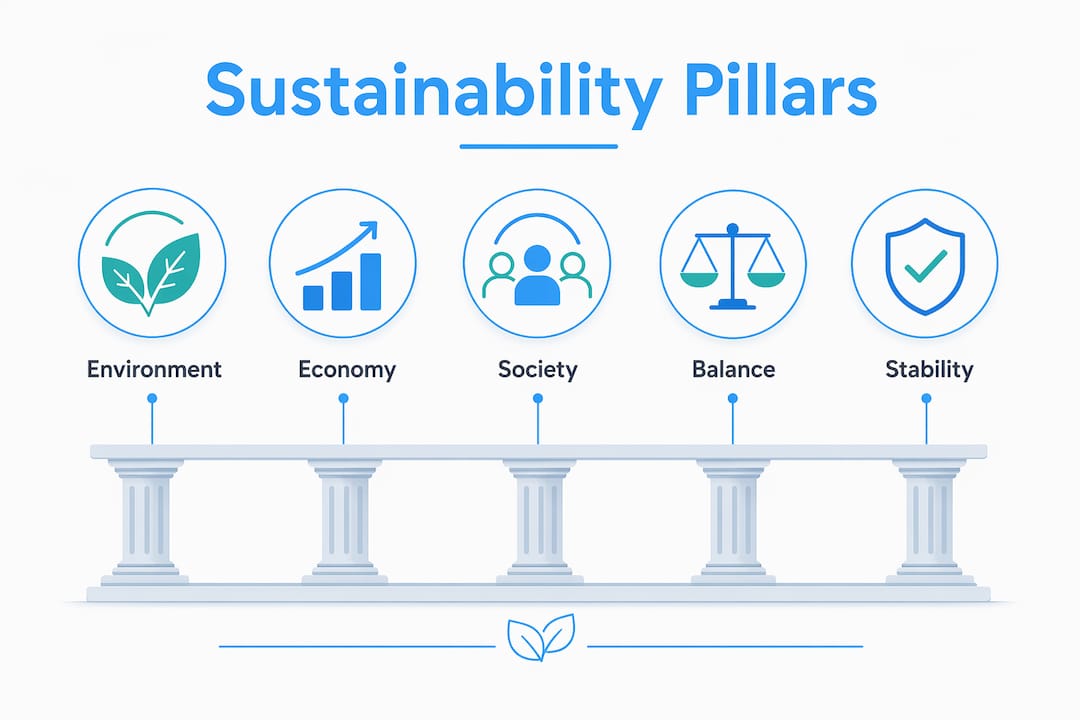
True sustainability requires pursuing environmental, economic, and social factors at the same time. Addressing only one dimension in isolation produces incomplete and often counterproductive results. This balanced approach is called the triple bottom line, and it is the foundation of sustainability education worldwide.

The three pillars work like legs on a stool. Remove one and the whole structure collapses.
| Pillar | Focus | Example |
|---|---|---|
| Environmental | Protecting ecosystems and natural resources | Reducing carbon emissions, preserving biodiversity |
| Social | Ensuring equity, health, and community well-being | Access to clean water, gender equity, education |
| Economic | Supporting long-term financial health and livelihoods | Green jobs, circular economy models, fair trade |
A common misunderstanding is that sustainability is purely an environmental issue. Students often arrive in IB ESS classes thinking sustainability means recycling or saving endangered species. Those actions matter, but sustainability is an interdisciplinary field that integrates environmental health, social justice, and economic prosperity. A city that cleans its air but ignores poverty has not achieved sustainability. All three pillars must advance together.
- Environmental pillar: Focuses on maintaining the natural systems that support life, including clean air, water, soil, and species diversity.
- Social pillar: Addresses human welfare, including access to education, healthcare, gender equity, and community infrastructure.
- Economic pillar: Promotes economic activity that generates long-term value without depleting natural or social capital.
Pro Tip: When you write an IB ESS essay on sustainability, always reference all three pillars. Examiners look for evidence that you understand sustainability as a multidimensional concept, not just an environmental one.
How has the definition of sustainability evolved over time?
The word “sustainability” predates the Brundtland Report by centuries, but the modern definition crystallized in 1987. The World Commission on Environment and Development, chaired by Gro Harlem Brundtland, published Our Common Future. That report gave the world its most widely cited definition of sustainable development.
Professionals use two related but distinct terms. Sustainability refers to the long-term state or goal. Sustainable development refers to the active processes and pathways used to reach that goal. Think of sustainability as the destination and sustainable development as the road. This distinction matters in academic writing and policy discussions.
| Year | Milestone | Significance |
|---|---|---|
| 1987 | Brundtland Report published | Established the foundational definition of sustainable development |
| 1992 | Rio Earth Summit | Launched Agenda 21 and global environmental governance |
| 2000 | UN Millennium Development Goals | Set first global targets linking poverty and environment |
| 2015 | UN SDGs adopted | Replaced MDGs with 17 goals covering all three sustainability pillars |
| 2026 | SDG progress reviews ongoing | Nations report on progress toward 2030 targets |
Understanding this timeline helps you place sustainability concepts in context during exams and internal assessments. The IB student’s guide to sustainability breaks down how these milestones connect to the ESS curriculum specifically.
Key distinctions to remember:
- Sustainability is the goal: a stable, equitable, and thriving world for all generations.
- Sustainable development is the process: policies, technologies, and behaviors that move society toward that goal.
- Frameworks like the UN SDGs and ISO 14001 provide structured pathways for organizations and governments to act.
What role does sustainability reporting play in organizations today?
Sustainability reporting, also called ESG reporting, is the disclosure of an organization’s environmental, social, and governance impacts. ESG reporting goes beyond traditional financial statements to show how an organization manages its effects on people and the planet. By 2026, this type of reporting is used extensively by corporations, governments, and universities to demonstrate accountability and manage long-term risk.
Organizations report on metrics such as carbon footprint, water usage, employee diversity, supply chain ethics, and board governance. These are non-financial indicators, but they carry real financial consequences. A company with a high carbon footprint faces regulatory risk. A company with poor labor practices faces reputational damage. Structured sustainability reporting makes these risks visible and measurable.
Greenwashing is the practice of making misleading sustainability claims without data to back them up. Genuine sustainability reporting avoids greenwashing by adhering to recognized global frameworks such as the Global Reporting Initiative (GRI), the Task Force on Climate-related Financial Disclosures (TCFD), and ISO 20400. These frameworks set standards for what gets measured and how it gets disclosed.
- What good reports include: Carbon emissions data, water and energy consumption, social equity metrics, governance structures, and year-on-year progress.
- What to watch for: Vague language like “eco-friendly” or “green” without supporting data signals greenwashing.
- Why it matters for students: Reading a company’s sustainability report is a real-world skill tested in IB ESS internal assessments and extended essays.
Pro Tip: When analyzing a sustainability report for your IB ESS IA, check whether the organization references a recognized framework like GRI or TCFD. Reports that cite no external standard are far more likely to contain greenwashing.
How does sustainability shape education, policy, and daily life?
Education for Sustainable Development equips learners to make informed decisions that balance environmental integrity, economic viability, and social justice. It is not a separate subject. It is a lens applied across disciplines, from biology and economics to geography and ethics. UNESCO recognizes it as a core component of quality education worldwide.
Policy connects sustainability theory to real-world action. The UN SDGs give governments a shared language and measurable targets. Goal 13 addresses climate action. Goal 6 covers clean water. Goal 10 targets reduced inequalities. These goals do not operate in isolation. Progress on clean water (Goal 6) supports health (Goal 3), which supports economic productivity (Goal 8). The SDGs are designed to reflect the interdependence of all three sustainability pillars.
“Sustainability initiatives must start with people. Addressing interconnected social issues such as poverty, gender equity, and community infrastructure is as critical as protecting the environment.” — Penn State Sustainability
Sustainability in daily life takes many forms. Here are practical ways students and individuals can apply sustainable practices right now:
- Reduce your ecological footprint by choosing public transport, plant-based meals, or secondhand clothing.
- Track your energy use at home and identify where consumption is highest.
- Engage with local policy by attending community meetings or supporting sustainability-focused initiatives.
- Apply sustainability thinking in your studies by connecting course topics to real SDG targets.
- Read corporate sustainability reports to evaluate whether organizations’ claims match their data.
The role of education in sustainability goes beyond classroom knowledge. Students who understand sustainability frameworks are better prepared to contribute to policy debates, evaluate environmental claims, and make decisions that account for long-term consequences. That is a skill set with lifelong value.
Key Takeaways
Sustainability is a multidimensional concept requiring the simultaneous pursuit of environmental health, social equity, and economic vitality, grounded in the 1987 Brundtland Report definition.
| Point | Details |
|---|---|
| Core definition | Sustainability means meeting present needs without compromising future generations’ ability to meet theirs. |
| Three pillars | Environmental, social, and economic factors must all advance together, not in isolation. |
| Sustainability vs. development | Sustainability is the goal; sustainable development is the process used to reach it. |
| ESG reporting | Organizations use structured reporting frameworks like GRI and TCFD to measure and disclose real progress. |
| Education and action | Education for Sustainable Development and the UN SDGs connect theory to individual, community, and policy-level action. |
Why sustainability is more than an environmental buzzword
Students often tell me they came into IB ESS thinking sustainability was mostly about climate change and recycling. I understand why. Those topics dominate headlines. But after years of teaching and examining, I am convinced that the biggest gap in sustainability education is not knowledge of ecosystems. It is the failure to connect environmental issues to social and economic ones.
A student who can explain carbon cycles but cannot explain why poverty makes communities more vulnerable to environmental damage is only seeing part of the picture. Sustainability’s importance comes from its insistence that these dimensions are inseparable. That is not just an academic point. It is the reason why the most effective environmental policies in the world also address housing, income, and access to education.
My honest advice: treat sustainability as a systems thinking exercise. Every time you study an environmental issue, ask who is affected socially and what the economic consequences are. That habit will make your essays stronger, your internal assessments more nuanced, and your understanding of the world far more accurate. The students who score highest in IB ESS are almost always the ones who make those connections naturally.
— Marija
Esstutor can help you master sustainability for IB ESS
Sustainability is one of the most frequently examined concepts in IB ESS, and getting it right requires more than memorizing a definition. You need to apply it across case studies, internal assessments, and essay questions with confidence.

Esstutor offers personalized online tutoring for IB ESS students worldwide, with sessions tailored to your specific needs, whether that is exam preparation, internal assessment support, or building conceptual understanding from the ground up. With over 13 years of experience as an IB examiner and educator, Esstutor knows exactly what examiners look for. If you want expert guidance on your IB ESS internal assessment, a trial lesson is available to get you started. You can also explore ESS exam preparation strategies to build your confidence before exam day.
FAQ
What is the standard definition of sustainability?
Sustainability is defined as meeting the needs of the present without compromising the ability of future generations to meet their own needs. This definition comes from the 1987 Brundtland Report and remains the global standard.
What is environmental sustainability specifically?
Environmental sustainability refers to the protection and maintenance of natural systems, including clean air, water, soil, and biodiversity. It is one of the three pillars of sustainability, alongside social and economic dimensions.
What is sustainability reporting?
Sustainability reporting is the disclosure of an organization’s environmental, social, and governance (ESG) impacts using structured frameworks like GRI or TCFD. It goes beyond financial reporting to show how an organization manages its effects on people and the planet.
How is sustainability different from sustainable development?
Sustainability is the long-term goal of a stable and equitable world. Sustainable development refers to the active processes, policies, and behaviors used to reach that goal. Professionals use these terms distinctly to separate the destination from the path.
How can students apply sustainability in daily life?
Students can reduce their ecological footprint through transport and food choices, engage with local sustainability initiatives, and connect their coursework to the UN SDGs. Education for Sustainable Development builds the skills needed to make these connections across all areas of life.
No Comments