

17 Apr IB ESS IA Structure 2026: Format, Criteria, and Tips
17 Apr How to Structure a High-Scoring ESS IA
Practical work in IB ESS continues to be a central aspect of the ESS course. Practical scheme of work allows students to gain a deeper understanding of the subject content and associated concepts and that provides opportunities to develop a wide range of skills. The practical scheme of work should be broad and balanced to give students the opportunity to experience a wide range of tasks—from closed to open inquiry, and from hands-on experimentation through to the use of cartographic analysis, surveys, and questionnaires—mirroring the diverse skills needed for success and aligning with best practices like those outlined in How to Structure a High-Scoring ESS IA.
Starting in the May 2026 session, the Internal Assessment (IA) of the IB Environmental Systems and Societies (ESS) course will contribute 25% towards the final grade for Standard Level (SL) students and 20% for Higher Level (HL) students. Students are required to conduct an individual investigation into a chosen environmental issue, applying interdisciplinary approaches that encompass both scientific and socio-economic perspectives. This project gives students the opportunity to demonstrate the application of their skills and knowledge in a practical context.
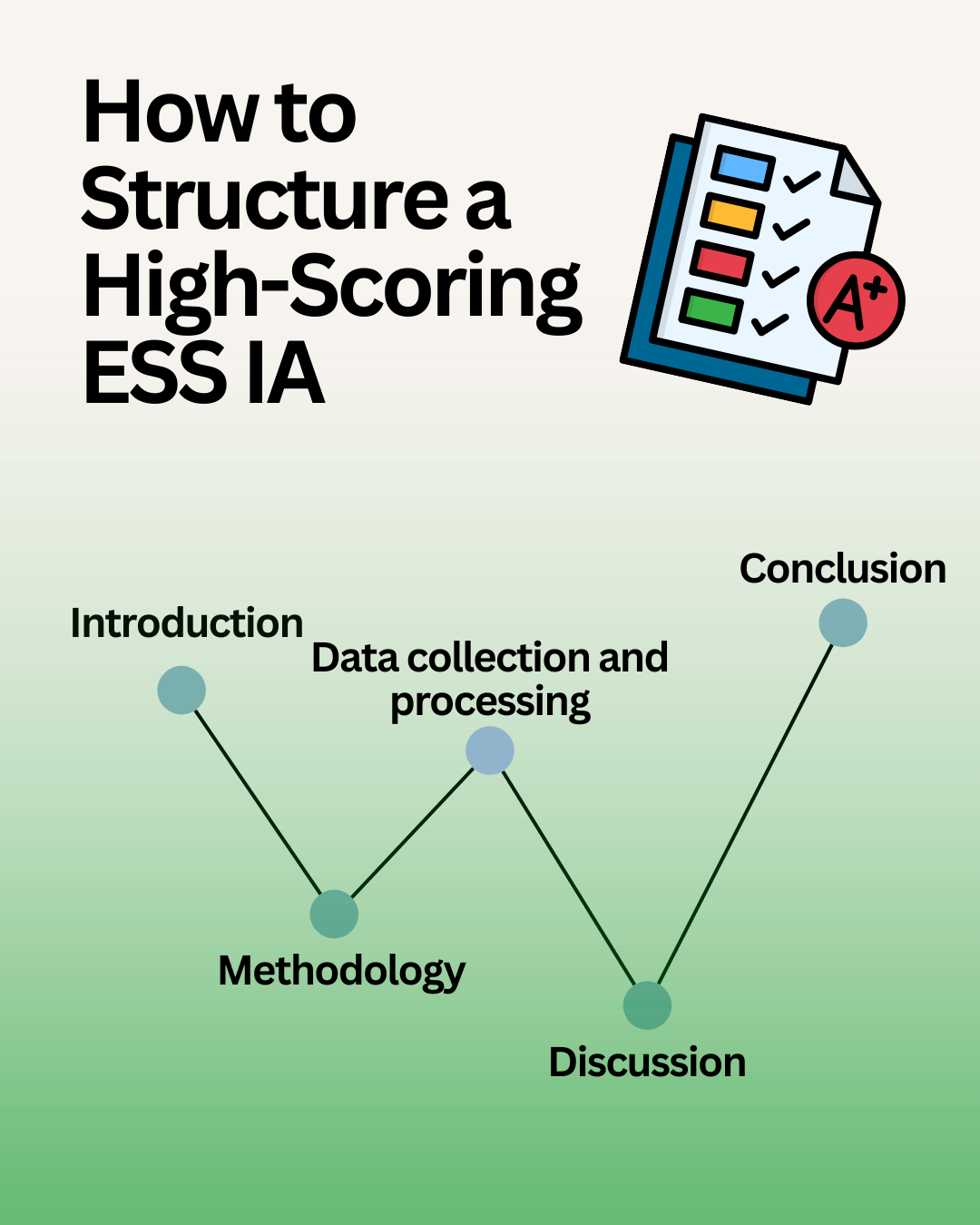
How to Structure a High-Scoring ESS IA
The ESS (Environmental Systems and Societies) Internal Assessment (IA) is a crucial component of your IB assessment. It requires you to demonstrate the scientific inquiry process, focusing on a topic related to environmental systems. Here’s the typical structure you should follow for your ESS IA:
- Introduction
- Methodology
- Data collection and processing
- Discussion
- Conclusion
Read about ESS IA format and structure HERE.
ESS IA Assessment Criteria and Marking Explained
Your ESS IA is marked against six official IB criteria, labeled A through F, for a total of 30 marks. Each section of the structure you follow lines up with specific criteria, so knowing the connection helps you see exactly where marks come from:
- Introduction: links to the criteria assessing your research question and background context.
- Methodology: assessed on how clearly and appropriately you planned your data collection.
- Data collection and processing: marked on accuracy, presentation, and how well you process raw data.
- Discussion: assessed on how well you analyze and interpret your results.
- Conclusion: marked on whether your conclusion is justified by your data and links back to your research question.
Before your introduction even begins, the IB also expects your title, your candidate personal code, the personal codes of any group members, and your word count listed at the start of the report. Your names and school should not appear.
Common Mistakes in ESS IA Structure and How to Avoid Them
Even a well-organized ESS IA can lose marks if the content behind the structure has weak foundations. Here are the mistakes to check for before you submit:
- A research question that isn’t really environmental. A question like “How does air pollution affect breathing?” is a biology question, not an ESS one. Fix it by tying your question directly to an environmental system or issue, not a health outcome.
- A question that only invites a literature review. If your research question can be fully answered by reading existing sources, it won’t satisfy the IA requirement for original data collection. Fix it by rephrasing your question so it demands your own data, such as measurements, surveys, or fieldwork you carry out yourself.
- Sections that drift off-topic. A methodology or discussion that strays from the environmental issue in your research question weakens the whole report. Fix it by rereading your research question before drafting each section and checking that everything ties back to it.
Tips and Strategies for a High-Scoring ESS IA Structure
Once your basic structure is in place, a few strategic choices can push your report from solid to high-scoring:
- Use clear section headings. Label each part of your report so the marker can quickly match your content to the relevant criterion.
- Align your discussion directly to the criteria. Write your discussion so it explicitly interprets your results and ties them back to your research question, rather than simply describing what the data shows.
- Keep your sections in a logical sequence. Following the introduction, methodology, data collection, discussion, and conclusion order makes your reasoning easy to follow and easier to assess.
- Lean on figures and appendices. Charts, diagrams, and data tables don’t count toward your word limit, so use them to present data clearly instead of describing it in dense paragraphs.
For a deeper look at how each criterion maps to your write-up, see this criterion-by-criterion guide to ESS IA structure.
No Comments