


10 Apr Master IB ESS: Succeed with Evidence-Based Strategies
TL;DR:
- IB Environmental Systems and Societies integrates science, social analysis, and ethics, offering dual group credit.
- Success relies on understanding perspectives, systems thinking, and sustainability, not just memorization.
- Practice analyzing data, structuring arguments, and evaluating real-world issues to excel in assessments.
IB Environmental Systems and Societies is not just another science course you tick off your diploma checklist. It is one of the most strategically valuable subjects in the entire IB Diploma Programme, and students who understand that tend to outperform those who treat it like a standard biology or geography class. Offered at both SL and HL, ESS is the only IB course that simultaneously satisfies Group 3 and Group 4 requirements, giving you real scheduling flexibility. This guide walks you through the course structure, core concepts, assessment strategies, and the skills that separate a 5 from a 7.
Table of Contents
- What is IB Environmental Systems and Societies?
- Unifying concepts: Perspectives, systems thinking, and sustainability
- How assessment works: Exams, internal investigations, and HL challenges
- Essential skills for success: Systems, data literacy, and evaluation
- Our perspective: What most IB ESS guides miss about real achievement
- Take the next step with personalized ESS support
- Frequently asked questions
Key Takeaways
| Point | Details |
|---|---|
| Interdisciplinary advantage | ESS combines scientific and societal perspectives, offering IB students flexible diploma pathways. |
| Focus on core concepts | Mastering perspectives, systems, and sustainability is essential for excelling in coursework and exams. |
| Assessment strategy | High scores depend on strong data analysis, structured argumentation, and hands-on research for the IA. |
| Skills over memorization | Developing systems thinking and evaluative skills leads to higher grades and real-world readiness. |
| Benefit of personalized tutoring | Expert online support can address weaknesses, clarify concepts, and give you a competitive exam advantage. |
What is IB Environmental Systems and Societies?
Now that you have a glimpse of why ESS matters, let’s get clear on what the course actually entails.
ESS is an interdisciplinary subject available at both SL and HL, first assessed in 2026. That interdisciplinary label is not just marketing language. It means you are genuinely expected to combine scientific reasoning with social analysis, ethical judgment, and real-world case evaluation, all within the same lesson, essay, or exam paper.
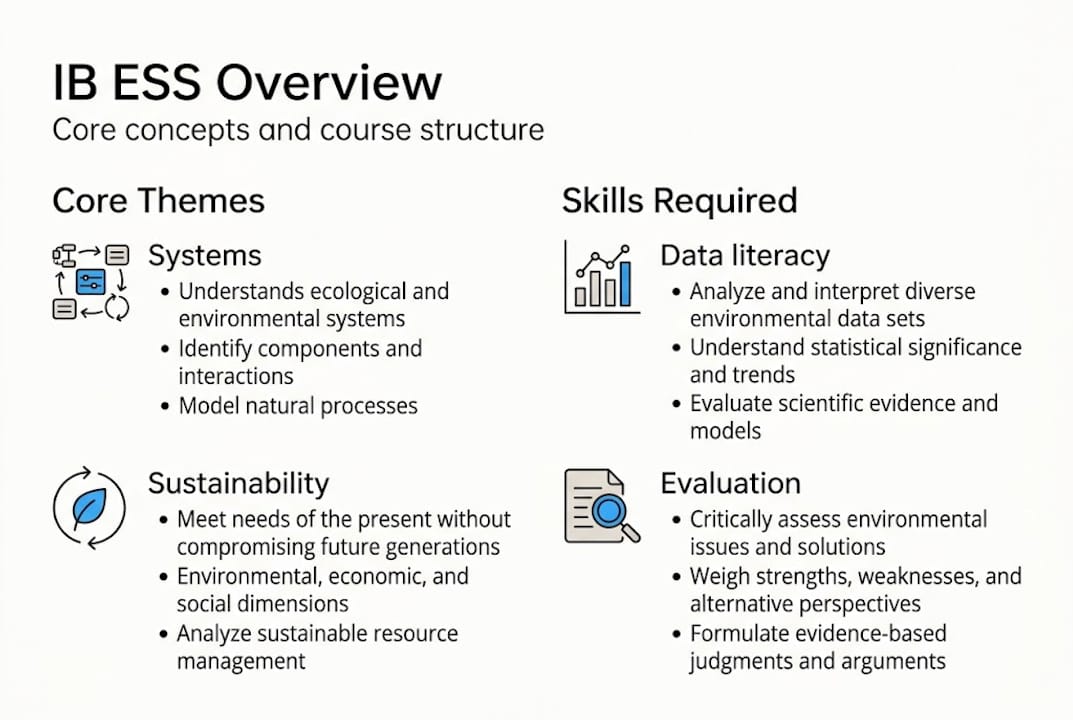
Most IB sciences ask you to master a body of knowledge and apply it in structured ways. ESS asks something different. You need to analyze environmental issues from multiple angles, weigh competing values, and support your conclusions with data. That is a much richer academic challenge, and honestly, a more useful one.
Here is what makes ESS stand out from other diploma courses:
- Dual group credit: ESS counts toward both Group 3 (Individuals and Societies) and Group 4 (Sciences), freeing up space in your subject choices.
- SL and HL pathways: Both levels are available, with HL adding advanced lenses including law, economics, and ethics.
- Application over memorization: Success comes from using knowledge, not just storing it. You will evaluate, argue, and interpret far more than you will recall.
- Real-world relevance: Topics like biodiversity loss, climate policy, and resource management connect directly to global conversations happening right now.
- Flexible assessment: The course blends fieldwork, internal investigation, and written exams, rewarding a range of academic strengths.
If you want to understand what IB ESS covers in more detail, including unit breakdowns and key themes, that resource gives you a solid starting point.
Pro Tip: If you enjoy connecting ideas across disciplines rather than drilling one subject in isolation, ESS will feel like a natural fit. Lean into that strength early.
Unifying concepts: Perspectives, systems thinking, and sustainability
Understanding the course foundation unlocks its real power. Let’s break down what drives ESS learning and assessment.
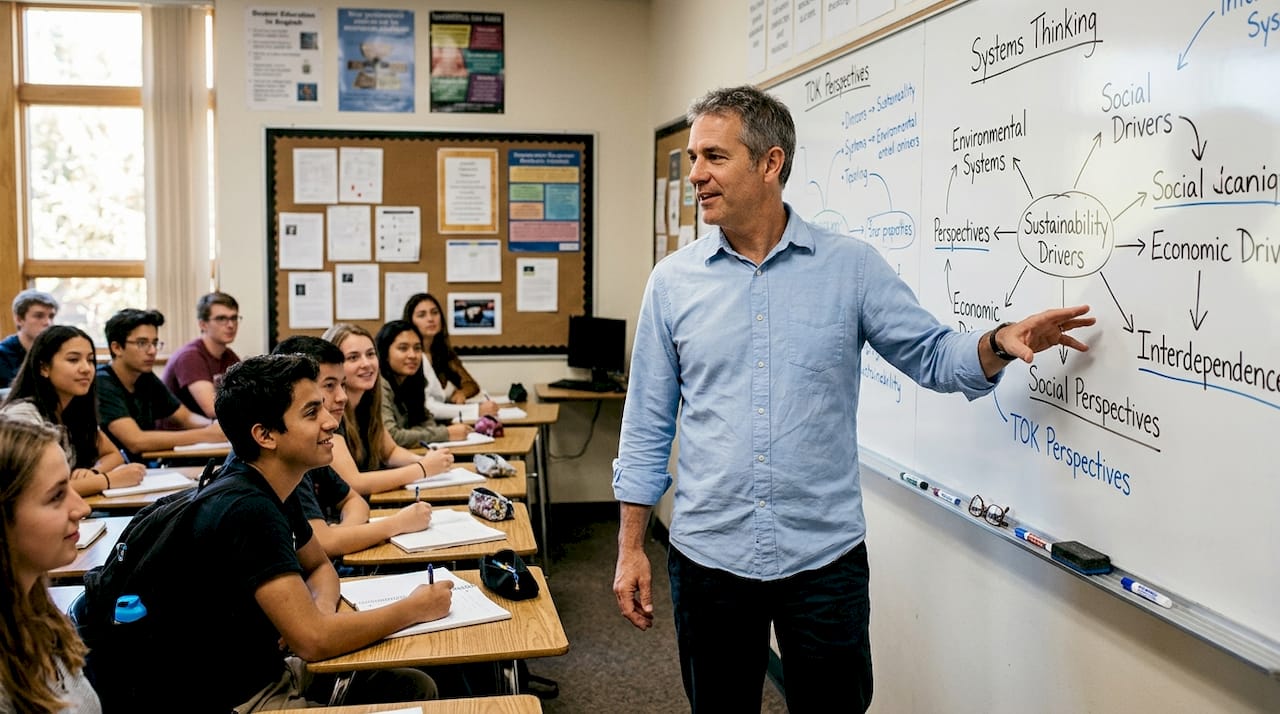
The course is structured around three unifying concepts: perspectives, systems, and sustainability. These are not just background theory. They shape how you approach every unit, every case study, and every exam question.
Perspectives refer to the worldviews people bring to environmental issues. The three main ones you need to know are:
| Perspective | Core belief | Typical policy stance |
|---|---|---|
| Ecocentric | Nature has intrinsic value | Prioritize conservation, limit human interference |
| Anthropocentric | Humans are central, nature serves us | Balance development with responsible stewardship |
| Technocentric | Technology can solve environmental problems | Support innovation-led solutions, trust human ingenuity |
Being able to identify and apply these perspectives in your writing is a skill that examiners reward directly. Do not just name them. Show how they lead to different decisions.
Systems thinking is the analytical framework that ties ESS together. You will learn to map flows, storages, and feedbacks within natural and human systems. For example, understanding how carbon moves through the atmosphere, oceans, and land as a system is more powerful than memorizing isolated facts about CO2.
Sustainability runs through everything. It is the guiding principle behind how ESS evaluates resource use, policy decisions, and environmental trade-offs.
Mastering these three concepts is not optional. They are the lens through which every topic in ESS is examined, and they are the foundation of high-scoring responses.
You can explore core ESS concepts in more depth to see how they connect across different units and assessment tasks.
How assessment works: Exams, internal investigations, and HL challenges
With a solid grasp of the core ideas, it’s time to see how you’ll be challenged and how you can win at assessment.
The ESS assessment model is built around three components. Here is a clear breakdown:
| Component | Weight | Format | Key focus |
|---|---|---|---|
| Paper 1 | 25 to 30% | Case study and data response | Applying concepts to unseen material |
| Paper 2 | 50% | Short and extended responses | Knowledge, argument, and evaluation |
| Internal Assessment (IA) | 20 to 25% | Individual investigation, max 3000 words | Hands-on research and data analysis |
Paper 1 tests your ability to respond to unseen case studies and data, Paper 2 rewards structured argumentation, and the IA is your chance to demonstrate independent research skills.
Here are the key strategies for strong performance across all three:
- Read the command term carefully. Words like “evaluate,” “discuss,” and “explain” require very different responses. Misreading them costs marks.
- Use data explicitly. In Paper 1, always reference figures, units, and trends directly. Vague references to graphs will not score well.
- Structure your arguments. For extended responses, use a clear claim, evidence, and counter-perspective format.
- Start your IA early. The IA advice for top marks is consistent: students who begin planning their investigation early produce stronger, more focused work.
- Practice past papers under timed conditions. Familiarity with the format reduces exam anxiety and improves pacing.
For a step-by-step breakdown of the investigation process, the internal assessment guide is a practical resource. And if you want a broader strategy framework, ESS exam preparation covers timing, revision techniques, and paper-specific tactics.
Pro Tip: Aim to include both a strength and a limitation in every evaluative response. Examiners reward balanced thinking, and it signals genuine analytical skill rather than one-sided argument.
Essential skills for success: Systems, data literacy, and evaluation
Knowing what you’ll be assessed on is crucial, but understanding the toolbox for tackling ESS is where real success starts.
The core methodologies in ESS include systems thinking, environmental value systems, data interpretation, case study analysis, and ethical or socio-political evaluation. Each of these is a learnable skill, not a fixed talent.
Data literacy is where many students lose marks unnecessarily. You need to do more than read a graph. You need to state the trend, quantify it, explain what it means in context, and identify its limitations. That four-step habit alone can lift your Paper 1 scores significantly.
Systems modeling involves drawing or interpreting diagrams that show how components of an environmental system connect. Feedbacks (positive and negative), storages, and flows are the building blocks. Concept mapping is a great study tool here because it forces you to visualize relationships rather than list facts.
Evaluative writing is the skill that separates good students from great ones. ESS builds critical thinking through application over rote learning, and that shows up most clearly in extended essay questions. You need to weigh ethical, social, and political dimensions, not just scientific ones.
Here is a practical process for breaking down exam questions:
- Identify the command term and what it requires.
- Identify the environmental system or issue being addressed.
- Note which perspectives are relevant (ecocentric, anthropocentric, technocentric).
- Gather your evidence, including data, case studies, and examples.
- Write your response with a clear structure: claim, support, counter-view, conclusion.
For a deeper look at how to apply these frameworks, understanding EVS perspectives is a useful starting point. And for exam-specific strategies, ESS exam tips covers the practical moves that push scores into the 6 to 7 range.
Pro Tip: Always acknowledge the limitations of any model or data set you use. Examiners know that real-world systems are messy. Showing that awareness earns you marks that many students leave on the table.
Our perspective: What most IB ESS guides miss about real achievement
You have learned the roadmap. Now here is the real-world wisdom few ESS resources share.
Most students spend the majority of their revision time memorizing content: species names, ecosystem definitions, case study facts. And then they wonder why their exam scores do not reflect all that effort. The truth is that ESS rewards analytical and evaluative skills far more than content recall. You can walk into the exam knowing every detail of the Amazon rainforest and still score a 4 if you cannot structure a balanced argument or interpret unfamiliar data.
What actually moves the needle is consistent practice with real data sets, past paper questions, and honest feedback on your written responses. That is not something a textbook can give you on its own.
Targeted tutoring makes a measurable difference here because it focuses on your specific gaps, not a generic syllabus overview. Understanding the online ESS lesson benefits helps you see why personalized support, especially from someone who knows the examiner’s perspective, accelerates progress in ways that self-study simply cannot match.
Take the next step with personalized ESS support
Ready to go from understanding to action?
If any part of this guide felt familiar because you have been struggling with the same challenges, you are not alone. ESS is a demanding course, and the gap between knowing the content and performing well in exams is real. That is exactly where personalized support makes the biggest difference.

With over 13 years of experience as an IB examiner and ESS educator, I work with students on exactly the skills that matter: data analysis, evaluative writing, IA planning, and exam strategy. Whether you need help with your ESS Extended Essay resources or want structured support across the whole course, online ESS tutoring gives you a clear path forward. Start early, get the right guidance, and give yourself the best chance at a 7.
Frequently asked questions
What makes IB Environmental Systems and Societies unique compared to other IB sciences?
ESS combines scientific and human-centered analysis, fulfills two diploma requirements at once, and builds systems thinking and sustainability skills that no other single IB course delivers. It is first assessed in 2026 at both SL and HL.
How is the ESS Internal Assessment (IA) different from the exams?
The IA is a 20 to 25% coursework component focused on hands-on independent research up to 3000 words, while exams test your ability to respond to data and construct structured arguments under timed conditions.
What topics or skills are hardest for ESS students?
Most students find systems modeling, data evaluation, and balancing ethical or socio-political perspectives most challenging. These core ESS methodologies require consistent practice, not just content review.
Does taking ESS at HL make university applications stronger?
ESS HL adds depth through law, economics, and ethics lenses, and HL adds depth in ways that signal strong interdisciplinary and research skills to university admissions teams, especially for environmental sciences programs.
No Comments