


30 Mar Environmental concepts: your key to IB ESS success
Many IB ESS students spend hours memorizing definitions, species names, and case study facts, only to feel stuck when exam questions ask them to “evaluate” or “discuss.” The truth is, scoring well in IB ESS is not about how much you can recall. It is about how deeply you understand environmental concepts and how confidently you apply them. This guide walks you through the core concepts that matter most, how examiners actually test them, common mistakes even strong students make, and how real-world examples can sharpen both your understanding and your answers.
Table of Contents
- What are core environmental concepts in IB ESS?
- Environmental value systems: perspectives that shape solutions
- How environmental concepts drive assessment success
- Expert nuances and edge cases in environmental concepts
- From theory to practice: real-world application in IB ESS
- How expert support accelerates your IB ESS mastery
- Frequently asked questions
Key Takeaways
| Point | Details |
|---|---|
| Systems thinking is essential | Understanding environmental systems and feedbacks is crucial for top IB ESS marks. |
| Balance your arguments | Using Environmental Value Systems creates stronger, higher-band essays. |
| Real-world cases matter | Applying concepts to global examples like Kiribati impresses examiners and clarifies theory. |
| Command terms drive high scores | Analyzing, evaluating, and discussing using key concepts fulfills assessment criteria. |
| Expert support accelerates learning | Tutoring and strong resources can streamline your path to IB ESS success. |
What are core environmental concepts in IB ESS?
Now that you know why concepts, not just facts, are crucial, let’s define what the key environmental concepts actually are.
In IB ESS, “environmental concepts” refers to the big ideas and frameworks you use to analyze environmental issues. These are not isolated facts. They are lenses. According to the key concepts in environmental systems, understanding these frameworks is what separates a level 4 response from a level 7. The ESS course overview confirms that the subject is built around systems thinking from the very first unit.
Systems thinking views the environment as interconnected systems with flows, storages, inputs, outputs, and feedback loops, which is essential for analyzing complex issues holistically. Here are the core concepts you need to know:
- Open systems: Exchange both matter and energy with their surroundings (e.g., a forest ecosystem)
- Closed systems: Exchange only energy, not matter (e.g., Earth as a whole)
- Isolated systems: Exchange neither matter nor energy (theoretical only)
- Flows and storages: Matter and energy move between stores within a system
- Inputs and outputs: What enters and leaves a system
- Feedback loops: Responses that either amplify (positive) or reduce (negative) change within a system
| Concept | Key feature | Example |
|---|---|---|
| Open system | Exchanges matter and energy | Forest ecosystem |
| Closed system | Exchanges energy only | Earth’s biosphere |
| Positive feedback | Amplifies change | Melting ice reduces albedo, causing more warming |
| Negative feedback | Reduces change | Increased vegetation absorbs more CO2 |
| Flows | Movement of matter/energy | Carbon cycling through atmosphere |
| Storages | Accumulation points | Carbon stored in soil or biomass |
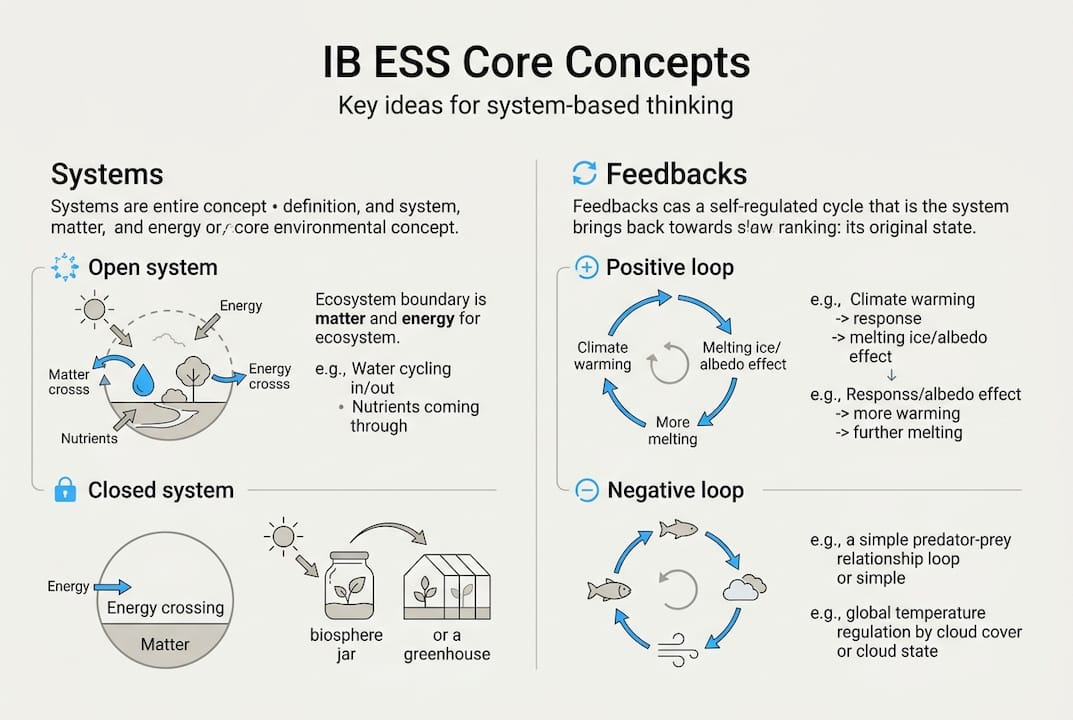
The IB ESS exam guide highlights that systems-based questions appear across all papers, so fluency with these ideas is non-negotiable.
Pro Tip: Even when a question does not explicitly mention “systems,” referencing flows, storages, or feedback loops in your answer signals conceptual depth to the examiner and can push your response into a higher mark band.
Environmental value systems: perspectives that shape solutions
With the most important systems concepts clear, let’s look at how values and perspectives shape ESS arguments and assessments.

An Environmental Value System (EVS) is a worldview or set of beliefs that shapes how a person or group perceives and responds to environmental issues. Understanding EVS is not just background knowledge. It is a tool you use to build balanced, nuanced arguments, especially in Paper 2 essays. Contrasting EVS viewpoints include ecocentric (nature’s intrinsic value), anthropocentric (human benefits first), and technocentric (technology solves problems) perspectives, and students must apply these for balanced arguments.
| EVS | Core belief | Strength | Weakness |
|---|---|---|---|
| Ecocentric | Nature has value beyond human use | Protects biodiversity long-term | May limit economic development |
| Anthropocentric | Environment matters because it serves humans | Practical and widely accepted | Can justify overexploitation |
| Technocentric | Technology can fix environmental problems | Encourages innovation | May delay urgent behavioral change |
Referencing EVS in your responses helps you in several concrete ways:
- It shows the examiner you understand that environmental issues are not just scientific but also social and political
- It allows you to present multiple perspectives without appearing one-sided
- It supports higher-band marks by demonstrating evaluation rather than description
- It strengthens your Internal Assessment when discussing stakeholder perspectives
- It gives structure to Paper 2 extended responses
“Students who reach the top mark bands consistently name and apply specific EVS perspectives rather than vaguely referring to ‘different views.’ Naming ecocentric or technocentric positions and explaining their implications is what separates a good answer from an outstanding one.”
You can also use environmental indicators alongside EVS to show how different value systems prioritize different metrics. For a broader look at applying these ideas, the environmental management guide and ESS success tips are excellent next reads. For a clear breakdown of EVS definitions, the sustainability directory offers a useful reference.
How environmental concepts drive assessment success
Now that EVS perspectives and systems are defined, it’s time to see how these concepts are examined on IB assessments and how to use them for top scores.
Paper 1 focuses on data analysis using case studies and graphs, while Paper 2 requires extended responses with command terms like “evaluate” and “discuss,” and the Internal Assessment involves fieldwork or secondary research with clear methodology and ESS concept application. Here is how conceptual understanding supports each component:
- Paper 1: You analyze data from unfamiliar case studies. Knowing systems concepts helps you interpret graphs showing flows, storages, or feedback effects accurately.
- Paper 2: Extended responses reward students who evaluate using EVS perspectives and connect arguments to systems thinking. Simply describing facts earns low marks.
- Internal Assessment: Your IA needs a clear conceptual framework. Linking your research question to a specific ESS concept (e.g., negative feedback in a local ecosystem) strengthens your methodology section.
The ESS exams overview confirms that command terms like “evaluate” and “discuss” appear in every extended response question. These terms require you to weigh evidence, consider multiple perspectives, and reach a supported conclusion. That is impossible without conceptual grounding.
Pro Tip: Every time you see the command term “discuss” or “evaluate,” plan your answer around at least two EVS perspectives and one systems concept. This structure alone can move your response from a mid-band to a top-band mark.
For targeted preparation, the ESS exam strategies page offers practical techniques, and the ESS Extended Essay guide is essential if you are writing an EE in this subject.
Expert nuances and edge cases in environmental concepts
Beyond the basics, mastering expert subtleties and real-world details gives you the final edge in assessments.
Feedback loops are one of the most commonly misunderstood concepts. A negative feedback loop stabilizes a system. For example, when a predator population grows, prey decreases, which then causes the predator population to fall back. A positive feedback loop amplifies change. Arctic ice melt is a classic example: less ice means less sunlight reflected (lower albedo), which causes more warming, which melts more ice. Many students confuse “positive” with “good” and “negative” with “bad.” They are simply directions of change.
Open versus closed versus isolated systems also trip students up. Earth is often described as a closed system for matter but an open system for energy. That distinction matters in exam answers. Edge cases like these including HL lenses covering environmental law, ethics, and economics, and evaluating model limitations like climate predictions, are exactly what harder exam questions target.
Here are the most frequent expert-level mistakes and how to avoid them:
- Describing feedback loops without stating whether they are positive or negative
- Confusing “closed system” with “isolated system”
- Applying EVS without explaining the implications of each perspective
- Discussing model limitations without naming a specific model (e.g., GLOBIO for biodiversity)
- Using generic case studies instead of specific data points
“The students who score 7s are not necessarily the ones who know the most facts. They are the ones who use precise terminology, name specific models, and acknowledge limitations. That level of critical thinking is what the mark scheme rewards.”
For more on applying these nuances in extended writing, the extended essay nuances page is worth reviewing. The IB ESS Syllabus Guide also outlines exactly which concepts appear at each level.
From theory to practice: real-world application in IB ESS
With advanced concepts and pitfalls addressed, you’re ready to see how these ideas shape real IB answers and, more importantly, real environmental decisions.
Case studies are not just decoration in your answers. They are evidence. Using specific data from real situations shows the examiner you can connect theory to practice. Here are three case studies that illustrate key ESS concepts:
| Case study | Key metric | ESS concept illustrated |
|---|---|---|
| Kiribati (sea level rise) | 1.2 cm average annual land loss | Systems thinking, climate feedback loops, migration as adaptation |
| Data centers (energy use) | Global data centers use ~1% of world electricity | Open systems, energy flows, anthropocentric EVS |
| Biodiversity Intactness Index | MSA metric via GLOBIO model | Model limitations, biodiversity measurement, ecocentric EVS |
Kiribati’s situation involving sea level rise, erosion, and climate migration is one of the most powerful examples of systems thinking applied to a real crisis. The biodiversity intactness study using the MSA metric shows how models quantify ecological change, and also how they have limitations worth discussing in your answers.
Here is how to connect a case study to an exam answer using concepts:
- Identify the ESS concept the question is testing (e.g., feedback loops, EVS, system boundaries)
- Choose a case study where that concept is clearly visible
- State a specific data point or outcome from the case study
- Explain how it illustrates the concept
- Evaluate its implications using at least one EVS perspective
This five-step approach works for both Paper 2 extended responses and IA discussions. For more on applying real-world concepts in ESS, the esstutor.net resource page breaks down each concept with examples you can use directly in your answers.
How expert support accelerates your IB ESS mastery
Mastering environmental concepts takes more than reading notes. It takes practice, feedback, and someone who knows exactly what examiners are looking for. With over 13 years of experience as an IB examiner and educator, I work with students one-on-one to build the conceptual fluency that drives real score improvements.

Whether you need help structuring your IB ESS IA, want to strengthen your Paper 2 essay technique with targeted ESS Paper 2 support, or are looking for reliable IB ESS notes and resources to consolidate your understanding, esstutor.net has you covered. Book a trial lesson today and start building the conceptual confidence that turns good students into top scorers.
Frequently asked questions
What are the main environmental concepts in IB ESS?
Systems thinking, flows, storages, and feedback loops form the foundation, alongside Environmental Value Systems (EVS), which frame how different perspectives approach environmental problems.
How do environmental concepts help in Paper 2 essays?
Contrasting EVS perspectives allow you to build nuanced, balanced arguments that directly respond to command terms like “evaluate” and “discuss,” which are required for top-band marks.
What is an Environmental Value System (EVS) and why does it matter?
EVS represents ecocentric, anthropocentric, and technocentric viewpoints and is essential for understanding how different stakeholders perceive and respond to environmental challenges in both essays and the IA.
Can you give an example of a real-world application of environmental concepts?
Kiribati’s response to sea level rise illustrates systems thinking and climate feedback loops in action, showing how environmental concepts apply directly to real migration and adaptation decisions.
Why did the 2026 IB ESS syllabus change its approach?
The 2026 syllabus prioritizes interdisciplinary skills and real-world application over rote learning, which means conceptual understanding and critical thinking are now more important than ever for exam success.
No Comments