


10 May Understand systems modeling: Key concepts for IB ESS success
TL;DR:
- Systems modeling is a vital skill in IB ESS, enabling students to understand environmental systems through simplified diagrams of stocks, flows, and feedback loops. Clear, well-labeled models demonstrate understanding of system interactions and emergent properties, which are essential for assessments. Focus on clarity and accuracy to effectively analyze environmental issues like climate feedbacks and biogeochemical cycles.
Systems modeling sits at the heart of IB Environmental Systems and Societies, yet so many students treat it as an obstacle rather than a tool. If you’ve stared at a diagram and wondered where to even begin, you’re not alone. The good news is that systems modeling is far more accessible than it looks. Once you understand the basic components, including boundaries, stocks, flows, and feedback loops, you’ll be able to analyze almost any environmental issue clearly and confidently. This guide breaks it all down so you can apply systems modeling directly to your coursework and assessments.
Table of Contents
- What is systems modeling in IB ESS?
- Core components of systems models: Diagrams, stocks, flows, and feedback
- Types of systems modeling approaches: Diagrams and case studies
- How to apply systems modeling in your IB ESS coursework
- Why most students misunderstand systems modeling (and how to get it right)
- Boost your IB ESS modeling skills with expert resources
- Frequently asked questions
Key Takeaways
| Point | Details |
|---|---|
| Clear modeling basics | Systems modeling in IB ESS breaks down complex issues into understandable diagrams, helping you ace assessments. |
| Core components matter | Boundaries, stocks, flows, and feedback loops are crucial for building effective system models. |
| Use real examples | Case studies like Gaia or the carbon cycle deepen your practical understanding. |
| Practical application | Apply step-by-step modeling methods directly to coursework for higher marks. |
What is systems modeling in IB ESS?
Now that you know systems modeling is a core skill, let’s clarify what it actually means for your IB coursework.
In IB ESS, a system is any set of interacting components that form a unified whole. Think of a lake ecosystem, the global atmosphere, or even a city’s waste management cycle. A model is a simplified representation of that system. It highlights the most important parts and relationships without capturing every single detail.
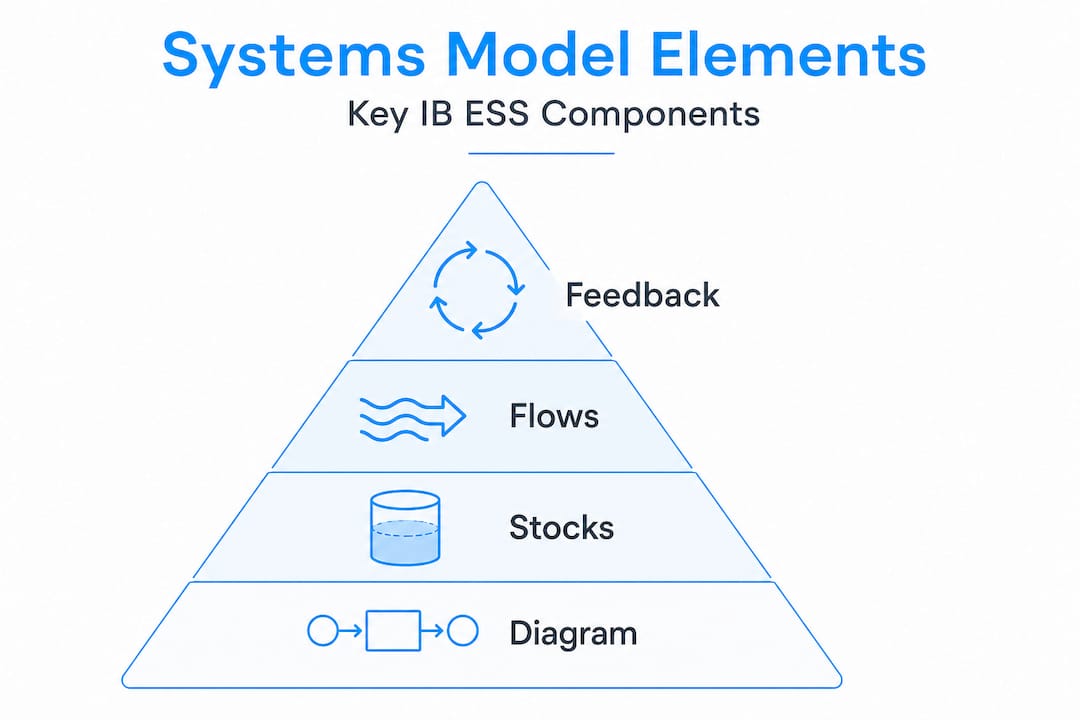
Systems modeling, then, is the process of creating and using these simplified representations to understand how environmental systems work, change, and respond to stress. It’s a foundational skill that appears in your internal assessment, your Paper 1 exam, and your extended essays.
The IB ESS curriculum identifies the following core components you need to know and use:
- Boundaries: The defined limits of a system, separating what is inside from what is outside.
- Stocks: Quantities stored within the system, like carbon stored in biomass or water held in a lake.
- Flows: The movement of matter or energy into or out of stocks, such as evaporation or photosynthesis.
- Feedback loops: Processes where output from a system influences its own input. Positive feedback amplifies change; negative feedback stabilizes the system.
- Emergent properties: Behaviors or characteristics that only appear when components interact, which you wouldn’t predict by looking at each part alone.
It’s also worth knowing the difference between qualitative and quantitative evaluation in systems modeling. Qualitative modeling focuses on the relationships and directions of change without assigning specific numerical values. In IB ESS, most of your modeling work is qualitative. You’re identifying whether a feedback loop accelerates or dampens a process, not calculating exact rates. Understanding why models matter in IB ESS will help you see why this qualitative focus is actually an advantage, not a limitation. Developing your systems thinking for IB ESS is what ties all of this together.
Pro Tip: Keep your diagrams clean and simple. Examiners want to see that you understand the key relationships. A cluttered diagram with every possible detail often scores lower than a clear, well-labeled one that shows the core flows and feedbacks accurately.
Core components of systems models: Diagrams, stocks, flows, and feedback
With the fundamentals defined, let’s explore how each component forms the structure of a system model and why each matters for your understanding and exam performance.

A strong systems model isn’t just a pretty diagram. Each element carries specific meaning and earns you marks when used correctly. Here’s a summary of the key components and what they represent:
| Component | Definition | Example in ESS |
|---|---|---|
| Boundary | The line separating the system from its surroundings | The shoreline defining a lake ecosystem |
| Input | Matter or energy entering the system | Rainfall adding water to a lake |
| Output | Matter or energy leaving the system | Evaporation removing water from a lake |
| Stock | A quantity stored within the system | Water volume in the lake |
| Flow | The rate of transfer between stocks | Liters of water evaporating per day |
| Positive feedback | A loop that amplifies change in the system | Melting ice reducing albedo, causing more warming |
| Negative feedback | A loop that resists or stabilizes change | Increased plant growth absorbing more CO₂ as temperatures rise |
| Emergent property | A property arising from component interactions | Life itself arising from chemical interactions in an ecosystem |
Now let’s look at how to actually build a system diagram step by step. The systems approach for IB ESS exams uses this exact process:
- Choose your system and define its boundary. Decide what you’re modeling (e.g., the carbon cycle in a forest) and draw a clear boundary around it.
- Identify the major stocks. These become labeled boxes in your diagram. For a forest carbon model, your stocks might be atmospheric CO₂, plant biomass, soil carbon, and decomposers.
- Draw the flows between stocks. Use arrows to show direction and label each flow (e.g., “photosynthesis,” “respiration,” “decomposition”).
- Add feedback loops. Look for places where a change in one stock ultimately influences itself. Use curved arrows or annotations to mark whether each loop is positive or negative.
- Identify emergent properties. After mapping the system, ask yourself: what behaviors appear in this system as a whole that you wouldn’t predict from any single component?
A real-world example makes this concrete. In climate systems, melting Arctic sea ice exposes darker ocean water. This darker surface absorbs more solar radiation than reflective ice did, causing further warming and more ice melt. That’s a classic positive feedback loop. The IB ESS curriculum highlights albedo feedback as one of the most discussed examples in assessments, and being able to draw and explain it earns you marks across multiple question types.
Types of systems modeling approaches: Diagrams and case studies
Having identified the building blocks, it’s time to compare major modeling strategies side by side, so you can choose the best approach for your IB tasks.
In IB ESS, you’ll mainly use two modeling approaches: qualitative diagramming and case study analysis. Both appear in exams and the internal assessment. Knowing when to use which one gives you a real advantage.
| Feature | Qualitative diagramming | Case study analysis |
|---|---|---|
| Format | Visual diagram with labeled components | Written or mixed analysis of a real-world example |
| Best for | Showing structure and relationships | Demonstrating real-world application |
| Key strength | Clarity of system logic | Depth of real-world evidence |
| When to use | Paper 1 questions, IA system diagrams | Extended responses, IA investigations |
| Common ESS examples | Carbon cycle, albedo feedback, nutrient cycles | Gaia hypothesis, tropical deforestation, coral bleaching |
According to the MBSE framework, rigorous systems modeling focuses on qualitative evaluation through diagrams and case studies rather than strict empirical benchmarks, which aligns closely with how IB ESS assesses student understanding. This means you don’t need to memorize statistical thresholds. What matters is how clearly and accurately you represent relationships and processes.
The Gaia hypothesis is a brilliant case study for systems modeling. It treats Earth itself as a self-regulating system where living organisms maintain conditions suitable for life through feedback mechanisms. Daisy World, a simplified model within Gaia theory, shows how light and dark daisies regulate planetary temperature through albedo effects. Being able to explain Gaia as a systems model in your own words, with a quick diagram, is the kind of answer that impresses examiners. You can find strong systems modeling case study examples that use exactly this approach.
Pro Tip: When a question asks you to “evaluate” a systems model, use a named real-world example like Gaia or albedo feedback. Named examples show examiners you can connect theory to reality, which is often the difference between a 4 and a 6.
Exploring systems approach for IB ESS exams can help you see how examiners frame systems-based questions and what language they expect in strong responses.
How to apply systems modeling in your IB ESS coursework
You now know the tools and choices. Here’s how to put systems modeling to work to boost your scores and understanding.
Turning a real-world environmental problem into a systems model follows a logical sequence. Here’s the process I recommend to every student I work with:
- Read the question or topic carefully. Identify the environmental issue. Is it pollution, climate change, biodiversity loss? The issue tells you what system you’re working with.
- Define your system boundary. Be deliberate. A boundary that’s too wide makes your model vague. Too narrow and you miss crucial connections.
- List stocks and flows. Before drawing anything, jot down all the stores of matter or energy you can think of. Then identify what connects them.
- Sketch your diagram in draft. Use pencil first. Place stocks as boxes, draw flows as arrows, and label everything clearly.
- Check for feedback loops. Ask: does any output from this system loop back to affect a stock or flow? If yes, label it positive or negative.
- Identify emergent properties. Step back and ask: what does this system as a whole do that its individual parts don’t?
- Annotate and refine. Add brief notes to explain key relationships. Clean up the diagram so it’s easy to read at a glance.
The IB ESS curriculum expects students to apply this kind of thinking across several assessment tasks. Here are the most common ones where systems modeling appears:
- Paper 1 data-based questions: You may be given a diagram and asked to explain or extend it.
- Paper 2 essay questions: Strong essays use systems language to structure arguments about environmental issues.
- Internal assessment: Many IAs require you to describe the system you’re investigating and situate your data within it.
- Extended essays: Systems thinking helps you build a logical structure for complex environmental arguments.
“Students are expected to demonstrate understanding of systems by drawing and labeling diagrams that show boundaries, stocks, flows, and feedback loops, and to evaluate how these components interact to produce emergent properties.” — IB ESS Assessment Guidance
Understanding why models matter in IB ESS gives you the conceptual grounding to approach these tasks with confidence. You can also explore IB ESS example assessments to see exactly how top students have used systems modeling in their own work.
Why most students misunderstand systems modeling (and how to get it right)
With step-by-step strategies in hand, let’s look at what most students and even some teachers often get wrong about systems modeling in IB ESS.
After working with IB ESS students for many years, I’ve noticed a consistent pattern. The students who struggle most aren’t struggling because systems modeling is hard. They’re struggling because they’ve learned to equate complexity with quality. They pack their diagrams with every possible component, every arrow they can think of, every label they’ve seen in their textbook. The result is a diagram that’s impossible to read and even harder to explain.
Here’s the truth: clarity is the skill. A simple, accurate, well-labeled diagram demonstrates far more understanding than a messy one. IB examiners aren’t looking for the most detailed diagram. They’re looking for evidence that you understand which components matter and how they connect.
The second major mistake is ignoring feedback loops and emergent properties. Students often list stocks and flows correctly but then forget to check whether any process circles back to influence the system itself. This is where real understanding lives. A static list of inputs and outputs tells you very little. A feedback loop tells you how the system responds to change, and that’s what environmental science is really about.
For example, when modeling ocean acidification, students typically note that CO₂ dissolves in seawater to form carbonic acid. That’s a good start. But the emergent property here is the disruption of entire marine food webs, something you couldn’t predict from looking at the chemistry alone. Students who capture that level of insight consistently earn top marks.
My practical advice: start small. Pick a simple system like a single pond or a soil carbon store. Build a clear, annotated model of just that one system before you try to connect it to larger global cycles. Then expand outward. Developing your systems thinking strategies progressively like this builds genuine confidence rather than surface familiarity.
Also, always align your model scope with the IB mark scheme. If a question is worth 3 marks, your model needs to show three distinct, accurate relationships. No more, no less. Overcomplicating your answer for a 3-mark question wastes time and risks introducing errors.
Pro Tip: Before any exam or IA submission, practice drawing three core ESS systems from memory: the carbon cycle, the nitrogen cycle, and the hydrological cycle. If you can draw all three cleanly and accurately without notes, systems modeling will feel natural in any assessment context.
Boost your IB ESS modeling skills with expert resources
Ready to transform your understanding of systems modeling into top scores? Access these resources built for IB ESS students like you.

Whether you’re working on your internal assessment or prepping for Paper 1, having the right support makes a real difference. Start with quality IB ESS notes and textbook resources that are aligned with the current IB curriculum and cover systems modeling in depth. If your IA is coming up and you need targeted guidance, our IB ESS IA tutors provide personalized support to help you design, model, and write up your investigation to the highest standard. You can also follow our ESS coursework step-by-step guide to work through every stage of your assessments with confidence. With over 13 years of IB examining and teaching experience behind every session, we’re here to help you succeed.
Frequently asked questions
What is an example of a systems model in IB ESS?
The Gaia hypothesis, climate models, and the carbon cycle are common ESS systems model examples, with qualitative case studies) like albedo feedback appearing frequently in assessments.
How do you draw a simple system diagram for IB ESS?
Identify system boundaries, add boxes for stocks, draw arrows for flows, and use circular arrows for feedback loops, following the IB ESS diagram guidelines.
Why is systems modeling important in ESS assessments?
It helps you visualize complex interactions clearly, and IB examiners specifically look for systems diagram skills across Paper 1, Paper 2, and the internal assessment.
What are emergent properties in systems modeling?
Emergent properties are new behaviors that arise from interactions between system components, as outlined in the IB ESS curriculum, such as ecosystem stability arising from species diversity.
No Comments