


21 May Why Are Ecosystems Important: A Student’s Guide
TL;DR:
- Ecosystems are essential for supporting all life, providing services that sustain food, water, and climate stability.
- Their economic value exceeds $125 trillion annually, highlighting the importance of conservation and system resilience.
- Degradation and collapse threaten biodiversity, climate regulation, and human security, requiring urgent systemic action.
Ecosystems are far more than scenic backdrops for nature documentaries. They are the life-support systems that produce your food, purify your water, stabilize your climate, and even protect your country’s national security. Understanding why are ecosystems important is not just an academic requirement for IB Environmental Systems and Societies (ESS) students. It is foundational knowledge for anyone who wants to understand how the planet actually works. This guide breaks down the science, the economics, and the very real consequences of getting it wrong.
Table of Contents
- Key takeaways
- What ecosystems are and why they matter
- Ecosystem services explained: the four categories
- The economic and ecological value of ecosystems
- What happens when ecosystems collapse
- My perspective on what students get wrong
- How Esstutor can help you master this topic
- FAQ
Key takeaways
| Point | Details |
|---|---|
| Ecosystems support all life | Every organism, including humans, depends on ecosystem functions for food, water, and climate stability. |
| Ecosystem services have real economic value | Global ecosystem services are worth an estimated $125–140 trillion per year. |
| Four service categories matter | Provisioning, regulating, supporting, and cultural services all interact and depend on each other. |
| Degradation creates collapse risk | Losing species reduces functional redundancy, making ecosystems suddenly vulnerable to failure. |
| Students can act on this knowledge | Understanding ecosystems strengthens your IB ESS performance and your capacity to address real environmental challenges. |
What ecosystems are and why they matter
Before we can explore why are ecosystems important, it helps to be clear about what an ecosystem actually is. An ecosystem is a community of living organisms interacting with each other and with their physical environment as a system. That means it includes both biotic components (plants, animals, fungi, microorganisms) and abiotic components (sunlight, temperature, water, soil minerals, and atmospheric gases). Neither part works without the other.
Ecosystems come in an extraordinary range of types. Some of the most studied include:
- Tropical rainforests: High biodiversity, major carbon storage, and significant rainfall generation
- Coral reefs: Cover less than 1% of the ocean floor but support around 25% of all marine species
- Wetlands: Natural water filters that also buffer flood events and store carbon in peat
- Temperate grasslands: Critical for agriculture and home to highly adapted soil communities
- Boreal forests: One of Earth’s largest terrestrial biomes and a major carbon sink
- Open oceans: Drive global nutrient and gas cycles that regulate atmospheric chemistry
What makes ecosystems genuinely complex is their interconnectedness. A change in one component, such as removing a top predator or altering rainfall patterns, can trigger changes throughout the entire system. This is called a trophic cascade, and it can reshape an ecosystem far beyond what anyone initially expected. That interconnectedness is exactly what makes studying ecosystems so rewarding and so challenging at the same time.
Ecosystem services explained: the four categories
One of the most useful frameworks for understanding the role of ecosystems is the concept of ecosystem services. These are the direct and indirect benefits that ecosystems provide to people. There are four recognized categories, and they do not operate in isolation.
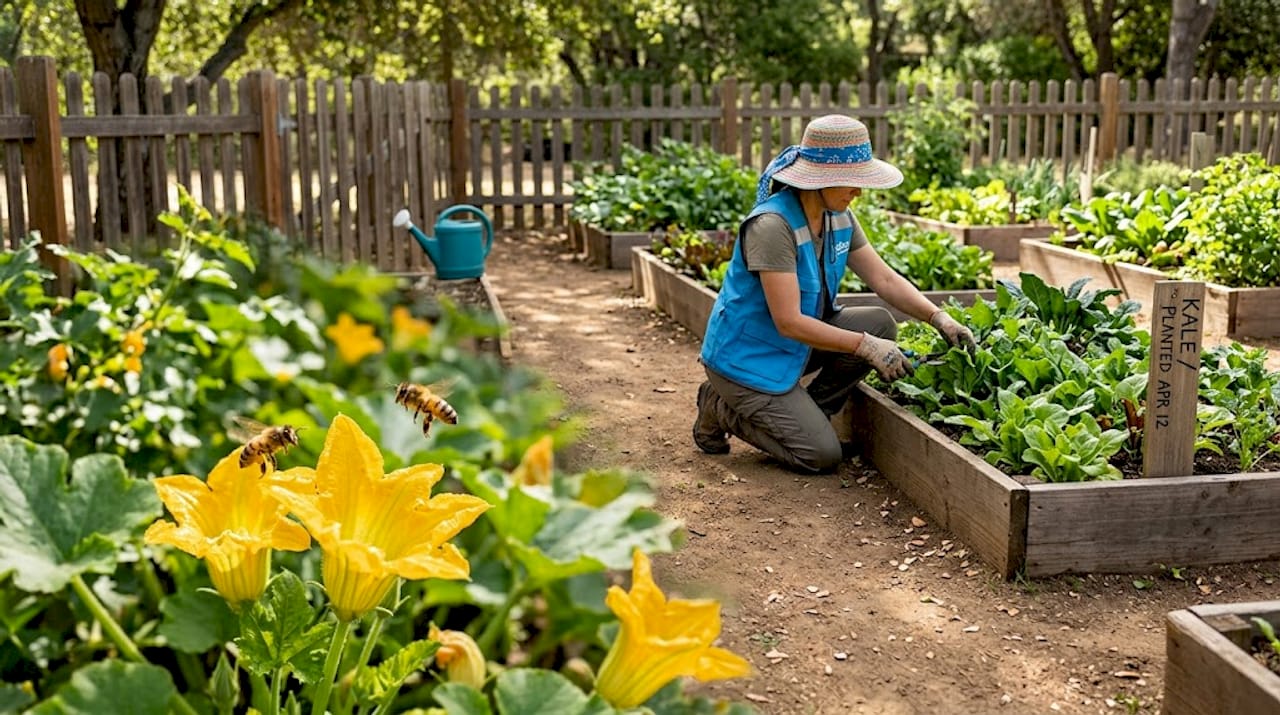
Provisioning services are the products ecosystems supply directly. Food, freshwater, timber, fiber, and medicinal plants all fall into this category. Pollination supports the reproduction of 75% of the world’s leading crops, making it one of the most economically significant provisioning links in the food system.
Regulating services are the ways ecosystems control and moderate environmental conditions. These include climate regulation through carbon sequestration, water purification as runoff filters through wetland soils, pollination by insects and birds, and natural flood protection provided by forests and mangroves. Natural ecosystems perform flood protection, water purification, and climate regulation as standard functions, not bonuses.
Supporting services are the underlying processes that make everything else possible. Nutrient cycling, soil formation, photosynthesis, and water cycling all belong here. Supporting services are foundational because without them, provisioning and regulating services simply cannot exist. They are not visible to most people, but they are the engine beneath every other ecosystem benefit.
Cultural services include the non-material benefits ecosystems provide, such as recreation, spiritual connection, aesthetic value, and inspiration for art and science. Cultural services foster community identity, mental well-being, and creativity in ways that are difficult to price but deeply felt.
These four categories are interdependent. Damage to supporting services, for example through soil degradation, will eventually collapse provisioning services, which will then affect food security, economies, and cultural practices. The cascade moves in one direction and rarely reverses quickly.
Pro Tip: When writing about ecosystem services in your IB ESS internal assessment, always explain the links between categories rather than treating them as separate boxes. Examiners reward students who show systemic thinking.
The economic and ecological value of ecosystems
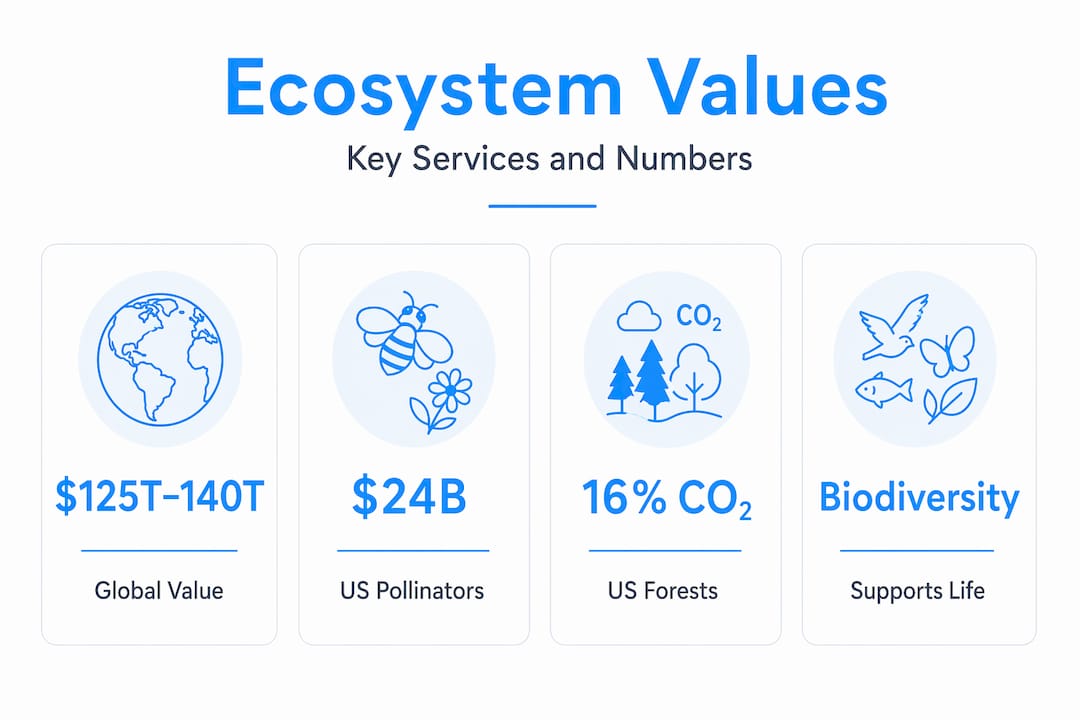
Here is where the numbers become hard to ignore. Ecosystem services contribute an estimated $125 to $140 trillion to the global economy every year. To put that in perspective, the entire global GDP in 2023 was approximately $105 trillion. Nature produces more economic value annually than all human economic activity combined.
| Ecosystem service | Economic value | Source |
|---|---|---|
| Total global ecosystem services | $125–140 trillion/year | Science Times, 2026 |
| U.S. crop pollination by animals | $24 billion/year | CurlewCall, 2025 |
| Native pollinator contribution (U.S.) | Over $9 billion/year | CurlewCall, 2025 |
| U.S. forest carbon sequestration | Over $120 billion/year | CurlewCall, 2025 |
Animal pollinators contribute approximately $24 billion annually to U.S. crop production alone, with native bees and other wild pollinators accounting for over $9 billion of that figure. Understanding pollinator importance at a local level helps explain why a single species like the bumblebee carries such significant weight in a national food system.
U.S. forests tell a similar story. They sequester about 16% of the country’s annual CO2 emissions, a service valued at over $120 billion per year in avoided climate damages. No technology currently exists that can replicate this at scale, and certainly not at zero marginal cost.
The ecological argument is equally strong. When ecosystems function well, they maintain the biodiversity that allows for adaptation to change. Species diversity is not just aesthetically pleasing. It is the mechanism through which ecosystems remain resilient. Undervaluing nature financially drives biodiversity loss and increases systemic risks for the global economy and human well-being. Pricing nature at zero is the most expensive accounting error a society can make.
What happens when ecosystems collapse
Ecosystem degradation is not a slow, distant problem. It is already affecting agriculture, water availability, and geopolitical stability in measurable ways. Understanding the consequences helps you grasp why the value of ecosystems extends far beyond science class.
Ecosystem collapse refers to a sudden, irreversible shift in an ecosystem’s condition that fundamentally impairs its ability to deliver services. Here is what that looks like in practice:
- Trophic cascades: When apex predators are removed, prey populations explode, overgrazing vegetation and destabilizing soil. The reintroduction of wolves to Yellowstone in 1995 reversed this process and restored river banks and forest structure.
- Soil degradation: Soil microorganisms and fungi drive nutrient cycling and soil formation, but intensive agriculture and land clearing destroy these communities, reducing soil fertility for decades.
- Water insecurity: Loss of wetland and forest cover reduces water retention, increases flood severity, and lowers groundwater recharge rates in surrounding regions.
- Biodiversity loss: Negative nature impacts by businesses are estimated at $7.3 trillion, a number that reflects real losses in natural capital and future productive capacity.
There is also a resilience problem that does not get nearly enough attention. Functional redundancy is the safety net of ecosystems. It means that multiple species can perform the same ecological function, so if one disappears, others compensate. But human activity has been stripping out those surplus species for decades, and the safety net is thinning. When it fails, it fails fast.
“Ecosystem collapse includes irreversible shifts impairing essential services like clean water, food, and climate regulation, creating serious national security risks through food scarcity and political instability.” — National security assessment on global ecosystems
Biodiversity loss threatens food production, and no amount of technological innovation fully replaces the services that functioning ecosystems deliver for free. This is not pessimism. It is a call to prioritize biodiversity conservation strategies as a matter of practical urgency.
My perspective on what students get wrong
In my experience teaching IB ESS and working with students preparing for exams, the most common gap is not a lack of information. It is a failure to connect the dots between ecosystem function and real-world consequence. Students can define a trophic cascade and still not truly understand why it matters for a farming community in Kenya or a coastal city in Bangladesh.
What I have found is that two concepts consistently get underestimated. The first is soil biodiversity. Soil biodiversity is foundational to ecosystem stability, yet most conservation conversations focus on charismatic megafauna. The second is functional redundancy. Once students understand that ecosystems have built-in backup systems and that we are dismantling those backups, the urgency of conservation becomes visceral rather than abstract.
I also think students underestimate how much this knowledge empowers them. Ecosystems and climate, biodiversity, food security, and economic stability are not separate topics. They are the same conversation. When you understand why ecosystems matter, you are equipped to analyze almost any environmental issue at a systems level, which is exactly what your IB ESS examiners are looking for.
If you want to strengthen that systems-level thinking, working through ecosystem services concepts with structured support makes a real difference. It is the kind of understanding that lifts scores from a 4 to a 6.
— Marija
How Esstutor can help you master this topic
Are you preparing for your IB ESS exams or working on an internal assessment that touches on ecosystem services or biodiversity? Esstutor offers personalized, one-on-one tutoring sessions designed specifically for IB ESS students at every level.
With over 13 years of experience as an IB examiner and educator, Esstutor helps students not just understand ecosystems but apply that understanding under exam conditions. Whether you need support with your IB ESS IA, essay structure, or past paper practice, each session is tailored to exactly where you are right now. Explore the resources and book your trial lesson today.
FAQ
Why are ecosystems important for human survival?
Ecosystems provide food, clean water, breathable air, and climate stability. Without functioning ecosystems, human civilization cannot sustain itself at its current scale.
What are the four types of ecosystem services?
The four types are provisioning (food, water), regulating (climate, pollination, flood control), supporting (nutrient cycling, soil formation), and cultural (recreation, spiritual value). All four are interdependent.
How much are ecosystem services worth economically?
Global ecosystem services are estimated to contribute $125 to $140 trillion annually, which exceeds the total global GDP and underscores why ecosystem protection is an economic priority, not just an environmental one.
What causes ecosystem collapse?
Ecosystem collapse is triggered by factors such as habitat destruction, species loss, pollution, and climate change. Functional redundancy loss makes ecosystems more vulnerable to sudden, irreversible failure when these pressures accumulate.
How does ecosystem degradation affect climate?
Degraded ecosystems release stored carbon and lose their capacity to regulate temperature and rainfall. Forests alone sequester around 16% of annual U.S. CO2 emissions, so their loss directly accelerates climate change.
No Comments