


20 May The Role of Trial Lessons in IB ESS Tutoring
TL;DR:
- A well-structured IB ESS trial lesson functions as a diagnostic, confidence, and compatibility assessment for students. It includes evaluating current understanding, setting specific goals, and building rapport to ensure effective long-term tutoring. Pricing and preparation significantly influence engagement, with paid trials and clear goal-setting leading to better outcomes and stronger commitments.
Most students and parents assume a trial lesson is simply a free session to “try before you buy.” That assumption costs them. The real role of trial lessons goes much deeper. A well-structured trial is a diagnostic tool, a confidence check, and a compatibility test all at once. For students tackling IB Environmental Systems and Societies, where the coursework spans ecological systems, sustainability models, and rigorous internal assessments, finding the right tutor fit from day one can genuinely change your final score. This article breaks down exactly what trial lessons do, why they matter, and how to get the most out of one.
Table of Contents
- Key takeaways
- What trial lessons actually are
- Benefits of trial lessons for students and parents
- Trial lesson pricing and what it signals
- How to get the most from a trial lesson
- My take on what trial lessons reveal
- Start your IB ESS tutoring with a structured trial
- FAQ
Key takeaways
| Point | Details |
|---|---|
| Trials are diagnostic tools | A good trial lesson identifies learning gaps and sets measurable goals for IB ESS progress. |
| Fit matters as much as knowledge | Compatibility between student and tutor directly affects confidence and long-term academic results. |
| Pricing signals commitment | Low-cost trials reduce no-shows and reflect the professional value of the tutoring relationship. |
| Preparation multiplies value | Students who arrive with clear goals and questions get far more from a trial session. |
| Follow-up is where decisions live | Evaluating the trial thoughtfully helps families commit to tutoring with real confidence. |
What trial lessons actually are
Many people treat a trial lesson like a product sample. It is not. A trial teaching session in the context of IB ESS tutoring is a structured first meeting with a clear purpose: to assess where you are, figure out where you need to go, and determine whether this tutor can actually get you there.
A well-conducted trial includes three core components. First, a diagnostic assessment to understand your current level. In IB ESS, that might mean reviewing how well you understand ecosystem concepts, where your Internal Assessment planning stands, or how you approach past paper questions. Second, the session should involve goal-setting. Not vague goals like “do better on exams,” but specific targets tied to IB ESS requirements, such as improving your Paper 2 structured essay responses or strengthening your understanding of systems diagrams and energy flows. Third, a good trial builds rapport. You need to feel comfortable asking questions, admitting confusion, and pushing back when something is unclear.
Here is what a trial lesson in IB ESS tutoring typically covers:
- A review of your current grades, predicted scores, and specific subjects of concern within the ESS syllabus
- A short task or discussion to gauge your conceptual understanding and analytical thinking
- A conversation about your learning style and what has or has not worked for you in school
- Initial goal-setting aligned with upcoming exams or internal assessments
- A preview of how the tutor structures sessions and explains complex environmental topics
Pro Tip: Before the trial, write down the two or three IB ESS topics you find most confusing. Bringing a specific example, like struggling with the differences between natural capital and natural income, gives the tutor immediate context and makes the session far more productive.
Benefits of trial lessons for students and parents
The importance of trial lessons becomes clearest when you look at what students walk away with after a good one. For IB ESS students specifically, the benefits are not generic. They are tied directly to the demands of a course that is interdisciplinary and cognitively demanding in ways that standard science or humanities courses are not.
The first benefit is personalization. IB ESS draws on biology, geography, chemistry, and social science simultaneously. A trial lesson reveals which of those areas is your weak point so the tutor can prioritize accordingly. One student might need help with the quantitative ecology sections. Another might struggle with the systems thinking framework that runs throughout IB ESS objectives. The trial makes that visible immediately.
The second benefit is confidence. Many IB ESS students arrive at tutoring feeling anxious and uncertain about whether they can actually pass. A trial lesson that produces one clear moment of understanding, where something clicks that never clicked in class, changes that. Positive impressions from trials increase motivation and long-term commitment to study.

For parents, the trial lesson serves a different but equally important purpose. It gives you a chance to observe the teaching style firsthand, ask about the tutor’s experience with IB examinations and internal assessments, and assess whether the approach matches your child’s personality and learning pace.
Additional benefits worth noting:
- Students reduce exam anxiety by becoming familiar with the tutor’s style before high-stakes sessions begin
- Parents gain early insight into how progress will be tracked and communicated
- Both parties can align on realistic expectations for score improvement and study frequency
- Students preparing for IB ESS challenges get an honest picture of the work ahead without feeling overwhelmed
Pro Tip: If you are a parent sitting in on the trial, resist the urge to answer for your child. Watch how the tutor responds when your child is uncertain or slow to answer. That reaction tells you everything about how the tutor handles frustration and confusion.
Trial lesson pricing and what it signals
The pricing structure of a trial lesson is not just an administrative detail. It shapes behavior on both sides of the tutoring relationship. Trial lessons are used by hundreds of educational institutions to improve conversion rates and long-term retention, but the way they are priced dramatically affects the quality of engagement.
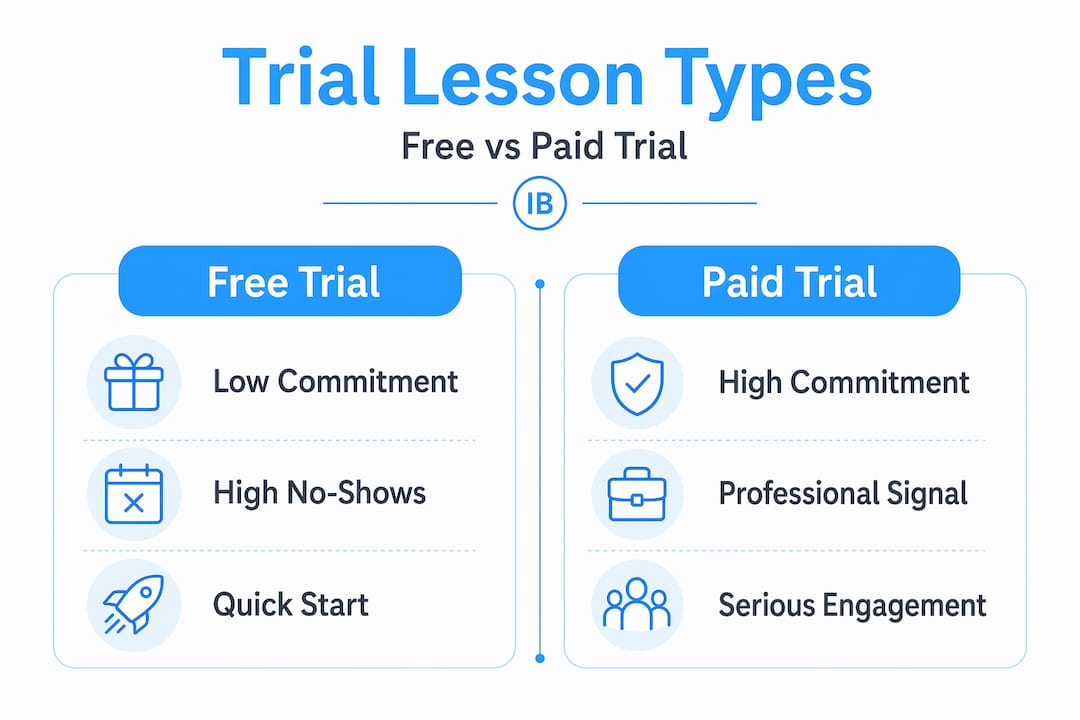
Here is a comparison of the three most common trial lesson formats and how they affect students, parents, and tutors:
| Format | Student commitment | Perceived value | No-show risk | Best for |
|---|---|---|---|---|
| Free trial | Low initial barrier | Can feel low-value | High | Broad outreach and first contact |
| Discounted trial | Moderate commitment | Balanced accessibility | Moderate | Families evaluating multiple tutors |
| Full-price trial | High commitment | Professional and serious | Low | Students ready to commit quickly |
Charging a nominal fee reduces no-shows and increases the perceived professionalism of the tutoring relationship. When a student pays something upfront, even a small amount, they are more likely to prepare, show up on time, and engage seriously during the session. That attitude directly affects trial lesson effectiveness.
From a practical standpoint, a discounted or nominally priced trial is often the strongest signal of a tutor who values their work appropriately. Free trials can inadvertently suggest a lack of confidence in the service. For IB ESS tutoring specifically, where the tutor’s depth of knowledge about internal assessments, exam markschemes, and IB ESS objectives should be substantial, a professional pricing structure matches the professional standard you are paying for.
The follow-up after the trial matters just as much as the session itself. A good tutoring platform or tutor will send a summary of what was covered, what gaps were identified, and a suggested plan for moving forward. Effective follow-up workflows significantly improve conversion from trial to regular tutoring.
How to get the most from a trial lesson
Knowing the role of introductory lessons is useful. Knowing how to act on that knowledge is what produces results. Here is a step-by-step approach to making your trial lesson count, whether you are the student or the parent coordinating the process.
Set your goals before the session. Decide what you want from tutoring overall. Are you aiming for a 6 or 7? Do you need support with the Internal Assessment specifically? Is your Paper 1 short-answer technique the problem? Knowing your answer before the trial means the session starts at a practical level rather than a general one.
Clarify what the trial will include. Failing to set clear expectations before the trial is one of the most common mistakes families make. Some tutors use the trial purely for assessment. Others will teach actual content. Knowing which to expect helps you prepare appropriately.
Bring a real problem to solve. Arrive with a past paper question you have attempted but got wrong, or a section of the ESS syllabus you genuinely do not understand. Watching how the tutor explains it to you live is the most direct way to evaluate their teaching quality.
Observe the tutor’s responsiveness. Does the tutor check in when you look confused? Do they adjust their explanation if the first one does not land? Professionalism during a trial reliably predicts the quality of every session that follows.
Evaluate the session afterward with a clear head. Ask yourself: Did I understand something I did not understand before? Did I feel heard and supported? Could I see myself working with this person through stressful exam preparation? If the answer to all three is yes, you have found a good match.
Pro Tip: After the trial, write three sentences summarizing what you learned, one concern you still have, and one thing the tutor did particularly well. That exercise forces a real evaluation rather than a vague gut feeling.
My take on what trial lessons reveal
I have worked with IB ESS students for over 13 years, and I will tell you honestly: the trial lesson is where I learn the most. Not just about the student’s knowledge gaps, but about how they think, how they respond to challenge, and what kind of encouragement actually reaches them.
What surprises many families is how much the trial reveals about the student’s relationship with the subject itself. Some students who score average in class are genuinely curious about environmental systems. They just need someone to organize their thinking. Others have disconnected emotionally from the material and need a different approach entirely before any content instruction can take hold. I can see that within the first 20 minutes of a trial.
The sessions I value most are the ones where the student pushes back. When a student says “that explanation does not make sense to me,” that is not a problem. That is the most useful data point of the entire session. It tells me exactly how to teach them going forward.
One thing I would encourage every parent to resist is the pressure to convert a trial into a regular booking on the same day. Take a breath. Review what happened. Talk to your child about how they felt. The impact of trial lessons becomes clear when you give yourself 24 hours to reflect before committing. In my experience, the families who make that choice end up more committed and more consistent throughout the tutoring relationship.
— Marija
Start your IB ESS tutoring with a structured trial
If you are looking for a clear, low-pressure way to begin IB ESS tutoring, Esstutor offers trial lessons designed to do exactly what this article describes: assess your current level, identify your focus areas, and give you a concrete plan for improvement.
At Esstutor, every trial session is run by a tutor with over 13 years of IB teaching and examining experience. The session covers your specific syllabus gaps, your Internal Assessment timeline, and your exam preparation needs. You leave with a clear picture of where you stand and what comes next. For students also working on extended essays, you can explore ESS extended essay guidance as part of your tutoring plan. Book a trial and find out what focused, personalized IB ESS tutoring feels like from the very first session.
FAQ
What is the role of trial lessons in IB ESS tutoring?
Trial lessons serve as a diagnostic and compatibility check. They identify your learning gaps, establish academic goals, and help you decide whether the tutor’s style matches your needs before you commit to regular sessions.
Should a trial lesson include actual teaching or just assessment?
It depends on the tutor’s structure, so ask in advance. The most effective trial lessons include both: a brief diagnostic to understand your level and at least one real teaching moment to show you how the tutor explains IB ESS concepts.
How do I know if the trial lesson was worth it?
Ask yourself whether you understood something new by the end and whether you felt comfortable with the tutor’s approach. Trial lessons that motivate students tend to produce stronger long-term attendance and results.
Is a paid trial lesson better than a free one?
A low-cost trial typically leads to more serious engagement from both student and tutor. Free trials lower the barrier to entry but can reduce commitment and preparation on the student’s side.
What should I bring to an IB ESS trial lesson?
Bring a specific topic or past paper question you are struggling with, your current grade or predicted score, and a clear idea of your upcoming deadlines, such as your Internal Assessment submission date or next exam sitting.
No Comments