


22 May What Is a System Model in ESS: Your IB Guide
TL;DR:
- A system model in IB ESS is a simplified representation of environmental systems used to understand processes and predict responses to change. It helps analyze complex interactions, visualize flows, and identify feedback mechanisms, despite involving necessary assumptions and limitations. Effective use of models in exams and assessments requires justifying their purpose, assumptions, and scope to demonstrate systems thinking skills.
If you’ve just started IB ESS and heard the term “system model,” you might think it means building a perfect, accurate replica of nature. It doesn’t. A system model in ESS is a simplified version of reality used to represent how a system works and predict how it responds to change. That distinction matters more than it sounds. Once you understand what a model actually is, and what it isn’t, you’ll find that system modeling becomes one of the most useful thinking tools in your entire IB ESS course.
Table of Contents
- Key takeaways
- What is a system model in ESS
- Why models matter in ESS
- Common ESS system model examples
- How to use system models in assessments and exams
- My perspective on teaching system models in ESS
- Ready to master ESS system models with expert support?
- FAQ
Key takeaways
| Point | Details |
|---|---|
| Models simplify, not replicate | A system model represents reality in a simplified way to make complex systems easier to study and predict. |
| Systems have distinct types | Open, closed, and isolated systems differ by what they exchange with their surroundings: matter, energy, or neither. |
| Multiple model forms exist | ESS uses diagrams, simulations, mathematical models, and physical models depending on the system being studied. |
| Limitations are expected | All models involve assumptions and simplifications. Knowing those limits is part of using models correctly. |
| Exam strategy matters | Justifying your model’s simplifications in assessments is more valuable than trying to make it exhaustive. |
What is a system model in ESS
Before you can understand a model, you need to understand what a system is. In ESS, a system is a set of interacting components that form a unified whole, with defined boundaries and identifiable inputs, outputs, and flows of energy or matter. Your school garden is a system. The global carbon cycle is a system. So is a single coral reef.
System boundaries define what type of system you are dealing with and what kinds of exchanges happen across that boundary. Open systems exchange both energy and matter with their surroundings. A forest ecosystem is a good example: it receives sunlight and rainfall, and it loses heat and water through evaporation. Closed systems exchange energy but not matter. Isolated systems exchange neither, and the cosmos as a whole is the closest example we have.
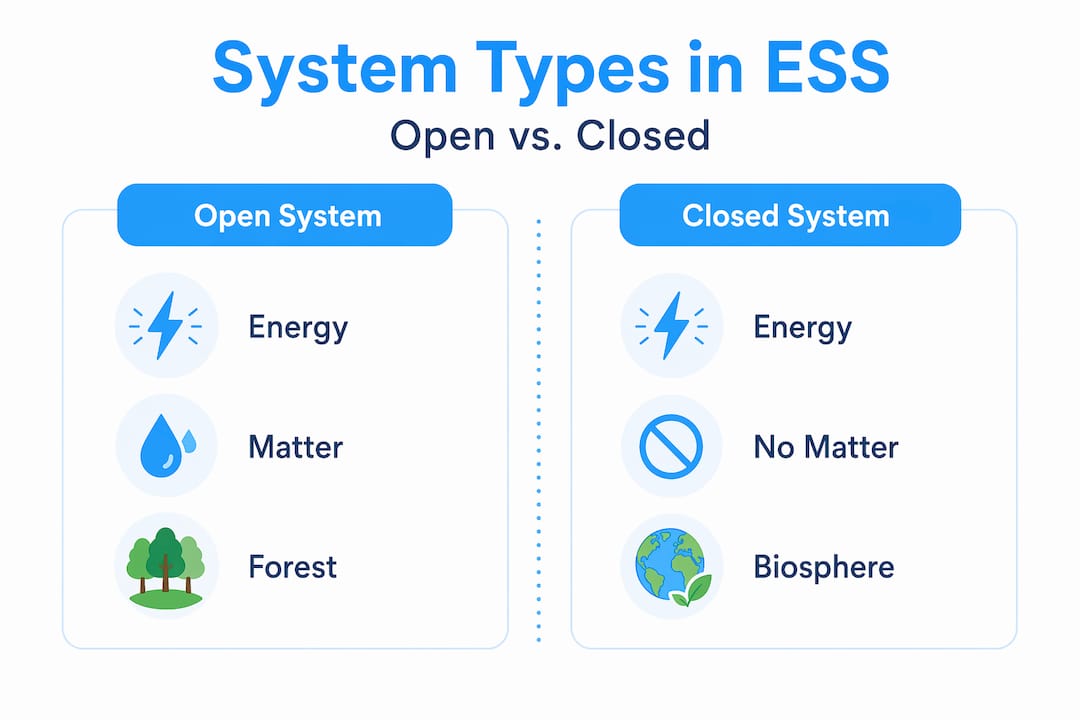
A system model is then a simplified representation of that system. Models take many forms in ESS: diagrams, graphs, simulations, mathematical equations, or even written descriptions. Each form serves a different purpose depending on what part of the system you’re trying to understand.
| System type | Exchange with surroundings | ESS example |
|---|---|---|
| Open system | Energy and matter | Forest ecosystem, lake, human body |
| Closed system | Energy only | Global water cycle (approximation) |
| Isolated system | Neither | The universe (theoretical) |
| Diagrammatic model | Visual | Energy flow diagram, food web |
| Computer simulation | Digital | Climate change projection model |
Understanding these distinctions is not just background knowledge. They appear directly in ESS exam questions and form the foundation of systems thinking in ESS.
Why models matter in ESS
Models are not decorative. They do real work. Here is why they are so central to ESS learning and analysis:
- They simplify complexity. Real environmental systems involve thousands of interacting variables. A model reduces that to the most relevant components so you can actually analyze what’s happening without losing the overall picture.
- They allow prediction. Models let you change system inputs hypothetically to observe effects without waiting for real-world events. Want to know what happens to a lake ecosystem if phosphate levels triple? A model can show you without polluting a real lake.
- They reveal feedback loops. Models are particularly useful for showing how positive and negative feedback mechanisms drive system behavior, something you cannot easily see just by observing nature directly.
- They support resilience and stability analysis. By pushing model inputs to extremes, you can identify tipping points and thresholds in systems like fisheries or atmospheric CO₂ levels.
That said, every model has limitations. All models involve simplification and approximation, which means predictions are only as good as the model’s design and the quality of data going into it. Even the most powerful climate models running on supercomputers still simplify many Earth processes because of computational limits.
Pro Tip: When evaluating any model in ESS, ask yourself two questions: What has been left out? And does leaving it out affect the core conclusion? If you can answer those clearly, you’re already thinking like an IB examiner.
Common ESS system model examples
One reason students struggle with system modeling in ESS is that models feel abstract until you see concrete examples. Let’s fix that.

Physical models are the most intuitive. A child’s toy model of a rainforest with plastic trees and a spray bottle for rain is technically a physical model. It captures structure but cannot reproduce nutrient cycling or canopy temperature gradients. Simple, yes. But it helps younger learners build mental frameworks.
Diagrammatic models are the ones you’ll use most in IB ESS. Energy flow diagrams, nutrient cycle diagrams, and systems diagrams with boxes and arrows fall into this category. They show how components connect and where flows move through a system. Your food web for a grassland ecosystem is a diagrammatic model.
Computer simulation models operate at a different scale entirely. Weather forecasting models update hourly based on real-time data. Climate change projections run on supercomputers and model decades of atmospheric and oceanic behavior. AI models now integrate multi-type Earth system data to improve predictions even when some input data is incomplete, showing how rapidly model technology is evolving.
The most intellectually rich example for IB ESS is the Daisyworld model, part of James Lovelock’s Gaia hypothesis. Daisyworld demonstrates emergent properties by showing how interactions between living organisms (black and white daisies) and their non-living environment produce stable temperature regulation through feedback loops. No single component controls the temperature. The stability emerges from the system as a whole. That is a powerful concept for understanding real-world Earth systems.
| Model type | Complexity level | Typical application in ESS |
|---|---|---|
| Physical model | Low | Visualizing structure of ecosystems |
| Diagrammatic model | Low to medium | Nutrient cycles, energy flow, food webs |
| Mathematical model | Medium to high | Population dynamics, carbon budgets |
| Computer simulation | High | Climate change, weather forecasting |
| Daisyworld model | Medium | Emergent properties, feedback, Gaia hypothesis |
If you want a deeper walkthrough of how these examples connect to IB ESS assessment criteria, Esstutor’s guide on why models matter breaks it down topic by topic.
How to use system models in assessments and exams
Knowing what a model is means very little if you cannot apply that knowledge under exam conditions. Here is how to use system models effectively in IB ESS coursework and exams.
In exam answers, the most common mistake students make is describing a model without evaluating it. An examiner marking a top-band response wants to see that you understand both what the model shows and what it leaves out. Mention the model type, identify its key assumptions, and explain whether those assumptions affect the validity of its outputs.
- Identify the type of system being modeled (open, closed, isolated).
- State what the model includes and what it excludes.
- Explain the direction of flows: energy, matter, or both.
- Evaluate the model’s usefulness given its purpose.
- Connect model outputs to real-world environmental consequences.
In your Internal Assessment, system models can appear in your methodology or your analysis. If you are investigating soil nutrient levels across land uses, for example, you might reference a nutrient cycling model to frame your hypothesis and then compare your field data against model predictions. That comparison is where strong analysis lives.
Justifying model simplifications in assessment work is genuinely important. You do not need a perfect model. You need an appropriate one, and you need to explain why it is appropriate. That is a very different standard, and once you internalize it, writing about models in exams becomes much less stressful.
Pro Tip: In your IA or exam answers, always state one specific limitation of the model you are using and explain why that limitation does not undermine your core argument. This single habit can push your response into the top mark band.
For more detailed strategies on meeting the IB ESS assessment criteria, check out Esstutor’s step-by-step IA guide.
My perspective on teaching system models in ESS
I’ve taught IB ESS for over 13 years, and I can tell you that system models are where students either start thinking like environmental scientists or stay stuck memorizing facts. The difference is real, and it shows up in exam scores.
The most common misconception I see is students believing that a “better” model is always a more detailed one. That is not true in ESS, and it is not true in real science either. A model is only as good as its fitness for purpose. A simple nutrient cycle diagram drawn by hand can earn full marks if it correctly identifies flows, stores, and feedback. A sprawling 20-component simulation that confuses the examiner will not.
What I’ve learned is that students who struggle with models are usually struggling with one underlying issue: they haven’t been encouraged to think about what the model is for. Once you frame every model as a tool designed with a specific question in mind, the concept clicks. You stop asking “Is this model accurate?” and start asking “Is this model useful for this question?” That shift in thinking is what systems modeling for ESS is really about.
My advice for educators: introduce system boundaries and model types early in Topic 1, and return to them in every subsequent topic. Students who see models reinforced across ecosystems, biodiversity, climate, and pollution topics build genuine systems thinking. And systems thinking, more than any other skill, is what the IB ESS curriculum is actually trying to develop.
— Marija
Ready to master ESS system models with expert support?

If system models feel manageable after reading this but you still want guided practice applying them to your Internal Assessment or exam papers, Esstutor is here to help. With over 13 years of IB ESS teaching and examining experience, personalized sessions focus on exactly what you need, whether that is structuring a model-based IA, evaluating models in exam answers, or building your confidence in systems thinking from the ground up. Explore IA tutoring support or browse ESS notes and resources to get started today.
FAQ
What is a model in ESS?
In IB ESS, a model is a simplified version of reality used to represent a system and predict how it responds to change. Models are not expected to be perfect replicas of nature.
What are the main types of system models used in IB ESS?
System models in ESS include diagrammatic models like energy flow diagrams, physical models, mathematical models, and computer simulations. The Daisyworld model is a well-known curriculum example illustrating emergent properties and feedback loops.
Why are system models important in ESS?
Models simplify complex environmental interactions, allow hypothetical testing without real-world experimentation, and help explain feedback, resilience, and system stability. They are central to both exams and Internal Assessments in IB ESS.
What is the difference between open, closed, and isolated systems?
Open systems exchange both energy and matter with their surroundings, closed systems exchange energy only, and isolated systems exchange neither. Most ecosystems studied in ESS are open systems.
How should I use system models in my IB ESS exam answers?
Identify the model type, state its key assumptions, explain what it includes and excludes, and evaluate its usefulness for the specific question. Justifying simplifications is more important in ESS assessments than attempting to make a model exhaustively detailed.
No Comments