


26 May The Role of Feedback in Learning: A Student Guide
TL;DR:
- Effective feedback focuses on guiding future learning rather than evaluating past work, making it a powerful instructional tool.
- Timely, specific, and emotionally safe feedback enhances student motivation, understanding, and willingness to improve through constructive dialogue.
Feedback gets a bad reputation. Many students hear “feedback” and brace for criticism, while some educators treat it as a final judgment delivered after the work is done. Both of those views miss the point entirely. The role of feedback in learning is not to evaluate what went wrong. It’s to actively shape what happens next. When feedback is specific, timely, and forward-looking, it becomes one of the most powerful tools in any classroom, and understanding how it works can genuinely change the way you learn and teach.
Table of Contents
- Key Takeaways
- The role of feedback in learning, defined
- How feedback shapes cognition and motivation
- Common challenges in giving and receiving feedback
- Practical strategies to maximize feedback’s impact
- Feedback types and their impact across learning environments
- My perspective on feedback and what actually works
- Improve your IB ESS results with expert feedback
- FAQ
Key Takeaways
| Point | Details |
|---|---|
| Feedback drives learning, not grading | Effective feedback focuses on improving future performance, not judging past work. |
| Timing and emotion matter | Feedback delivered without emotional safety triggers defensiveness and blocks learning. |
| Less is more with next steps | Limiting feedback to one or two next steps prevents cognitive overload and aids revision. |
| Feed-forward beats looking backward | Future-oriented feedback reduces defensiveness and increases student motivation to act. |
| AI and peer feedback expand options | Multiple feedback formats, including peer and automated sources, support timely and personalized learning. |
The role of feedback in learning, defined
Feedback in education is any information a student receives about their performance or understanding that helps them close the gap between where they are and where they need to be. That definition matters because it immediately separates feedback from grading. A grade tells you the outcome. Feedback tells you how to get a better one.
There are several distinct forms feedback can take:
- Verbal feedback: Real-time spoken comments during class discussion or one-on-one conversations
- Written feedback: Annotations on essays, marked-up lab reports, or comments in a shared document
- Gestural feedback: Non-verbal cues like nodding, pausing, or redirecting during presentations
- AI-enabled feedback: Automated responses generated by platforms that analyze writing, quiz answers, or problem-solving steps
One of the most referenced frameworks in education is Hattie’s Feed Up, Feed Back, Feed Forward model. Feed Up clarifies the goal. Feed Back shows where the student currently stands. Feed Forward points toward the next concrete step. This three-part structure shifts feedback from a verdict into a conversation, and that shift changes everything.
The importance of feedback in education goes beyond correcting mistakes. It affects cognitive development, self-confidence, study habits, and even a student’s willingness to take intellectual risks. Feedback that is thoughtful and well-timed helps students understand their own thinking, not just their answers.
How feedback shapes cognition and motivation
The science here is worth paying attention to. Online feedback shows strong cognitive gains, with an effect size of g=1.238 for cognitive outcomes compared to g=0.275 for affective outcomes. That gap tells us something important: feedback moves the needle most on what you know and how you think, and its effect on emotions, while real, is secondary.
Research involving 597 participants found that practice with explanatory feedback significantly outperforms lecture-based instruction for memory retention and conceptual understanding. Students who received feedback during practice didn’t just remember more. They could apply what they learned to new situations, which is the mark of genuine understanding.
Here’s where motivation enters the picture. A longitudinal study of 142 students showed that defensive image motivation reduces engagement with feedback significantly. When students feel their identity or status is threatened by feedback, they stop listening. They protect themselves instead of learning. Relational trust between student and educator, and high-quality feedback design, are the two factors that counteract this most effectively.

| Feedback quality factor | Effect on learning |
|---|---|
| Specific and actionable comments | Improves revision quality and retention |
| Timely delivery | Increases motivation and reduces misconceptions |
| Emotionally safe framing | Reduces defensiveness, increases engagement |
| Explanatory (not just corrective) | Supports metacognitive calibration and generalization |
Educational researcher Dylan Wiliam captures the core principle well: effective feedback must cause thinking, not an emotional reaction. If a student spends ten minutes upset about a comment and zero minutes revising because of it, the feedback has failed, regardless of how accurate it was.
Pro Tip: When giving or receiving feedback, ask one question: “Does this make me think about my next step?” If the answer is no, the feedback needs to be reframed before it can do any good.
Common challenges in giving and receiving feedback
Most problems with feedback are not about content. They’re about timing, framing, and emotional context. Research points to a clear pattern: the brain treats threatening feedback as a social threat, triggering a fight-or-flight response that makes learning nearly impossible.
The SCARF model, used widely in educational neuroscience, identifies five domains where feedback can accidentally trigger that threat response. These are: Status (feeling judged or diminished), Certainty (unclear expectations), Autonomy (no control over next steps), Relatedness (lack of trust with the person giving feedback), and Fairness (feeling the feedback is biased or inconsistent). When educators understand these emotional triggers, they can frame feedback in ways that protect the learner’s sense of identity while still delivering honest assessment.
A few specific challenges come up again and again in classrooms:
- Grades overshadowing feedback: When a grade appears alongside comments, students almost universally focus on the number and ignore the comments. Studies show that comments-only feedback produces stronger academic performance and motivation than grades combined with feedback.
- Cognitive overload: When educators mark up every error on a page, students don’t know where to start. The result is paralysis, not improvement.
- Feedback as monologue: When students have no opportunity to respond or ask questions, feedback becomes a verdict they can agree or disagree with privately, rather than a dialogue they learn from.
“Feedback should be a conversation, not a courtroom. The moment a student feels they’re being sentenced rather than supported, you’ve lost the learning opportunity.” Source: The Core Collaborative
Creating a psychologically safe environment means making low-stakes feedback a regular part of class, not a high-pressure event that only happens before a grade is due. When students know they can take risks without fear of judgment, they engage more honestly with feedback.
Practical strategies to maximize feedback’s impact
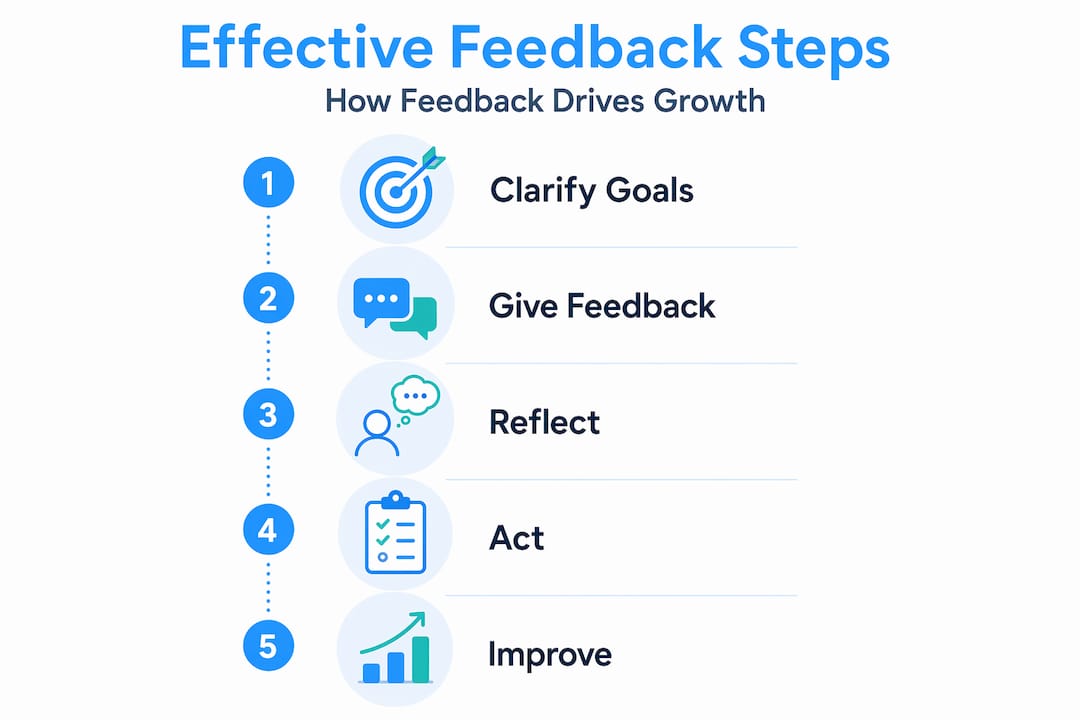
Whether you’re an educator designing a feedback system or a student learning to use feedback well, there are specific strategies that make a real difference. Here’s a practical sequence that works in both online and face-to-face settings.
- Align feedback to learning intentions. Before giving any feedback, be clear about what success looks like. Feedback disconnected from a clear goal is hard for students to use.
- Use feed-forward language. Instead of “this paragraph doesn’t work,” try “your next draft could strengthen this section by adding a specific example of a real environmental case study.” Feed-forward feedback reduces defensiveness by making improvement feel possible rather than dwelling on what went wrong.
- Limit next steps to one or two. Research strongly supports limiting actionable next steps to avoid cognitive overload. Pick the most important thing to fix, not every possible thing.
- Build in peer and self-assessment. Peer feedback gives students timely responses when the educator can’t be available. Self-assessment builds metacognitive awareness and teaches students to identify their own gaps. Both are backed by strong evidence as feedback strategies for learning.
- Give students time to respond. After sharing feedback, pause. Ask students to write one thing they understood and one question they still have. This turns feedback into a two-way process.
For students specifically, learning through constructive criticism requires a shift in mindset. Try separating your identity from your work. The comment is about the essay, not about you. When you receive feedback, write down one concrete revision you’ll make before the next session. That simple habit builds a direct link between feedback and action.
Pro Tip: Students: after receiving feedback, write one sentence that starts with “Next time I will…” before closing your assignment. This single habit can double how much you actually use the feedback you receive.
Feedback types and their impact across learning environments
Not all feedback formats produce the same results, and the setting matters a lot. Here’s how different types compare across common learning environments.
| Feedback type | Strengths | Limitations | Best used for |
|---|---|---|---|
| Verbal (in person) | Immediate, relational, adaptive | Not recorded; can be forgotten | One-on-one tutoring, class discussion |
| Written | Detailed, reviewable, precise | Can feel impersonal if not carefully worded | Essays, internal assessments, lab reports |
| Peer feedback | Timely, builds critical thinking | Accuracy depends on training | Drafts, presentations, group projects |
| AI-enabled feedback | Scalable, personalized, always available | May miss nuance or context | Grammar, structure, practice quizzes |
| Gestural/non-verbal | Natural, low-stakes | Limited in detail | Real-time classroom moments |
Online feedback with a moderate positive effect on learning is well-documented, and AI-generated explanatory feedback in particular supports metacognitive calibration, helping students judge their own understanding more accurately. Factors like group size, subject area, and educational level all moderate how effective a given feedback format will be. A high-stakes IB internal assessment benefits from detailed written feedback and one-on-one dialogue. A quick vocabulary exercise benefits from instant automated response.
Immediate feedback tends to work best for procedural tasks. For complex analytical writing, some delay can actually be productive because it gives students time to attempt revision before they see the response. The role of assessment in feedback is to generate the information that makes all of this possible. Without clear assessment criteria, there’s no baseline to give feedback against.
My perspective on feedback and what actually works
I’ve worked with IB students across many different countries, and I can tell you with confidence: the biggest barrier to feedback working is not the quality of the comments. It’s the relationship between the student and the person giving them.
I’ve seen beautifully written, detailed feedback go completely unused because the student felt judged rather than supported. And I’ve seen a single verbal comment, delivered at exactly the right moment with the right tone, shift how a student approached their entire internal assessment. That experience taught me to prioritize emotional timing before I prioritize content.
What I’ve also learned is that students who resist feedback are almost never lazy or careless. They’re scared. They’ve often internalized the idea that their academic performance is a reflection of their worth. Once you help them separate those two things, feedback becomes something they actually want. They start asking for it.
The move toward feed-forward feedback has been the most transformative shift in my own practice. Framing every comment around “here’s what will strengthen your next attempt” rather than “here’s what was wrong” changes the entire emotional register of the interaction. Students leave feeling capable, not defeated.
I’m genuinely excited about where AI-assisted feedback is heading, not because it replaces human feedback, but because it can deliver timely, specific responses at scale. When students get instant guidance on their ESS practice essays at 11 p.m. before an exam, that’s feedback that actually reaches them when they’re ready to learn.
— Marija
Improve your IB ESS results with expert feedback
If you’re an IB student working through ESS assessments, you already know how much detailed, specific feedback matters for internal assessments and exam preparation. At Esstutor, every session is built around giving you exactly the kind of feedback that moves your work forward, not generic comments, but precise, personalized guidance tied to IB marking criteria.

Whether you need support with your IB ESS internal assessment or want to sharpen your exam technique through targeted feedback on past papers, Esstutor’s approach puts feedback at the center of every lesson. You’ll know exactly what to revise, why it matters, and what to do differently next time. Explore the benefits of ESS tutoring and see how personalized feedback can make a measurable difference in your IB scores.
FAQ
What is the role of feedback in learning?
Feedback helps students close the gap between their current understanding and their learning goals. When it’s specific and forward-focused, it actively improves performance and builds metacognitive awareness.
Why is feedback more effective than grades alone?
Research shows that comments-only feedback produces stronger academic outcomes than grades paired with feedback, because students focus on the grade and ignore the comments. Separating the two keeps attention on the learning.
How much feedback should educators give on one assignment?
Educators should limit actionable feedback to one or two next steps per assignment. More than that overloads students and reduces the chance they’ll act on any of it.
What is feed-forward feedback and why does it matter?
Feed-forward feedback focuses on future improvement rather than past mistakes. It reduces defensiveness and makes students more likely to engage with the guidance, according to Hattie’s widely used feedback framework.
How can students use feedback more effectively?
Students can improve how they use feedback by separating their identity from their work, writing one specific revision plan after receiving comments, and treating feedback as a starting point for their next draft rather than a final judgment.
No Comments