


12 Jun The Role of Formative Assessments in Student Learning
TL;DR:
- Formative assessments provide continuous, low-stakes feedback that guides instruction and enhances student progress. They create a real-time feedback loop, enabling timely instructional adjustments and fostering a classroom culture of risk-taking and engagement. When followed by targeted teaching, formative assessment significantly boosts achievement, motivation, and metacognitive skills.
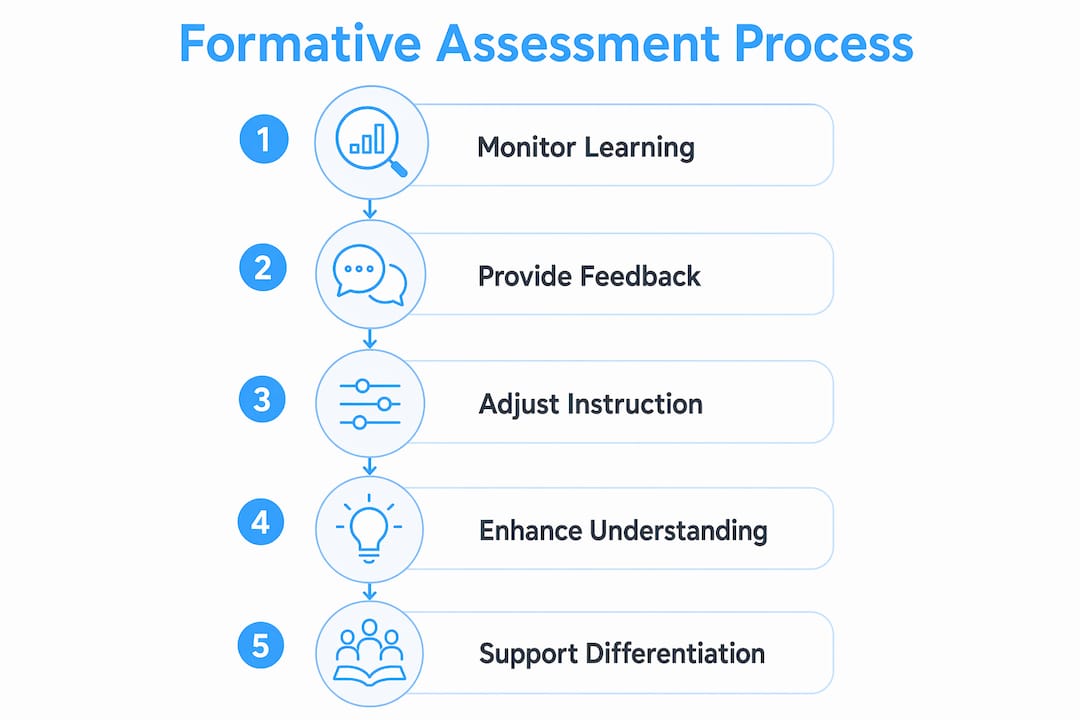
Formative assessment is defined as a continuous, low-stakes feedback process that monitors student understanding in real time and guides instructional decisions before a course or unit ends. Unlike a final exam or a standardized test, formative assessment is not about assigning a grade. It is about catching gaps early, adjusting teaching, and keeping students actively involved in their own progress. A 2026 study of 4,500 students found that formative assessment strategies produce a mean increase of 25.3% in academic achievement and 31.7% in student engagement. Those numbers signal something significant: when feedback is timely and content-directed, learning accelerates.
What is the role of formative assessments in education?
The role of formative assessments is to create a feedback loop between teaching and learning that operates continuously throughout a unit, not just at the end. The Australian Curriculum describes formative assessment as a central component of the “assessment for learning” cycle, where real-time data enables immediate instructional adjustments. This distinguishes it from summative assessment, which evaluates what students have already learned, and from diagnostic assessment, which maps prior knowledge before instruction begins.

Formative assessment works because it keeps both the teacher and the student informed at the moment when that information can still change outcomes. A teacher who discovers mid-unit that half the class misunderstands a concept can reteach it immediately. A student who receives specific feedback on a draft can revise with purpose rather than guessing. This responsiveness is what makes ongoing assessment so powerful compared to a single high-stakes test.
The importance of formative assessments also extends to classroom culture. When low-stakes check-ins replace the anxiety of surprise quizzes, students become more willing to take risks, ask questions, and admit confusion. That shift in culture is not a soft benefit. It is a precondition for deeper learning.
What are the key benefits of formative assessments for student learning?
The benefits of formative assessments reach well beyond test scores. Research confirms gains in achievement and engagement, but the motivational and metacognitive effects are equally significant for long-term student development.
Here are the core benefits supported by current evidence:
- Higher academic achievement. The 2026 study recorded a 25.3% mean increase in academic achievement, with immediate, content-directed feedback producing the largest effect. This means the quality and speed of feedback matter as much as its frequency.
- Stronger student engagement. The same study found a 31.7% increase in student engagement, with cultural context and digital tools identified as significant predictors. Engaged students are not just present; they are actively processing and responding to learning.
- Metacognitive development. Formative assessment shifts classroom power by involving students in self- and peer-assessment, which builds their ability to monitor and regulate their own learning. This reduces dependence on teacher correction and increases learning autonomy.
- Reduced test anxiety. When students receive regular, low-stakes feedback, the grade on a single summative test carries less psychological weight. The UVA Teaching Hub notes that formative assessment moves focus from grades to learning processes, which directly reduces extrinsic motivation and exam-related anxiety.
- Ownership of learning. Students who understand where they are in relation to a learning goal take more initiative. Formative feedback gives them that map.
“Formative assessment is integral to the learning culture, offering transparent feedback that builds metacognitive awareness essential for student success.” — Australian Curriculum Resources
Pro Tip: When sharing formative feedback with students, frame it around the learning goal rather than the student’s performance. “Your argument needs a second piece of evidence to meet the goal” is more motivating than “This is incomplete.”
How do formative, summative, and diagnostic assessments differ?
Understanding the differences between assessment types helps educators use each one at the right moment and for the right purpose. The three types are not interchangeable, and treating them as such leads to missed opportunities.
| Assessment type | Timing | Purpose | Stakes | Example |
|---|---|---|---|---|
| Formative | During learning | Guide instruction and feedback | Low | Exit ticket, peer review, mini-quiz |
| Summative | End of unit or course | Evaluate final learning outcomes | High | Final exam, standardized test, IB paper |
| Diagnostic | Before learning begins | Assess prior knowledge and readiness | None or low | Pre-test, KWL chart, entry survey |
The key distinction is that formative assessment informs teaching in real time, summative assessment evaluates outcomes after the fact, and diagnostic assessment maps the starting point. Each serves a different function in the instructional cycle, and all three are necessary for a complete picture of student learning.
Educators sometimes confuse formative and diagnostic assessments because both can use similar tools, such as short quizzes or surveys. The difference is timing and intent. A quiz given before a unit to reveal prior knowledge is diagnostic. The same quiz given mid-unit to check whether students are grasping new content is formative. The tool is less important than the question you are asking with it.
Pro Tip: Use diagnostic data to set the starting point for your unit, then use formative data to track movement from that point. Comparing the two at the end gives you a clear picture of actual growth, not just final performance.
What effective formative assessment strategies can educators use?
Effective formative assessment strategies share three qualities: they are low-stakes, they generate usable data quickly, and they connect directly to a learning goal. The University of Louisiana Monroe identifies the following as high-impact tools that educators can embed into daily routines:
- Minute papers. At the end of a lesson, students write one thing they learned and one question they still have. This takes two minutes and gives the teacher a clear picture of where the class stands before the next session.
- Polls and digital check-ins. Tools like Google Forms, Mentimeter, or Kahoot allow real-time data collection across an entire class. Digital tools increase the speed and impact of formative assessment while reducing the grading burden on teachers.
- Mini-quizzes. Short, ungraded or lightly graded quizzes after a lesson segment reveal specific misconceptions. They work best when followed immediately by class discussion of the answers.
- Peer assessment. Structured peer review, where students evaluate each other’s work against a clear rubric, develops both critical thinking and self-assessment skills. It also gives teachers insight into how well students understand the success criteria.
- Exit tickets. A single targeted question at the end of class, answered in writing or digitally, tells the teacher which students are ready to move forward and which need additional support.
The critical step that many educators skip is the instructional pivot. Collecting data without changing instruction is one of the most common reasons formative assessment fails to improve learning. When exit ticket data shows that a third of the class missed a key concept, the next lesson must address that gap directly, through reteaching, a different explanation, or targeted small-group work.
Pro Tip: Set a simple decision rule before you collect formative data. For example: “If more than 30% of students miss this concept, I will reteach it before moving on.” Having the rule in place makes it easier to act on the data rather than rationalize moving forward.
How do formative assessments support differentiated instruction?
Formative data is the foundation of differentiated instruction. Without it, teachers are guessing about which students need more support, which are ready for extension, and which have already mastered the content. With it, those decisions become specific and defensible.
Here is how formative assessment data directly informs differentiation:
- Flexible grouping. When formative check-ins reveal that some students have mastered a concept while others are still developing it, teachers can group students by readiness for targeted activities rather than keeping the whole class on the same task.
- Tiered assignments. Formative data identifies the range of readiness levels in a class, which allows teachers to design tasks at different levels of complexity that all address the same learning goal.
- Personalized scaffolding. A student who consistently struggles with a specific skill, identified through repeated formative check-ins, can receive targeted support before the difficulty compounds into a larger gap.
- Early intervention. Voyager Sopris Learning notes that formative assessment provides early warning signs for intervention teams, allowing targeted supports to be designed before learning challenges escalate. Catching a gap in week three is far easier to address than catching it in week ten.
The role of feedback in learning is most powerful when it is specific to the individual. Formative assessment makes that specificity possible at scale, even in large classrooms.
What challenges do educators face with formative assessments?
The most common challenge is treating formative assessment as a data collection task rather than a teaching mindset. Many educators run exit tickets or mini-quizzes but do not change their instruction based on the results. Without instructional response, the assessment has no impact on learning, regardless of how well it was designed.
A second challenge is the pull toward grading everything. When teachers assign numeric scores to formative tasks, students focus on the grade rather than the feedback. This undermines the purpose of the assessment and reintroduces the anxiety that formative practice is meant to reduce. Qualitative, specific feedback, such as “your hypothesis is missing a measurable variable,” produces more learning than a score of 6 out of 10.
A third challenge is classroom culture. Students who have been trained to see assessment as judgment rather than support will resist self-assessment and peer review. Building a culture where mistakes are treated as information rather than failure takes time, but it is the condition under which formative assessment works best. Starting with low-stakes, anonymous check-ins can help students engage honestly before they feel safe enough to be transparent in more visible formats.
Pro Tip: Introduce student self-assessment gradually. Begin with students rating their own confidence on a scale of 1 to 3 before moving to written reflections. Confidence ratings are low-threat and give you immediate data on where students feel uncertain.
Key takeaways
Formative assessment works when it is continuous, feedback-driven, and followed by instructional change. Without that response, data collection alone does not improve learning.
| Point | Details |
|---|---|
| Define the purpose clearly | Formative assessment guides instruction in real time; it is not a grading tool. |
| Act on the data | Reteach, scaffold, or adjust pacing based on what formative check-ins reveal. |
| Use low-stakes tools | Minute papers, exit tickets, and peer review generate usable data without adding grading burden. |
| Differentiate with precision | Formative data identifies readiness levels and supports flexible grouping and tiered tasks. |
| Build a feedback culture | Students engage more honestly when mistakes are treated as learning information, not judgment. |
Why formative assessment changed how I teach
I have worked with IB students for over 13 years, and the single biggest shift in my practice came when I stopped treating assessment as something that happens at the end of a unit and started treating it as something that happens every lesson. That change was not about adding more quizzes. It was about asking better questions in real time and actually changing what I did next based on the answers.
What I have seen consistently is that students who receive specific, timely feedback on their work, whether on an ESS internal assessment draft or a practice paper response, make faster progress than students who wait for a grade. The feedback does not need to be long. It needs to be specific and connected to a clear goal. “Your discussion of biodiversity loss needs to reference a named case study” is more useful than “good effort, needs more detail.”
The motivational impact is real too. When students see that their teacher is paying attention to where they are right now, not just where they end up, they invest more. That investment shows up in the quality of their work and in their willingness to revise rather than submit and forget.
If you are an educator looking to strengthen your practice, I would encourage you to start small. Pick one formative tool, use it consistently for two weeks, and commit to changing at least one instructional decision based on what you learn. That cycle, repeated over a semester, is what transforms a classroom.
— Marija
How Esstutor supports assessment-driven learning
Esstutor brings the same feedback-first approach to IB ESS students worldwide. Every tutoring session is built around identifying where a student is right now and adjusting the lesson to close the gap, which is formative assessment in practice.
If you are an IB ESS student preparing for your internal assessment, Esstutor’s IB ESS IA tutoring service provides personalized, feedback-driven support from an experienced IB examiner. Sessions are flexible, remote, and tailored to your specific needs, whether you are drafting your IA, reviewing past papers, or preparing for Paper 2. You can also explore the benefits of ESS tutoring to see how structured, ongoing feedback accelerates results.
FAQ
What is the role of formative assessments in teaching?
Formative assessment monitors student understanding continuously during a unit and provides real-time data that teachers use to adjust instruction. Its primary role is to guide teaching decisions, not to assign grades.
How do formative assessments improve learning outcomes?
A 2026 study of 4,500 students found that formative assessment strategies produce a 25.3% mean increase in academic achievement, with immediate, content-directed feedback showing the largest effect. The improvement comes from closing gaps while there is still time to act on them.
What is the difference between formative and summative assessments?
Formative assessment occurs during learning and informs instruction in real time, while summative assessment occurs at the end of a unit or course to evaluate final outcomes. Formative is low-stakes and ongoing; summative is high-stakes and final.
What are the most effective formative assessment strategies?
Minute papers, exit tickets, mini-quizzes, peer assessment, and real-time digital polls are among the most effective tools. Their impact depends on whether the teacher uses the data to make instructional adjustments before the next lesson.
Why do formative assessments sometimes fail to improve learning?
Formative assessments fail when teachers collect data but do not change their instruction in response. Voyager Sopris Learning identifies this gap between data collection and instructional action as the primary reason formative assessment underperforms in practice.
No Comments