


10 Jun How to Reference in ESS IA: A Student Guide
TL;DR:
- Proper referencing in ESS IA involves consistent citation of sources, visuals, and data throughout the document.
- Applying a single citation style—APA, MLA, or Chicago—uniformly enhances credibility and demonstrates research integrity.
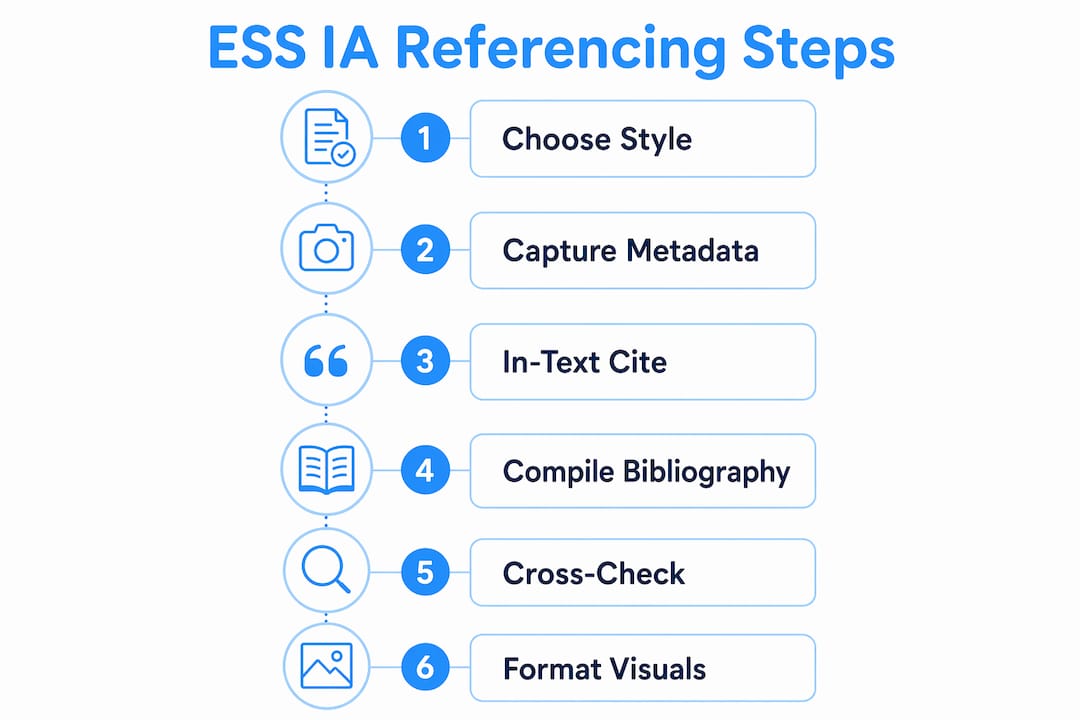
Referencing in ESS IA is the process of correctly citing all sources, data, and visuals to demonstrate academic integrity and research transparency. The IB does not mandate a single citation style, but it requires you to apply APA, MLA, or Chicago consistently from the first page to the last. Get this right, and your examiner sees a credible, well-grounded investigation. Get it wrong, and even strong environmental analysis loses marks.
How to reference in ESS IA: the core rules
The IB’s position on citation style is clear: consistency is required, but the choice of APA, MLA, or Chicago belongs to you. That single rule carries more weight than most students realize. Mixing formats, even slightly, signals carelessness to an examiner who reads dozens of IAs each session.

Your in-text citations and your bibliography must mirror each other exactly. Every source cited in the body of your IA needs a full entry in the reference list, and every entry in the reference list must appear somewhere in the text. Think of it as a closed loop. If one side is missing a link, the loop breaks.
Academic integrity in the IB Diploma Programme is non-negotiable. Unattributed ideas, data, or visuals are treated as plagiarism regardless of intent. Proper referencing is your protection, and it also shows examiners that your conclusions are grounded in credible external knowledge rather than unsupported claims.
What tools and preparation do you need before you start citing?
Strong referencing starts before you write a single sentence of your IA. Capturing full metadata the moment you find a source is the single most effective habit you can build. Metadata includes the author, title, publication date, URL, and your access date. Students who skip this step routinely spend hours hunting down sources at the end of the process, and some never find them again.
Reference managers make this process far less painful. Zotero and Mendeley both allow you to save sources with one click, auto-generate citations in APA, MLA, or Chicago, and export a formatted bibliography directly into your document. Both are free. Zotero works as a browser extension, so you can capture a source the second you open it.
Writing aids like Grammarly help with clarity and consistency in your written citations, but they do not replace a reference manager. Use them together. Grammarly catches formatting inconsistencies in your prose; Zotero or Mendeley handles the structural accuracy of your citations.
Here is what to set up before your research phase begins:
- Choose one citation style (APA, MLA, or Chicago) and note it at the top of your working document
- Install Zotero or Mendeley and create a dedicated folder for your ESS IA sources
- Create a running source log in a spreadsheet or document with columns for author, title, date, URL, and access date
- Note the license type for any image or graph you plan to use (Creative Commons, public domain, or copyrighted)
Pro Tip: Set your reference manager to your chosen citation style on day one. If you switch styles midway through, you will need to reformat every entry manually.
How do you format different source types and visuals in ESS IA?
Formatting references for ESS IA covers several source types, and visuals deserve special attention because they carry their own rules beyond standard bibliography entries.
Books, journal articles, and websites
For a book in APA, the format is: Author, A. A. (Year). Title of work: Capital letter also for subtitle. Publisher. For a journal article, add the journal name, volume, issue, and DOI. For a website, include the author (or organization), year, page title, site name, and full URL with your access date. MLA and Chicago follow different ordering conventions, but the required data points are the same across all three styles.
Citing visuals, graphs, and tables
This is where most ESS IA students lose marks, and it is entirely avoidable. Each figure or table must carry a unique number (Figure 1, Table 2), a concise descriptive caption, and a clear credit line placed directly beneath it. The credit line is not optional. It tells the examiner exactly where the visual came from.
When you modify a published graph or map, the caption must read “Adapted from” followed by the original source details and a brief description of what you changed. Adapted visuals labeled this way protect you from plagiarism concerns and demonstrate honest scholarship. Leaving out the adaptation note is one of the most common and costly mistakes in ESS IAs.
For visuals you created yourself using student-collected data, the caption should state the software used (Excel, Google Sheets, QGIS) and reference the raw data. Raw data used to plot graphs should appear in an appendix, with axis labels, units, and data collection methods clearly documented.
The table below shows the key citation elements required for each source type:
| Source type | Required citation elements |
|---|---|
| Book | Author, year, title, publisher, edition if applicable |
| Journal article | Author, year, title, journal name, volume, issue, DOI or URL |
| Website | Author/org, year, page title, site name, URL, access date |
| Published visual | Figure number, caption, “Source:” credit line, full reference in bibliography |
| Adapted visual | Figure number, caption, “Adapted from:” note, description of changes, full reference |
| Student-generated graph | Figure number, caption, software used, raw data location (appendix) |
Pro Tip: Place your bibliography entry for every visual in the main reference list, not just in the caption. Examiners check both locations.
What are the most common referencing mistakes in ESS IA?
Knowing where students go wrong is just as useful as knowing what to do right. These are the mistakes that appear most frequently in ESS IAs, and each one is preventable.
Omitting in-text citations entirely. Some students write strong analysis but forget to link claims to sources in the body text. Every factual statement, statistic, or borrowed idea needs an in-text citation at the point where it appears.
Mixing citation styles. Mixing formats reduces examiner confidence and signals that the student did not plan their referencing. Pick one style and apply it to every entry, including captions.
Failing to cite adapted visuals. Reproducing a graph from a scientific paper without an “Adapted from” note is treated as plagiarism. This applies even when you redraw the graph by hand or recreate it in Excel.
Ignoring copyright documentation. Copyrighted visuals require documented permission or a clearly noted open license. Store permission emails or Creative Commons license screenshots in your project folder or appendix.
Assembling the bibliography at the last minute. Students who wait until the final week to compile their reference list frequently discover missing sources, broken URLs, and incomplete metadata. A running source log eliminates this problem entirely.
Incomplete bibliography entries. A reference that lists only an author and title is not a complete citation. Every entry must include enough detail for the examiner to locate the original source independently.
Pro Tip: Run a final cross-check by highlighting every in-text citation in your IA, then confirming each one has a matching full entry in your bibliography. This takes 20 minutes and catches most errors.
How do you verify your reference list meets IB ESS IA criteria?
The final verification stage is where good referencing becomes great referencing. The IB looks for thoroughness and consistency, and examiners notice when these qualities are present. You can read more about how referencing connects to your overall ESS IA assessment criteria to understand exactly where marks are allocated.
Work through this checklist before you submit:
- Every in-text citation has a corresponding full entry in the bibliography
- Every bibliography entry is cited at least once in the body text
- All captions for figures and tables include a source or “Adapted from” credit line
- The same citation style (APA, MLA, or Chicago) is used throughout, including captions
- Websites include access dates
- Adapted visuals describe what was changed from the original
- Raw data for student-generated graphs appears in an appendix with axis labels and units documented
- Copyrighted images have documented permissions or license notes stored in your project folder
- The bibliography is alphabetized (APA and MLA) or numbered (Chicago footnote style) correctly
- Your reference list does not count toward your IA word limit, but appendices should be clearly labeled and referenced in the main text
Cross-referencing your in-text citations against your bibliography is the most reliable quality check available to you. Do it twice: once when you finish drafting and once after your final edit. Sources sometimes disappear during revision when paragraphs are cut or reorganized.
Key takeaways
Accurate ESS IA referencing requires choosing one citation style, capturing metadata immediately, and applying consistent formatting to every source type including visuals, adapted figures, and student-generated graphs.
| Point | Details |
|---|---|
| Choose one style and commit | APA, MLA, or Chicago must be applied consistently across all citations and captions. |
| Capture metadata immediately | Record author, title, URL, and access date the moment you find a source to prevent lost references. |
| Cite every visual correctly | Each figure needs a number, caption, and credit line directly beneath it. |
| Label adapted visuals clearly | Write “Adapted from” plus a description of changes to protect academic integrity. |
| Verify with a cross-check | Match every in-text citation to a bibliography entry before submission to close the loop. |
Why referencing reflects your thinking, not just your formatting
I have reviewed hundreds of ESS IAs over 13 years, and I can tell within the first few pages whether a student understands what referencing actually does. Most students treat it as a bureaucratic requirement, something to tick off before submission. That framing costs them marks and misses the point entirely.
Referencing is how you show an examiner that your investigation sits within a larger body of scientific knowledge. In ESS, where systems thinking is central to the course, your citations are the visible connections between your local data and the broader environmental literature. A well-cited IA on soil erosion rates, for example, links your field measurements to published studies on land use change, rainfall intensity, and ecosystem services. That connection is what makes your analysis credible.
The students who score highest on their IAs are not necessarily the ones with the most sophisticated methodology. They are the ones whose work feels trustworthy from start to finish. Consistent, thorough referencing is a large part of what creates that feeling. It tells the examiner: this student knows where their ideas come from, and they are not hiding anything.
Start building citation habits in your first week of research, not your last. Use Zotero or Mendeley from day one. Log every source as you find it. Your future self will thank you, and your examiner will notice.
— Marija
Get expert help with your ESS IA referencing
Referencing is one of those areas where a single session with an experienced tutor can save you hours of confusion and prevent costly mistakes before submission.
At Esstutor, I work with IB ESS students one-on-one to review their citation practices, check bibliography completeness, and make sure every visual is correctly labeled and credited. With over 13 years of experience as an IB examiner and ESS educator, I know exactly what examiners look for and where students most often lose marks. If you want personalized guidance on your ESS IA referencing and structure, book a session and we will work through it together. You can also explore the benefits of ESS tutoring to see how targeted support improves scores across every IA component.
FAQ
What citation style should I use for my ESS IA?
The IB does not require a specific style, so APA, MLA, and Chicago are all acceptable. The requirement is that you apply your chosen style consistently throughout the entire IA, including captions and bibliography entries.
How do I cite a graph I adapted from a published source?
Write “Adapted from” in the caption beneath the figure, followed by the original source details and a brief note describing what you changed. Include the full reference in your bibliography as well.
Do I need to cite visuals I created myself?
Yes. Student-generated graphs need a caption stating the software used and a reference to the raw data, which should appear in an appendix with axis labels, units, and data collection details documented.
What happens if I use a copyrighted image without permission?
Using a copyrighted image without documented permission or a noted open license is treated as a breach of academic integrity under IB regulations. Store permission emails or Creative Commons license information in your project folder or appendix.
Does my reference list count toward the ESS IA word limit?
No. The bibliography and appendices do not count toward your word limit. Label all appendices clearly and reference them in the main body of your IA so examiners can locate supporting data easily.
No Comments