


16 Jun Why Ecological Restoration Matters: A 2026 Guide
TL;DR:
- Ecological restoration involves actively repairing damaged ecosystems to restore their health, biodiversity, and services. It provides ecological, social, and economic benefits, including disaster risk reduction, job creation, and climate resilience. Success relies on community involvement, sustainable design, and planning for future climate conditions.
Ecological restoration is defined as the process of repairing and renewing damaged ecosystems to recover their health, functionality, and benefits for both nature and human communities. This practice, formally studied under the field of restoration ecology, has become one of the most urgent responses to global habitat loss, biodiversity decline, and climate disruption. Research shows that investing $1 in floodplain restoration typically avoids about $5 in future flood-related damages in the US. That ratio alone makes a compelling case for why ecological restoration deserves serious attention from students, educators, and policymakers alike.
Why ecological restoration is critical for ecosystem health
Ecosystem rehabilitation addresses one of the most pressing environmental problems of our time: the widespread degradation of natural systems that support all life on Earth. When forests are cleared, wetlands drained, or rivers polluted, the web of species and processes that keep those systems running begins to collapse. Restoration ecology steps in to rebuild that web deliberately and systematically.
The environmental benefits of restoration fall into several clear categories:
- Biodiversity recovery: Restored habitats provide food, shelter, and breeding grounds for native species. Wetland restoration projects in the US, for example, have brought back populations of migratory birds, amphibians, and native fish that had disappeared from degraded sites.
- Water purification: Healthy riparian zones and wetlands filter pollutants, sediment, and excess nutrients from waterways. Removing invasive vegetation in South Africa increased annual water yield by 34.4 million cubic meters at less than 20% of the cost per cubic meter of a new dam. That result shows restoration can outperform expensive engineering solutions.
- Carbon storage: Restored forests, peatlands, and coastal mangroves lock carbon into biomass and soil, directly supporting climate mitigation goals.
- Sediment control: Large-scale restoration projects can reduce sediment flow in waterways by over 100 million tons annually. Excess sediment clogs rivers, destroys aquatic habitats, and reduces the lifespan of reservoirs.
Understanding ecosystem services helps you see why each of these benefits connects directly to human survival, not just wildlife conservation.
Pro Tip: Restoration and preservation are not competing strategies. The US EPA confirms that protecting intact ecosystems is the foundation; restoration complements but does not replace that protection. Always prioritize keeping healthy ecosystems intact before focusing resources on repairing degraded ones.
How does ecological restoration benefit communities and economies?
The socio-economic case for habitat restoration is just as strong as the ecological one. Restoration projects create jobs, reduce disaster risk, and improve the livelihoods of communities that depend directly on natural resources.
Here are four documented ways restoration delivers community benefits:
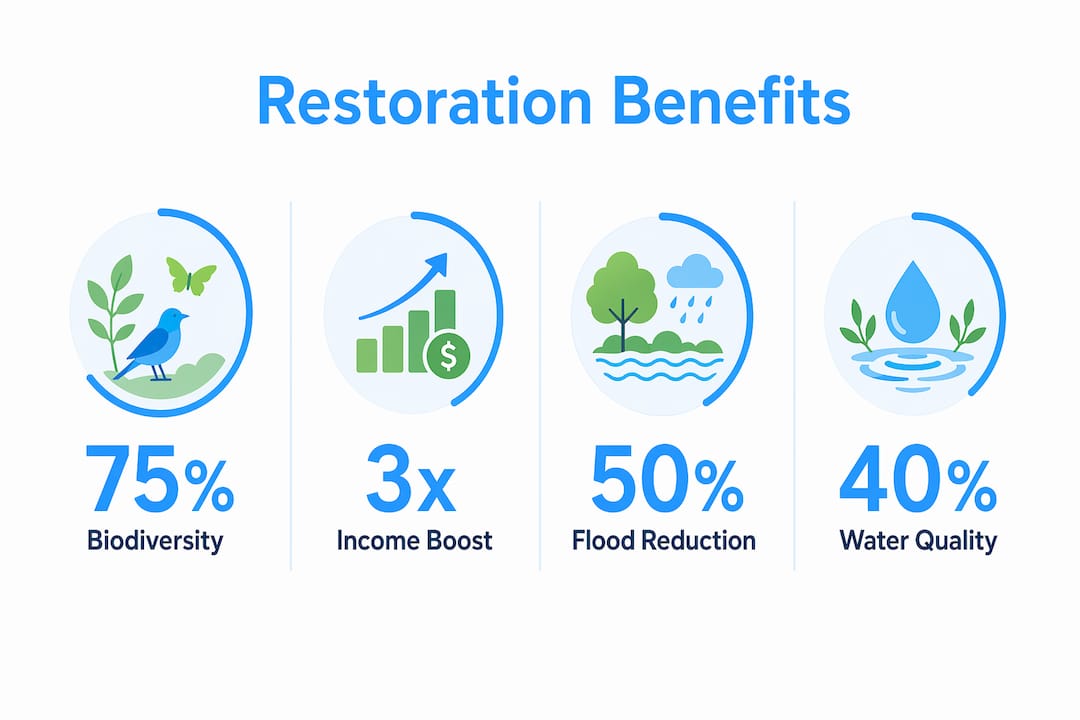
- Income growth: Large-scale restoration projects can triple average household incomes from US$70 to US$200 per capita. That kind of income shift transforms the economic stability of rural and indigenous communities.
- Disaster risk reduction: Restored floodplains and coastal wetlands absorb storm surges and floodwaters. The $1-to-$5 return on investment for floodplain restoration in the US reflects real reductions in property damage, infrastructure repair costs, and emergency response spending.
- Food security: Restored fisheries, forests, and grasslands support sustainable harvesting of food resources. Communities that previously faced food insecurity due to ecosystem collapse often see direct improvements after restoration.
- Climate resilience: Restored ecosystems buffer communities against the increasing frequency of droughts, floods, and heatwaves linked to climate change.
“Restoration projects that align with local community values and needs are more likely to succeed and provide environmental justice benefits.” — Phys.org, 2026
The South Africa water system example is worth studying closely. Clearing invasive plants restored native vegetation and dramatically increased water availability at a fraction of the cost of building new water infrastructure. That project delivered environmental, economic, and social returns simultaneously. It is exactly the kind of real-world case study that appears in IB ESS assessments, and understanding it deeply will strengthen your analysis skills.
What are the challenges in successful restoration projects?
Ecological restoration is not as simple as planting trees or reintroducing species. Ecosystems are dynamic, and restoration goals must reflect that reality. The field of restoration ecology recognizes that projects aim for a more natural equilibrium rather than an exact historical state. That distinction matters because ecosystems change over time, and trying to recreate a precise past condition is often neither possible nor ecologically appropriate.
The table below compares common pitfalls with proven best practices:
| Common Pitfall | Best Practice |
|---|---|
| Designing for constant human maintenance | Build for self-sustaining ecosystems that need minimal ongoing intervention |
| Ignoring local community input | Involve communities in planning, decision-making, and stewardship from the start |
| Relying on passive natural recovery | Use structured restoration approaches for severely degraded ecosystems where natural regeneration is too slow |
| Selecting non-native or climate-vulnerable species | Choose native, climate-resilient species suited to projected future conditions |
| Treating restoration as a one-time event | Plan for long-term monitoring and adaptive management |
Community involvement is not optional. Research published in 2026 confirms that local-led restoration is more effective because it aligns projects with real livelihoods, cultural values, and local ecological knowledge. Ignoring community input is one of the most common causes of restoration failure. Projects that bypass local voices often face abandonment, conflict, or ecological setbacks within a few years.
Pro Tip: When evaluating a restoration case study for your IB ESS internal assessment, always check whether the project included community participation. That single factor often explains why some projects succeed long-term while others fail.
How does restoration support climate change adaptation?
Ecological restoration is increasingly recognized as a front-line strategy for adapting to climate change, not just repairing past damage. Restoration ecology now anticipates future climate conditions by selecting resilient species and creating habitat corridors that support wildlife migration as temperatures shift. That forward-looking approach transforms restoration from a reactive tool into a proactive one.
The table below shows how specific restoration strategies map to climate adaptation goals:
| Restoration Strategy | Climate Adaptation Benefit |
|---|---|
| Planting climate-resilient native species | Maintains ecosystem function under projected temperature and rainfall changes |
| Creating wildlife corridors | Allows species to migrate as climate zones shift northward or to higher elevations |
| Restoring coastal wetlands and mangroves | Reduces storm surge damage and protects shorelines from sea-level rise |
| Rehabilitating peatlands and forests | Increases carbon sequestration and reduces atmospheric CO₂ |
| Restoring river floodplains | Improves water storage and reduces flood peaks during extreme rainfall events |
The IPCC has consistently identified ecosystem restoration as a nature-based solution that delivers both mitigation and adaptation benefits. For IB ESS students, this connection between climate change impacts and restoration responses is a high-value topic that appears across Paper 1 and Paper 2 exam questions. Understanding it at a systems level, rather than just memorizing facts, is what separates good answers from excellent ones.
Biodiversity conservation strategies that incorporate restoration planning are now considered standard practice in environmental management frameworks worldwide, including the UN Decade on Ecosystem Restoration (2021–2030).
Key takeaways
Ecological restoration delivers measurable benefits for biodiversity, community livelihoods, and climate resilience, but only when projects are designed for self-sustainability and built with genuine community involvement.
| Point | Details |
|---|---|
| Economic returns are strong | Every $1 invested in floodplain restoration avoids approximately $5 in future flood damages. |
| Community income rises significantly | Large-scale projects can triple household incomes from US$70 to US$200 per capita. |
| Self-sustaining design is non-negotiable | High-maintenance restoration designs increase costs and raise the risk of long-term failure. |
| Community involvement drives success | Local-led projects align with real livelihoods and are more likely to deliver lasting results. |
| Climate adaptation requires proactive planning | Selecting resilient species and building habitat corridors prepares ecosystems for future conditions. |
Restoration is more than repair: my perspective
I have worked with IB ESS students for over 13 years, and ecological restoration is one of those topics that genuinely excites me to teach. Most students arrive thinking restoration means planting a few trees and calling it done. The reality is far more interesting and far more demanding.
What I find most compelling is the tension between restoration and preservation. Many students treat them as alternatives. They are not. The US EPA is clear that protecting intact ecosystems is the foundation of any serious conservation strategy. Restoration fills the gaps where protection came too late. Both are necessary, and understanding why is the kind of nuanced thinking that earns top marks in IB ESS.
The community dimension also tends to surprise students. The 2026 research from Phys.org showing that locally led restoration outperforms externally designed projects is not just an interesting data point. It reflects a deeper truth about environmental stewardship: the people who live within an ecosystem understand it in ways that outside experts often miss. That insight connects directly to environmental stewardship principles that run through the entire IB ESS curriculum.
My advice to you is this: when you study restoration, look for the systems thinking behind it. Ask who designed the project, who maintains it, and who benefits. Those three questions will take you much further than memorizing definitions.
— Marija
How Esstutor helps you master ecological restoration
If you are studying IB ESS and want to understand ecological restoration at the depth the exam actually requires, Esstutor is built for exactly that. With over 13 years of IB examining experience, personalized sessions cover everything from ecosystem services and biodiversity to climate adaptation and internal assessment design.

Whether you are preparing for Paper 1 case studies, writing your IB ESS internal assessment, or trying to connect restoration concepts to broader ESS themes, Esstutor provides structured, one-on-one support tailored to your specific needs. You can also explore the full IB ESS course overview to see how restoration fits into the wider curriculum. Book a trial lesson and start building the kind of understanding that translates directly into higher scores.
FAQ
What is ecological restoration in simple terms?
Ecological restoration is the process of actively repairing damaged or degraded ecosystems to recover their natural functions, biodiversity, and services for both wildlife and people.
Why does ecological restoration matter for communities?
Restoration reduces flood damage, improves water supply, and can triple household incomes in communities that depend on healthy ecosystems for their livelihoods.
How does restoration differ from conservation?
Conservation protects intact ecosystems from damage, while restoration repairs ecosystems that have already been degraded. Both strategies are necessary and work best together.
What makes a restoration project succeed long-term?
Projects succeed when they are designed to be self-sustaining, involve local communities in decision-making, and use native species suited to current and projected climate conditions.
How does ecological restoration connect to climate change?
Restored ecosystems store carbon, buffer communities against extreme weather, and support wildlife migration as climate zones shift, making restoration a direct climate adaptation strategy.
No Comments