


20 Jun What Is Ecological Resilience? A Student Guide
TL;DR:
- Ecological resilience allows ecosystems to absorb disturbances while maintaining core functions and identity.
- It depends on biodiversity, redundancy, connectivity, and adaptive capacity to prevent crossing tipping points.
Ecological resilience is the capacity of an ecosystem to absorb disturbance, reorganize, and adapt while retaining its core function, structure, and identity. Ecologist C.S. Holling introduced this concept in 1973, and it remains one of the most important ideas in environmental science today. Understanding resilience in ecology helps you explain why some ecosystems survive floods, wildfires, and invasive species while others collapse entirely. If you are studying IB Environmental Systems and Societies (ESS), this concept appears across topics from biodiversity to climate change. This guide breaks it down clearly, from the definition to real-world examples and measurement methods.
What is ecological resilience and how is it defined?

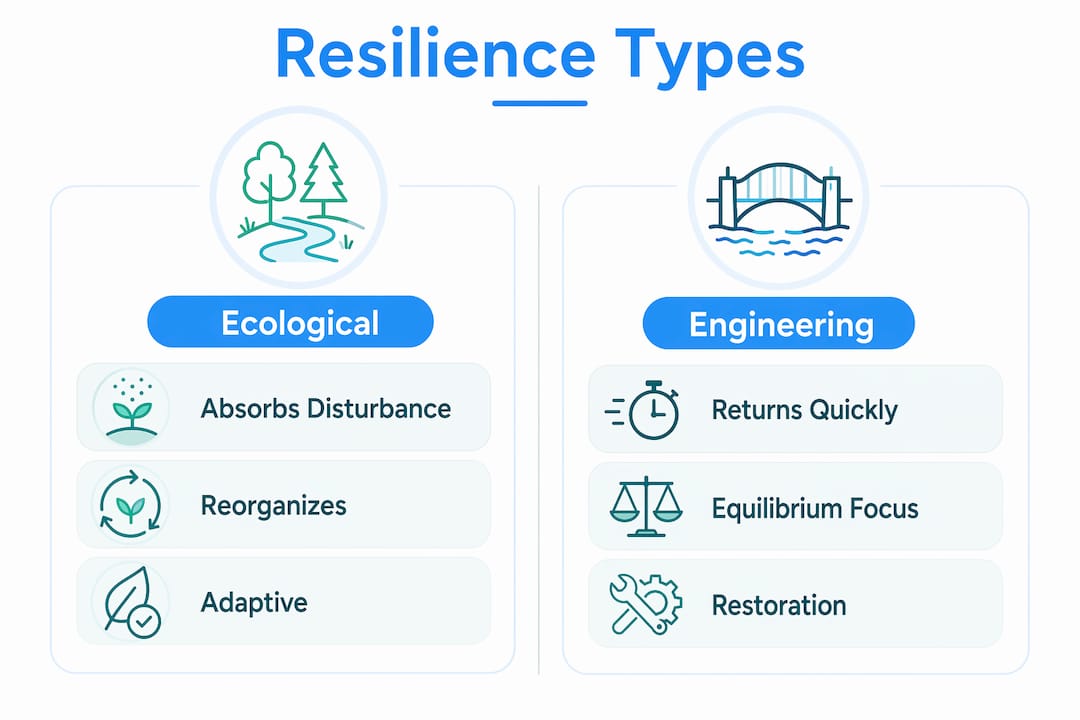
Ecological resilience is defined as the ability of a natural system to withstand disturbance and continue functioning without crossing into a fundamentally different state. This definition, pioneered by C.S. Holling, separates ecological resilience from older ideas about ecosystems simply “bouncing back” to an identical prior condition. The focus is on function, not on perfect restoration.
A closely related term you will encounter is engineering resilience. Engineering resilience measures how quickly a system returns to equilibrium after a disturbance. Ecological resilience, by contrast, measures how much disturbance a system can absorb before it shifts into a new state altogether. These are fundamentally different questions. One asks “how fast?” and the other asks “how much?”
Knowing the definition of ecological resilience also means understanding what it is not. It does not mean an ecosystem is unchanged after stress. A forest that regrows after a wildfire with a different mix of tree species is still ecologically resilient, provided the core ecosystem functions like nutrient cycling and habitat provision remain intact.
How does ecological resilience differ from engineering and climate resilience?
Students often confuse ecological resilience with two related terms: engineering resilience and climate resilience. Each concept measures something different, and mixing them up on an exam costs marks.
| Concept | Focus | Key Question | Example |
|---|---|---|---|
| Ecological resilience | Capacity to absorb disturbance | How much stress can the system take? | Wetland resisting invasive species |
| Engineering resilience | Speed of return to equilibrium | How fast does the system recover? | River returning to normal flow after a flood |
| Climate resilience | Human and natural systems adapting to climate change | How do communities and ecosystems adapt together? | Coastal city planning for sea level rise |
Climate resilience includes social and human systems, making it a broader concept than ecological resilience. Ecological resilience is foundational within climate resilience. You cannot have a climate-resilient community without ecologically resilient natural systems supporting it.
The key distinction to remember is this: ecological resilience is about the ecosystem’s capacity to keep functioning under pressure. Climate resilience adds the layer of human adaptation and social systems on top of that ecological foundation.
- Ecological resilience: Focuses on natural communities and their ability to withstand fire, floods, and invasive species.
- Engineering resilience: Focuses on return speed to a single stable state.
- Climate resilience: Covers both ecological and human systems responding to climate-driven change.
Understanding the difference between climate and sustainability also helps you place ecological resilience correctly within the broader ESS curriculum.
What are the core components of ecological resilience?
Biodiversity, redundancy, and connectivity are the three key components that enhance ecological resilience. Each one plays a specific role in keeping an ecosystem stable under stress.
- Biodiversity provides a range of species that perform similar functions. If one species declines, another can fill its role. A grassland with 40 plant species handles drought far better than one with only 5.
- Redundancy means multiple species perform the same ecological function. Pollination by bees, butterflies, and beetles is redundant. Lose one pollinator group and the others maintain the service.
- Connectivity allows species and energy to move across a landscape. Well-connected habitats let populations recolonize disturbed areas faster. Fragmented habitats reduce this capacity significantly.
Adaptive capacity is the fourth component worth knowing. It refers to an ecosystem’s ability to reorganize and adjust its structure in response to new conditions. High adaptive capacity means the system can shift its composition without losing its core functions.
The cup and ball model
The “cup and ball” model visualizes ecosystem stability in a way that makes resilience immediately clear. Picture a ball sitting inside a cup. The ball is the ecosystem’s current state. The walls of the cup represent the system’s resilience. As long as disturbances push the ball around inside the cup, the ecosystem recovers. When a disturbance is large enough to push the ball over the rim, the ecosystem crosses a threshold and enters a new stability domain, a fundamentally different state.
These thresholds matter enormously. Crossing a tipping point can cause permanent ecosystem regime changes where new processes take over. A clear lake tipping into a turbid, algae-dominated state is a classic example. Once that shift happens, reversing it requires far more effort than preventing it in the first place.
Pro Tip: Many students assume resilience always means returning to the exact prior state. It does not. Resilience is about functional persistence, not identical restoration. A forest with different species after a fire is still resilient if it keeps cycling nutrients and supporting wildlife.
What are real-world examples of ecological resilience?
Real examples make this concept stick, and they are exactly what IB ESS examiners want to see in your answers.
- Forests after wildfire: Boreal forests in Canada and Siberia are adapted to periodic fire. Fire clears dead wood, releases nutrients, and triggers seed germination in fire-adapted species like lodgepole pine. The forest regrows with a different age structure but maintains its core carbon storage and habitat functions.
- Coral reefs after bleaching: Coral reefs can recover from mild bleaching events if water temperatures return to normal and local stressors like pollution and overfishing are reduced. The Great Barrier Reef has shown partial recovery after bleaching events, though repeated stress reduces this capacity over time.
- Wetlands resisting invasive species: Wetlands with high plant diversity resist colonization by invasive species more effectively than degraded wetlands. The ecological resilience of wetlands depends directly on maintaining that biodiversity buffer.
- Grasslands after drought: Diverse native grasslands in the American Midwest recover from drought faster than monoculture croplands because multiple grass species respond differently to water stress.
Why resilience matters for ecosystem services
Maintaining ecological resilience is directly tied to the importance of ecosystems for human wellbeing. Resilient ecosystems keep delivering services like pollination, water filtration, flood control, and carbon sequestration even after disturbances. When resilience breaks down and a regime shift occurs, those services can collapse suddenly and at great cost to human communities.
Resilience is dynamic, aiming for adaptive capacity rather than a fixed pristine state. This means conservation strategies must focus on maintaining the conditions that allow ecosystems to keep adapting, not on freezing them in a single historical snapshot.
One more point worth noting: resilience is not always a positive thing. Ecological resilience can be positive or negative. A degraded, weed-dominated ecosystem can be highly resilient to restoration efforts, resisting the changes you actually want. This is why resilience must always be assessed relative to the desired outcome.
How do scientists measure ecological resilience?
Measuring resilience is one of the harder challenges in environmental science. Measurement frameworks quantify resilience using scales, adaptive capacity, and thresholds, but no single metric captures everything. Scientists use multiple complementary indicators to build a full picture.
| Indicator | What it measures | Why it matters |
|---|---|---|
| Species diversity | Number and variety of species present | Higher diversity signals greater functional redundancy |
| Functional redundancy | Multiple species performing the same role | Buffers against species loss |
| Connectivity | Links between habitat patches | Supports recolonization after disturbance |
| Threshold proximity | Distance from a known tipping point | Warns of regime shift risk |
| Recovery rate | Speed of return after a disturbance | Reflects engineering resilience component |
Resilience assessment requires integrated indicators and adaptive management to respond to evolving ecosystem conditions. Adaptive management means monitoring these indicators over time and adjusting conservation actions based on what the data shows. It treats management as an ongoing experiment rather than a one-time fix.
The challenge is that thresholds are often only visible in hindsight. A system can appear stable right up until it tips. This is why long-term monitoring programs, like those run by the Long Term Ecological Research (LTER) Network in the United States, are so valuable. They build the baseline data needed to detect early warning signals before a regime shift occurs.
Pro Tip: For your IB ESS internal assessment, measuring species diversity as a resilience indicator is a practical and examinable approach. Comparing diversity indices between disturbed and undisturbed sites gives you a clear, quantifiable resilience proxy.
Key Takeaways
Ecological resilience is defined by functional persistence under disturbance, not by perfect restoration, and it depends on biodiversity, redundancy, connectivity, and adaptive capacity working together.
| Point | Details |
|---|---|
| Core definition | Ecological resilience is the capacity to absorb disturbance while retaining core ecosystem functions and identity. |
| Key components | Biodiversity, redundancy, and connectivity are the three factors that most directly strengthen resilience. |
| Tipping points matter | Crossing a threshold causes a regime shift that is far harder to reverse than to prevent. |
| Resilience is not always positive | Some degraded systems resist beneficial change, so resilience must be assessed against desired outcomes. |
| Measurement requires multiple indicators | No single metric captures resilience; species diversity, functional redundancy, and threshold proximity work together. |
My take on teaching ecological resilience
I have worked with IB ESS students for over 13 years, and ecological resilience is consistently one of the concepts where students lose marks not because they do not understand it, but because they define it too narrowly. They write “the ecosystem returns to its original state” and lose the nuance that examiners are looking for.
The shift I always push students toward is this: stop thinking about resilience as restoration and start thinking about it as function under pressure. That reframe changes everything. Suddenly the coral reef that looks different after bleaching but still supports fish populations makes sense as resilient. The grassland that regrows with different species but still cycles nutrients makes sense as resilient.
I also think educators underuse the cup and ball model. It is genuinely one of the clearest visual tools in all of ecology, and students remember it. Draw it on a whiteboard, push the ball around, and ask “what makes the cup deeper?” That question leads directly to biodiversity, redundancy, and connectivity in a way that sticks.
The other thing I want students to appreciate is that resilience can work against you. A weed-dominated field is often highly resilient to restoration. Recognizing that resilience is neutral, not inherently good, is a sign of real ecological understanding. It is also exactly the kind of nuanced thinking that earns top marks in ESS.
— Marija
Strengthen your understanding with Esstutor
If ecological resilience is a concept you want to master for your IB ESS exams or internal assessment, personalized tutoring makes a real difference. At Esstutor, I work one-on-one with students worldwide to clarify exactly these kinds of complex ecological concepts, from tipping points to adaptive management.
Whether you are preparing for Paper 2 or working on your IB ESS Internal Assessment, understanding ecological resilience at a deep level gives you a genuine advantage. Esstutor sessions are tailored to your specific needs, your exam timeline, and the areas where you need the most support. Book a trial lesson and see how targeted preparation changes your results.
FAQ
What is the definition of ecological resilience?
Ecological resilience is the capacity of an ecosystem to absorb disturbance and reorganize while retaining its core function, structure, and identity. The concept was pioneered by ecologist C.S. Holling in 1973.
How does ecological resilience differ from engineering resilience?
Engineering resilience measures how quickly a system returns to equilibrium after disturbance, while ecological resilience measures how much disturbance a system can absorb before shifting into a new state entirely.
What factors affect ecological resilience?
Biodiversity, functional redundancy, and habitat connectivity are the three primary factors. Higher levels of each give an ecosystem a greater capacity to absorb stress without crossing a tipping point.
Can ecological resilience be measured?
Yes, though no single metric is sufficient. Scientists use indicators like species diversity, functional redundancy, connectivity, and proximity to known thresholds, combined with long-term monitoring and adaptive management.
Is ecological resilience always a good thing?
Not necessarily. Some degraded ecosystems are highly resilient to restoration efforts, resisting the changes needed to improve them. Resilience must always be assessed relative to the desired ecological outcome.
No Comments