


27 Jun ESS Essay Writing Workflow: Your IB Step-by-Step Guide
TL;DR:
- An effective ESS essay workflow involves separate phases of planning, drafting, and revising to improve quality. Students who analyze prompts thoroughly and build claim-based outlines produce stronger, better-aligned essays. Using multiple revision passes ensures clarity, flow, and precision, leading to higher IB scores.
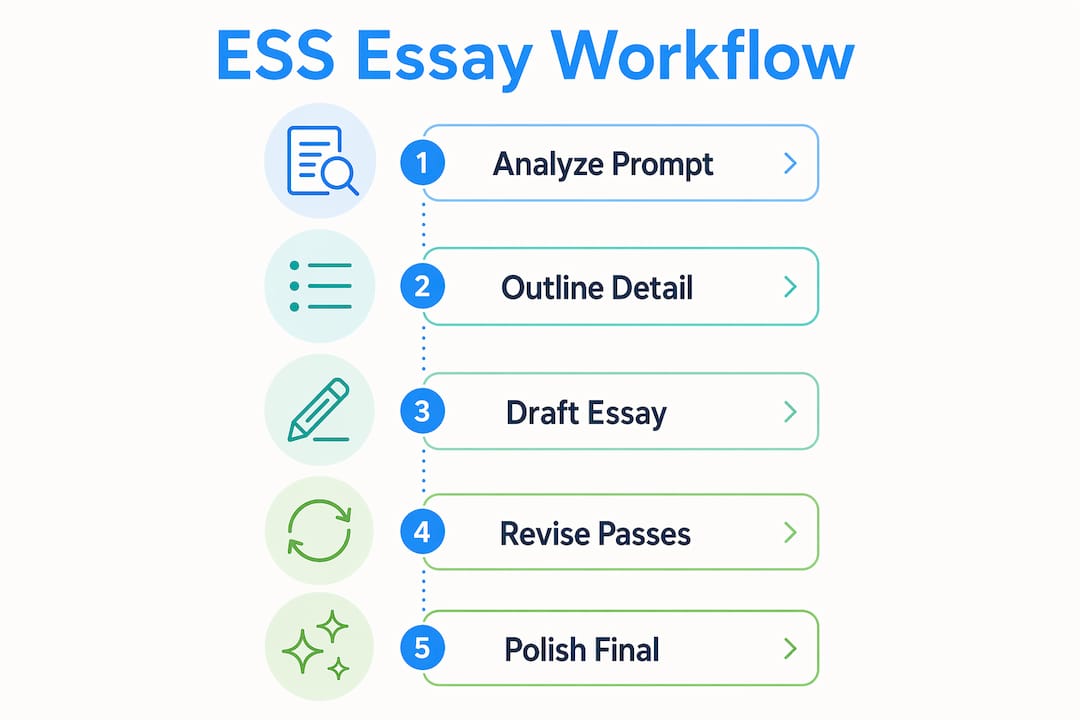
An ESS essay writing workflow is a structured sequence of steps that separates planning, drafting, and revising into distinct phases to produce clear, high-scoring essays. IB Environmental Systems and Societies students who follow this kind of academic writing workflow consistently produce stronger arguments and meet IB assessment criteria more reliably. The reason is simple: separating these three phases reduces cognitive load and prevents the mental fatigue that comes from trying to plan and polish at the same time. This guide walks you through every stage of that process, from reading the prompt to your final revision pass.

What initial steps should you take before writing an ESS essay?
Prompt analysis is the single most important step in the entire essay writing process. Missing the action verbs in a prompt leads to essays that are well written but misaligned with grading criteria. That gap between good writing and a good score is almost always caused by skipping this step.
Read the prompt at least three times before you write a single word. On the first read, get the general idea. On the second, underline the command terms: analyze, evaluate, compare, discuss. On the third, ask yourself what the examiner is actually testing. IB ESS prompts often hide expectations inside phrases like “with reference to a named example,” which requires specific case study evidence, not general knowledge.
Here is what a solid pre-writing phase looks like:
- Read the prompt three times. Each pass reveals something new about scope and expectations.
- Circle command terms. Words like “evaluate” require you to weigh strengths and limitations. “Describe” does not.
- Identify the ESS topic area. Is this about biodiversity, climate systems, or human population? Your examples must match.
- Brainstorm for 10–15 minutes. Effective brainstorming sessions at this length generate enough raw ideas without burning out your focus.
- Select your best three to four ideas. These become the backbone of your outline.
Pro Tip: Write the command term definition at the top of your planning page. If the prompt says “evaluate,” write “weigh evidence for and against” before you start. This keeps your argument aligned throughout.
Students often underestimate hidden assignment expectations. An ESS essay asking you to “discuss the impact of deforestation on species diversity” is not asking for a list of facts. It expects you to connect ecological concepts, cite named examples like the Amazon basin, and show cause-and-effect reasoning. Recognizing that distinction before you write saves you from a painful rewrite later.
How do you design an effective outline for ESS essays?
An outline is not a list of topics. Each outline point should link to a claim with supporting evidence that directly answers the essay question. That distinction matters because a topic-based outline produces a descriptive essay, while a claim-based outline produces an analytical one.
A strong ESS outline has three layers for each body paragraph: the topic sentence (your claim), the evidence (a named example, statistic, or case study), and the analysis (how the evidence supports your claim). Think of it as a mini-argument for each paragraph. When your outline is this detailed, drafting becomes much faster because you are filling in a structure, not inventing one.
Here is a comparison of outline detail levels to show you the difference in practice:
| Outline level | What it includes | Drafting speed | Essay quality |
|---|---|---|---|
| Basic (topic only) | Paragraph topic, no claim | Slow, requires rethinking | Often descriptive, not analytical |
| Intermediate (claim + evidence) | Topic sentence and one example | Moderate | Meets most IB criteria |
| Detailed (claim + evidence + analysis) | Topic sentence, named example, and analytical link | Fast, structure is clear | Consistently high scoring |
Pro Tip: Remove any outline point that does not have both a claim and at least one piece of evidence. If you cannot support it, cut it. Unsupported points waste word count and weaken your argument.
For an ESS essay on ecological footprint, a detailed outline point might read: “Claim: High-income nations have disproportionately large ecological footprints. Evidence: The United States’ per-capita footprint is roughly five times the global average. Analysis: This shows that consumption patterns, not population size alone, drive resource depletion.” That single outline point writes itself into a paragraph. A basic outline that just says “ecological footprint in rich countries” leaves you doing all that thinking during drafting, which slows you down and increases errors.
Esstutor’s IB ESS essay strategies consistently emphasize detailed outlining as the step that separates average scores from high ones.
How should you approach drafting your ESS essay for maximum effectiveness?
The goal of a first draft is to establish your argument’s structure, not to produce perfect sentences. Perfectionism during drafting reduces productivity and is one of the most common reasons students stall mid-essay. Write first. Fix later.
Trying to plan, draft, and edit simultaneously is a leading cause of writer’s block. When you sit down to draft, your only job is to translate your outline into paragraphs. Resist the urge to reread and rewrite sentences as you go.
Keep these drafting principles in mind:
- Start with body paragraphs, not the introduction. Your introduction is easier to write once you know exactly what your body argues.
- Use your topic sentences as anchors. Each paragraph starts with the claim from your outline. Everything else supports it.
- Write transitions at the end of each paragraph. A single sentence connecting your current point to the next one keeps the essay flowing logically.
- Set a time limit per paragraph. Giving yourself 10 minutes per body paragraph prevents overthinking and keeps momentum.
- Leave placeholders for missing evidence. If you cannot remember a specific statistic, write [FIND DATA] and keep going. Stop-and-search breaks your flow.
A strong body paragraph always contains a topic sentence, supporting evidence, detailed analysis, and a transition. In ESS essays, your evidence should be specific: name the ecosystem, the species, the policy, or the location. “Forests are being cut down” is weak. “The Brazilian Amazon lost an area larger than Belgium between 2019 and 2022” is strong.
Transition words improve flow by linking paragraphs and sentences logically. In ESS essays, transitions like “this contributes to,” “as a result,” and “in contrast” do more than connect ideas. They signal to the examiner that you understand cause-and-effect relationships, which is central to ESS assessment objectives.
What is the best revision workflow for ESS essays?
Revision done in a single pass almost always misses problems. Effective revision uses three distinct passes: a Clarity Pass, a Flow Pass, and a Word Choice Pass. Each pass has a specific focus, which prevents you from trying to fix everything at once and missing things as a result.
Clarity pass
Read your essay only for argument strength. Ask: does each paragraph make a clear claim? Does the evidence actually support that claim? Does the conclusion follow logically from the body? In ESS essays, a common clarity problem is stating a fact without connecting it to the question. “Biodiversity loss is increasing globally” is a fact. “Biodiversity loss reduces ecosystem resilience, which directly threatens the provisioning services that human populations depend on” is an argument.
Flow pass
Read your essay aloud. Your ear catches awkward transitions and repetitive sentence structures that your eye skips over. Look for paragraphs that feel disconnected from each other. Writing is a cyclical process, and the flow pass often reveals gaps in your argument that send you back to add a sentence or restructure a paragraph. That is normal and expected.
Word choice pass
This is where you cut filler and replace vague language with precise terms. In ESS, precision matters. Replace “the environment was affected” with “soil salinization reduced crop yields by disrupting osmotic balance.” Replace “many scientists think” with “the IPCC reports.” This pass also catches overused phrases and any sentence that restates a point you already made.
Here is a practical revision checklist you can use for every ESS essay:
- Does the introduction state a clear thesis that directly answers the prompt?
- Does each body paragraph open with a claim, not a fact?
- Is every piece of evidence linked to a named example (species, location, policy, or data)?
- Are transitions present between every paragraph?
- Does the conclusion synthesize the argument without introducing new information?
- Have you removed any paragraph that does not directly answer the question?
- Is your word count within the required range?
Pro Tip: Print your essay and revise on paper for the Clarity Pass. The physical distance from the screen helps you read what you actually wrote, not what you meant to write.
A common revision mistake is editing for style before checking for argument. Students fix grammar and word choice in paragraphs that should be cut entirely. Always check argument structure first. If a paragraph does not belong, no amount of polishing will save it.
Key takeaways
A structured ESS essay writing workflow built on three separate phases, prompt analysis, detailed outlining, purposeful drafting, and multi-pass revision, produces consistently stronger IB essays than writing without a plan.
| Point | Details |
|---|---|
| Analyze the prompt first | Identify command terms and hidden expectations before writing a single word. |
| Build claim-based outlines | Each outline point needs a claim, named evidence, and an analytical link. |
| Draft without editing | Write all body paragraphs before revising to avoid writer’s block and maintain momentum. |
| Revise in three passes | Use separate Clarity, Flow, and Word Choice passes to catch different types of problems. |
| Writing is cyclical | Expect to revisit earlier stages; returning to your outline during revision is normal and productive. |
What I’ve learned from watching students skip steps
After working with IB ESS students for over 13 years, the pattern I see most often is this: students who struggle with essays are not struggling because they lack knowledge. They struggle because they try to do everything at once. They open a blank document, read the prompt once, and start writing. By the third paragraph, they have lost the thread of their argument and are not sure how to get back to it.
The students who score highest treat writing as a process with distinct stages. They spend real time on prompt analysis, sometimes 15 minutes just on that. They build outlines that look almost like a rough draft. When they sit down to write, they are not thinking about what to say. They already know. They are just putting it into sentences.
The other thing I have noticed is that revision is where most students give up too early. They read through once, fix a few typos, and call it done. The three-pass revision method changes that completely. When you give each pass a specific job, you catch things you would never catch in a single read-through. I have seen students raise their essay scores significantly just by adding a proper revision stage to their ESS coursework workflow.
One more thing: do not treat the workflow as a rigid, one-way road. Writing is cyclical. If your revision reveals a gap in your argument, go back and fix the outline. If your drafting reveals that your thesis is too narrow, revise it before finishing the body. The workflow is a guide, not a cage.
— Marija
How Esstutor supports your ESS essay writing success
Esstutor is a specialized IB ESS tutoring platform built specifically for students who want to write stronger essays and score higher across all assessments. With over 13 years of IB examiner experience, Esstutor provides personalized guidance on every stage of the essay writing process, from prompt analysis to final revision.
Whether you are working on a timed exam essay or a longer extended essay, Esstutor’s resources are designed to meet you where you are. The ESS extended essay guide walks you through the full writing process with IB-specific strategies that align directly with assessment objectives. You can also explore the ESS assessment objectives workflow to make sure every essay you write hits the right criteria. Book a trial lesson and get feedback on your next essay from someone who has marked hundreds of them.
FAQ
What is an ESS essay writing workflow?
An ESS essay writing workflow is a structured sequence of planning, drafting, and revising stages designed to produce clear, well-argued IB Environmental Systems and Societies essays. Separating these phases reduces cognitive load and improves essay quality.
How long should I spend on planning before drafting?
Spend at least 10–15 minutes on brainstorming and prompt analysis before drafting. This time generates enough ideas and prevents structural problems that are costly to fix later.
Why do IB ESS essays need detailed outlines?
Detailed outlines that include a claim, named evidence, and analysis for each paragraph accelerate drafting and keep every paragraph directly linked to the essay question. Outlines without claims produce descriptive essays that score lower on IB criteria.
What is the three-pass revision method?
The three-pass revision method separates revision into a Clarity Pass (argument structure), a Flow Pass (transitions and readability), and a Word Choice Pass (precision and concision). Each pass catches a different category of problem that a single read-through misses.
How does Esstutor help with ESS essay writing?
Esstutor provides personalized IB ESS tutoring from an experienced IB examiner, covering essay planning, drafting feedback, and revision strategies tailored to IB assessment objectives.
No Comments