


14 May ESS extended essay: the IB student’s guide to success
TL;DR:
- The ESS extended essay is a challenging, interdisciplinary research project requiring systems thinking and original data analysis. It significantly impacts your IB Diploma, emphasizing clear structure, a focused research question, and rigorous methodology. Success depends on strategic planning, critical engagement, and understanding examiner expectations to achieve high marks.
The ESS extended essay is not a glorified report. That’s the first misconception worth clearing up. It’s a 4,000-word interdisciplinary research project that demands systems thinking, original data analysis, and the kind of critical argumentation that most students haven’t practiced before. It also carries real weight: the extended essay contributes up to 3 bonus points toward your IB Diploma, and failing to meet minimum standards can put your diploma eligibility at risk. This guide walks you through everything you need to know, from examiner expectations and research question strategies to timelines, structure, and the mistakes that cost students marks every year.
Table of Contents
- Understanding the ESS extended essay: requirements and expectations
- Choosing and developing your research question: strategies for ESS EEs
- Planning and executing your ESS extended essay research timeline
- Writing and structuring your ESS extended essay for top marks
- Common pitfalls and examiner insights to ace your ESS extended essay
- My perspective: the ESS EE rewards students who think, not just research
- Ready to get expert support for your ESS extended essay?
- Frequently asked questions
Key Takeaways
| Point | Details |
|---|---|
| Systems approach essential | The ESS extended essay requires integrating multiple disciplines with a clear systems approach to analyze environmental topics effectively. |
| Start early with planning | A structured 4-month timeline for topic selection, research, drafting, and revising helps meet IB deadlines and quality standards. |
| Sharp research question | Choose a focused research question demanding original data collection or rigorous analysis beyond literature reviews. |
| Follow essay structure | Use recommended word counts and sections, including introduction, body with subheadings, conclusion, and detailed methodology. |
| Reflect deeply on progress | Honest reflections in the RPPF are crucial for engagement marks and show your learning journey authentically. |
Understanding the ESS extended essay: requirements and expectations
The ESS extended essay sits at the intersection of science and social studies, which is exactly what makes it both challenging and genuinely interesting. Unlike extended essays in pure sciences or humanities, ESS requires you to connect environmental systems to human societies. You can’t write about deforestation rates in isolation. You need to analyze the ecological, economic, and social dimensions together.
According to IB and subject-specific guidance, ESS Extended Essays must demonstrate a systems approach, integrating theoretical contexts from multiple disciplines with primary or secondary data analysis, and use command terms effectively. This is a higher bar than many students expect going in.
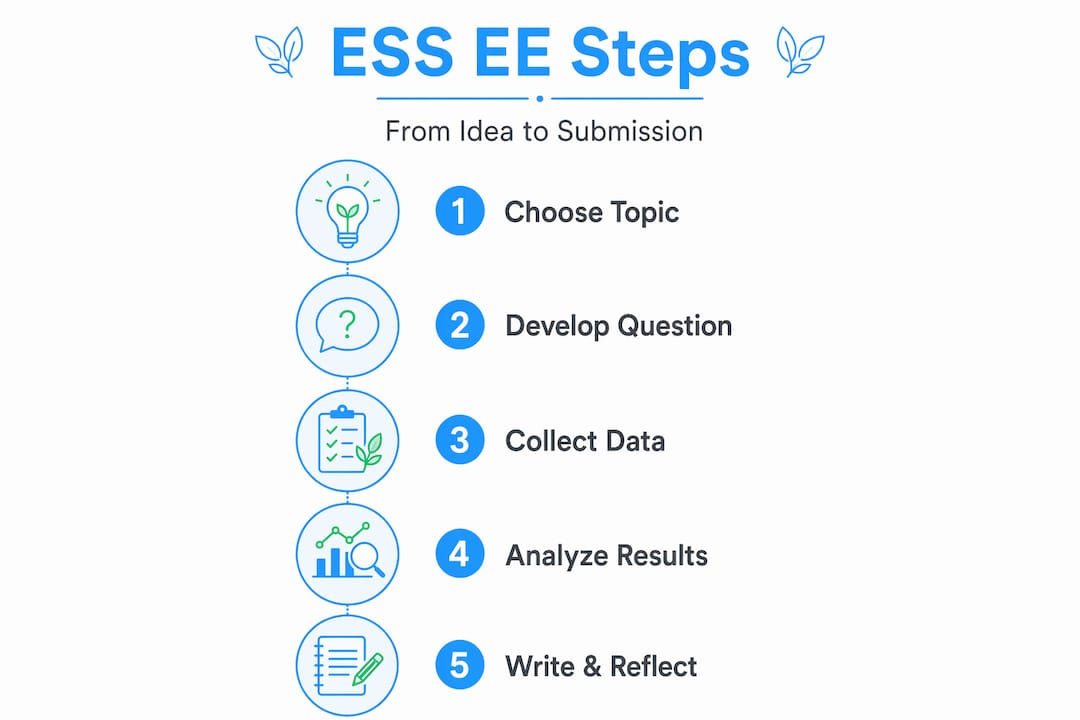
Understanding the systems approach in ESS is foundational. A systems approach means identifying inputs, outputs, feedback loops, and interactions between components. When you apply this to your essay, you’re not just describing a problem. You’re analyzing how different parts of a system interact and what that means for your research question.
Here are the core expectations examiners look for in a high-scoring ESS EE:
- Interdisciplinary integration: Your essay must draw on at least two disciplines. For example, combining ecology and economics when analyzing the impact of urban green spaces on local biodiversity and property values.
- Effective use of command terms: Words like evaluate, analyze, and discuss signal specific depth of thinking. Using them correctly in your writing shows examiners you understand what’s being asked.
- Methodology, not just description: Examiners consistently flag essays that describe environmental issues without analyzing data. You need to collect, process, and interpret evidence.
- Structured introduction and clear conclusion: Examiner reports repeatedly note that weak introductions and vague conclusions are among the most common reasons for lower scores.
- Academic integrity: Proper citation and paraphrasing are non-negotiable. Understanding how similarity reports strengthen academic integrity can help you approach referencing with the right mindset from the start.
The good news is that once you understand these expectations clearly, the path forward becomes much more manageable.
Choosing and developing your research question: strategies for ESS EEs
Your research question is the backbone of your entire essay. A weak or vague question leads to an unfocused essay, and no amount of polished writing can fix that. This is where many students underestimate the time needed upfront.
Start by brainstorming at least 10 potential research questions early, ideally within the first two weeks of beginning your ESS EE. Bring these to your supervisor. Their feedback at this stage saves you weeks of wasted effort later. Strong ESS research project ideas connect a local, observable environmental issue to broader systemic and societal factors.
Here’s a practical process for developing your research question:
- Identify a local environmental issue you can observe or measure. Think about your school grounds, a nearby river, a local forest, or urban air quality. Local topics make primary data collection realistic.
- Connect it to an ESS syllabus theme. Topics like biodiversity, pollution, climate change, food systems, or water management all align well with extended essay topics for ESS.
- Check whether it demands analysis, not just description. Ask yourself: can this question be answered by reading three articles? If yes, it’s too simple. Your question needs to require data collection and interdisciplinary reasoning.
- Test the scope. A question like “How does plastic pollution affect marine ecosystems?” is too broad. “How does microplastic concentration in [local river name] correlate with invertebrate species diversity?” is focused and measurable.
- Confirm feasibility. Can you realistically collect the data you need with school-level resources and within your timeline? If not, adjust.
The research question must demand rigorous data collection and analysis beyond simple literature review, with interdisciplinary ESS topics excelling when connecting environmental systems to societal impacts. This is exactly the standard your question needs to meet.
Pro Tip: Review past IB ESS examiner reports before finalizing your question. Examiners often describe the kinds of questions that score well and those that don’t. This is free, direct insight into what the people marking your essay actually want to see. You can also explore ESS research question strategies to sharpen your approach.
Planning and executing your ESS extended essay research timeline
Time management is where many students lose control of their ESS EE. The essay feels distant until it suddenly isn’t, and rushing the final draft almost always shows in the quality. A clear four-month plan keeps you on track without the last-minute panic.

A recommended four-month timeline for ESS EE completion includes Month 1 for topic and research question selection with supervisor approval (including a 500-word proposal), Month 2 for research with 20 or more sources and data collection, Month 3 for a first complete draft, and Month 4 for revisions and final submission by mid-March for May exams.
Here’s how each month should look in practice:
- Month 1: Finalize your topic and research question. Write a 500-word proposal outlining your RQ, methodology, and why it’s feasible. Get supervisor sign-off before moving forward.
- Month 2: Conduct your research. Gather at least 20 credible sources. Begin primary data collection if your methodology requires it. Keep detailed notes and cite as you go.
- Month 3: Write your first complete draft. Don’t aim for perfection here. Aim for completeness. Submit to your supervisor for feedback before the month ends.
- Month 4: Revise based on supervisor feedback. Finalize your essay, complete your RPPF reflections, and submit by the internal mid-March deadline.
| Month | Key tasks | Milestone |
|---|---|---|
| 1 | Topic selection, RQ development, supervisor meeting | Approved 500-word proposal |
| 2 | Literature review, data collection, source gathering | 20+ sources compiled |
| 3 | Full first draft written | Draft submitted to supervisor |
| 4 | Revision, RPPF completion, final formatting | Final essay submitted |
Pro Tip: Don’t wait for your supervisor to reach out to you. Schedule your own check-ins at the start of each month. Supervisors manage multiple students, and the ones who communicate proactively tend to get more useful feedback.
Writing and structuring your ESS extended essay for top marks
Knowing how to structure an ESS essay is just as important as the research itself. Examiners read hundreds of essays. A well-organized essay signals immediately that you understand the task.
Successful ESS EEs include 300 to 400 word introductions, 2,800 to 3,000 word bodies, and 250 to 350 word conclusions, per subject reports; they must integrate command terms and a systems approach throughout.
Here’s a breakdown of each section and what it needs to accomplish:
| Section | Word count | What it must include |
|---|---|---|
| Introduction | 300-400 | RQ, rationale, scope, structural roadmap |
| Body | 2,800-3,000 | Subheadings, data analysis, systems approach, argumentation |
| Conclusion | 250-350 | Direct answer to RQ, limitations, broader implications |
| References | No word count limit | 15+ academic sources, consistent citation style |
| RPPF | Max 500 words | Honest reflections on process, challenges, and growth |
A few structural rules that matter in practice:
- Your introduction must state your RQ clearly within the first paragraph. Don’t build up to it. State it, explain why it matters, and outline what your essay will cover.
- Use subheadings in the body that reflect your systems approach. For example, “Ecological impacts of agricultural runoff” and “Socioeconomic factors driving fertilizer use” shows interdisciplinary thinking through structure itself.
- Your conclusion must directly answer your RQ. Not summarize your essay. Answer the question, acknowledge limitations, and connect to broader environmental implications.
- Justify your methodology. Explain why you chose your data collection method, what its limitations are, and how it fits within what’s achievable with school-level resources.
You can find detailed ESS extended essay structure tips and writing tips for ESS essay scores to help you refine each section before submission.
Pro Tip: Write your conclusion before you finalize your introduction. It sounds counterintuitive, but knowing exactly what conclusion you’re building toward helps you write a sharper, more focused introduction.
Common pitfalls and examiner insights to ace your ESS extended essay
Understanding what goes wrong in low-scoring essays is just as valuable as knowing what goes right. After reviewing examiner reports and guidance from schools with strong ESS EE track records, a few patterns stand out clearly.
High-scoring ESS EEs always include a detailed methodology section justifying data collection feasibility; lack of rigorous analysis and weak reflections consistently cost marks across the board.
Here are the most common pitfalls to avoid:
- Vague or overly broad research questions. “How does climate change affect biodiversity?” cannot be answered in 4,000 words with any rigor. Narrow your focus to a specific location, species group, or measurable variable.
- Ignoring syllabus cross-referencing. Your essay should connect to ESS syllabus themes. If your examiner can’t see the ESS connection, you lose marks for subject-specific knowledge.
- Methodology that can’t be repeated. If another student couldn’t replicate your data collection using your description, it’s not rigorous enough. Include enough detail that your method is transparent and reproducible.
- Superficial RPPF reflections. Writing “I learned a lot and enjoyed the process” in your reflections earns zero engagement marks. You need to document specific challenges, decisions you made, and what you would do differently.
- Plagiarism through poor paraphrasing. Always cite your sources and make sure you understand how to maintain academic integrity in your writing.
“Examiners consistently reward essays that show genuine intellectual engagement with the research process, not just polished final products. The RPPF is your opportunity to demonstrate that engagement directly.” — Examiner guidance, ESS EE subject reports
You can also review the avoid ESS essay mistakes resource for more targeted advice on common errors and how to address them before submission.
My perspective: the ESS EE rewards students who think, not just research
After working with IB ESS students for over 13 years, I’ve noticed something that surprises many of them. The students who score highest on the ESS extended essay are not always the ones who collect the most data or cite the most sources. They’re the ones who genuinely think about what their data means.
The ESS EE is an invitation to think like an environmental scientist and a social analyst at the same time. That’s rare in secondary education, and it’s actually one of the things that makes writing an extended essay in ESS so worthwhile. Students who treat it as a box-ticking exercise almost always plateau around a C or D. Students who get curious about their question, who follow unexpected findings, who honestly reflect on what went wrong in their data collection, those students tend to reach A and B territory.
One thing I always tell students: don’t be afraid of limitations. Examiners don’t expect you to solve a global environmental problem in 4,000 words. They want to see that you understand the boundaries of your research and can discuss them intelligently. A conclusion that says “my sample size of 30 water samples limits the generalizability of these findings, but the trend observed suggests…” is far more impressive than one that overclaims certainty.
The ESS EE is genuinely one of the most intellectually rewarding parts of the IB Diploma. Approach it with curiosity, plan it carefully, and don’t wait until you’re stuck to ask for help.
Ready to get expert support for your ESS extended essay?
Navigating the ESS extended essay on your own can feel overwhelming, especially when you’re also managing exams, internal assessments, and the rest of your IB workload. That’s where personalized support makes a real difference.
At ESS Tutor, I work one-on-one with IB ESS students worldwide to help them develop strong research questions, build structured essays, and meet IB examiner expectations with confidence. With over 13 years of experience as an IB examiner and ESS educator, I know exactly what examiners look for and how to help you get there. Whether you’re just starting your ESS EE or need feedback on a draft, I’d love to help. Book a trial lesson today and let’s work on your essay together.
Frequently asked questions
What makes the ESS extended essay different from other IB extended essays?
The ESS extended essay requires a systems approach integrating multiple disciplines and original data analysis, not just literature review, to address environmental topics with the rigor IB expects.
How long should the ESS extended essay be and how is it structured?
It should be approximately 4,000 words, divided into a 300 to 400 word introduction, a 2,800 to 3,000 word body with subheadings, and a 250 to 350 word conclusion, plus references and RPPF reflections.
When should I start working on my ESS extended essay to meet IB deadlines?
Start at least four months before your internal deadline. A four-month timeline covers topic selection and proposal in Month 1, research in Month 2, drafting in Month 3, and revisions and final submission in Month 4.
How important are the reflections and engagement in my ESS EE?
Very important. The RPPF reflections directly affect your Engagement marks, and superficial reflections score zero even when the essay itself is strong. Write honestly about your process, challenges, and what you learned along the way.
No Comments