


27 Mar How to prepare for ESS exams: proven strategies for IB success
You have the ESS syllabus open, a stack of past papers on your desk, and about three weeks until your exam. The subject blends environmental science, systems thinking, and real-world case studies, and it can feel overwhelming to know where to start. The good news is that ESS rewards students who prepare strategically, not just those who study the longest. This guide walks you through the exact steps to structure your revision, sharpen your exam technique, and use every available resource to aim for a 6 or 7.
Table of Contents
- Understanding the ESS exam structure and syllabus
- Building your personalized revision plan
- Mastering command terms and data interpretation
- Case studies, mind maps, and Paper 2 essay technique
- Practice, well-being, and effective use of tutoring
- Getting your ESS Internal Assessment right
- Unlock your full ESS potential with expert support
- Frequently asked questions
Key Takeaways
| Point | Details |
|---|---|
| Know your exam structure | Understanding the ESS syllabus and assessment format streamlines your revision and boosts confidence. |
| Active learning works best | Spaced repetition, mind maps, and practice questions are far more effective than passive reading. |
| Command terms are critical | Mastering command terms and data interpretation is essential for scoring well, especially in Paper 1. |
| Case studies strengthen essays | Organized case study banks help you write high-scoring Paper 2 essays and answer complex questions. |
| Practice and feedback matter | Regular past paper mocks and seeking feedback from tutors accelerate progress and improve final scores. |
Understanding the ESS exam structure and syllabus
Before you write a single revision note, you need to know exactly what you are being tested on. ESS is offered at Standard Level (SL) and Higher Level (HL), and the assessment structure differs meaningfully between them.
For SL, external exams are 75% of your grade: Paper 1 is 25% (1 hour, 35 marks) and Paper 2 is 50% (2 hours, 60 marks), with the Internal Assessment (IA) making up the remaining 25%. For HL, external exams are 80%: Paper 1 is 30% (2 hours, 70 marks) and Paper 2 is 50% (2.5 hours, 80 marks), with the IA at 20%.
| Component | SL weighting | HL weighting |
|---|---|---|
| Paper 1 | 25% (1 hr, 35 marks) | 30% (2 hr, 70 marks) |
| Paper 2 | 50% (2 hr, 60 marks) | 50% (2.5 hr, 80 marks) |
| Internal Assessment | 25% | 20% |
The 2026 syllabus updates place stronger emphasis on systems thinking, multiple perspectives, and sustainability frameworks. HL students also engage with additional lenses including environmental law and ethics. If you are studying for the first exams in May 2026, make sure your notes reflect these changes, not the old syllabus.
Key areas to prioritize in your revision:
- Systems diagrams and feedback loops
- Sustainability concepts across all topics
- Perspectives (environmental, economic, social)
- HL lenses for students at Higher Level
Understanding the ESS class overview early helps you see how topics connect, which is exactly what the exam rewards. If you are still deciding whether ESS is the right fit, the ESS suitability guide is worth a read.
Building your personalized revision plan
A generic study schedule rarely works for ESS. The subject is broad, and every student has different gaps. The most effective approach is to use the IB ESS syllabus as your primary revision roadmap, breaking it into sections and allocating more time to your weakest areas.
Start by rating your confidence in each topic from 1 to 5. Topics rated 1 or 2 get the most revision time. Topics rated 4 or 5 need only light review and practice questions.

Comparison: topic-based vs. time-based revision
| Approach | Best for | Risk |
|---|---|---|
| Topic-based | Filling specific knowledge gaps | May neglect weaker areas |
| Time-based | Consistent daily progress | Can waste time on strong topics |
| Combined (recommended) | Targeted and consistent | Requires honest self-assessment |
Once you have your priority list, build your schedule around active learning techniques like spaced repetition and visual aids rather than passive re-reading. Passive reading feels productive but does not build the retrieval skills the exam demands.
- Map the syllabus and rate your confidence per topic
- Create flashcards for key terms, case studies, and definitions
- Draw systems diagrams from memory to test recall
- Schedule spaced repetition sessions every 3 to 5 days for difficult topics
- Review and adjust your plan weekly based on mock results
Pro Tip: Block 20 minutes at the end of each study session to write down three things you learned and one thing you still find confusing. This forces active processing and gives you a ready-made list for your next session.
For curated study materials, the ESS revision resources page and the ESS success tips guide are both excellent starting points.
Mastering command terms and data interpretation
One of the most common reasons students lose marks in ESS is misreading what a question is actually asking. IB questions are built around command terms, and each one signals a specific type of response.
The most frequently tested command terms in ESS include:
- Define: Give the precise meaning of a term
- Explain: Give a detailed account of causes or mechanisms
- Evaluate: Make a judgment based on evidence and reasoning
- Discuss: Present multiple perspectives with supporting evidence
- Outline: Give a brief account or summary
You can find full definitions in the ESS command terms guide. Knowing the difference between “explain” and “evaluate” can be the difference between a 4 and a 6.
Paper 1 is where data interpretation skills matter most. You will face unseen stimulus material including graphs, tables, and diagrams, and you need to practice data interpretation regularly to build confidence with unfamiliar formats.
ESS rewards application and evaluation over rote memorization. Unseen stimuli in Paper 1 test your ability to think on your feet, not just recall facts.
The best way to build this skill is through consistent work with past papers for ESS. Aim to attempt at least one full Paper 1 per week in the final month before your exam.
Case studies, mind maps, and Paper 2 essay technique
Paper 2 is where your preparation either pays off or falls apart. Strong essay answers require more than content knowledge. They require structure, evidence, and clear evaluation.
Start by building a bank of detailed case studies organized by topic. Each case study entry should include the location, time period, specific data points, and the environmental issue it illustrates. Vague references to “a country in Africa” will not earn marks. Specific references to the Aral Sea shrinkage or the Amazon deforestation rate will.
Mind maps are one of the fastest tools for recall under pressure. Draw one mind map per major topic, connecting concepts, case studies, and perspectives. Redraw them from memory the following day. The act of reconstructing the map is what builds retention.
For Paper 2 essays, structure your answers with a clear argument in the opening sentence, evidence from at least two case studies, a balanced evaluation of different perspectives, and an explicit conclusion that directly answers the question.
- Opening sentence: State your argument clearly
- Body paragraphs: One idea per paragraph, supported by case study evidence
- Evaluation: Acknowledge counterarguments or limitations
- Conclusion: Directly answer the question in 2 to 3 sentences
Pro Tip: Before writing your essay in the exam, spend 3 minutes planning your argument and selecting two case studies. Students who plan first consistently write more focused, higher-scoring essays.
If your IA overlaps with your essay topics, the ESS IA ideas page and the ESS IA guide can help you see how your investigation connects to broader exam themes.
Practice, well-being, and effective use of tutoring
Knowledge without practice is not enough. The students who score 6s and 7s in ESS are not necessarily the ones who know the most. They are the ones who have practiced applying that knowledge under timed, exam-like conditions.
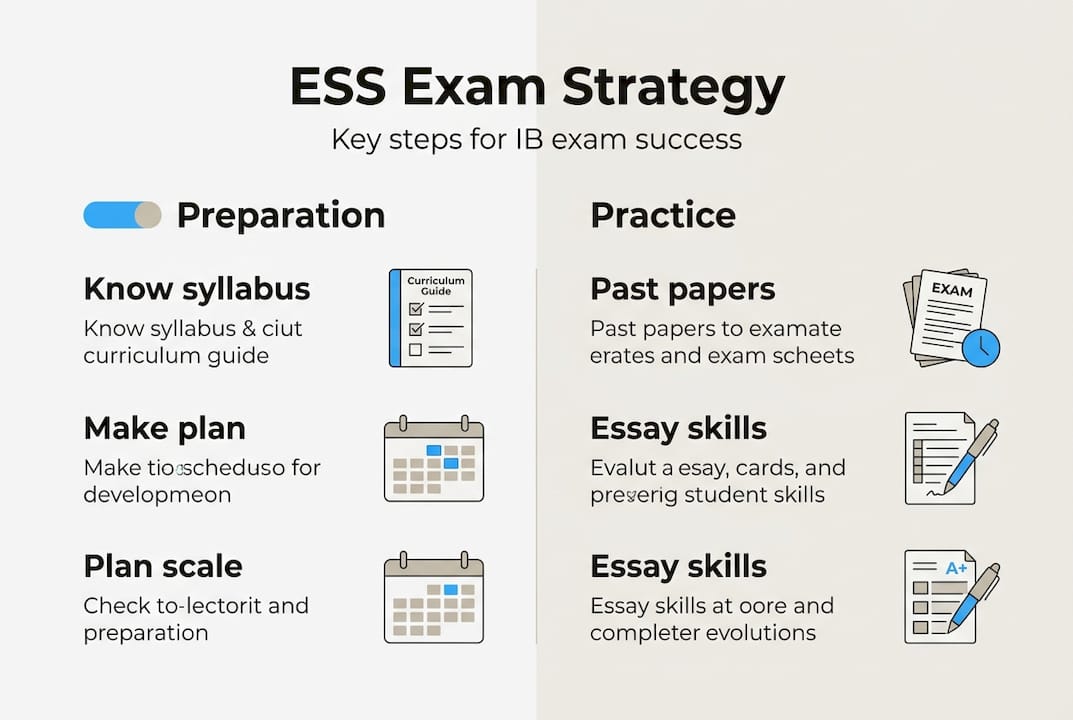
In 2024, 65% of SL students achieved grade 4 or above with an average score of around 4.2 out of 7. That means a significant portion of students are passing, but the gap between a 4 and a 7 comes down to technique and targeted preparation.
Key habits of high-scoring ESS students:
- Timed past paper practice at least twice per week in the final month
- Self-marking with mark schemes to understand exactly where marks are awarded
- Regular sleep and exercise to maintain cognitive performance
- Seeking feedback on essays and IA drafts from someone who knows the mark scheme
Practicing past papers under timed conditions builds both technique and stamina. Many students underestimate how tiring a 2.5-hour paper feels without prior practice.
One-on-one tutoring is particularly effective for ESS because the subject requires nuanced feedback. A tutor who understands the mark scheme can show you exactly why an essay scores a 6 instead of a 7, and what to change. Top scorers balance mocks with well-being and use tutoring to fill the gaps that self-study cannot address. You can explore expert tutor tips and find out more about remote ESS tutoring options that fit your schedule.
Getting your ESS Internal Assessment right
The IA is not a bonus. At SL it is 25% of your final grade, and it is one of the few components where you have full control over the outcome. A well-executed IA can anchor your overall score even if exam day does not go perfectly.
The foundation of a strong IA is a focused, testable research question. Broad questions like “How does pollution affect ecosystems?” are impossible to investigate meaningfully in a school-based study. Narrow it down to a specific location, variable, and measurable outcome.
Structure your IA logically with a clear introduction that contextualizes your research question, a methodology section that explains your data collection process, a data analysis section with appropriate graphs and statistics, and an evaluation that honestly addresses limitations and suggests improvements.
- Research question: Specific, measurable, and environmentally relevant
- Introduction: Context, background, and hypothesis
- Methodology: Reproducible and clearly justified
- Data and analysis: Processed data with visual representation
- Evaluation: Limitations, improvements, and real-world relevance
Pro Tip: Write your evaluation section last but plan for it first. Knowing your methodology’s limitations before you collect data helps you design a stronger investigation from the start.
For detailed guidance, the writing ESS IA page and the score 7 in ESS IA guide walk you through every criterion with examples.
Unlock your full ESS potential with expert support
You now have a clear framework: understand the exam structure, build a targeted revision plan, master command terms, practice essays with real case studies, and nail your IA. The next step is making sure you are not doing all of this alone.
At esstutor.net, personalized tutoring is built specifically for IB ESS students. With over 13 years of experience as an IB examiner and educator, the tutor knows exactly what examiners look for and where students typically lose marks. Whether you need expert ESS exam tips, access to quality ESS study notes, or targeted ESS IA tutoring to push your IA score higher, there is a session format that fits your needs. Book a trial lesson and start closing the gap between where you are and the score you want.
Frequently asked questions
What are the most effective ways to revise for ESS exams?
Active learning techniques like spaced repetition, mind maps, and timed past paper practice consistently outperform passive re-reading for ESS. Combine these with regular self-marking to build both knowledge and exam technique.
How much of the ESS grade comes from the Internal Assessment?
For SL, the IA is 25% of your grade; for HL, it is 20%. Both levels weight the IA significantly, making it a high-value component worth investing serious time in.
What do top ESS students do differently to score 6 or 7?
They combine consistent past paper practice with strong essay structure and detailed case studies. Top scorers also seek targeted feedback from tutors who understand the mark scheme rather than relying solely on self-study.
How should I structure my Paper 2 ESS essays?
Open with a clear argument, support it with specific case study evidence, evaluate multiple perspectives, and close with a direct conclusion. Planning for 3 minutes before writing makes a measurable difference in essay quality.
What’s the biggest mistake students make on ESS exams?
Ignoring command terms and failing to adapt to unseen stimuli in Paper 1 are the most common causes of lost marks. ESS rewards application over memorization, so students who only recall facts without analyzing them consistently underperform.
No Comments