


02 Apr How to use past papers for ESS exam success
Most IB ESS students who regularly practice with past papers report dramatically improved scores and confidence going into their final exams. Yet many students still sit down with a past paper, flip through a few questions, and wonder why it is not helping. The problem is not the tool. It is the strategy. 65% of SL students passed in 2024 among those who used past papers with a clear plan. This guide walks you through exactly how to use past papers effectively, from building a weekly routine to mastering command terms and reviewing your answers like an examiner would.
Table of Contents
- Understanding why past papers matter in ESS
- How to create a strategic past paper practice routine
- Mastering command terms and exam skills with past papers
- Reviewing and analyzing your past paper answers
- A new way to use past papers: Go beyond memorization
- Next steps: Get expert support for your ESS exams
- Frequently asked questions
Key Takeaways
| Point | Details |
|---|---|
| Practice makes perfect | Consistent, realistic past paper practice is the best way to boost ESS scores. |
| Command terms are key | Learning to decode and target command terms is crucial for scoring high. |
| Review for growth | Analyzing mistakes with markschemes helps you learn faster and avoid repeating errors. |
| Recent papers matter | Use the latest ESS past papers to ensure you are studying the current exam format. |
Understanding why past papers matter in ESS
If you have ever opened an ESS exam paper and felt unsure about what the question was actually asking, you are not alone. The IB ESS exam has a specific structure, and understanding it early gives you a real advantage. Paper 1 focuses on data analysis and short-answer questions based on a provided resource booklet. Paper 2 covers extended essays and application of environmental concepts. Knowing this structure matters because each paper demands a different set of skills.
The role of past papers goes far beyond simple repetition. They show you exactly what the IB expects, how questions are phrased, and which topics come up repeatedly. More importantly, they train you to recognize command terms, the specific verbs like define, explain, evaluate, and discuss that tell you exactly what kind of answer is needed.
Command terms are one of the most misunderstood parts of the ESS exam. Students often write general answers when the question demands a specific type of response. Practicing with recent past papers hones command terms and exam technique in a way that reviewing notes simply cannot.
Benefits of past paper practice
| Benefit | What it builds |
|---|---|
| Confidence | Familiarity with question styles reduces exam anxiety |
| Timing | You learn to pace yourself across each paper |
| Format familiarization | You understand how marks are distributed |
| Command term mastery | You respond precisely to what each question asks |
Here is a quick summary of why past papers are so valuable:
- They expose you to the real language and tone of IB questions
- They reveal which topics are tested most frequently
- They help you practice under timed, realistic conditions
- They show you where your knowledge gaps actually are
“Using ESS exam strategies grounded in past paper practice is one of the most reliable ways to improve your score. Students who engage with real exam questions consistently outperform those who rely on notes alone.” — IB ESS Examiner with 13 years of experience
One more thing worth noting: IB updates its exam format periodically. Using the most recent papers ensures you are practicing with the current structure and markscheme style. Older papers are still useful for variety, but always prioritize the latest ones.
With the value of past papers established, the next step is to set up a routine that makes your practice truly pay off.
How to create a strategic past paper practice routine
Having a stack of past papers is one thing. Using them strategically is another. The students who see the biggest gains are the ones who treat past paper sessions like real exams, not casual study time.

Start by selecting your papers in order. Begin with the most recent years first, since these reflect the current format and markscheme expectations. Once you have worked through the last three to four years, move to older papers for additional variety and exposure to different question angles.
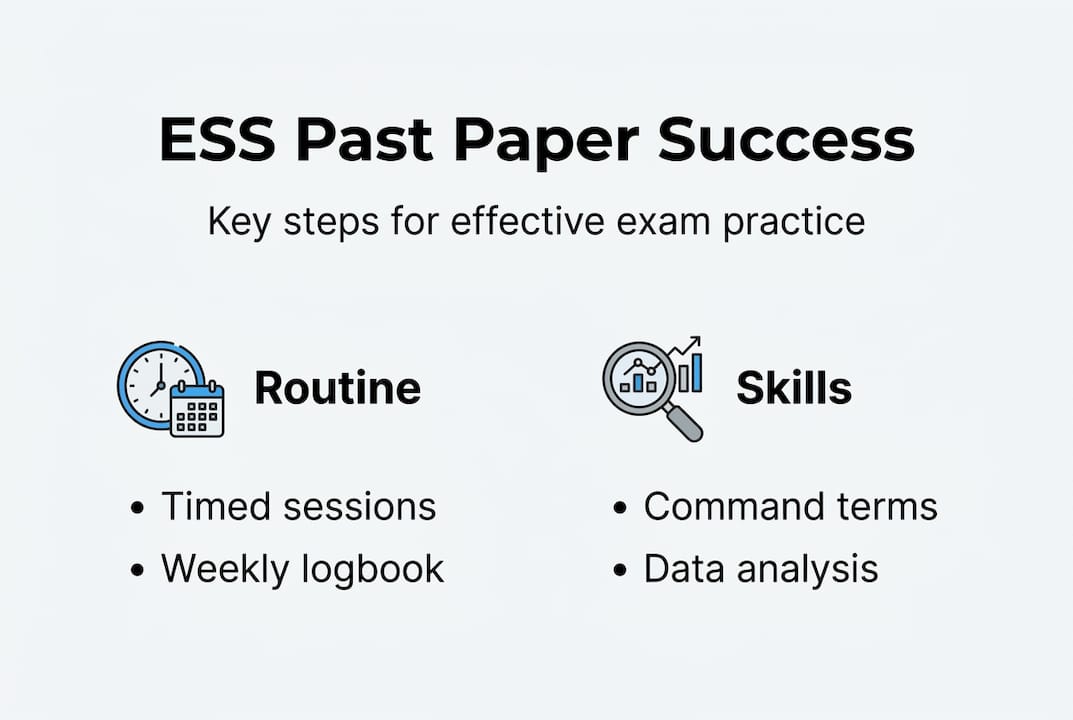
Here is a weekly routine that works well in the final month before exams:
- Select your paper. Choose either IB ESS Paper 1 or IB ESS Paper 2 for the session. Alternate between them across the week.
- Simulate real exam conditions. Set a timer, remove your notes, and sit somewhere quiet. Treat it like the actual exam.
- Complete the paper without stopping. Resist the urge to check answers mid-way. Build your stamina and decision-making under pressure.
- Review your answers using the markscheme. Go through each response carefully and identify where you lost marks.
- Analyze your command term usage. Ask yourself: did I actually answer what was asked, or did I answer what I wanted to say?
- Update your logbook. Record recurring mistakes, tricky topics, and command terms you struggled with.
That logbook is genuinely one of the most useful tools you can keep. Over time, patterns emerge. You might notice you consistently lose marks on evaluate questions, or that ecosystem services questions trip you up. This kind of targeted awareness makes your study time far more efficient.
Practice at least one full Paper 1 per week in the final month to sharpen your data interpretation skills. Paper 1 requires you to read graphs, analyze trends, and draw conclusions quickly. That skill only improves with repetition.
Pro Tip: Keep a dedicated logbook just for past paper mistakes. Write down the question, the command term used, your answer, and what the markscheme expected. Review it weekly. You will be surprised how quickly you stop making the same errors. For more targeted advice, check out these study pro tips from an IB examiner.
A solid routine is essential, but to maximize your gains, you must understand the language and expectations of the examiners.
Mastering command terms and exam skills with past papers
Command terms are the backbone of every IB ESS question. If you misread a command term, you can write a perfectly accurate answer and still lose most of the marks. This is one of the most common and most avoidable mistakes students make.
Let us look at the most important command terms and what examiners actually expect:
| Command term | What the examiner wants |
|---|---|
| Define | A precise, concise meaning of a term |
| Explain | A reason or mechanism, showing cause and effect |
| Evaluate | A balanced judgment with evidence on both sides |
| Justify | A reason or argument supporting a position |
| Discuss | A consideration of multiple perspectives or arguments |
The difference between explain and evaluate trips up a lot of students. Explaining means you show how or why something happens. Evaluating means you weigh up strengths and weaknesses, advantages and disadvantages, and reach a reasoned conclusion. These are very different tasks.
Here are some practical techniques to improve your command term responses:
- Read the command term first, before anything else in the question
- Underline it and write a quick mental note of what it demands
- Structure your answer to match the command term, not just the topic
- Use the markscheme to check whether your response type matched the expectation
- Practice writing short responses to each command term type using ESS command terms as a reference
Command terms like evaluate require balanced arguments and are best developed through repeated past paper practice. You genuinely cannot learn this skill from notes alone. You need to practice writing under the pressure of a timed exam.
The ESS syllabus overview can also help you connect command terms to specific topic areas. Some topics lend themselves to evaluate questions more than others, such as environmental value systems or sustainability strategies.
Pro Tip: After completing a past paper question, write the command term in the margin next to your answer. Then ask a classmate or tutor to check whether your response actually matches what that term demands. This kind of peer review is one of the fastest ways to sharpen your exam technique. You can also explore command terms in ESS for detailed definitions.
With command terms decoded, it is time to ensure your practice translates to real exam confidence by learning how to review, analyze, and learn from your mistakes.
Reviewing and analyzing your past paper answers
Completing a past paper is only half the work. The review process is where the real learning happens. Many students skip this step or rush through it, and that is a missed opportunity.
Here is a step-by-step process for reviewing a completed past paper effectively:
- Compare your answers to the markscheme. Go line by line. Do not just check if you got the right topic. Check if you used the right language and structure.
- Identify where you lost marks. Be honest. Was it missing content, a misread command term, or poor essay structure?
- Rewrite or annotate your answer. Take your weakest response and rewrite it using the markscheme as a guide. This active correction builds memory far better than passive reading.
- Track your score across papers. Keep a simple record of your total marks over time. Watching your score improve is genuinely motivating.
- Adjust your study focus. If you keep losing marks on biodiversity topics or pollution case studies, that is where your next study session should go.
Use past papers to train essay structure for Paper 2 and data interpretation for Paper 1. These are distinct skills, and your review process should reflect that. For Paper 2 analysis, focus on whether your essays have a clear argument, relevant examples, and a conclusion that directly addresses the question.
Here are the most common mistakes students make and how to avoid them:
- Missing the command term. Always re-read the question after writing your answer to check alignment.
- Insufficient depth. One-sentence answers rarely earn full marks. Expand your points with examples or data.
- Poor essay structure. Use a clear introduction, body paragraphs with one idea each, and a focused conclusion.
- Ignoring the resource booklet. In Paper 1, the data is there to be used. Reference it explicitly in your answers.
- Not using ESS command terms correctly. Review the definitions regularly, not just before the exam.
By now, you have a complete system for leveraging past papers. Let us tie everything together and reveal how these strategies create lasting exam readiness.
A new way to use past papers: Go beyond memorization
Here is something I want you to think about. Most students use past papers to memorize model answers. They read the markscheme, copy the expected points, and move on. This feels productive, but it is actually one of the least effective approaches.
The students who perform best are the ones who use past papers to build flexibility. They ask themselves: what if this question came from a slightly different angle? What if the data showed a different trend? What if the case study was unfamiliar? This kind of reflective thinking is what separates a 6 from a 7.
“Students who adapt past paper routines to simulate real exam challenges build lasting exam readiness, not just familiarity with old questions.”
Markscheme perfection is less useful than learning to analyze and adapt. When you encounter a question that throws you off, note what specifically confused you. Was it the phrasing? The topic combination? The command term in an unexpected context? Then rehearse responses to similar variations.
Using past papers strategically means treating each session as a thinking exercise, not a memory test. That mindset shift is what makes practice your real competitive advantage.
Next steps: Get expert support for your ESS exams
Using past papers with a clear strategy will take your ESS preparation to a new level. But combining that practice with expert feedback is where students see the most significant gains. Having an experienced IB examiner review your responses, identify your blind spots, and guide your revision can make a real difference in your final score.
At esstutor.net, you can access personalized tutoring for every part of your ESS assessment, including internal assessment tutoring, targeted Paper 2 guidance, and a full library of ESS study notes. Whether you need help structuring your essays, interpreting data, or understanding markscheme expectations, support is available. Book a trial lesson today and start building the exam confidence you need.
Frequently asked questions
How many past papers should I practice before the ESS exam?
Aim to complete at least one full Paper 1 per week in the last month before your exam. Consistent, timed practice builds the data interpretation and timing skills you need most.
Is it better to use recent or older ESS past papers?
Prioritize recent papers since the IB updates its format and markscheme style over time. Use older papers for additional variety once you have covered the most current ones.
How do I check if my past paper answers are good enough?
Compare your responses directly to the official markscheme and focus on whether your answer matches the command term. Markscheme alignment and precise use of command terms are the two clearest indicators of a strong answer.
Can practicing past papers help with ESS Paper 2 essays?
Yes, absolutely. Repeated practice with essay questions builds essay structure, strengthens your argument quality, and gives you the confidence to tackle unfamiliar topics under timed conditions.
No Comments