


28 Mar IB ESS internal assessments: boost your score in 2026
Many IB ESS students pour their energy into exam preparation and treat the internal assessment as an afterthought. That’s a costly mistake. Your internal assessment (IA) is not a side project. It’s a structured, graded component that directly shapes your final IB diploma score. In this guide, we’ll break down exactly what internal assessments are in Environmental Systems and Societies, how they influence your learning, and what you can do right now to perform at your best.
Table of Contents
- What are internal assessments in IB ESS?
- How internal assessments influence learning and achievement
- Common teacher strategies for internal assessments
- Internal assessments in digital and hybrid IB classrooms
- How internal assessments drive curriculum and adaptation
- Get expert support for your IB ESS internal assessments
- Frequently asked questions
Key Takeaways
| Point | Details |
|---|---|
| IA impacts your IB score | Internal assessments contribute a significant portion of your final IB ESS grade. |
| Skill-building opportunity | ESS IAs foster research, critical thinking, and real-world application. |
| Digital tools are beneficial | Online platforms and tutoring boost IA performance for students in hybrid classrooms. |
| Teacher feedback is crucial | Guidance and frameworks from teachers maximize IA results and learning. |
| IAs shape curriculum | Assessment outcomes help inform ongoing improvement of IB ESS course content. |
What are internal assessments in IB ESS?
The internal assessment in IB ESS is a student-led investigation into a real environmental issue or system. You design a research question, collect data, analyze your findings, and present conclusions. It’s your chance to demonstrate scientific thinking outside of a formal exam setting.
Unlike your Paper 1 or Paper 2 exams, the IA is evaluated by your teacher first and then moderated by an IB examiner. This means your classroom teacher plays a direct role in your grade. According to the IB ESS assessment model, internal assessments contribute significantly to your final IB score, making them impossible to ignore.
Here’s a quick overview of how the ESS assessment breaks down:
| Component | Format | Weighting |
|---|---|---|
| Paper 1 | Case study based | 25% |
| Paper 2 | Short answer and essay | 50% |
| Internal assessment | Individual investigation | 25% |
The IA counts for 25% of your total grade. That’s a full quarter of your diploma score sitting in your hands right now. Key features of the ESS IA include:
- A focused, testable research question
- Primary data collection in a real-world context
- Quantitative and qualitative analysis
- Evaluation of methodology and results
- Clear connections to ESS concepts like biodiversity, ecological footprint, or pollution
How internal assessments influence learning and achievement
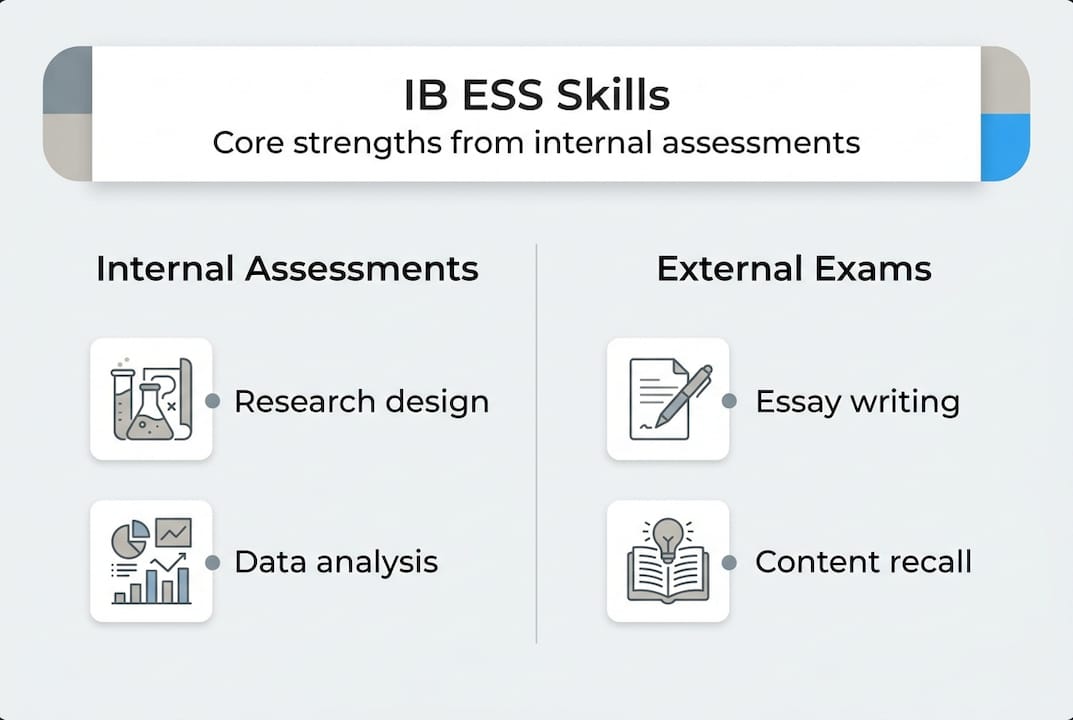
The IA is not just about marks. It builds skills you’ll use throughout your academic life. When you design your own investigation, you practice forming hypotheses, gathering evidence, and thinking critically about what your data actually means.
Research shows that IAs promote analytical and research skills that external exams simply cannot replicate. You’re not memorizing content. You’re applying it.

Here’s how internal and external assessments compare in terms of what they develop:
| Skill area | Internal assessment | External exam |
|---|---|---|
| Research design | High focus | Not assessed |
| Data analysis | High focus | Moderate focus |
| Time management | Student-driven | Exam-controlled |
| Critical evaluation | High focus | Moderate focus |
| Content recall | Moderate | High focus |
Choosing the right topic is also a major factor in your success. Strong ESS IA ideas are specific, measurable, and connected to real environmental systems. Vague topics lead to weak investigations.
Here are the core skills the IA helps you build:
- Designing a clear and focused research question
- Selecting appropriate methods for data collection
- Interpreting results with scientific reasoning
- Reflecting on limitations and sources of error
- Communicating findings in a structured, academic format
These are exactly the skills that effective ESS IA writing demands. And they’re skills that will serve you well beyond IB.
Common teacher strategies for internal assessments
Your teacher is your first line of support for the IA. Most IB ESS teachers follow structured frameworks to guide students through each stage of the investigation. Understanding how they approach this process helps you work with them more effectively.
Teachers guide students through the IA using specific frameworks aligned with IB criteria. The typical process looks like this:
- Topic selection: Your teacher helps you narrow down a broad environmental interest into a focused, researchable question.
- Methodology review: Before you collect data, your teacher checks that your method is appropriate and safe.
- Draft feedback: You submit a draft, and your teacher provides written comments based on the IB assessment criteria.
- Revision guidance: You revise your work based on feedback before final submission.
- Internal marking: Your teacher marks your IA using the official IB rubric.
- Moderation: A sample of IAs from your school is sent to an IB examiner for external moderation.
Knowing how to structure a high-scoring ESS IA at each of these stages gives you a real advantage. The IB ESS assessment frameworks are publicly available, and reading them yourself is one of the smartest things you can do.
Pro Tip: Ask your teacher to show you the IB assessment criteria document before you begin writing. Understanding exactly what examiners look for helps you target your effort where it counts most.
Common grading standards teachers apply include:
- Clarity and focus of the research question
- Quality and relevance of data collected
- Depth of analysis and interpretation
- Acknowledgment of limitations
- Presentation and referencing
Internal assessments in digital and hybrid IB classrooms
More IB students are now completing their studies in online or hybrid environments. This changes how you interact with your teacher, how you submit work, and how you access feedback. The good news is that online ESS lesson advantages are real. Digital settings offer new opportunities alongside new challenges for IA completion.
Here’s what to keep in mind if you’re working in a digital or hybrid setting:
- Submission platforms: Familiarize yourself with your school’s submission system early. Missing a deadline due to a technical issue is avoidable.
- Digital data collection: Many ESS investigations can use publicly available environmental datasets, satellite imagery, or citizen science platforms when fieldwork isn’t possible.
- Asynchronous feedback: In hybrid classrooms, teacher feedback may come via written comments or recorded video. Read it carefully and follow up with questions.
- Peer review: Online tools like shared documents or learning management systems make it easy to exchange drafts with classmates for peer feedback.
- Time zone awareness: If you’re working with an online tutor or international classmates, plan your collaboration sessions around time differences.
Pro Tip: Use a shared document to track every piece of feedback you receive on your IA draft. This creates a clear revision history and shows your teacher that you’re engaging seriously with their guidance.
Staying organized in a digital environment is a skill in itself. Build a simple folder system for your IA files, label each version clearly, and back up your work regularly.
How internal assessments drive curriculum and adaptation
Your IA doesn’t just affect your grade. It also feeds back into how your teacher plans future lessons. When teachers review IA results across a cohort, they identify patterns in student understanding and adjust their teaching accordingly.
Assessment outcomes inform curriculum adjustments in meaningful ways. For example, if many students struggle with data analysis in their IAs, a teacher might spend more time on statistical methods in class the following year.
Here’s how IA results typically shape curriculum planning:
- Identifying knowledge gaps: Low scores in specific criteria reveal where students need more instruction.
- Refining topic guidance: If certain ESS IA topics consistently produce weak investigations, teachers adjust their recommendations.
- Improving feedback cycles: Teachers refine how and when they give feedback based on what helps students most.
- Aligning with IB updates: Moderation reports from IB examiners highlight trends, and teachers use these to update their approach.
Here’s a simplified view of how IA score trends can guide teaching decisions:
| IA criterion | Common student challenge | Curriculum response |
|---|---|---|
| Research question | Too broad or vague | More practice with narrowing topics |
| Data analysis | Weak statistical interpretation | Added lessons on data tools |
| Evaluation | Superficial reflection | Structured reflection exercises |
| Presentation | Inconsistent referencing | Dedicated referencing workshops |
You can explore the full ESS internal assessment overview to understand how these criteria connect to your final score.
Get expert support for your IB ESS internal assessments
You’ve seen how much the IA matters and how much goes into doing it well. If you want personalized guidance from someone who knows the IB ESS criteria inside and out, working with a specialist tutor makes a real difference. Our IB ESS IA tutors have helped students around the world sharpen their research questions, strengthen their analysis, and submit IAs they’re genuinely proud of.
You can also access our ESS notes and textbook resources to build your content knowledge alongside your IA work. And if you’re just getting started, our effective ESS IA guide walks you through every section step by step. Book a trial lesson today and let’s work on your IA together.
Frequently asked questions
How much does the IB ESS internal assessment affect my final grade?
The internal assessment in IB ESS counts for 25% of your final grade, making it one of the most significant single components of your diploma score. Treating it seriously from the start is essential.
What are common mistakes in IB ESS internal assessments?
The most frequent issues include vague research questions, insufficient data analysis, and failing to address IB criteria directly. Following the IB assessment frameworks from the beginning helps you avoid these pitfalls.
Can online resources improve my internal assessment performance?
Absolutely. Online tutoring and ESS resources give you access to expert feedback and structured guidance that can significantly strengthen your IA before submission.
How do internal and external assessments differ in IB ESS?
Internal assessments are teacher-evaluated investigations, while external assessments are formal exams marked by IB examiners. You can review IA examples to see what a strong internal assessment looks like in practice.
How do IA results influence the ESS curriculum?
Teachers use IA outcome data to identify where students struggle most and adjust their lesson plans, feedback methods, and topic recommendations for future cohorts.
No Comments