


01 Jun IB ESS Revision Workflow: Your 2026 Exam Guide
TL;DR:
- A structured IB ESS revision workflow focuses on syllabus-based practice, regular self-assessment, and applying HL lens frameworks to improve exam performance. It emphasizes early timed practice, integrating real-world case studies, and tailoring revision techniques through iterative feedback for maximum effectiveness. Consistent use of core documents, targeted drills, and workflow adjustments prepare students for Paper 1 and Paper 2 success.
An environmental systems revision workflow is a structured, repeatable study process that organizes your IB ESS preparation to maximize both understanding and exam performance. Without a clear system, students often spend hours reviewing content they already know while neglecting the topics that carry the most marks. A well-built workflow targets Paper 1 and Paper 2 directly, integrates the IB ESS syllabus from day one, and builds the kind of conceptual fluency that examiners reward. Tools like Quizlet flashcards, digital concept maps, and IB mark schemes are not optional extras. They are the foundation of any revision process that actually works.
What are the essential components of an environmental systems revision workflow?
The revision process for IB ESS starts with three non-negotiable resources: the current IB ESS syllabus document, official mark schemes, and past papers. These three items define what you are being tested on, what correct answers look like, and how questions are phrased. Starting revision without them is like studying for the wrong exam.

Beyond those core documents, digital and physical tools like color-coded notes, Quizlet flashcard decks, and concept mapping software improve information retention by forcing active engagement with the material. Color-coding by topic unit (for example, blue for biodiversity, green for pollution, orange for climate change) creates visual memory anchors that speed up recall under exam pressure.
Here is a direct comparison of physical and digital revision methods to help you choose what fits your learning style:
| Method | Best for | Limitation |
|---|---|---|
| Handwritten notes | Deep encoding of new concepts | Slower to update and search |
| Quizlet flashcards | Spaced repetition and active recall | Less effective for essay structure |
| Digital concept maps (Canva, Coggle) | Seeing system connections | Can become cluttered without planning |
| Past paper practice | Exam timing and question familiarity | Requires mark scheme to self-assess |
| Color-coded revision guides | Topic organization and visual memory | Time-intensive to create |
For HL students, the workflow must also include the HL lens essay framework from the start. This means understanding the four lenses (environmental, economic, social, and political) and practicing how to apply them as reasoning tools, not just labels. The HL lens essay framework is what separates a grade 5 essay from a grade 7.
Pro Tip: Build your Quizlet decks by syllabus topic unit, not by chapter. This mirrors how IB examiners organize questions and makes it easier to identify gaps.
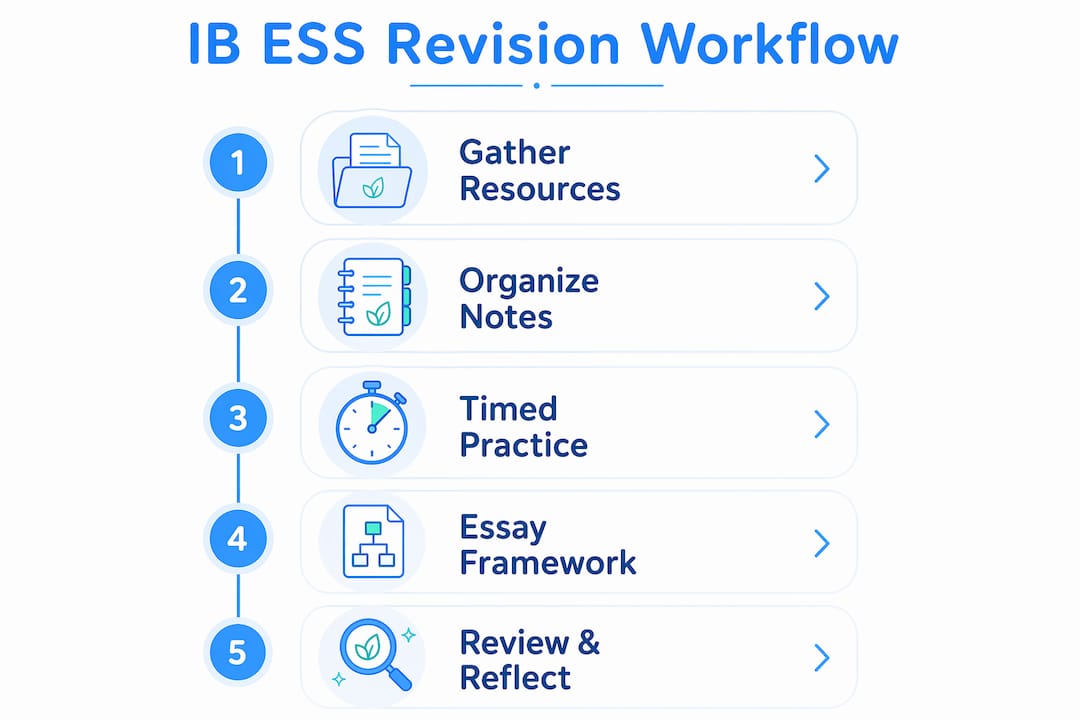
How to structure your revision workflow for Paper 1 and Paper 2 success
Paper 1 lasts 1 hour at SL and 2 hours at HL, while Paper 2 runs 2 hours at SL and 2.5 hours at HL. Knowing these time constraints shapes how you allocate revision hours across topics. HL students need significantly more practice with extended writing under timed conditions.
Here is a step-by-step revision workflow built specifically around IB ESS exam demands:
- Break down the syllabus by topic and weighting. Identify which units appear most frequently in past papers. Topics like climate change, biodiversity, and pollution consistently carry high mark allocations across both papers.
- Practice timed questions from week one. Timed practice with past papers builds the speed and precision you need to answer ESS questions accurately within strict time limits. Do not save this for the final two weeks.
- Apply the HL lens essay framework for Paper 2 extended responses. Write a hinge sentence before drafting each essay. This sentence states the evaluative tension between your chosen lenses and anchors every paragraph that follows.
- Self-assess every practice attempt against the mark scheme. Do not just check if your answer is “right.” Identify which marking points you missed and why. This is where real improvement happens.
- Repeat the cycle with adjusted focus. After each self-assessment round, update your revision priority list. Move mastered topics to maintenance mode and shift time toward weaker areas.
The table below shows recommended weekly revision time allocations for SL and HL students in the final eight weeks before exams:
| Revision focus | SL (hours/week) | HL (hours/week) |
|---|---|---|
| Syllabus content review | 3 | 4 |
| Past paper practice (timed) | 2 | 3 |
| HL lens essay writing | N/A | 2 |
| Case study integration | 1 | 1.5 |
| Self-assessment and feedback | 1 | 1.5 |
Balanced, evidence-based arguments with clear introductions, structured paragraphs, and solid conclusions are what IB examiners reward. This structure does not happen naturally under exam pressure. It has to be practiced repeatedly during revision.
Pro Tip: Write your hinge sentence before you write a single body paragraph. If you cannot write it clearly, you do not yet understand the question well enough to answer it.
What are common revision mistakes in environmental systems?
The most damaging mistake HL students make is using lens terminology decoratively rather than logically. Writing “from an economic lens” at the start of a paragraph does not earn marks. Markers distinguish essays where the lens wording actually drives the reasoning from those where it is just a label. The lens must change what you argue, not just how you label it.
Here are the most common revision mistakes and how to correct them:
- Skipping timed practice until the last minute. Students who only practice untimed questions consistently underperform on exam day because they have never built the mental speed required. Start timed practice in the first week of revision.
- Memorizing definitions without understanding systems. IB ESS questions test your ability to apply concepts to new scenarios, not recite them. Memorizing the definition of “ecological footprint” is not enough. You need to explain what happens to it when population density increases in a specific context.
- Ignoring real-world case studies. Case study integration deepens conceptual understanding and prepares you directly for Paper 1 application questions. Build a personal case study bank covering at least one example per major topic unit.
- Treating all topics as equally important. Some units appear in almost every exam. Others appear rarely. Use past paper frequency analysis to weight your revision time accordingly.
- Not reviewing feedback from practice attempts. Completing a past paper without analyzing your errors against the mark scheme gives you the feeling of productivity without the actual learning.
Pro Tip: After each timed practice session, spend at least as long reviewing your answers as you did writing them. The review session is where the learning actually happens.
How can students optimize and personalize their revision workflow?
The Plan-Do-Check-Act cycle is an effective framework for iterative improvement in any revision workflow. Plan your revision topics, do the practice, check your performance against mark schemes, and act by adjusting your focus. This loop prevents the common trap of repeating the same revision activities without measurable progress.
Personalizing your workflow means more than choosing between flashcards and notes. It means tracking which question types consistently cost you marks and building targeted drills around those specific weaknesses. If you lose marks on data-based questions in Paper 2, dedicate one session per week exclusively to interpreting graphs and tables from past papers.
Here are strategies to optimize your revision process for maximum retention and efficiency:
- Use spaced repetition for content-heavy topics. Quizlet’s built-in spaced repetition algorithm resurfaces cards at the optimal interval for long-term memory. Set up decks for each topic unit and review them daily for 10 to 15 minutes.
- Incorporate peer discussion sessions. Explaining a concept to another student forces you to identify gaps in your own understanding. Study groups work best when each member prepares a short explanation of one topic to teach the others.
- Balance theory with application. For every concept you review, write one sentence applying it to a real-world example. For instance, after reviewing eutrophication, write a sentence connecting it to agricultural runoff in the Mississippi River basin.
- Schedule breaks deliberately. Revision sessions longer than 90 minutes without a break produce diminishing returns. Use the Pomodoro technique (25 minutes of focused work followed by a 5-minute break) to maintain concentration across longer study days.
- Adjust your workflow based on exam preparation strategies and ongoing self-assessment. Your revision plan at week one should look different from your plan at week six. Build in a weekly review of what is working and what is not.
Pro Tip: Keep a simple error log. Every time you miss a mark scheme point, write down the topic and the reason. After two weeks, patterns will emerge that tell you exactly where to focus.
Key takeaways
A structured environmental systems revision workflow built around timed practice, HL lens essay technique, and regular self-assessment is the most direct path to high IB ESS scores.
| Point | Details |
|---|---|
| Start with core documents | Use the IB ESS syllabus, past papers, and mark schemes before any other resource. |
| Practice timed from week one | Timed past paper practice builds the speed and precision examiners expect. |
| Apply HL lenses as reasoning tools | The lens must drive your argument, not just label your paragraphs. |
| Use the Plan-Do-Check-Act loop | Regular self-assessment and workflow adjustment produce measurable improvement. |
| Integrate real-world case studies | One case study example per topic unit prepares you directly for Paper 1 application questions. |
What I have learned from watching students build their revision systems
After working with IB ESS students for over 13 years, the pattern I see most often is this: students who start structured revision early and adjust it regularly outperform students who study harder but without a system. It is not about the number of hours. It is about what you do with them.
The HL lens essay is the single area where I see the biggest gap between students who understand the concept and students who can execute it under exam pressure. Reading about the lenses is not enough. You need to write at least 10 to 15 timed essays before the exam, each one starting with a pre-written hinge sentence. The first few will feel awkward. By essay eight or nine, the structure becomes automatic.
I also want to say this directly: do not wait until you feel “ready” to start timed practice. That feeling rarely comes. The discomfort of attempting a past paper before you feel prepared is exactly what builds exam readiness. Lean into it early.
If you want to see what a well-structured essay writing approach looks like in practice, start there. Then build your workflow around the gaps it reveals.
— Marija
How Esstutor can support your IB ESS revision
Esstutor offers personalized, one-on-one tutoring sessions designed specifically for IB ESS students preparing for Paper 1, Paper 2, and Internal Assessments. With over 13 years of experience as an IB examiner and educator, Marija works directly with students to build revision workflows that target their specific weak areas, master the HL lens essay technique, and approach exam questions with confidence.
Whether you need structured IB ESS notes and resources to anchor your self-study or want expert guidance on your Internal Assessment, Esstutor provides the support that turns a good revision plan into real exam results. Book a trial lesson and find out exactly where your workflow needs to go next.
FAQ
What is an environmental systems revision workflow?
An environmental systems revision workflow is a structured, repeatable study process that organizes IB ESS preparation around syllabus topics, past paper practice, and regular self-assessment. It replaces unplanned studying with a system that targets exam demands directly.
How should I split revision time between Paper 1 and Paper 2?
SL students should allocate roughly equal time to both papers, while HL students need additional hours for extended essay writing practice given that Paper 2 runs 2.5 hours and includes HL lens essays. Use past paper frequency data to weight topic revision within each paper.
What is the HL lens essay hinge sentence?
The hinge sentence is a single statement written before drafting your essay that establishes the evaluative tension between your chosen lenses. Top-scoring HL essays are built around this sentence because it aligns every subsequent argument to the chosen lenses and command terms.
How many past papers should I practice before the exam?
There is no fixed number, but completing at least one full past paper per week in the final eight weeks before exams is a strong benchmark. The goal is not volume alone. Each paper must be reviewed against the mark scheme to produce genuine improvement.
When should I start timed revision practice?
Start timed practice in the first week of revision, not the last. Practicing under timed conditions from early in the revision cycle builds the speed and precision that examiners expect, and it reveals content gaps far earlier than untimed review does.
No Comments