


26 Apr IB ESS Rubric Explained: Score Higher by Understanding What Matters
TL;DR:
- Understanding the IB ESS rubric guides students to demonstrate scientific thinking and clear communication.
- High-scoring IAs focus on specific, testable questions, detailed methods, and critical evaluation.
- Using the rubric proactively from the start improves quality and increases chances of achieving top grades.
Most students approach the IB ESS internal assessment rubric like a checklist they need to tick before submitting. That approach costs marks. The rubric isn’t just a list of boxes to fill. It’s a window into exactly what examiners value, how they award marks, and where the difference between a 5 and a 7 actually lies. Students who understand the rubric’s logic before they start writing outperform those who read it only at the end. In this guide, we’ll break down each part of the ESS rubric, show you what high-scoring work looks like, and give you practical strategies to improve both your IA and your exam results.
Table of Contents
- What is the IB ESS rubric and why does it matter?
- Breaking down the ESS IA rubric: Criteria and what examiners look for
- How to apply the rubric: Real IA examples and examiner expectations
- From confusion to clarity: Common mistakes and how to avoid them
- A fresh perspective: What most students miss about mastering the ESS rubric
- Get specialized support for your IB ESS success
- Frequently asked questions
Key Takeaways
| Point | Details |
|---|---|
| Focus on the research question | A clearly defined and testable research question is crucial for high marks in the ESS IA. |
| Detailed methods matter | Your method must be clear and repeatable to earn the highest rubric scores. |
| Critical evaluation is required | Great work addresses uncertainties, discusses limitations, and suggests improvements. |
| Use the rubric for self-review | Treat the rubric as a checklist to guide your writing and revision before submission. |
What is the IB ESS rubric and why does it matter?
The IB ESS rubric is the official framework examiners use to evaluate your work. It applies to both your internal assessment and externally marked papers. For the IA specifically, the rubric has distinct criteria that each carry a specific mark range. Examiners use these criteria to judge every section of your investigation, from how you framed your research question to how thoroughly you evaluated your results.
Here’s why understanding the rubric matters more than most students realize:
- It defines what ‘good’ actually means. Examiners don’t reward effort. They reward evidence of scientific thinking, clearly communicated.
- It removes guesswork. Instead of wondering what to include, the rubric tells you exactly what each mark band expects.
- It helps you allocate your time. Knowing which criteria carry more weight helps you focus on what matters most.
- It reveals the gap between average and excellent. Most students can reach mid-band scores with decent effort. Getting to the top band requires targeting specific language and depth.
One of the biggest misconceptions students carry is that the rubric rewards completeness. If I wrote a lot and covered everything, I should do well. That’s not how it works. The ESS IA rubric basics reward quality of reasoning, not volume of content.
Examiners look for evidence-based discussion: interpretation linked back to the research question, evaluation including uncertainties and limitations, and concrete improvement suggestions. That’s a very specific kind of writing. It’s analytical, not descriptive.
Pro Tip: Before you write a single sentence of your IA, read through the rubric and write a one-line goal for each criterion. This keeps you focused from the very first draft.
The rubric also impacts your final grade more than students expect. The IA contributes 20% of your overall ESS score. A student who consistently misinterprets rubric expectations might score 8 out of 30 when they were capable of scoring 22. That gap can change your final grade band significantly.
Breaking down the ESS IA rubric: Criteria and what examiners look for
Now that you know why the rubric matters, let’s break down what each part means, criterion by criterion. The IB ESS IA rubric has five core criteria.
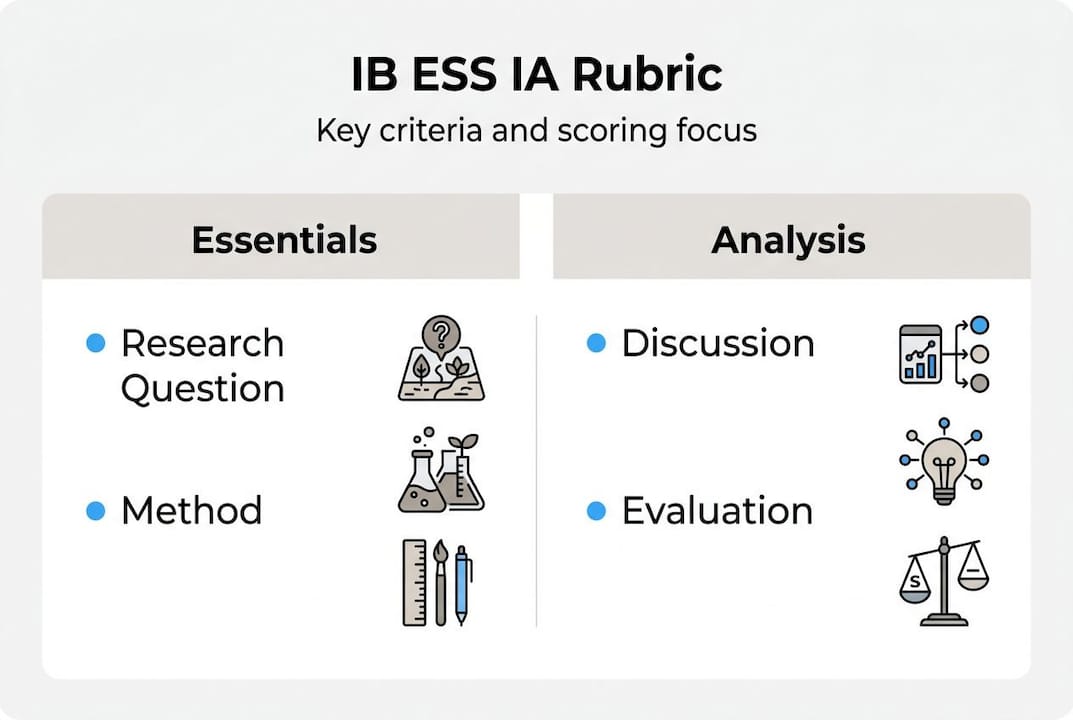
| Criterion | What it rewards | Marks available |
|---|---|---|
| Personal engagement | Genuine curiosity, clear connection to ESS topics | 2 |
| Exploration | Clear RQ, justified method, relevant variables | 6 |
| Analysis | Processed data, visual presentation, trends identified | 6 |
| Evaluation | Discussion of results, limitations, improvements | 6 |
| Communication | Structure, format, scientific language | 4 |
Here’s what each criterion actually expects, in practice:
- Personal engagement: This doesn’t mean writing about your feelings. It means showing that your topic choice has a clear and relevant ESS connection and that your approach reflects genuine curiosity, not a generic template.
- Exploration: Your research question must be narrow and testable. Vague questions like “How does pollution affect ecosystems?” don’t score well. Examiners want to see a focused, specific question tied to measurable variables.
- Analysis: It’s not enough to show graphs. You need to identify trends, explain what the data shows, and link it to your research question. A graph with no written interpretation scores poorly.
- Evaluation: This is where most students lose marks. Mid vs high scoring IAs differ here: the research question must be explicitly testable, the method repeatable, and the discussion must evaluate rather than restate results.
- Communication: Clear structure, appropriate headings, and proper scientific formatting matter. A well-organized IA is easier to mark generously.
Pro Tip: Read the mark descriptors for each band, not just the top band. Understanding what the 1-2 band says helps you see exactly which step up you need to take to reach the 3-4 band.
If you want a clear path to the top, the guide on how to score a 7 in your ESS IA maps this structure directly to grade outcomes. You can also explore practical writing strategies in the guide on how to write an outstanding ESS IA.
How to apply the rubric: Real IA examples and examiner expectations
Understanding the rubric is powerful, but let’s make it practical. Here’s how high-achieving IAs and examiner decisions look in reality.

Consider two students investigating the effect of light intensity on photosynthesis in aquatic plants. Student A writes: “The results showed that more light led to more bubbles, which means more photosynthesis.” Student B writes: “As light intensity increased from 200 to 1000 lux, the rate of oxygen production increased by 34%, consistent with the prediction in the research question. This supports the hypothesis that higher light intensity drives faster photosynthetic rates in Elodea under controlled temperature conditions.”
Student B earns higher marks in both analysis and evaluation. The difference isn’t the experiment. It’s the specificity, the link to the research question, and the scientific language.
Here’s a simple comparison of rubric elements and how they map to marks:
| IA element | Low-scoring version | High-scoring version |
|---|---|---|
| Research question | “How does water quality affect fish?” | “How does nitrate concentration (5, 10, 20 mg/L) affect the survival rate of Daphnia magna over 48 hours?” |
| Method | Describes steps loosely | Detailed, repeatable, includes controls and variables |
| Discussion | Summarizes results only | Evaluates reliability, identifies specific limitations, suggests realistic improvements |
Examiners consistently note that testability and methodological repeatability are what separates strong IAs from weak ones. Another student could theoretically follow your method and replicate your investigation. If they couldn’t, your method needs more detail.
“The best IAs read like a clear, honest account of a real scientific investigation, where the student knows exactly what they found, what might have gone wrong, and what they’d do differently.”
Before submitting your IA, go through this checklist:
- Is your research question specific, testable, and linked to ESS content?
- Have you identified all key variables and explained how you controlled them?
- Does your data presentation include processed results, not just raw numbers?
- Have you interpreted trends and linked them to your research question?
- Have you discussed at least two specific limitations and suggested realistic improvements?
For more guidance, explore the ESS IA example guide or browse internal assessment ideas that work well within the rubric.
From confusion to clarity: Common mistakes and how to avoid them
Armed with actionable examples, it’s crucial to also recognize the biggest traps and errors students make, and exactly how to bypass them.
Here are the most common rubric-related mistakes:
- Vague research questions: Many students write questions that are too broad to test. If your method can’t directly answer your question, the question needs revising.
- Copying a generic method without adaptation: A method copied from a textbook that isn’t tailored to your specific question and context will score low on exploration.
- Describing instead of evaluating: Restating what the data shows is not evaluation. Evaluation means asking why the results look like this, what could have caused error, and how you’d improve the study.
- Ignoring uncertainties: Leaving out measurement uncertainties or statistical variation signals to examiners that you haven’t thought critically about your data.
- Weak communication: Missing headings, inconsistent formatting, and undefined abbreviations make an IA harder to follow and mark.
Good structuring your IA habits prevent most of these errors before they start. And understanding the full IA criteria for assessment ensures nothing is overlooked.
“Focused testable RQ, detailed repeatable method, organized raw data, appropriate statistical processing, and critical evaluation of limitations and improvements” are the core elements that separate strong IAs from weak ones.
Pro Tip: After writing your first draft, read through only the evaluation section and ask yourself: “Does this paragraph evaluate, or does it just describe?” If every sentence starts with “The results showed…”, you’re describing. Add a sentence that starts with “This suggests…”, “A possible source of error is…”, or “To improve reliability, I would…” to push into evaluation territory.
Moving up a mark band often comes down to one or two targeted improvements. Narrowing your research question, adding specific uncertainty values, or including one concrete improvement suggestion can shift you from a 4 to a 6 in the evaluation criterion alone.
A fresh perspective: What most students miss about mastering the ESS rubric
Here’s something that often surprises students: the highest-scoring IAs don’t feel like they were written to meet a rubric. They feel like a student genuinely investigating something they care about, thinking critically, and being honest about what worked and what didn’t.
Most students use the rubric as a post-submission checklist. The students who score at the top use it as a writing guide from day one. Every decision, from choosing a research question to deciding how many trials to run, is made with the rubric in mind.
I’ve seen students spend hours polishing their graphs while leaving their evaluation section vague and generic. That’s an unbalanced investment. Examiners spend significant time in the evaluation section, and that’s where the most marks are left on the table.
The deeper insight is this: the rubric rewards thinking like a scientist, not performing like one. Acknowledging what you couldn’t control, explaining why your results might not be fully reliable, and suggesting specific and realistic improvements all show genuine scientific maturity. Understanding the role of examiners in the marking process can shift how you write, from trying to impress to trying to communicate clearly.
That shift makes all the difference.
Get specialized support for your IB ESS success
Now that you know how to master the rubric, here are resources and experts that can help you put this knowledge into action.
If you’re ready to move from understanding the rubric to applying it in a way that genuinely raises your score, targeted support makes a real difference. The ESS IA step-by-step guide walks you through every criterion with detailed explanations and worked examples. For personalized feedback on your own IA, working with an experienced ESS IA tutor gives you the kind of direct, rubric-focused guidance that transforms a mid-band submission into a high-scoring one. You don’t have to figure this out alone. Reach out and let’s work through it together.
Frequently asked questions
What are the most important parts of the ESS IA rubric?
The most important parts are a clear, testable research question, a detailed and repeatable method, and a discussion that evaluates uncertainties and suggests realistic improvements rather than just restating results.
How can I improve my score using the rubric?
Use the rubric as a writing checklist from the start, ensuring your work links results to the research question, addresses uncertainties, and provides clear and repeatable method details throughout.
Why do students lose marks on the IB ESS IA?
Most students lose marks by writing vague or unfocused research questions, using unclear methods, and failing to evaluate uncertainties and limitations with enough depth and specificity.
What does ‘evidence-based discussion’ mean in the IA rubric?
It means interpreting your data, relating your results directly to the research question, and discussing uncertainties and reliability instead of simply summarizing what your data shows.
No Comments