


30 Apr Master the ESS coursework process: Step-by-step guide for IB success
TL;DR:
- The IB ESS IA accounts for 25% of the final grade and must be a 3000-word individual report.
- New syllabus requirements emphasize independence, exploring tensions between perspectives, and evaluating reliability.
- Effective planning, clear methodology, systematic data collection, and strong analysis are essential for top marks.
If you are preparing for IB Environmental Systems and Societies (ESS) and feeling uncertain about where to start with your internal assessment (IA), you are not alone. The new 2026 syllabus has introduced updated requirements that can feel confusing at first, from word limits and independence rules to a brand-new “tensions between perspectives” criterion. The good news is that once you understand the full picture, you can move through each stage with confidence. This guide walks you through every step of the ESS coursework journey so you can produce a strong, well-organized IA that reflects your best work.
Table of Contents
- Understand the ESS coursework structure and requirements
- Plan and prepare: Getting ready for your ESS IA
- Execute your investigation: From data collection to results
- Craft your analysis and evaluation for maximum marks
- Final checks: Polishing and submitting your IA
- What sets a standout ESS coursework apart? Unconventional wisdom
- Essential resources to supercharge your ESS coursework success
- Frequently asked questions
Key Takeaways
| Point | Details |
|---|---|
| ESS IA is 25% of grade | Your internal assessment makes up a quarter of your total IB ESS score, so invest effort in every section. |
| Individual report required | Even with group work during early stages, your IA must be submitted as fully independent work. |
| New perspectives criterion | Address the ‘tensions between perspectives’ requirement by comparing stakeholder views and outcomes. |
| Specific evaluation is vital | Avoid generic critiques—directly link limitations and improvements to your method or results. |
| Final checks matter | Double-check word limits, formatting, and examiner expectations before submitting your report. |
Understand the ESS coursework structure and requirements
Before you write a single word of your IA, you need to know exactly how ESS is assessed and how the IA fits into your final grade. ESS uses a dual-assessment model that combines external exams with internally assessed coursework.
Here is a quick breakdown of the main assessment components:
| Component | Format | Weighting |
|---|---|---|
| Paper 1 | Case study exam | 25% |
| Paper 2 | Essay-based exam | 50% |
| Internal assessment | Individual investigation report | 25% |
The IA counts for 25% of your final grade, which means it is worth exactly the same as your Paper 1 exam. That is significant. Neglecting your IA or rushing through it is a costly mistake many students make.
Under the updated 2026 requirements, the IA is an individual investigation submitted as a written report with a maximum word count of 3,000. This is a hard limit, and IB examiners will not mark beyond it.
Key new features of the 2026 syllabus include:
- A strict 3,000-word maximum for the written report
- Full individual independence in writing, even if some fieldwork is shared
- A new criterion requiring you to explore tensions between different perspectives
- Greater emphasis on evaluating the reliability and validity of your investigation
Understanding all of these requirements from day one will help you plan more effectively and avoid common pitfalls. For a detailed overview of what the IA involves from top to bottom, check out this IB ESS IA overview to get familiar with how each section is scored.
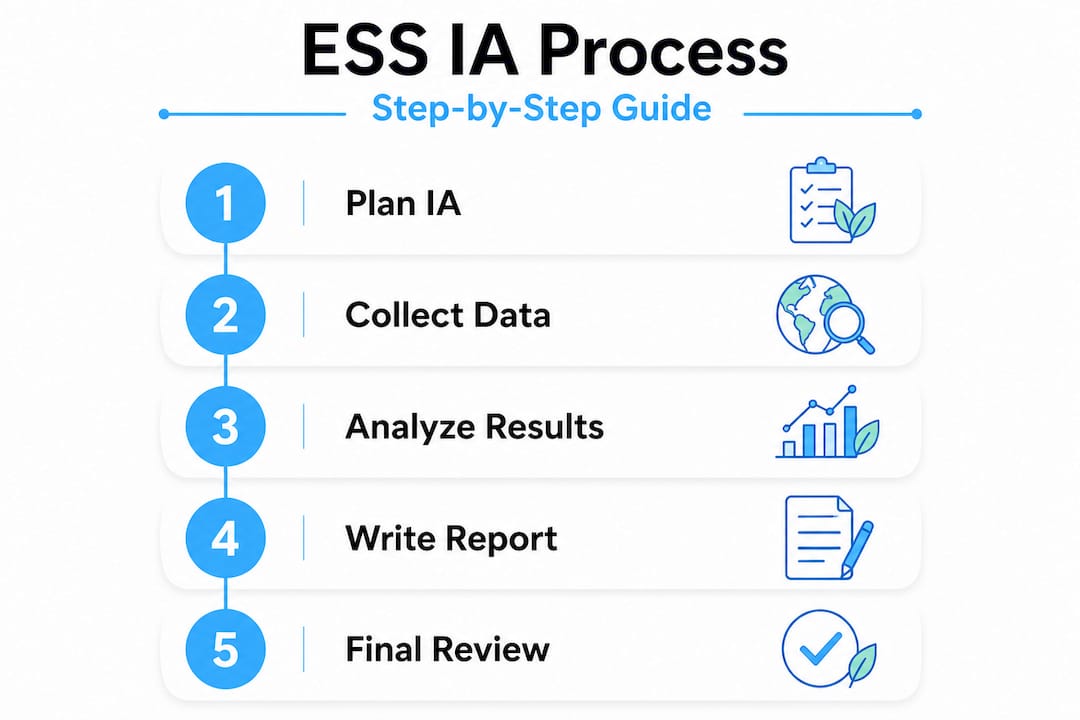
Plan and prepare: Getting ready for your ESS IA
Once you are clear on the structure and expectations, it is time to prepare your investigation and make sure you set off on the right foot. Good planning at this stage saves you enormous stress later.
What you need before you start:
- A clear understanding of the ESS topic areas covered in your course
- Access to field sites, secondary data sources, or lab equipment depending on your chosen method
- Your school’s IA timeline and teacher feedback schedule
- A research question that is specific, measurable, and directly connected to an ESS concept
One important nuance in the new syllabus is worth highlighting here. While students may collaborate during initial fieldwork or support each other during data collection, IB is very clear that the written report itself must remain entirely individual. This means your analysis, evaluation, and conclusions cannot be shared or co-written with another student, even if you collected data together.
Step-by-step preparation process:
- Select your topic. Choose something that genuinely interests you and has a clear environmental angle. Topics involving biodiversity, water quality, soil health, or carbon cycling work well because they allow for both primary data collection and connection to broader systems thinking. For inspiration, browse this list of assessment topic ideas.
- Form your research question. Keep it focused and achievable within your resources. A question like “How does distance from a road affect species diversity in a local woodland?” is specific and testable.
- Plan your methodology. Decide whether you will collect primary data in the field, use secondary datasets, or combine both. Your method must be clearly justified in your report.
- Get teacher approval. Submit your research question and proposed method to your teacher before collecting any data. Changes made later can cost you valuable time.
- Build your timeline. Map out data collection, processing, writing, and review stages. Leave at least one full week for editing and feedback before your submission deadline.
A step-by-step IA guide can help you move through each phase with clear, structured support at each milestone.

Pro Tip: Create a simple project log where you record what you did each week during your investigation. This makes it much easier to write your methodology section accurately later, and it shows genuine independence in your process.
Execute your investigation: From data collection to results
With your plan in place, you carry out your investigation, collect evidence, and synthesize results. This is where many students either gain or lose marks, so attention to detail here really matters.
How to collect strong data:
- Be systematic. Use consistent sampling methods, record exact locations, conditions, and times. Inconsistent data collection is one of the most common sources of low reliability in student IAs.
- Document every stage. Take photos, keep raw data tables, and note any anomalies or unexpected observations in real time. You cannot reconstruct these details accurately from memory later.
- Collect enough data points. Aim for a minimum of 30 data points where possible for statistical analysis to be meaningful. If you are comparing two sites, collect data from both on the same day under similar conditions.
- Process your results clearly. Use appropriate graphs, descriptive statistics, and where relevant, inferential statistics like the t-test or chi-squared test to support your analysis.
- Label everything clearly. Every figure and table in your report needs a title and a clear explanation. Examiners should not have to guess what a graph means.
“The main quantitative anchor for your report is the 3,000-word maximum; plan enough time to produce both processed results and a detailed evaluation section.”
Staying within 3,000 words while covering all the required sections means being concise and deliberate. You cannot afford to repeat information, over-explain simple concepts, or write lengthy introductions. Every sentence should serve a clear purpose. For practical advice on managing your time and workflow across all stages, the ESS workflow tips resource is a great reference point.
Pro Tip: Write your methodology section immediately after collecting your data, not weeks later. The details are freshest in your mind right after fieldwork, and you will write it more accurately and efficiently.
Craft your analysis and evaluation for maximum marks
After conducting your investigation, building a targeted analysis and evaluation section is critical for top marks. This is the part of the IA that separates good reports from excellent ones, and it is also where the new 2026 requirements have the most impact.
What strong analysis looks like:
- You interpret your results clearly and connect them to your research question
- You identify patterns, trends, or anomalies in your data and explain them using ESS theory
- You discuss the reliability and validity of your results honestly
The new “tensions between perspectives” criterion is a key addition to the 2026 syllabus. The IB now requires that students explore tensions between different viewpoints and explain how those perspectives affect environmental or societal outcomes. This is not just about listing stakeholder opinions. You need to analyze how, for example, a conservationist’s perspective on land management conflicts with a farmer’s economic priorities, and how that tension shapes real-world outcomes for the ecosystem you studied.
Strong evaluation also means being honest about the limitations of your investigation. High-performing IAs consistently address reliability, validity, and uncertainty, and they propose realistic improvements directly connected to the specific investigation rather than generic statements.
Common mistakes to avoid in your evaluation:
- Writing vague limitations like “human error may have affected results” without explaining what went wrong and why
- Suggesting improvements that are not relevant to your actual method
- Ignoring the impact of environmental variability on your data
- Failing to connect your limitations to specific data points or anomalies
The ESS IA evaluation tips resource provides targeted advice on structuring this section effectively.
“The IA is designed and implemented by the student and submitted as a written report, accounting for 25% of the final assessment.” This means your analysis and evaluation must reflect original thinking, not a formula borrowed from someone else’s report.
Final checks: Polishing and submitting your IA
With your analysis and evaluation complete, give your IA a thorough review before submission. A few targeted checks at this stage can protect marks you have already earned.
Submission checklist:
- Research question is clearly stated in the introduction
- Methodology is detailed enough for another person to replicate
- All data tables and figures are labeled with titles
- Analysis directly addresses the research question
- Evaluation includes specific limitations and realistic improvements
- “Tensions between perspectives” section is present and well-developed
- Word count is at or below 3,000
- Report is written entirely in your own words and reflects your independent analysis
- References are cited consistently throughout
The IB is very clear that the final report must remain individual, even if some earlier research stages were shared with peers. Passing off shared writing as your own, even unintentionally, can trigger academic integrity concerns.
| Final review area | What to check |
|---|---|
| Structure | All required sections present and in order |
| Word count | At or below 3,000 words |
| Independence | All writing is your own original work |
| Clarity | Figures and tables labeled, language precise |
| Evaluation | Specific limitations and improvements included |
| Perspectives criterion | Tensions between perspectives clearly explored |
Pro Tip: Ask a peer or family member who does not study ESS to read your introduction and conclusion. If they can understand what your investigation was about and what you found, your report is clear enough for an examiner who has never seen your data.
For additional guidance on aligning your report with the updated 2026 curriculum expectations, reviewing syllabus strategies before your final submission is highly recommended.
What sets a standout ESS coursework apart? Unconventional wisdom
Now that you have refined your IA, consider what truly distinguishes exceptional coursework from the merely adequate.
Most students focus on following the steps correctly, and that is important. But in my experience working with IB students and examiners, the reports that score at the top of the mark scheme do something different. They show genuine curiosity. The student did not just follow a formula; they actually cared about the environmental question they were investigating, and it shows in the way they interpret their findings.
One underrated strategy is connecting your local findings to a bigger picture. If you measured biodiversity in a small urban park, the best IAs do not stop there. They link the local result to regional habitat fragmentation, or to policy debates around urban green space, or to broader ecological theories. That kind of thinking signals a student who understands ESS as a living discipline, not just a set of criteria to satisfy.
The “tensions between perspectives” criterion is another area where most students play it safe. They list two perspectives and describe them briefly. The standout reports go further. They argue. They use their own data to show how one perspective is supported by evidence from the investigation, and why another falls short in this particular context. That takes intellectual courage, but it is exactly what the role of IB examiners involves evaluating: whether a student can genuinely reason through complexity.
One more thing. Think about examiner empathy. Your report will be read by someone who has already reviewed dozens of IAs that day. Signpost your insights clearly. Use concise headings, topic sentences that preview each paragraph’s purpose, and a conclusion that tells the examiner exactly what you found and why it matters. Making your report easy to follow is not a small detail; it is a strategy.
Essential resources to supercharge your ESS coursework success
Ready to take your ESS coursework further? Here is where to get expert guidance and targeted resources built specifically for IB ESS students like you.
Working through an IA on your own can be challenging, especially when you are trying to meet the new 2026 requirements and still keep your word count under control. That is where personalized support makes a real difference. Our IB ESS IA tutors offer one-on-one sessions tailored to your specific investigation, helping you identify gaps in your analysis, sharpen your evaluation, and meet the tensions-between-perspectives criterion with confidence. You can also explore a full range of ESS notes and textbook resources to reinforce the subject knowledge behind your investigation. For a complete hub of IA support, the ESS IA resources page brings together everything you need in one place.
Frequently asked questions
What is the minimum and maximum word count for the ESS IA?
The maximum is 3,000 words, and there is no official minimum. Your report must still cover all required sections thoroughly within that limit.
Can you write the ESS internal assessment with a partner or as a group?
You can collaborate during fieldwork, but IB requires the written report to be entirely individual. Shared writing is not permitted.
How much is the IB ESS IA worth in final grading?
The IA is worth 25% of your total IB ESS grade, making it equal in weight to Paper 1.
What is the “tensions between perspectives” requirement?
This new 2026 criterion requires you to explore how different perspectives shape outcomes for the environmental issue you investigated, going beyond simply listing stakeholder viewpoints.
What is the most common mistake in the ESS IA?
Weak, generic evaluation is one of the biggest mark-losers. High-performing IAs link limitations and improvements directly to the specific investigation, rather than using vague, catch-all statements.
No Comments