


07 Apr Understand the role of IB examiners for ESS success
TL;DR:
- IB examiners use standardized rubrics to objectively assess ESS papers and internal assessments worldwide.
- Success depends on understanding and addressing command terms, providing specific data, and demonstrating systems thinking.
- Preparing with examiner insights and focusing on clear, purposeful responses greatly improves your IB ESS results.
Most students believe that studying harder automatically leads to better IB exam results. That’s only half the picture. What actually makes the difference is understanding how your work is read and judged. IB examiners mark external exam papers and moderate internal assessments for the Diploma Programme, including ESS. When you know what examiners are looking for, you stop guessing and start answering with purpose. This guide walks you through exactly what IB examiners do, how they assess your work, and what practical steps you can take to improve your ESS results right now.
Table of Contents
- What is the role of an IB examiner in ESS?
- How IB examiners assess ESS: Methods and frameworks
- What do ESS examiners look for in your responses?
- IB examiner moderation and internal assessments: How your IA is reviewed
- A fresh perspective: What most students miss about examiners (and how to get ahead)
- Unlock your potential with pro support for IB ESS
- Frequently asked questions
Key Takeaways
| Point | Details |
|---|---|
| Examiners ensure fairness | Your ESS exams are marked using consistent global standards, not teacher opinion. |
| Marking uses clear criteria | Every point you earn is based on meeting rubric requirements, so match your answers accordingly. |
| Evidence matters | Command terms, data, and real examples are what examiners reward in both essays and IAs. |
| Moderation can adjust your IA | Even strong IAs may have marks tweaked by examiners during IB moderation. |
What is the role of an IB examiner in ESS?
With that context, let’s break down exactly what IB examiners do for ESS. Many students picture a single teacher reading their paper and making judgment calls. The reality is far more structured than that.
IB examiners mark external exam papers and moderate internal assessments across the Diploma Programme. For ESS specifically, their responsibilities cover every part of your final grade. Here is what that looks like in practice:
- Paper 1 marking: Examiners assess your response to an unseen data-based case study. This accounts for 25% of your SL grade.
- Paper 2 marking: Structured questions and essays are marked here, making up 50% of your SL grade.
- IA moderation: Your internal assessment, worth 25% of your SL grade, is first marked by your teacher and then reviewed by an external examiner.
The ESS external assessment is weighted heavily, with 75% of your SL grade coming from Papers 1 and 2 combined. That means examiners directly influence most of your final score.
Examiners are not your teachers. They do not know you, your school, or your background. Their only job is to apply IB standards consistently to every student worldwide. This is actually good news. It means the system is fair, and you can prepare for it directly.
“Standardization ensures every candidate is treated equally, regardless of where they study.”
Examiners use standardized rubrics to grade work. These rubrics remove personal bias and make scoring predictable. If you know the rubric, you know the target. You can look at IA examples to see how strong work is structured, and explore strategies for raising your IA score before your submission date.
How IB examiners assess ESS: Methods and frameworks
Understanding their responsibilities, what tools and frameworks do IB examiners actually use? This is where most students gain a real advantage.
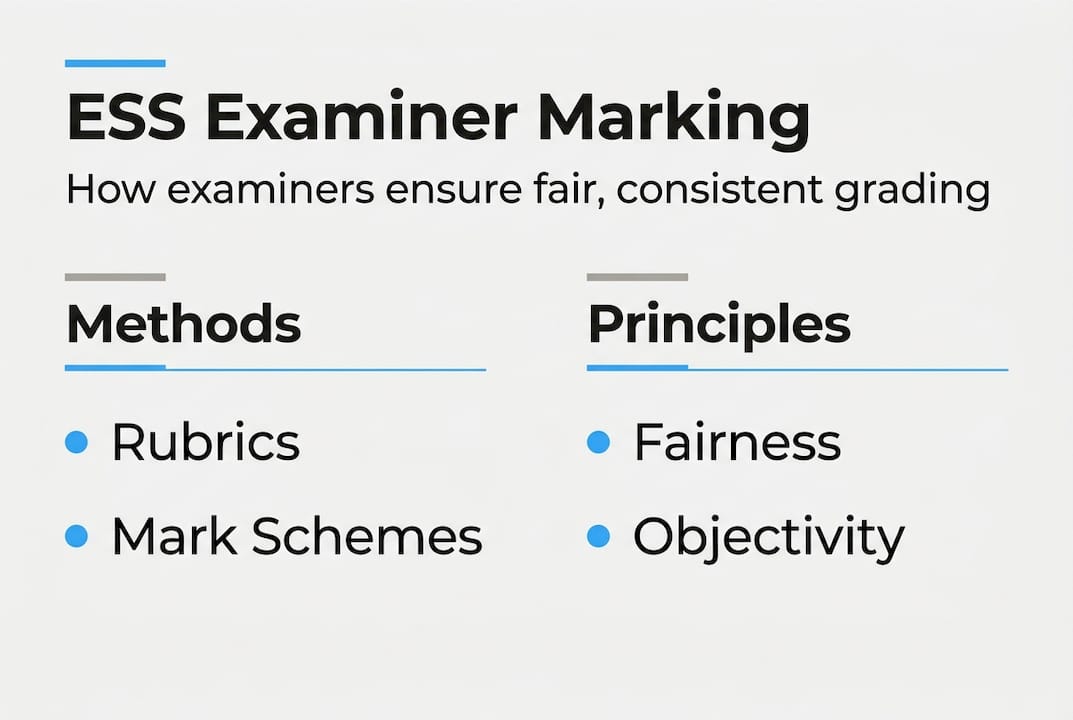
Examiners use criterion-referenced marking with detailed rubrics and mark schemes to ensure objectivity, fairness, and consistency across global candidates. Criterion-referenced means your work is compared to a fixed standard, not to your classmates. A strong answer earns full marks whether ten students or ten thousand students write it.
Here is a quick comparison of criterion-referenced versus norm-referenced assessment, so you can see why this matters:
| Feature | Criterion-referenced | Norm-referenced |
|---|---|---|
| Compared to | Fixed standard | Other students |
| Can everyone score high? | Yes | No |
| Predictable? | Yes, if you know criteria | No |
| IB ESS uses this? | Yes | No |
Mark schemes tell examiners exactly which points earn credit. Training and standardization sessions ensure examiners apply mark schemes uniformly, and levels of response are used for extended answers, with grade boundaries set after marking based on global performance. This means grade boundaries shift slightly each year depending on how all students performed. You cannot control the boundary, but you can control how well you meet the criteria.
For essays and extended answers, examiners use levels of response. This means they look at the overall quality of your thinking, not just whether you mentioned certain keywords. Systems thinking, evidence, and clear evaluation all push you into higher levels.
Pro Tip: Always reference the marking rubric when preparing any answer. Read each criterion and ask yourself, “Have I clearly addressed this in my response?” Knowing the ESS command terms is essential here. If you are working on a longer piece, the extended essay guide shows how these frameworks apply to more complex writing. You can also browse IA ideas to find investigations that naturally lend themselves to strong criterion-based responses.
What do ESS examiners look for in your responses?
So, how does this marking system affect what you actually write in your ESS answers? Quite a lot, it turns out.
Examiner insights for ESS show that the most common mistakes are vague case studies, ignoring anomalies or trends in data, and failing to address the command term. These are all avoidable with the right preparation.
Here are the top 5 things examiners look for in your ESS responses:
- Command term precision. “Evaluate” requires judgment. “Describe” requires detail. “Explain” requires cause and effect. Using the wrong approach loses marks immediately.
- Specific data and case studies. Vague references to “pollution” or “deforestation” are not enough. Name a location, cite a figure, reference a real event.
- Acknowledgment of anomalies and trends. When data shows an unexpected result, address it. Examiners reward students who notice and explain these moments.
- Systems thinking. Show how ideas connect. A change in one part of an ecosystem affects others. Examiners want to see that you understand these links.
- Evidence-backed evaluation. Do not just describe. Make a judgment and support it with evidence.
“Top scores require evidence-backed evaluation, not description.”
Pro Tip: Before writing any extended answer, underline the command term and write a one-sentence plan. This keeps your response focused and ensures you are answering the actual question. Check out these ESS exam tips and ESS exam prep strategies to build these habits before exam day.
IB examiner moderation and internal assessments: How your IA is reviewed
Beyond the exam papers, examiners play a crucial role in assessing your internal assessment. This part of the process surprises many students because it happens after your teacher has already marked your work.

Teachers mark using IB criteria, and a sample is sent for external moderation by examiners to adjust if needed. The ESS IA is out of 24 marks total. If an examiner finds that your teacher’s marks are consistently higher or lower than IB standards, all marks in your class may be adjusted up or down.
Here is a breakdown of the IA criteria and what examiners check:
| IA criterion | Description | How examiners check it |
|---|---|---|
| Research question | Clear, focused, and measurable | Is it specific and testable? |
| Data collection | Sufficient raw data with units | Are tables and methods clear? |
| Data processing | Calculations and graphs | Are methods appropriate and accurate? |
| Evaluation | Strengths, weaknesses, improvements | Is the analysis honest and specific? |
| Applications | Real-world relevance | Does it connect to ESS concepts? |
Several situations can trigger a closer examiner review of your IA:
- Your teacher’s marks are significantly higher or lower than the IB standard
- There is a large spread of grades within your class
- Suspected inconsistency in how criteria were applied
- A random sample selection as part of routine moderation
The best way to protect your IA grade is to make sure your work clearly meets each criterion on its own terms. Reviewing an IA sample helps you see what strong work looks like. You can also browse more IA examples to compare different approaches and find what works best for your investigation.
A fresh perspective: What most students miss about examiners (and how to get ahead)
With all this in mind, here is an insider perspective on how to truly stand out to examiners. Most students spend their preparation time memorizing content. That is necessary, but it is not enough.
The students who consistently score at the top think like examiners. They read their own answers and ask, “Would someone marking this for the first time understand my point immediately?” They structure responses around criteria, not around what they find interesting.
Examiner priorities are clear: command terms, specific evidence, and systems thinking. These are not secrets. They are published, taught, and available to every student. The gap between average and excellent scores is almost always in execution, not knowledge.
Clear, concise, and analytical responses are always rewarded. An examiner marking hundreds of papers will notice immediately when a student writes with purpose. That impression matters. Knowing whether ESS is right for you is the first step, but thinking with examiner awareness is what takes you to a 6 or 7.
Pro Tip: Before submitting any essay or IA, ask yourself, “Would an examiner see each criterion clearly addressed in my answer?” If the answer is no, revise before you submit.
Unlock your potential with pro support for IB ESS
Ready to move from understanding to action? Here is how you can get personalized support tailored to how actual examiners will mark your work.
At esstutor.net, I work with IB ESS students every day, drawing on over 13 years of experience as an IB examiner and educator. I know exactly what examiners look for because I have been one. Whether you need focused IA tutoring to make sure your investigation meets every criterion, or you want to sharpen your essay technique using proven Paper 2 strategies, I can help. You can also access curated ESS notes and textbook resources to support your study. Book a trial lesson and start preparing the smart way.
Frequently asked questions
How do IB examiners ensure fairness when marking ESS exams?
Examiners use criterion-referenced marking with detailed rubrics and attend standardization training sessions that align how marks are applied consistently across all global candidates.
What are the main parts of the ESS exam that examiners assess?
For SL students, Paper 1 covers a data case study worth 25%, Paper 2 covers structured questions and essays worth 50%, and the Internal Assessment worth 25% is moderated by external examiners.
What do examiners look for in an ESS essay?
Examiners prioritize command terms, specific data or real-world examples, and answers that show clear connections between ideas rather than surface-level descriptions.
How does the IA moderation process affect student marks?
If your teacher’s marks differ from IB examiner standards, your entire class’s IA grades may be adjusted upward or downward during external moderation.
Why is examiner perspective important for ESS exam prep?
Knowing how your work is marked lets you structure answers for maximum points. Common pitfalls like vague case studies and ignoring data trends are easy to avoid once you understand what examiners actually reward.
No Comments