


04 Jun The Role of Laws in Environmental Protection Explained
TL;DR:
- Environmental laws regulate human activities to protect ecosystems, but their success depends on enforcement and institutional capacity. Climate change integration has expanded legal frameworks to include emissions standards, resilience, and adaptation, linking national and international efforts. Rights of Nature frameworks provide legal standing for ecosystems, yet they require operational institutions to translate recognition into tangible ecological protection.
Environmental laws are the legal frameworks that regulate how humans interact with air, water, land, and biodiversity to prevent harm and secure long-term sustainability. Known formally as environmental law or environmental legislation, these rules set the boundaries for industrial activity, resource extraction, waste disposal, and land use. Without them, there is no binding mechanism to hold governments, corporations, or individuals accountable for ecological damage. The role of laws in environmental protection extends from local pollution controls to international climate treaties, and understanding that scope is the first step toward engaging with environmental governance meaningfully.
How do environmental laws function to protect ecosystems?
Environmental law operates through a layered system of legal instruments. Statutes passed by legislatures set the overarching rules. Regulations issued by agencies like the U.S. Environmental Protection Agency (EPA) or the European Environment Agency (EEA) translate those statutes into specific, enforceable standards. Permits control what pollutants a factory can discharge into a river or how much carbon dioxide a power plant can emit. Each layer depends on the one above it, and the whole system depends on enforcement.

UNEP defines environmental rule of law as a prerequisite for sustainable development, emphasizing that governance must go beyond laws on paper to include accountability, transparency, and real enforcement capacity. This distinction matters enormously. A country can have excellent environmental statutes and still see deforestation accelerate if courts lack resources, inspectors lack authority, or penalties lack teeth.
Effective environmental protection policies rely on three enforcement pillars:
- Monitoring and inspection: Agencies conduct field inspections, satellite surveillance, and water quality testing to detect violations before they become irreversible.
- Penalties and liability: The “polluter pays” principle, recognized in both EU law and international frameworks, assigns the cost of cleanup and harm to the party responsible for the damage.
- Transparency and public participation: Laws like the U.S. National Environmental Policy Act (NEPA) require public comment periods, giving communities a voice in decisions that affect local ecosystems.
Pro Tip: When studying environmental law for your IB ESS internal assessment, always distinguish between the law as written and the law as enforced. That gap is where the most interesting analysis lives.
What is the relationship between environmental laws and climate change?
Climate change has fundamentally reshaped the priorities of environmental legislation. What began as laws targeting local pollution, such as the U.S. Clean Air Act of 1970, now must address global greenhouse gas emissions, ecosystem resilience, and climate adaptation. The University of Maine confirms that climate action is operationalized through environmental regulatory frameworks alongside standalone climate policies, meaning the two fields are now inseparable.
Here is how environmental law integrates climate priorities in practice:
- Emissions standards: Regulations set maximum allowable greenhouse gas outputs for vehicles, power plants, and industrial facilities, directly reducing the drivers of warming.
- Ecosystem resilience requirements: Laws protecting wetlands, forests, and coastal zones preserve natural carbon sinks that absorb CO2 and buffer communities from extreme weather.
- Precautionary principle: This legal principle, embedded in the EU Treaty and many national laws, requires governments to act on environmental threats even before full scientific certainty is established. It is a powerful tool for early climate action.
- Polluter pays in a climate context: Emerging carbon pricing mechanisms and climate liability cases apply this principle to greenhouse gas emissions, making emitters financially responsible for climate damages.
- Adaptation mandates: Some jurisdictions now require infrastructure projects to demonstrate climate resilience, embedding adaptation into permitting and planning law.
The integration of climate and environmental law creates a more coherent governance system, but it also raises the stakes for enforcement. When climate targets are legally binding, failure to meet them carries legal consequences, not just political ones.
How do international and national laws enforce environmental protection?
International environmental law sets obligations that states must meet, but enforcement depends heavily on national legal systems. The Convention on Biological Diversity (CBD), the Paris Agreement, and the Ramsar Convention on Wetlands each create binding or soft-law commitments that shape national legislation. In 2026, the International Court of Justice issued an advisory opinion affirming that states have obligations under international law to protect the climate system, and explicitly rejected the idea that the Paris Agreement displaces other treaties. That ruling strengthens the legal basis for biodiversity protection alongside climate action.
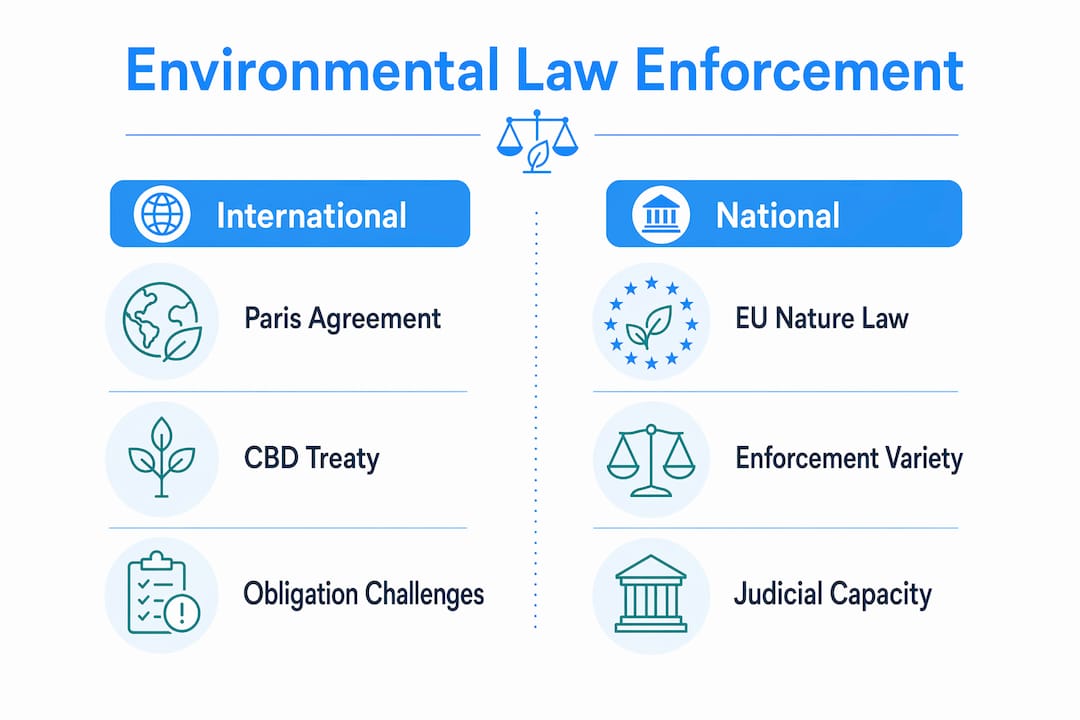
At the national level, enforcement quality varies dramatically. The EU Nature Restoration Law represents one of the most ambitious recent examples, requiring restoration of 20% of EU land and sea by 2030 and all degraded ecosystems by 2050. Analysis shows the law faces governance delays, exemptions, and ambition gaps that limit its real-world effectiveness despite being legally binding. This is a clear illustration of the gap between legal obligation and ecological outcome.
| Enforcement level | Example | Key challenge |
|---|---|---|
| International | Paris Agreement, CBD | No binding enforcement body; relies on national compliance |
| Regional | EU Nature Restoration Law | Governance delays and member-state exemptions |
| National | U.S. Clean Air Act, California lead ammo ban | Agency capacity and political will |
| Local | Municipal zoning and pollution permits | Limited technical expertise and resources |
Judicial capacity is another critical factor. UNEP capacity-building initiatives specifically target judges and prosecutors, training them in technical environmental knowledge so courts can adjudicate complex cases consistently. Without that training, even well-written laws produce inconsistent outcomes.
Pro Tip: For IB ESS essays on environmental governance, use the distinction between international obligations and national enforcement capacity as a framework. It shows evaluative thinking and earns marks in the higher bands.
How are Rights of Nature frameworks shaping environmental law?
Rights of Nature is a legal concept that grants ecosystems, rivers, or species the same standing in court that corporations or individuals hold. Ecuador’s constitution, adopted in 2008, was the first to enshrine these rights nationally. New Zealand granted the Whanganui River legal personhood in 2017. Colombia’s Supreme Court recognized the Colombian Amazon as a subject of rights in 2018. These are not symbolic gestures. They are legally enforceable frameworks that allow guardians to sue on behalf of nature.
However, recognition alone is insufficient without operational institutional design. The comparative evidence shows that Rights of Nature frameworks become effective only when paired with guardianship bodies, procedural standing for litigation, and clear compliance mechanisms. Where those elements are absent, the rights exist on paper but produce no change in practice.
| Feature | Symbolic declaration | Operational framework |
|---|---|---|
| Legal standing | Nature named in law | Guardians can file lawsuits |
| Enforcement body | None specified | Dedicated agency or ombudsperson |
| Compliance mechanism | Aspirational language | Binding restoration orders |
| Conflict resolution | No process defined | Courts adjudicate industry vs. nature |
The practical challenge is that Rights of Nature frameworks frequently conflict with extractive industries that hold existing permits under older legal regimes. Resolving those conflicts requires courts with both the technical knowledge and the institutional authority to prioritize ecological rights. This is where biodiversity conservation strategies and legal design intersect in ways that IB ESS students find genuinely fascinating to analyze.
What do recent laws teach us about impact and limitations?
Real-world cases reveal both the power and the limits of environmental legislation. California’s ban on lead ammunition in hunting is one of the most studied examples of laws for wildlife protection. The legislation reduced lead exposure in scavenging birds like California condors, but a study published in Nature Communications found that behavioral shifts can mask the measurable success of the law. Hunters adapted their behavior in ways that complicated ecological monitoring, meaning legal compliance did not automatically translate into clear ecological recovery data.
This finding has broad implications for how we evaluate the importance of environmental regulations. Legal compliance is a necessary condition, not a sufficient one. Ecological and behavioral science must be integrated into evaluations to understand whether a law is actually working.
The UN-Canada partnership in the Amazon offers a different lesson. That program focuses on enforcement capacity building through monitoring infrastructure, inter-agency collaboration, and specialized expertise. The lesson is that laws need institutional muscle behind them. Governance programs that train inspectors, build monitoring systems, and coordinate across agencies produce results that legislation alone cannot.
Key lessons from recent environmental laws:
- Legal compliance and ecological success are not the same metric. Measure both separately.
- Enforcement capacity, including trained personnel and monitoring technology, determines whether laws produce real outcomes.
- Behavioral responses from regulated parties can obscure whether a law is achieving its ecological goals.
- Governance programs that build institutional capacity alongside legislation produce more durable results than laws passed without implementation support.
Key takeaways
Environmental laws protect ecosystems only when paired with strong enforcement, judicial capacity, and governance systems that close the gap between legal obligation and ecological outcome.
| Point | Details |
|---|---|
| Laws require enforcement to work | Statutes without inspection, penalties, and judicial capacity produce no real ecological change. |
| Climate and environmental law are unified | Regulations addressing emissions, resilience, and adaptation now form a single integrated legal system. |
| International obligations need national action | Treaties like the CBD and Paris Agreement depend entirely on national enforcement systems to produce results. |
| Rights of Nature need institutional design | Legal recognition of nature’s rights is ineffective without guardianship bodies and procedural standing. |
| Evaluate laws ecologically, not just legally | Behavioral shifts and ecological dynamics can mask whether a law is actually protecting wildlife or habitat. |
Why I think legal literacy is the missing skill for environmental advocates
After working with IB ESS students for over 13 years, I have noticed a consistent gap. Students can explain the nitrogen cycle, calculate ecological footprints, and analyze species diversity data with real confidence. But ask them how a specific law translates into protection for a wetland or a migratory bird, and the conversation gets vague fast.
That gap matters. Environmental advocates who understand environmental justice principles and legal frameworks are far more effective than those who rely on moral arguments alone. Laws give you leverage. They give communities standing in court. They create accountability that goodwill cannot.
What I find most exciting about the current moment is the convergence of climate law and biodiversity law. The ICJ advisory opinion in 2026 made clear that states cannot hide behind the Paris Agreement to avoid broader environmental obligations. That is a significant shift, and it opens new avenues for legal action on habitat destruction, species loss, and ecosystem degradation.
My honest view is that the Rights of Nature movement is the most promising development in environmental law in decades, but only if advocates push for operational design, not just symbolic recognition. A river with legal personhood but no guardian and no court willing to hear its case is no better protected than before. The legal text is the beginning, not the end.
For educators, the most useful thing you can do is teach students to read environmental laws critically. Not just what they say, but how they are enforced, who monitors compliance, and what happens when they are violated. That analytical skill transfers directly to IB ESS assessments and to real-world environmental work.
— Marija
Deepen your understanding with Esstutor
If this article sparked questions about how environmental systems and legal frameworks connect within the IB curriculum, Esstutor is built to help you go further. I work with IB ESS students worldwide on exactly these topics, from internal assessments analyzing specific environmental laws to extended essays that require rigorous engagement with governance frameworks and ecological outcomes.
The ESS Extended Essay guide at Esstutor is a strong starting point if you are planning a research paper on environmental legislation, biodiversity law, or climate governance. You can also explore the ESS course overview to see how legal frameworks fit into the broader curriculum. Book a trial lesson and we can map out exactly where your understanding needs to grow.
FAQ
What is the role of laws in environmental protection?
Environmental laws regulate human activities that affect air, water, land, and biodiversity by setting enforceable standards, assigning liability, and creating governance frameworks. Their effectiveness depends on enforcement capacity, judicial training, and accountability mechanisms, not just the text of the legislation.
Why is enforcement more important than the law itself?
UNEP identifies environmental rule of law as requiring accountability and transparency beyond written statutes. A law without inspection systems, trained prosecutors, and functioning courts produces no measurable ecological improvement.
How do international treaties connect to national environmental laws?
International agreements like the CBD and the Paris Agreement create obligations that states must implement through national legislation and enforcement systems. The 2026 ICJ advisory opinion confirmed that these obligations are cumulative, meaning states cannot use one treaty to avoid duties under another.
What are Rights of Nature laws?
Rights of Nature laws grant ecosystems or species legal standing, allowing guardians to sue on their behalf. Comparative research shows these frameworks only produce real protection when paired with operational institutions like guardianship bodies and clear enforcement mechanisms.
How should students evaluate whether an environmental law is working?
Legal compliance data alone is not sufficient. Students should assess ecological outcomes, behavioral responses from regulated parties, and enforcement capacity alongside statutory compliance to form a complete picture of a law’s real-world impact.
No Comments