


10 Mar What is an environmental value system? IB ESS guide 2026
You might think environmental decisions come from analyzing data and scientific reports, but research shows that values explain up to 60% of environmental behavior while knowledge plays a smaller role. Your environmental value system (EVS) shapes how you see nature, prioritize resources, and evaluate solutions to ecological challenges. For IB ESS students, understanding EVS provides the conceptual foundation to analyze stakeholders, interpret case studies, and craft stronger exam responses. This guide explains what EVS means, explores the three core types, clears up common misconceptions, and shows you how to apply this knowledge to ace your IB assessments in 2026.
Table of Contents
- What Is An Environmental Value System? Defining EVS
- How EVSs Influence Environmental Decision-Making
- Main Types Of Environmental Value Systems
- Common Misconceptions About EVSs
- Real-World EVS Applications: Case Studies
- Comparative Frameworks For EVS Analysis
- Applying EVS Knowledge To IB Environmental Systems And Societies
- Explore ESS Tutoring And Resources At ESSTutor.net
- Frequently Asked Questions
Key takeaways
| Point | Details |
|---|---|
| EVS represents core values and beliefs that shape how individuals and societies interact with the environment. | |
| Three primary types exist: ecocentric (nature-centered), anthropocentric (human-centered), and technocentric (technology-driven). | |
| EVS influences environmental decisions, behaviors, and policies more than scientific knowledge alone. | |
| Common misunderstandings include treating EVS as rigid categories or ignoring cultural context. | |
| Mastering EVS analysis is essential for IB ESS exams, essays, and internal assessments. |
What is an environmental value system? Defining EVS
An environmental value system is a culturally and philosophically shaped framework of values, beliefs, and attitudes that determines how you perceive and interact with the natural world. Think of EVS as the lens through which you view environmental problems and solutions. When two people look at a forest, one might see timber for economic growth while another sees an ecosystem worth protecting for its own sake. These different perspectives stem from their underlying EVS.
The framework includes three interconnected components working together:
- Values: Core principles that define what matters most, such as preserving biodiversity or maximizing human welfare
- Beliefs: Accepted truths about how nature works and humanity’s role within it
- Attitudes: Emotional and behavioral responses toward environmental issues and actions
These components directly shape environmental behavior and policy making. When policymakers with an anthropocentric EVS craft regulations, they balance environmental protection with economic development. Leaders holding ecocentric values prioritize conservation even when it limits resource extraction. Your EVS acts as a decision filter, determining which environmental outcomes you consider acceptable or necessary.
For IB ESS, recognizing EVS helps you analyze stakeholder positions in case studies, predict policy outcomes, and structure arguments in essays. The syllabus explicitly requires you to identify and compare different environmental worldviews, making EVS literacy fundamental to course success.
Pro Tip: When you encounter an environmental controversy in your studies, immediately ask yourself what values each stakeholder prioritizes. This habit builds your EVS analysis skills for ess ib exam questions.
How EVSs influence environmental decision-making
Your EVS doesn’t just affect what you believe about nature. It directly shapes the actions you take and the policies you support. Research demonstrates that environmental attitudes explain up to 60% of variation in pro-environmental behavior, far exceeding the influence of environmental knowledge alone. This means that someone with strong ecocentric values but limited scientific understanding will often act more sustainably than someone with extensive ecology knowledge but weak environmental ethics.
EVS influences decisions at multiple levels:
- Individual choices: What you buy, how you travel, and whether you recycle stem from your values about nature’s worth
- Community action: Neighborhood conservation efforts reflect collective attitudes toward local ecosystems
- National policy: Climate legislation depends on whether lawmakers prioritize economic growth or ecological stability
- International agreements: Treaties like the Paris Agreement emerge from negotiations between nations with conflicting EVSs
The mechanism works through framing. If you hold technocentric values, you perceive environmental problems as engineering challenges solvable through innovation. Climate change becomes an opportunity to develop carbon capture technology rather than a signal to reduce consumption. Conversely, ecocentric values frame the same issue as evidence that humanity must fundamentally change its relationship with nature.
This understanding matters enormously for IB ESS assessments. When exam questions ask you to evaluate a proposed solution or compare stakeholder perspectives, your ability to identify the underlying EVS determines the depth of your analysis. Weak answers describe what people believe. Strong answers explain why those beliefs lead to specific policy preferences and behaviors.
Pro Tip: Practice identifying EVS types in news articles about environmental conflicts. This real-world application strengthens your ability to spot value systems quickly during timed exams.
Main types of environmental value systems
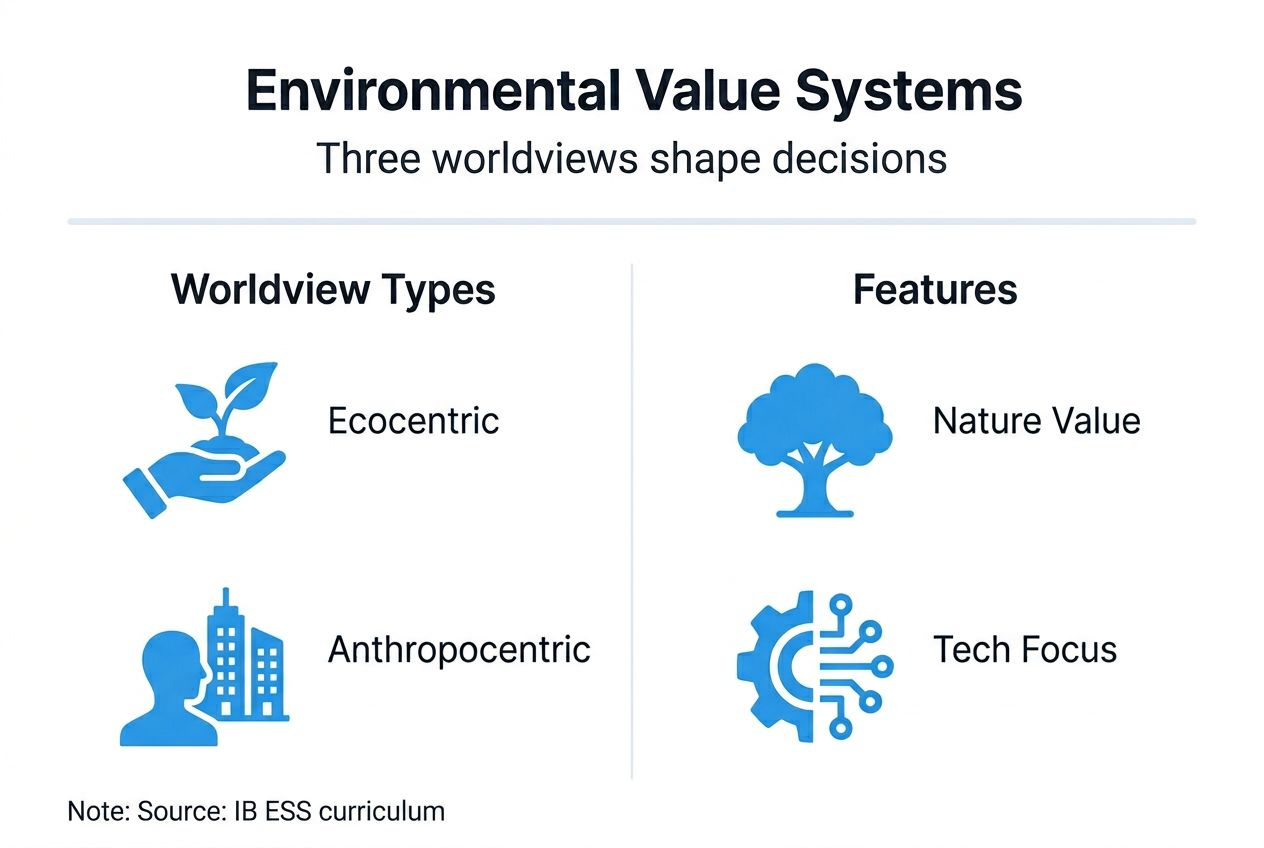
The IB ESS curriculum organizes EVS into three primary worldviews, each representing a distinct philosophy about humanity’s relationship with nature. Understanding these categories allows you to classify stakeholder positions and predict their preferred solutions.
Ecocentric EVS places intrinsic value on nature independent of human utility. Followers believe ecosystems deserve protection for their own sake, not just for the resources they provide. This worldview supports strict conservation measures, opposes large-scale resource extraction, and views technological fixes with skepticism. Deep ecologists and many indigenous cultures hold ecocentric values, advocating for minimal human interference in natural systems.
Anthropocentric EVS centers on human welfare and sees the environment primarily as a resource for human benefit. This doesn’t mean anthropocentrists ignore environmental protection. Instead, they frame conservation as necessary for human survival and prosperity. Anthropocentric EVSs support sustainable development frameworks that balance economic growth with environmental stewardship. Most governments and international organizations operate from this worldview, seeking solutions that serve both ecological health and human needs.
Technocentric EVS expresses optimism that technology and human ingenuity can solve environmental problems without major lifestyle changes or economic sacrifices. Technocentrists support innovation in renewable energy, genetic engineering, and geoengineering as solutions to ecological challenges. They believe market mechanisms and technological progress will naturally address environmental degradation as these issues become economically significant.
| Worldview | Core Value | View of Nature | Technology Role | Policy Preference |
|---|---|---|---|---|
| Ecocentric | Intrinsic value of nature | Sacred, interconnected | Limited, potentially harmful | Strict conservation, protected areas |
| Anthropocentric | Human welfare | Resource for sustainable use | Useful tool with limits | Balanced development, regulations |
| Technocentric | Human innovation | Problem to manage | Primary solution | Market-based, innovation incentives |
These categories exist on a spectrum rather than as rigid boxes. Real people and policies often blend elements from multiple worldviews. A farmer might hold anthropocentric values about cropland while maintaining ecocentric attitudes toward a nearby forest. Recognizing this nuance prevents oversimplification in your analysis.
Pro Tip: When the ess ib syllabus asks you to evaluate an environmental management strategy, identify which EVS it reflects and explain how a different worldview would approach the same problem differently. This comparative analysis demonstrates sophisticated understanding.
Common misconceptions about EVSs
Students often stumble when applying EVS concepts because they hold mistaken assumptions about how value systems work in practice. Recognizing these misconceptions sharpens your analytical skills and prevents exam errors.
First, environmental decisions are never purely scientific or objective. Even when policymakers claim to follow the science, they make value judgments about acceptable risk levels, which stakeholders matter most, and how to weigh competing priorities. A study might show that a proposed dam will flood 50 square kilometers of forest. The scientific data tells you what will happen. Your EVS determines whether you consider this an acceptable tradeoff for hydroelectric power.
Second, cultural context profoundly shapes EVS formation. Western industrial societies tend toward technocentric or anthropocentric worldviews, while many indigenous communities maintain ecocentric values rooted in spiritual connections to land. Assuming your own cultural perspective represents the universal standard leads to misunderstanding stakeholder positions in case studies.
Third, EVS categories overlap and blend rather than creating distinct camps. You might hold ecocentric values about wilderness preservation while supporting technocentric solutions for urban air pollution. Most people and organizations exhibit mixed value systems depending on the specific environmental issue at hand.
Fourth, values influence policy outcomes more than commonly recognized:
- Legislative priorities reflect the dominant EVS of elected officials and their constituents
- Funding decisions about conservation versus development stem from underlying value judgments
- International cooperation depends on finding common ground between nations with different environmental worldviews
- Public support for environmental regulations correlates more strongly with values than with scientific literacy
Research shows that stakeholder values predict their positions on environmental controversies with 85% accuracy, while scientific knowledge alone predicts positions with only 35% accuracy.
Understanding these realities prepares you to analyze environmental conflicts with the sophistication IB examiners expect. When you encounter a case study, resist the urge to label stakeholders as simply right or wrong. Instead, identify their EVS and explain how their values logically lead to their positions.
Real-world EVS applications: case studies
Abstract EVS theory becomes tangible when you examine actual environmental conflicts through this lens. The Amazon rainforest debates illustrate how different value systems produce radically different policy preferences for the same ecological system.

Brazilian cattle ranchers and soy farmers often hold anthropocentric values, viewing the rainforest as underutilized land that could support economic development and reduce poverty. They argue that wealthier nations destroyed their own forests during industrialization and now hypocritically demand that Brazil preserve its natural resources. This perspective led to policies encouraging agricultural expansion and road construction through previously protected areas.
Conversely, indigenous communities and international conservation organizations typically maintain ecocentric values toward the Amazon. They see the rainforest as inherently valuable, home to millions of species, and critical for global climate regulation. These groups advocate for expanding protected areas, recognizing indigenous land rights, and limiting resource extraction regardless of economic opportunity costs.
Measurable outcomes reflect these conflicting EVSs. Deforestation rates reduced by 12% in protected areas influenced by ecocentric values versus 5% in economically driven zones during the same period. The data demonstrates how underlying values translate into concrete environmental results.
Other brief examples showing EVS impact include:
- Norwegian whaling policy reflects anthropocentric sustainable use values versus ecocentric preservation ethics of anti-whaling nations
- China’s massive investment in renewable energy technology demonstrates technocentric faith in innovation solving pollution problems
- Costa Rica’s payment for ecosystem services program balances anthropocentric economic incentives with ecocentric conservation goals
For your ess internal assessment examples, follow these case study analysis steps:
- Identify the environmental issue and key stakeholders involved in the conflict
- Determine each stakeholder’s EVS based on their stated positions and proposed solutions
- Explain how their values logically produce their policy preferences
- Evaluate the effectiveness of implemented policies by examining measurable outcomes
- Propose alternative approaches that might bridge conflicting value systems
This structured method ensures your internal assessment demonstrates the critical thinking skills that earn top marks.
Comparative frameworks for EVS analysis
Developing mental models for comparing EVSs helps you analyze exam questions efficiently and structure coherent essay responses. Think of these frameworks as analytical tools that organize your thinking when evaluating stakeholder positions or environmental policies.
Two primary axes create useful comparison space. The first axis measures where a worldview falls between valuing nature for its own sake versus valuing nature primarily for human benefit. Ecocentric views cluster at one extreme while anthropocentric positions occupy the middle ground. The second axis evaluates technology optimism versus skepticism. Technocentrists believe innovation solves environmental problems while ecocentrists worry that technology often creates new ecological challenges.
| Dimension | Ecocentric | Anthropocentric | Technocentric |
|---|---|---|---|
| Nature’s value | Intrinsic, independent of humans | Instrumental for human welfare | Resource to manage efficiently |
| Human role | Participant within ecosystems | Steward balancing use and protection | Problem solver through innovation |
| Technology stance | Skeptical, prefer low-impact solutions | Useful tool requiring careful regulation | Primary solution to environmental challenges |
| Policy approach | Preservation, strict limits on use | Sustainable development, balanced regulations | Market incentives, technological innovation |
| Time horizon | Long-term ecological stability | Balance present needs with future sustainability | Confidence in future innovation |
Applying these comparisons in exams requires practice. When a question presents a proposed solution, immediately ask which EVS it reflects and how stakeholders with different worldviews would evaluate it. A carbon pricing scheme appeals to technocentric and anthropocentric thinkers who trust market mechanisms but may frustrate ecocentrists who see it as commodifying nature.
Expert tips for using frameworks effectively:
- Start by identifying the dominant EVS in any scenario before diving into technical details
- Use EVS categories to organize essay paragraphs, dedicating sections to each worldview’s perspective
- Explicitly compare and contrast positions to demonstrate sophisticated analysis
- Connect EVS differences to specific policy recommendations rather than treating them as abstract philosophy
These strategies prove especially valuable for ess ib assessment model questions requiring evaluation of multiple perspectives. Examiners reward students who move beyond describing different views to analyzing why those views exist and what they imply for environmental management.
Applying EVS knowledge to IB Environmental Systems and Societies
Transforming your EVS understanding into exam success requires deliberate practice connecting theory to IB assessment formats. The syllabus tests this knowledge through multiple question types, each demanding specific application skills.
Identifying EVS types in exam questions starts with recognizing trigger phrases. Questions asking you to evaluate stakeholder perspectives, compare management approaches, or explain policy conflicts almost always require EVS analysis. When you see these prompts, immediately activate your comparative framework and consider how different worldviews would approach the scenario.
Integrating EVS into internal assessments strengthens your research question and analysis:
- Frame your investigation around how different EVSs produce different outcomes for an environmental issue
- Interview stakeholders and categorize their responses by underlying values
- Use EVS as an analytical lens to explain conflicting data or unexpected results
- Demonstrate critical thinking by acknowledging that your own EVS influences your interpretation
Essay writing improves dramatically when you structure arguments around value systems. Instead of simply listing facts about an environmental problem, explain how stakeholders with ecocentric values prioritize different solutions than those with technocentric worldviews. This approach shows examiners that you understand the human dimensions of environmental science, not just the technical aspects.
Interpreting stakeholder values requires reading between the lines. A company spokesperson might not explicitly state their technocentric worldview, but you can infer it from their emphasis on technological solutions and economic efficiency. Indigenous leaders may not use the term ecocentric, but their language about spiritual connections to land reveals this value orientation.
Pro Tip: Work through past papers specifically looking for EVS opportunities, even in questions that don’t explicitly mention value systems. This practice builds pattern recognition so you automatically spot these analytical openings during actual exams.
Your success in what is environmental systems and societies ib ess course depends partly on mastering technical content about ecosystems and pollution, but equally on understanding the human values driving environmental decisions. Check internal assessment examples to see how top students incorporate EVS analysis. Browse the ess blog regularly for additional case studies applying these concepts to current events.
Explore ESS tutoring and resources at ESSTutor.net
Mastering EVS analysis and other IB ESS core concepts becomes easier with expert guidance tailored to your learning needs. ESSTutor.net offers personalized tutoring from an experienced IB examiner who understands exactly what assessors look for in student responses. Whether you struggle with identifying value systems in case studies or need help structuring your internal assessment around EVS frameworks, focused tutoring accelerates your progress.
The platform provides comprehensive support beyond EVS, covering all syllabus areas from ecosystem ecology to resource management. Explore the ess course overview to understand how tutoring aligns with your curriculum. Review internal assessment examples showing how successful students applied EVS concepts to earn top marks. Access ess ib exam preparation resources that transform theory into practical test-taking strategies. With over 13 years of IB teaching experience, ESSTutor.net delivers the targeted support you need to achieve your academic goals in 2026 and beyond.
Frequently asked questions
What is an environmental value system and why does it matter?
An environmental value system is your framework of beliefs, values, and attitudes that shapes how you perceive and interact with nature. It matters because your EVS determines which environmental problems you prioritize, which solutions you support, and how you balance ecological protection with human needs. For IB ESS, understanding EVS is essential because the syllabus requires you to analyze stakeholder perspectives and evaluate environmental policies through this lens.
How do I identify someone’s environmental value system?
Listen for what they prioritize in their arguments and proposed solutions. Ecocentric speakers emphasize nature’s intrinsic worth and advocate for preservation regardless of economic cost. Anthropocentric voices balance environmental protection with human welfare and sustainable development. Technocentric arguments focus on innovation, efficiency, and faith that technology will solve environmental challenges. Their choice of language, preferred policies, and underlying assumptions reveal their worldview even when they don’t explicitly name it.
What’s the difference between ecocentric and anthropocentric worldviews?
Ecocentric worldviews assign intrinsic value to nature independent of human utility, supporting strict conservation and minimal human interference. Anthropocentric worldviews center on human welfare, viewing the environment primarily as a resource that requires sustainable management for long-term human benefit. While ecocentrists might oppose a development project because it harms ecosystems, anthropocentrists would support it if designed sustainably to meet human needs without irreversible ecological damage.
Can someone hold multiple environmental value systems simultaneously?
Yes, most people exhibit mixed or context-dependent EVSs rather than purely adhering to one worldview. You might maintain ecocentric values about wilderness areas while supporting technocentric solutions for urban pollution. Your EVS can also shift over time through education, experiences, and cultural influences. For IB ESS analysis, recognize that stakeholders often blend elements from multiple worldviews depending on the specific environmental issue at hand.
How should I use EVS concepts in IB ESS exam answers?
Identify the EVS underlying each stakeholder position presented in the question, then use this framework to structure your analysis and evaluation. Explain how different worldviews logically produce different policy preferences rather than simply describing what people believe. Compare and contrast approaches by explicitly connecting them to ecocentric, anthropocentric, or technocentric values. This demonstrates sophisticated understanding that earns higher marks than purely technical responses lacking human dimension analysis.
Recommended
- What is environmental systems and societies ib / ESS course
- ENVIRONMENTAL SYSTEMS AND SOCIETIES EXTENDED ESSAY – ESS
- What is an “environmental issue” considered in ESS? – ESS Online tutor
- How is an environmental system defined? – esstutor.net
No Comments