


17 Apr What is exam technique? Mastering ESS exams for top IB results
TL;DR:
- Effective IB ESS exam success depends on mastering exam technique, not just memorizing content.
- Key skills include interpreting command terms, planning answers, managing time, and structured responses.
- Practice with past papers and review examiner feedback to build deliberate, confident exam strategies.
Many IB ESS students walk into exams convinced that memorizing more content is the key to higher scores. It is a common assumption, and it holds a lot of students back. The truth is that exam prep for ESS involves far more than just knowing your material. Exam technique, meaning the way you approach, structure, and manage your answers during the exam itself, is just as important as subject knowledge. In this article, we will break down exactly what exam technique means in the context of IB ESS and show you practical strategies to apply it right away.
Table of Contents
- Understanding exam technique: Definition and its role in IB ESS
- Key exam techniques for IB ESS: Practical strategies that work
- Common exam mistakes and how better technique prevents them
- Building your exam technique: Practice and preparation
- What most students miss about exam technique in ESS
- Take the next step: Master ESS exam technique with expert support
- Frequently asked questions
Key Takeaways
| Point | Details |
|---|---|
| Exam technique matters | How you answer questions can make as much difference as what you know. |
| Strategy beats memorization | Practicing exam strategy regularly leads to better outcomes than memorizing content alone. |
| Avoid common mistakes | Learning and applying good technique helps you sidestep frequent errors in ESS exams. |
| Practice builds confidence | Timed practice with past papers is the fastest way to master exam technique and reduce stress. |
Understanding exam technique: Definition and its role in IB ESS
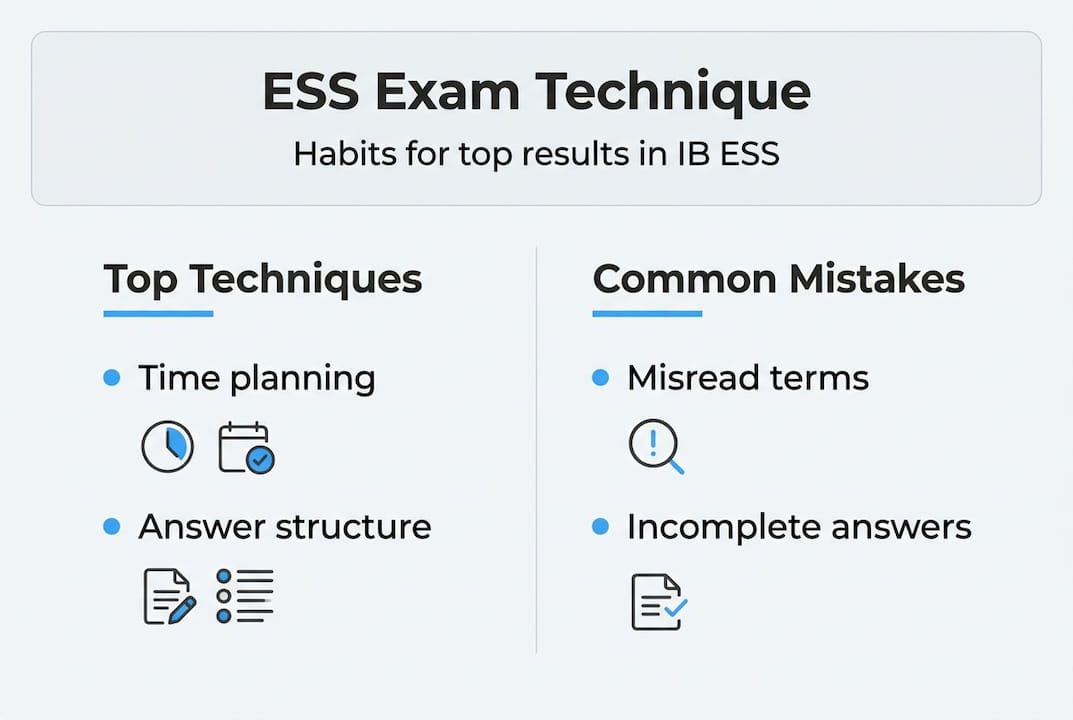
So what does exam technique actually mean? It is not a vague buzzword. Exam technique refers to the specific approach, timing, structure, and method you use when tackling exam questions. Think of it as the toolkit you bring into the exam room alongside your knowledge. Without it, even strong content knowledge can fail to translate into marks.
In the context of IB ESS, exam technique covers several practical skills. You need to interpret command terms correctly. Words like evaluate, discuss, outline, and explain each require a different type of response. Misreading a command term is one of the most common ways students lose marks, and it has nothing to do with whether they know the topic.
Exam technique also means structuring your answers clearly, managing your time across sections, and knowing when to move on instead of getting stuck. As skillful exam technique directly impacts student success in IB programs, it is worth treating this as a learnable skill, not an afterthought.
“Exam technique is not about what you know. It is about how effectively you communicate what you know under exam conditions.”
Here are the core elements of strong exam technique in IB ESS:
- Understanding command terms: Know the difference between state, describe, explain, and evaluate before you sit the exam.
- Answer planning: Spend 1 to 2 minutes organizing your thoughts before writing, especially for extended response questions.
- Prioritizing questions: Start with questions you feel confident about to build momentum and secure early marks.
- Time management: Allocate time based on mark allocation and stick to it.
- Checking your work: Reserve a few minutes at the end to review answers for completeness and accuracy.
Strong exam preparation techniques build these habits before exam day, so they feel natural when it counts. When you walk in with a plan, your confidence rises and your stress drops noticeably.
Key exam techniques for IB ESS: Practical strategies that work
With a clear definition in hand, let us explore proven techniques you can use to improve your performance specifically in the IB ESS exam. Each paper type demands a slightly different approach, and recognizing that is already a step ahead.
For multiple-choice questions, read every option before selecting. Eliminate obvious wrong answers first. Do not rush. For data-based questions, always reference the data directly in your answer. Examiners reward students who engage with what is actually on the page, not just what they remember from class.
For extended response and essay questions, use a structured approach. Here is a step-by-step process that works:
- Read the question carefully and underline the command term.
- Identify all parts of the question, including any sub-components.
- Spend 1 to 2 minutes planning your answer using bullet points or a quick outline.
- Write your response using the PEEL structure: Point, Evidence, Explanation, Link.
- Check that you have answered every part of the question before moving on.
- Leave time at the end for a brief review of your response.
Time management is especially important in ESS exams. Divide your total time by the number of marks and use that as a rough guide. For example, if you have 60 minutes for a 40-mark section, you have about 1.5 minutes per mark. Sticking to this prevents you from spending 20 minutes on a 4-mark question.
Using proven study strategies alongside these techniques enhances exam performance measurably. Check out these top ESS exam tips for additional guidance tailored to the ESS syllabus.
Pro Tip: Practice writing quick 90-second answer plans for past paper questions. This habit alone prevents the mid-exam brain freeze that derails so many students. Managing your exam time effectively is a skill you can build well before the actual exam.
Common exam mistakes and how better technique prevents them
Having explored what works, it is just as important to see where students often go astray and how the right technique helps you avoid those traps. Recognizing your patterns is the first step toward correcting them.
The three most common mistakes IB ESS students make are misreading command terms, running out of time, and writing incomplete answers. Each of these is preventable with the right approach.

| Common mistake | How better technique prevents it |
|---|---|
| Misreading command terms | Underline the command term before writing anything |
| Running out of time | Use mark-based time allocation from the start |
| Incomplete answers | Plan your answer before you begin writing |
| Vague, unstructured responses | Use PEEL structure for every extended answer |
| Ignoring data in questions | Always reference given data directly in your response |
Here is how improved technique helps at each stage of the exam:
- Clarify the question first: Read slowly, annotate, and confirm you understand what is being asked before writing a single word.
- Plan your answer: Even a brief outline ensures you cover every required point and avoid trailing off mid-response.
- Save time for review: A final check catches missing examples, incomplete explanations, or calculation errors.
From an examiner’s perspective, understanding examiner expectations can prevent common scoring pitfalls that cost students marks they clearly earned on content. The difference between a good answer and a great answer is often just clarity and structure. For Paper 2 specifically, reviewing ESS Paper 2 strategies helps you understand what examiners are looking for section by section. Avoiding common exam errors is entirely achievable when you build awareness of your own habits.
Building your exam technique: Practice and preparation
Knowing what to avoid and strive for, the next question is: how do you reliably build these techniques before exam day? The answer is consistent, deliberate practice with real ESS materials.
Practicing with past ESS papers is one of the most effective ways to refine exam technique because it exposes you to real question formats, command term patterns, and mark allocation structures. Do not just complete past papers and move on. Review the examiner reports afterward. These reports tell you exactly what distinguished strong answers from weak ones.
Here is a sample weekly schedule you can use during your revision period:
| Day | Activity | Time |
|---|---|---|
| Monday | Timed past paper (one section) | 45 minutes |
| Tuesday | Review examiner report and mark scheme | 30 minutes |
| Wednesday | PEEL writing practice for 2 topics | 40 minutes |
| Thursday | Command term drills and vocabulary review | 25 minutes |
| Friday | Full timed practice paper under exam conditions | 90 minutes |
| Saturday | Self-assessment and error log review | 30 minutes |
| Sunday | Rest or light concept review | Optional |
Following an exam practice plan like this builds consistency and prevents last-minute cramming. It also gives you a clear sense of your progress over time.
Pro Tip: Simulate exam conditions at home. Sit at a clear desk, set a timer, and remove all distractions. This kind of rehearsal builds mental resilience and reduces surprise on exam day. Pair this habit with strategies for overcoming exam anxiety to feel genuinely prepared rather than just hopeful.
What most students miss about exam technique in ESS
Here is something I see consistently in tutoring sessions: students who score in the 5 to 6 range often know the content just as well as students who score 7s. The difference is almost never about knowledge. It is about how they communicate that knowledge on the page.
Most IB ESS students overestimate the value of memorization and underestimate the power of deliberate practice. They study topics. They review notes. But they rarely practice the act of sitting an exam with a clock running. That gap shows up in results.
The small habits matter more than you might expect. Annotating the question before writing. Spending 90 seconds on a plan. Checking that you have addressed every part of the prompt. These are not big strategies. They are tiny, repeatable actions that accumulate into significantly better answers. Exploring what really works in ESS exams often reveals that top scorers are not necessarily smarter. They are simply more deliberate. That is a quality you can develop right now, not just something you are born with.
Take the next step: Master ESS exam technique with expert support
You now have a clear picture of what exam technique is, why it matters in IB ESS, and how to start building it. Applying these strategies consistently will make a real difference to your results.
If you want to move faster and get feedback that is tailored to your specific strengths and gaps, personalized support makes a meaningful difference. Our ESS exam strategy guide is a great starting point. You can also work through ESS mock exams designed to mirror real IB exam conditions. And if you want to understand why exam prep is worth prioritizing right now, read more about how you can succeed with exam prep with targeted resources built specifically for IB ESS students.
Frequently asked questions
What exactly is exam technique in IB ESS?
Exam technique is the way you approach, structure, and answer exam questions to maximize marks, not just knowing content. Good exam technique is a major factor in higher IB exam performance.
How does exam technique differ from regular studying?
Regular studying focuses on learning content, while exam technique means using strategies for understanding questions, time management, and structured answers. Strategy-rich exam prep is more effective than content memorization alone.
What is the best way to practice exam technique for ESS?
The best approach is to use past papers under timed conditions and review examiner comments after each session. Practicing with real exam materials refines your exam approach in a way that regular revision cannot.
Can better exam technique reduce stress during ESS exams?
Yes, having strong exam technique boosts confidence and reduces stress on exam day. Strong technique lessens the impact of exam-day anxiety by giving you a clear plan to follow when pressure builds.
No Comments