


08 Apr What is IB ESS? Guide to success in environmental systems
TL;DR:
- IB ESS blends science and social studies, offering interdisciplinary understanding of environmental issues.
- The course emphasizes systems thinking, data analysis, and evaluating social and scientific perspectives.
- Success requires connecting concepts across topics, real-world examples, and early preparation for assessments.
Many IB students arrive at ESS unsure whether it counts as a science, a humanities course, or something in between. That confusion is completely understandable. Environmental Systems and Societies sits at a unique crossroads in the IB Diploma Programme, blending ecology, economics, ethics, and policy into one subject. This guide breaks down exactly what IB ESS is, why students choose it, and what you can do right now to perform at your best. Whether you are just starting out or preparing for final exams, you will find clear, practical direction here.
Table of Contents
- What is IB ESS and why does it matter?
- Core themes and key concepts in IB ESS
- Coursework, internal assessments, and exams: How IB ESS is structured
- Tips for excelling in IB ESS coursework and exams
- What most students misunderstand about IB ESS
- Take your IB ESS results to the next level
- Frequently asked questions
Key Takeaways
| Point | Details |
|---|---|
| ESS combines science and society | IB ESS offers an interdisciplinary approach ideal for understanding environmental issues and solutions. |
| Assessments include IAs and exams | Your ESS grade is based on both an independent project and standardized exams, so time management is essential. |
| Success demands active strategies | Top scores come from developing analytical thinking, mastering key concepts, and applying them to real-world scenarios. |
| It’s not a shortcut science | Treating ESS as an ‘easy option’ underestimates the skills needed for high achievement in this unique course. |
What is IB ESS and why does it matter?
IB Environmental Systems and Societies, commonly known as ESS, is one of the most distinctive courses in the IB Diploma Programme. Unlike most subjects that sit cleanly in either Group 3 (Individuals and Societies) or Group 4 (Sciences), ESS bridges both groups. That means you can use it to satisfy either requirement, which gives you real flexibility when planning your diploma subject choices.
At its core, IB ESS is an interdisciplinary subject combining environmental science and social studies. You are not just learning about ecosystems in isolation. You are also examining how human societies interact with, depend on, and impact those systems. That dual lens is what makes ESS genuinely different from Biology or Geography.
The official IBO overview describes the course as one that encourages students to adopt a holistic perspective on environmental issues, recognizing that solutions require both scientific understanding and social awareness.
“ESS enables students to adopt an informed personal response to the wide range of pressing environmental issues that they will inevitably come to face.”
Students choose ESS for many reasons. Some are passionate about climate change, biodiversity loss, or sustainability. Others appreciate that the course connects directly to real global challenges. Some find that it fits their diploma structure well, especially when they are already taking two other sciences. Whatever your reason, knowing whether ESS is the right fit for your goals is a smart first step.
Here are some of the real-world themes you will explore in IB ESS:
- Ecological footprints and how consumption patterns affect planetary resources
- Biodiversity and conservation, including species diversity and habitat loss
- Climate change and the science and politics behind international responses
- Pollution management, from water quality to atmospheric toxins
- Food and soil systems, including sustainable agriculture and soil degradation
- Human population dynamics and resource distribution
These are not abstract textbook topics. They are issues shaping policy decisions right now, and ESS gives you the tools to analyze them critically.
Core themes and key concepts in IB ESS
Now that you know why IB ESS matters, it is time to look at what you will actually study and the skills you will build along the way.
The course is organized around interconnected themes rather than isolated chapters. IB ESS develops understanding of key environmental topics across multiple scales, from local ecosystems to global systems. That multi-scale thinking is one of the most valuable skills you will develop.

Here is a summary of the major themes and why each one matters:
| Theme | Example topic | Why it matters |
|---|---|---|
| Systems and models | Energy flow in ecosystems | Builds analytical thinking |
| Sustainability | Ecological footprint analysis | Links science to policy |
| Biodiversity | Species richness and conservation | Connects ecology to ethics |
| Pollution | Eutrophication in water bodies | Applies chemistry to real issues |
| Climate change | Carbon cycle disruptions | Integrates science and society |
Beyond content knowledge, ESS builds a specific set of skills that you will use throughout your exams and internal assessment. The benefits of studying environmental systems go well beyond the classroom, including stronger analytical reasoning and the ability to evaluate competing perspectives.
Key skills every ESS student develops:
- Systems thinking: Understanding how components of an ecosystem interact and affect each other
- Data analysis: Interpreting graphs, field data, and scientific studies
- Evaluating perspectives: Weighing scientific evidence against social, economic, and political factors
- Written argumentation: Constructing well-supported responses in exams and essays
These environmental concepts are not just tested in isolation. Examiners want to see you connect them across topics.
Pro Tip: When writing exam essays, do not treat science and society as separate boxes. The strongest answers show how a scientific concept, such as biomagnification, directly influences a social or policy outcome. That integration is exactly what ESS examiners reward.
Coursework, internal assessments, and exams: How IB ESS is structured
Understanding the assessment structure early gives you a real advantage. IB ESS is assessed through a combination of external exams and an internal assessment (IA). Here is how the components break down:
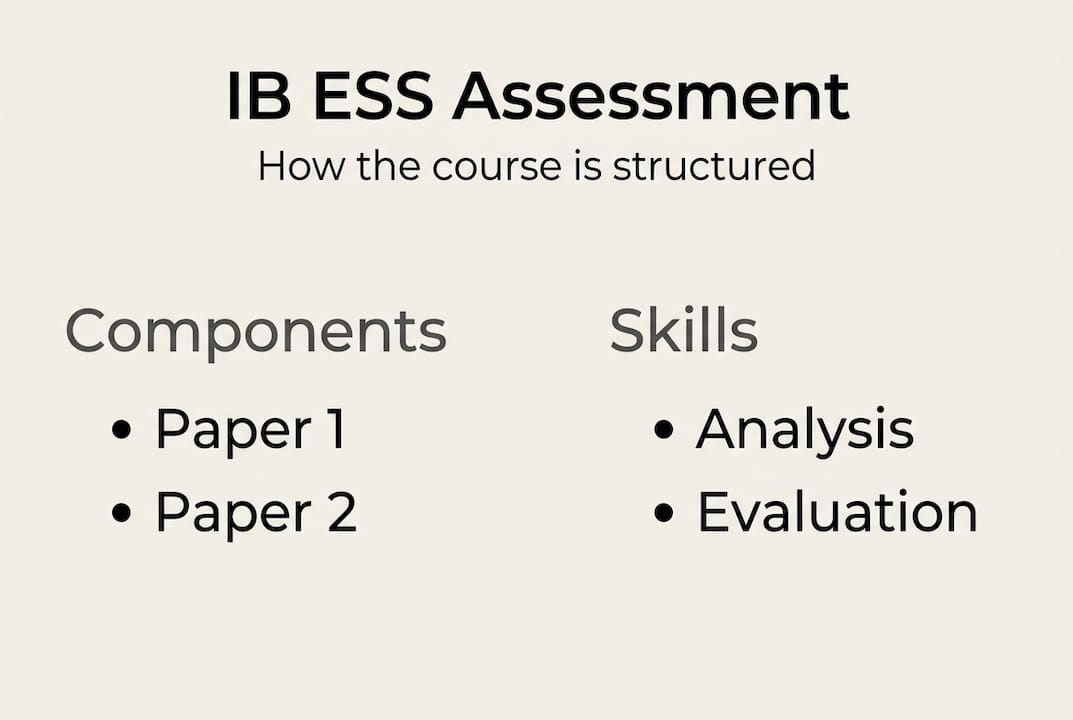
| Component | % of grade | Skills assessed | Duration |
|---|---|---|---|
| Paper 1 (case study) | 25% | Analysis, evaluation, application | 1 hour |
| Paper 2 (structured questions and essays) | 50% | Knowledge, argumentation, synthesis | 2 hours |
| Internal Assessment | 25% | Investigation design, data collection, analysis | Ongoing |
You can explore the full breakdown through the ESS assessment model to understand exactly how marks are allocated across each component.
Internal assessment in IB ESS is a significant component, requiring students to design and complete their own investigation. This is your chance to study an environmental issue that genuinely interests you, collect real data, and apply ESS concepts to your findings.
Here are the key steps to starting your IA project effectively:
- Choose a focused research question that is testable and relevant to ESS topics
- Review the assessment criteria before you begin collecting data, not after
- Plan your methodology carefully, including how you will control variables
- Collect sufficient data across multiple trials or locations for reliability
- Analyze your data using appropriate graphs and statistical tools
- Evaluate your method honestly, including limitations and sources of error
- Connect your findings back to broader ESS concepts and real-world implications
Starting your IA with a clear plan saves enormous time later. Students who treat the IA as an afterthought almost always struggle with the write-up. Treat it as an opportunity to genuinely investigate something you care about, and the process becomes much more manageable.
Tips for excelling in IB ESS coursework and exams
With the course structure clear, here is what you can actually do to perform at your best in IB ESS.
Preparation and understanding key concepts are critical for success in IB ESS exams and coursework. But preparation looks different in ESS than in a traditional science subject.
Top study strategies for IB ESS:
- Use past papers regularly. ESS exam questions follow recognizable patterns. Practicing with real past papers helps you understand command terms like “evaluate,” “discuss,” and “explain,” which each require a different type of response.
- Organize your notes by theme, not by chapter. ESS examiners often ask questions that connect multiple topics. Notes organized around big ideas like sustainability or systems make those connections easier to see.
- Build a case study bank. Real-world examples are essential for Paper 2 essays. Collect 10 to 15 solid case studies covering different biomes, pollution types, and conservation efforts.
- Review your IA criteria early and often. Since the IA counts for 25% of your final grade, understanding the marking criteria from the start shapes every decision you make.
Pro Tip: When answering a Paper 2 essay, open with a clear definition of the key term in the question, then immediately link it to a real-world example. Examiners notice when students ground their arguments in specific, named case studies rather than vague generalities.
Common pitfalls to avoid:
- Writing only about science without addressing social or political dimensions
- Using vague language instead of specific data or named examples
- Ignoring the command term and writing a description when an evaluation is required
- Leaving IA planning until the last few weeks of the course
The students who score highest in IB ESS are not necessarily the ones who memorize the most facts. They are the ones who can connect ideas across topics and apply them to unfamiliar scenarios.
What most students misunderstand about IB ESS
Here is something I see often: students choose ESS thinking it will be the “easy” science option, then feel blindsided when the exam demands genuine analytical depth. ESS is not a shortcut. It is a subject that rewards students who take its interdisciplinary nature seriously.
The biggest mistake is treating ESS like a content-heavy science where memorization is enough. It is not. The examiners are looking for students who can evaluate competing viewpoints, weigh evidence, and connect understanding key concepts to real social and political contexts. That requires practice and genuine engagement with the material.
I have seen students who came in with strong biology backgrounds struggle because they focused only on the science side and ignored the social analysis. And I have seen students with no science background thrive because they embraced the full scope of the course. The difference is mindset. Treat ESS as a subject that unifies two ways of understanding the world, and your results will reflect that.
Take your IB ESS results to the next level
If you are feeling uncertain about your IA, your exam technique, or just where to start, you do not have to figure it out alone.
Working with experienced IB ESS IA tutors can make a real difference, especially when you are navigating the IA process or trying to master Paper 2 essay structure. You can also strengthen your preparation with targeted IB ESS notes and textbook resources, or sharpen your exam approach with focused IB ESS Paper 2 strategies. Do not wait until the week before exams to seek support. Starting early gives you time to build genuine understanding, not just last-minute revision.
Frequently asked questions
Is IB ESS an easy subject compared to other sciences?
While IB ESS is accessible, it is not necessarily easier. ESS is interdisciplinary and requires deep analysis, not just memorization, making critical thinking essential for high scores.
What is the weight of the internal assessment in IB ESS?
Internal Assessment accounts for 25% of the total ESS grade, making it one of the most important components to plan and execute carefully.
Can IB ESS satisfy Group 3 or Group 4 requirements in the IB Diploma?
Yes. IB ESS can count for either Group 3 or Group 4 in the IB Diploma, giving students valuable flexibility in structuring their subject choices.
What are the benefits of taking IB ESS for university admissions?
ESS develops transferable skills and demonstrates environmental awareness, both of which are valued by universities worldwide, particularly in environmental science, policy, and sustainability programs.
No Comments