


03 Apr IB educators and ESS exam success: what really works
TL;DR:
- Personalized IB ESS coaching focuses on strategy, feedback, and concept mastery to improve grades.
- Educators guide students through exam practice, IA development, and understanding key environmental concepts.
- Expert guidance helps students transition from rote memorization to application and analytical skills.
Most IB ESS students study hard. Yet 65% of SL students only reach a grade 4 or above, with the average sitting at around 4.2 out of 7. The gap between a 4 and a 6 or 7 is rarely about effort alone. It comes down to strategy, personalization, and the kind of targeted feedback that only a skilled IB educator can provide. This guide breaks down exactly what IB ESS educators do, how they shape exam performance and Internal Assessment results, and why their involvement is the real differentiator for students aiming at the top grade brackets.
Table of Contents
- Understanding the role of the IB educator in ESS
- How IB educators drive exam preparation and performance
- Mentoring Internal Assessments (IA): From topic selection to grade boost
- Teaching nuanced concepts: Environmental value systems and systems thinking
- Why expert guidance beats DIY for IB ESS mastery
- Take the next step toward ESS excellence with an IB educator
- Frequently asked questions
Key Takeaways
| Point | Details |
|---|---|
| Personalized strategies matter | IB ESS educators use tailored revision plans, case studies, and feedback to address individual student needs and boost understanding. |
| Expert guidance for Internal Assessments | Educators help select topics, improve methodology, and ensure alignment with IB grading—raising both IA and overall course grades. |
| Mastery beats memorization | High achievers focus on conceptual fluency, command term mastery, and timed practice over rote learning for better exam results. |
| Nuanced concepts made clear | Skilled educators clarify complex themes like environmental value systems and systems thinking, making tough exam questions easier to tackle. |
Understanding the role of the IB educator in ESS
An IB ESS educator is not simply a classroom teacher who covers the syllabus and moves on. Their role is far more active and adaptive. Where a general teacher delivers content to a whole class, an IB educator works with your specific gaps, your timeline, and your learning style. That distinction matters enormously when you are preparing for a subject as broad and nuanced as ESS.
ESS is a trans-disciplinary subject that blends ecology, economics, politics, and ethics. No two students arrive with the same strengths. One student may grasp biodiversity concepts quickly but struggle with systems diagrams. Another may write strong evaluations but lose marks on data-based questions. A skilled IB educator identifies these gaps early and builds a revision plan around them.
Here is what that personalized approach typically looks like in practice:
- Syllabus gap analysis: Reviewing which topics you have covered and where your understanding is weakest
- Targeted revision plans: Scheduling content review around your exam date and IA deadlines
- Command term coaching: Teaching you what words like evaluate, discuss, and outline actually require in your answers
- Case study integration: Connecting real-world environmental examples to syllabus concepts
- Past paper practice: Working through questions under timed conditions with structured feedback
As one guiding principle in IB ESS tutoring puts it:
Targeted strategies such as active recall, spaced repetition, command term mastery, case study analysis, and personalized revision plans are what separate effective exam preparation from unfocused studying.
This is the core of what an IB educator brings. They do not just re-explain content you have already read. They teach you how to think about ESS questions, how to structure your responses, and how to apply knowledge under pressure.
How IB educators drive exam preparation and performance
When it comes to raising your ESS exam score, the method matters as much as the material. IB tutoring prioritizes application via case studies and command terms rather than rote memorization, and this shift in approach consistently produces higher scores.
The ESS exam has two papers with different demands. Here is a clear breakdown:
| Paper | Format | Key skills needed |
|---|---|---|
| Paper 1 | Data-based case study | Interpreting graphs, applying concepts, short answers |
| Paper 2 | Extended essays and short answers | Evaluation, argumentation, EVS perspectives |
High-achieving students do several things differently. Educators who track student progress consistently report that students moving from a grade 4 to a 6 or 7 follow a clear pattern:
- Practice under timed conditions: Regular mock papers that simulate real exam pressure
- Review feedback systematically: Going through every mark lost and understanding why
- Master command terms: Knowing that evaluate requires a judgment, not just a description
- Use ESS exam strategies that are specific to each paper type
- Work through using ESS past papers with an educator who can flag recurring question patterns
Pro Tip: Command term mastery is the single fastest way to improve your score. Students who confuse describe with explain or outline with discuss consistently leave marks on the table. Your educator should be drilling these distinctions every session.
Personalized mock exams are especially powerful. When an educator marks your paper and gives you specific, criterion-referenced feedback, you learn far more than you would from checking an answer key alone. That feedback loop, repeated over several sessions, is what builds real exam confidence.
Mentoring Internal Assessments (IA): From topic selection to grade boost
The IA accounts for 25% of your final ESS grade. That is a significant portion, and it is one of the areas where educator support makes the most measurable difference. Many students underestimate how much is involved in producing a strong IA, and they pay for it in their final score.

The ESS IA grading breakdown covers several criteria including personal engagement, exploration, analysis, evaluation, and communication. Each one requires a different skill set. An educator does not just proofread your draft. They guide you through the entire process.
Here is what IA tutor guidance typically covers:
- Topic selection: Choosing a focused, measurable research question that fits the ESS syllabus
- Methodology review: Ensuring your data collection method is valid and feasible
- Data analysis coaching: Teaching you how to present and interpret your results correctly
- Draft feedback: Reviewing your work against IB criteria, not just for grammar or clarity
- Final alignment check: Confirming your conclusion links back to your research question and data
The difference between a DIY IA and an educator-mentored one is significant:
| IA approach | Common outcome | Key risk |
|---|---|---|
| Self-directed | Broad topic, weak methodology | Loses marks on exploration and analysis |
| Educator-mentored | Focused question, strong design | Higher marks across all criteria |
If you are looking for inspiration, browsing IA topic ideas with your educator can help you land on something both manageable and genuinely interesting. The best IAs come from students who care about their topic, and a good educator helps you find that intersection between personal interest and syllabus relevance.
Teaching nuanced concepts: Environmental value systems and systems thinking
Some ESS concepts are genuinely difficult to master without guidance. Environmental Value Systems (EVS) and systems thinking are two areas where even strong students often lose marks because they misapply the ideas or treat them too superficially.
EVS refers to the worldview or set of values that shapes how an individual or group interacts with the environment. The three main perspectives are ecocentric, anthropocentric, and technocentric. In ESS evaluations, you are expected to present multiple EVS perspectives and weigh them against each other. Many students list the perspectives without actually using them to build an argument. That costs marks.
Key environmental concepts like feedback loops and systems diagrams are equally important. A skilled educator will teach you to:
- Draw and interpret systems diagrams: Showing storages, flows, and interactions clearly
- Distinguish feedback loop types: Understanding that a positive feedback loop amplifies change (not a good thing) while a negative feedback loop stabilizes a system
- Apply EVS perspectives to real cases: Linking ecocentric or anthropocentric views to specific environmental issues
- Use these tools in essays: Structuring your arguments around systems thinking rather than listing facts
Pro Tip: The most common mistake students make with feedback loops is assuming positive means beneficial. In ESS, positive feedback means the system is being pushed further from equilibrium, like melting permafrost releasing methane, which causes more warming. Your educator should correct this early.
Mastering these concepts transforms your essays from descriptive answers into analytical ones. That shift is exactly what examiners reward at the higher grade levels.
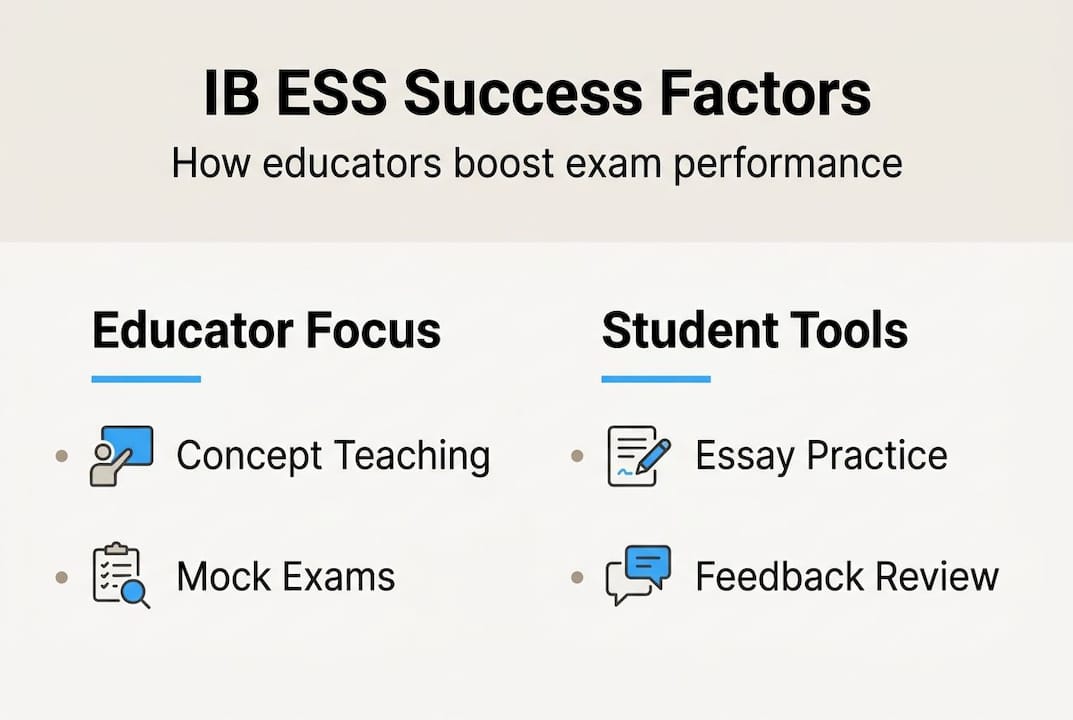
Why expert guidance beats DIY for IB ESS mastery
Here is something I have seen consistently: bright, motivated students plateau. They study hard, they read the textbook, they do past papers alone, and they still cannot break past a grade 5. The issue is rarely knowledge. It is the absence of adaptive feedback.
Self-study has a ceiling. Without someone who can identify why your answer scored a 3 instead of a 6, you keep making the same mistakes. Students who shift from rote memorization to concept application with guided feedback see the greatest jumps in their ESS scores. That is not an opinion. It is what tutors observe repeatedly.
There is also the issue of changing command term trends and evolving case study expectations. ESS examiners shift their focus over time. An experienced educator tracks these changes and adjusts your preparation accordingly. You would not know to look for them on your own.
Personalized learning is not a shortcut. It is optimal learning design. Understanding the value of exam prep focus means recognizing that working smarter with expert guidance compounds over time: better confidence, lower stress, stronger grades, and skills that transfer beyond ESS.
Take the next step toward ESS excellence with an IB educator
If you are serious about improving your ESS grade, the strategies in this article are your starting point. But knowing what works and actually applying it with expert support are two different things.

At esstutor.net, I work with IB ESS students worldwide to build personalized exam plans, strengthen IAs, and master the concepts that examiners actually reward. Whether you need an IB ESS IA tutor for your Internal Assessment, want to sharpen your approach with proven ESS exam success strategies, or need access to quality ESS notes and textbook resources, there is a clear next step waiting for you. Book a trial lesson and see what focused, experienced guidance actually feels like.
Frequently asked questions
What is the main role of an IB ESS educator?
An IB ESS educator provides personalized strategies for exam preparation, Internal Assessment support, and concept mastery, helping students build both knowledge and confidence in a structured way.
How do IB educators help with Internal Assessments?
They guide you through topic selection, methodology, draft feedback, and alignment with IB grading criteria, which directly improves your IA score and overall ESS grade.
Can an IB educator really improve my ESS exam score?
Yes. High achievers at grades 6 and 7 consistently use timed mocks, tutor feedback, and conceptual application rather than memorization, and this pattern is repeatable with the right guidance.
What are command terms and why do educators stress them?
Command terms tell you exactly what skill an examiner wants. Mastering terms like evaluate or discuss ensures you answer the actual question being asked, which is one of the fastest ways to gain marks.
No Comments