


16 Apr Environmental literacy explained: key concepts for IB ESS success
TL;DR:
- Environmental literacy involves understanding system interconnections, problem-solving, and action, not just facts.
- It is assessed through application, critical thinking, and evaluation in IB ESS coursework and exams.
- Developing environmental literacy requires practicing systems thinking, reflection, and real-world analysis beyond memorization.
Many IB ESS students assume environmental literacy simply means knowing ecological facts. It does not. Environmental literacy is the capacity to understand the interconnectedness of natural and human systems, enabling informed decision-making and responsible action on environmental issues. That definition matters for you because IB ESS assessments do not just reward memorization. Examiners want to see you apply knowledge, evaluate trade-offs, and propose solutions. When you genuinely understand what environmental literacy means and how it works, you will approach every exam question and internal assessment with far greater confidence.
Table of Contents
- Core components of environmental literacy
- Systems thinking and the special role of IB Environmental Systems and Societies
- How environmental literacy is measured and developed
- Environmental literacy in action: Applications for IB ESS assessments
- Why most ESS students underestimate environmental literacy—and how to stand out
- Take your IB ESS skills further with expert guidance
- Frequently asked questions
Key Takeaways
| Point | Details |
|---|---|
| More than facts | Environmental literacy is about understanding, skills, attitudes, and action—not just knowledge. |
| Systems thinking matters | Success in IB ESS hinges on connecting human and natural systems through critical thinking. |
| Application wins assessments | Applying your literacy in real-world scenarios is vital for high scores in IB ESS. |
| Assessment is multifaceted | Environmental literacy is measured by knowledge, actions, attitudes, and problem-solving ability. |
Core components of environmental literacy
With a clear introduction in place, let’s unpack exactly what environmental literacy is built from. Most frameworks agree on four foundational building blocks. According to NAAEE, environmental literacy involves awareness of and concern about the environment and its problems, combined with the knowledge, skills, and motivations to work toward solutions. That is broader than most students realize.
These four core components are: knowledge of ecological principles and issues, skills for critical thinking and problem-solving, dispositions such as attitudes and motivations for stewardship, and the ability to take action. Here is how each one connects to your IB ESS work:
- Knowledge: Understanding ecological principles, environmental issues, and the key concepts in ESS such as biodiversity, energy flow, and pollution cycles.
- Skills: Applying critical thinking, inquiry, and problem-solving to real environmental scenarios in exams and IAs.
- Dispositions: Developing values and motivations, recognizing that stewardship is not optional in ESS.
- Action: Participating in or designing solutions, which maps directly onto your IA and extended essay work.
The table below shows how these components show up in IB ESS contexts:
| Component | What it looks like in IB ESS |
|---|---|
| Knowledge | Explaining trophic levels, carbon cycles, or ecosystem services |
| Skills | Analyzing data, interpreting graphs, evaluating management strategies |
| Dispositions | Expressing value judgments on environmental trade-offs |
| Action | Proposing and evaluating real-world solutions in assessments |
This is why studying human-environment systems is so central to ESS. The subject asks you to see humans as part of ecosystems, not separate from them. That systems-based perspective is exactly what the workforce literacy framework also prioritizes for preparing future problem-solvers.
“Environmental literacy is not a destination. It is a capacity that grows through practice, reflection, and engagement with real-world issues.”
Systems thinking and the special role of IB Environmental Systems and Societies
Now that you know the core components, let’s see how IB ESS approaches these through systems thinking. Systems thinking means understanding how different parts of a system interact, influence each other, and produce outcomes that no single part could create alone. In ESS, this means tracing feedback loops, identifying emergent properties, and recognizing tipping points in ecosystems.
Research confirms that environmental literacy prioritizes systems thinking over rote facts. IB ESS is specifically designed around this. Your coursework embeds systems diagrams, input-output models, and interdisciplinary analysis because the IB wants you to think in systems, not in isolated facts.
It helps to understand how environmental literacy differs from related terms:
| Type of literacy | Core focus |
|---|---|
| Environmental literacy | Ecological and human system interactions |
| Sustainability literacy | Broader: includes social and economic pillars |
| Climate literacy | Focused specifically on climate systems and responses |
For your systems thinking in ESS practice, keep these four steps in mind:
- Identify the system boundaries (what is included and what is not).
- Map the inputs, outputs, and stores.
- Identify feedback loops, both positive and negative.
- Evaluate how a change in one variable affects the whole system.
The environmental education process described by the EPA reinforces this: environmental education is not just instruction about nature, it is building the capacity to analyze and act. And that is exactly what studying ESS benefits students who want transferable, real-world problem-solving skills.
Pro Tip: When answering a systems-based exam question, always state the feedback type explicitly. Writing “this is a positive feedback loop because…” signals to the examiner that you are thinking in systems, not just listing facts.
How environmental literacy is measured and developed
Understanding systems thinking sets a solid foundation, so how is your environmental literacy actually gauged and grown? Measurement of environmental literacy is multifaceted, involving assessments of knowledge, skills, attitudes, and observable actions. There is no single test that captures everything. Instead, multiple types of evidence build a picture of your literacy level.
Here are the main methods used:
- Surveys and self-assessments: Tools like the Environmental Literacy Indicator Tool (ELIT) track attitudes and awareness over time.
- Competence tests: These measure your ability to analyze scenarios, interpret data, and propose solutions.
- Classroom-embedded evidence: Your IAs, lab reports, and essay responses are direct demonstrations of environmental literacy in practice.
- Reflection activities: Journals and structured reviews help you identify gaps in your thinking.
NAAEE’s Guidelines for Excellence provide benchmarks for what proficiency looks like at different stages of learning. At a basic level, students recognize environmental issues. At an advanced level, they evaluate competing solutions and justify their reasoning with evidence. Your goal as an IB ESS student is to perform at that advanced level consistently.
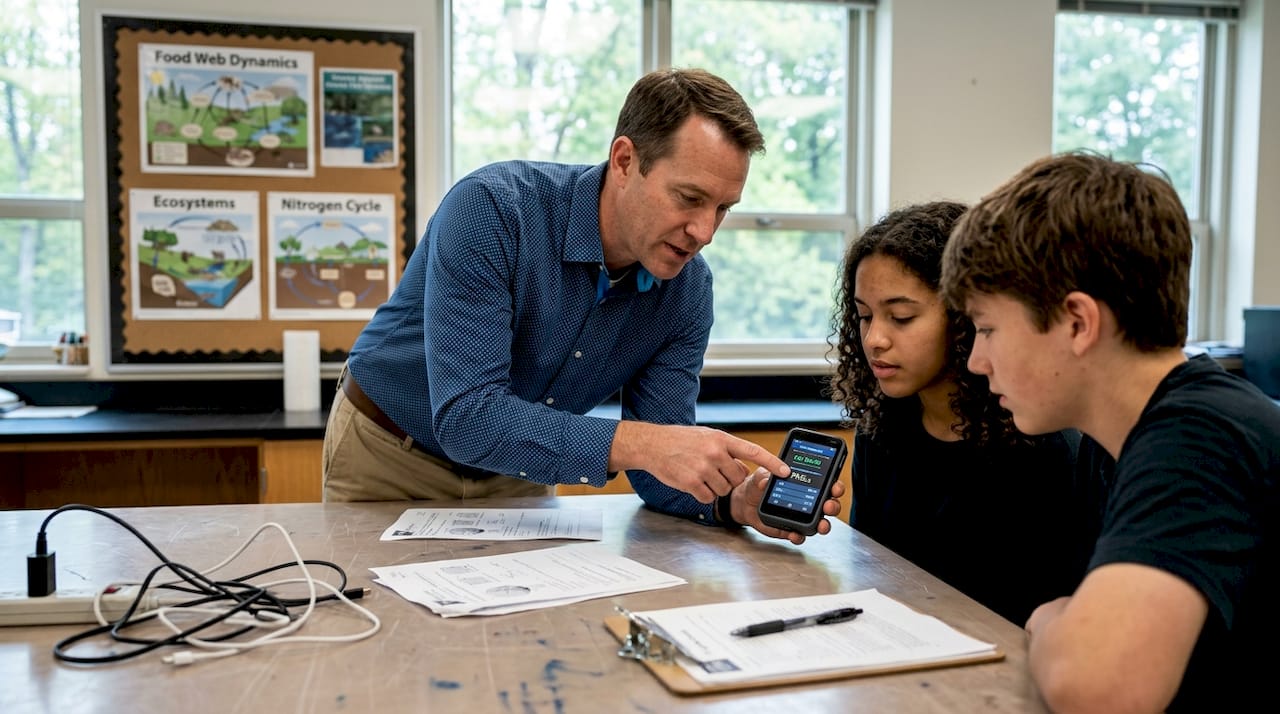
You can strengthen your environmental literacy by working with environmental indicators regularly and practicing with tools for environmental data collection and analysis. These habits build the skills component of your literacy, which examiners notice.
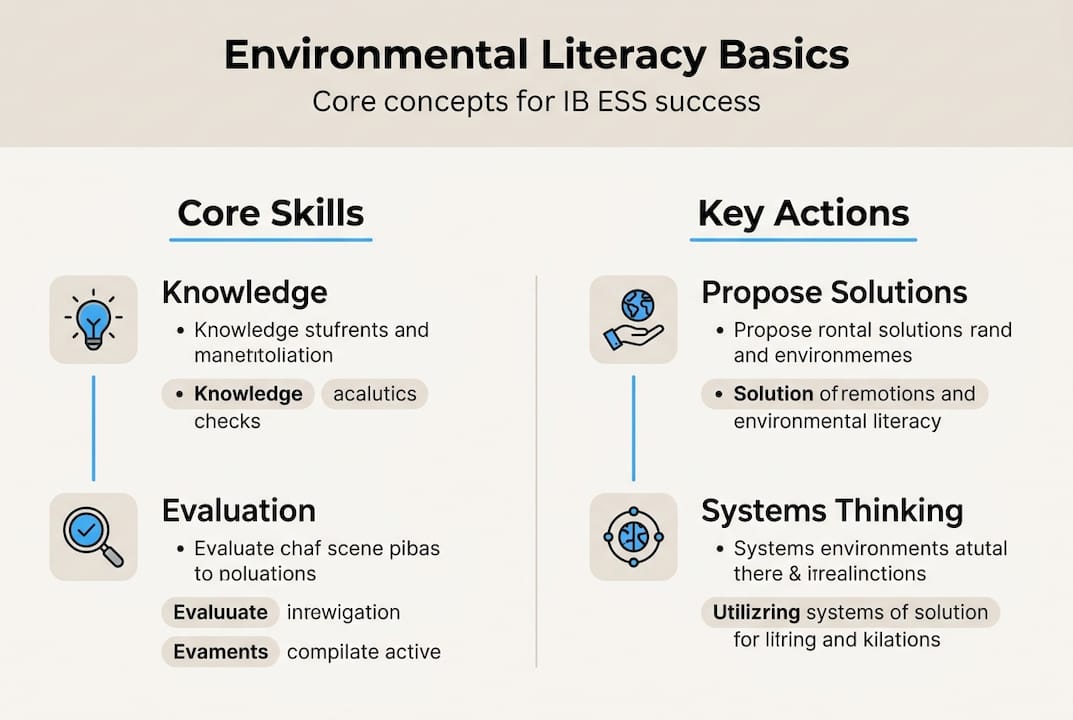
Pro Tip: After each practice essay or IA draft, ask yourself: “Did I only describe, or did I also evaluate and propose?” If you only described, revise to add a judgment or solution. That shift from description to evaluation is what moves you from basic to advanced literacy.
Environmental literacy in action: Applications for IB ESS assessments
With assessment metrics in hand, let’s put environmental literacy into practice for IB ESS and see what examiners are truly looking for. The IB ESS course explicitly requires students to demonstrate literacy via application and synthesis in exams through case studies, and in IAs through investigations that emphasize interdisciplinary evaluation.
Here is how to show environmental literacy across your different assessments:
- Paper 1 (case study): Analyze a resource or scenario you have not seen before. Show that you can apply ecological principles to a new context. Use action verbs: evaluate, analyze, suggest.
- Paper 2 (structured questions and essays): Link content knowledge to real-world issues. Bring in named examples. Do not just define terms, explain their significance.
- Internal assessment: Your IA should connect to a genuine environmental issue such as water pollution, soil degradation, or local biodiversity. Reviewing internal assessment examples can show you the standard to aim for.
Examiners are looking for evidence that you understand the fundamental nature of literacy as an integrated capacity, not just subject knowledge. Answers that score highly tend to move from description, to analysis, to evaluation, to a justified conclusion or recommendation.
“The best IB ESS answers read like the student genuinely cares about the issue and understands that solving it requires balancing ecological, social, and economic factors.”
Pro Tip: Prepare two or three real-world case studies you know well, such as the Aral Sea, deforestation in the Amazon, or coral bleaching on the Great Barrier Reef. Apply them flexibly across exam questions. Specific named examples always score better than vague references.
Why most ESS students underestimate environmental literacy—and how to stand out
Having covered strategies and examples, let’s step back for a frank look at how you can avoid the most common trap for IB ESS students. In my experience working with students across many cohorts, the ones who plateau at a mid-range score all share the same pattern: they focus almost entirely on content knowledge and definitions. They can explain the nitrogen cycle perfectly. But when the question asks them to evaluate a management strategy or justify a course of action, they freeze or default to more description.
High-scoring students are different. They treat every answer as an opportunity to show value judgment, propose realistic solutions, and acknowledge trade-offs. That is environmental literacy in action. It is not about knowing more facts. It is about thinking in systems and being willing to take a reasoned position.
The deeper benefits for IB students who internalize this mindset go beyond exam grades. You build the kind of critical thinking that serves you in university, in careers, and as a global citizen. The shift is simple but powerful: stop asking “What do I know about this topic?” and start asking “What is happening in this system, and what should be done?”
Take your IB ESS skills further with expert guidance
Ready to boost your IB ESS performance even further? Environmental literacy is a skill you develop with practice and the right feedback. Understanding what the four components are is just the starting point. Knowing how to demonstrate them in an exam or IA is where students often need support.

I have spent over 13 years helping IB ESS students move from uncertain to confident, from mid-range to top scores. Whether you want to fully understand the IB ESS course, get practical ESS success tips, or get targeted ESS IA guidance to sharpen your assessment performance, I am here to help. Book a trial lesson and let’s work on your environmental literacy together.
Frequently asked questions
What are the four components of environmental literacy?
The four core components are knowledge of ecological principles and issues, skills for critical thinking and problem-solving, dispositions such as attitudes and motivations for stewardship, and the ability to take action. Together, they form an integrated capacity rather than separate categories.
How is environmental literacy assessed in IB ESS?
IB ESS measures environmental literacy through exams and internal assessments that require application and synthesis of knowledge in real-world scenarios, with an emphasis on interdisciplinary evaluation rather than recall alone.
What is the difference between environmental, sustainability, and climate literacy?
Environmental literacy centers on ecological and human system interactions, sustainability literacy broadens this to include social and economic dimensions, and climate literacy focuses specifically on climate systems and their responses.
Which tools are used to evaluate environmental literacy?
Tools such as the Environmental Literacy Indicator Tool and standardized benchmarks from bodies like NAAEE assess knowledge, attitudes, skills, and observable actions to provide a full picture of a student’s literacy level.
No Comments