


15 May Your complete guide to excelling in IB ESS
TL;DR:
- IB ESS is an interdisciplinary course that requires analyzing systems, evaluating perspectives, and assessing sustainability, demanding complex thinking beyond memorization. Effective study strategies include asking inquiry questions, building case study banks, practicing interdisciplinary connections, and reviewing past papers, while personalized tutoring enhances understanding and assessment performance. Tailored ESS tutoring focuses on developing skills in perspective analysis, IA planning, and exam techniques, providing students with confidence and higher scores through expert guidance.
Many students assume ESS IB is the “easy science” option in the IB Diploma Programme. That assumption tends to disappear around week three. ESS is an interdisciplinary course that blends scientific methodology with social, ethical, and economic perspectives on real environmental issues, and it demands a different kind of thinking than most students expect. You are not just memorizing facts about ecosystems. You are analyzing systems, evaluating worldviews, and constructing arguments that hold up under exam conditions. The good news is that with the right support, this course becomes genuinely manageable and even exciting.
Table of Contents
- Understanding the core concepts of IB ESS
- How IB ESS assessments work and what tutors emphasize
- Implementing effective study strategies for ESS success
- Choosing the right IB ESS tutor: what personalized support looks like
- Why tutoring tailored specifically for IB ESS is a game changer
- Get expert help from top IB ESS tutors to boost your scores
- Frequently asked questions
Key Takeaways
| Point | Details |
|---|---|
| Interdisciplinary focus | IB ESS combines science with social, economic, and ethical perspectives for deeper environmental understanding. |
| Core concepts | Perspectives, systems, and sustainability unify the ESS curriculum and guide your learning. |
| Assessment model | The course includes two exam papers and an internal assessment with new collaborative and strategy elements. |
| Effective study | Inquiry-based methods and case studies boost engagement and conceptual clarity. |
| Personalized tutoring | Tailored support sharpens exam techniques, IA planning, and overall academic success. |
Understanding the core concepts of IB ESS
Now that you know ESS is interdisciplinary, let’s break down the key unifying concepts that form the course foundation.
The ESS curriculum includes three unifying concepts: perspectives, systems, and sustainability. These are not just chapter headings. They are lenses you apply to every topic, from biodiversity loss to plastic pollution to climate policy. Understanding how these three concepts connect is what separates students who scrape a 4 from those who score a 6 or 7.
Here is what each concept actually means in practice:
- Perspectives ask you to consider how different groups, including scientists, governments, local communities, and corporations, view the same environmental issue. A fishing community and a marine biologist may both care about ocean health but prioritize very different solutions. ESS trains you to recognize and evaluate those differences.
- Systems teach you to analyze how components interact within natural and human-constructed environments. You learn to identify inputs, outputs, feedback loops, and tipping points. Think of how deforestation affects rainfall patterns, which then affects agriculture, which then affects food security. That chain of cause and effect is systems thinking.
- Sustainability asks whether current resource use can continue without compromising future generations. This concept appears in topics like ecological footprints, carrying capacity, and the management of fisheries or freshwater supplies.
These three concepts are revisited throughout the entire course, so building a solid understanding early pays off in every unit that follows.
Pro Tip: When you study any ESS topic, ask yourself three questions: Whose perspective is this? How does this fit into a larger system? Is this sustainable long-term? Applying those questions consistently will sharpen your analysis across all assessments.
If you are working on your IB ESS internal assessment, these three concepts are especially relevant. Your investigation should reflect all three, even if the focus is narrow.
How IB ESS assessments work and what tutors emphasize
With a clear grasp of ESS concepts, understanding assessments will help you focus your study effectively.

The assessment model for ESS has been updated for 2026, and it is worth knowing exactly what you are preparing for. The new ESS assessment structure includes two external papers and an internal assessment with a collaborative element.
Here is a breakdown of what each component involves:
- Paper 1 presents a case study resource booklet. You read and analyze real environmental data, then answer structured questions. This tests your ability to interpret evidence and apply ESS concepts to an unfamiliar context.
- Paper 2 includes data-based questions and extended essay-style responses. You need to write clearly, use specific examples, and demonstrate command of course content under timed conditions.
- The internal assessment (IA) is an individual investigation with a collaborative element. You can share methodologies with a small group, but your data collection and written report must be your own. Critically, the IA now includes a strategy criterion that asks you to explore tensions between different perspectives on your chosen environmental issue.
“The ‘individual investigation’ includes collaboration, tension exploration between perspectives, and unique data collection per student.” — International Baccalaureate
This shift toward perspective-based analysis in the IA is significant. It is not enough to collect data and draw conclusions. You need to show that you understand why different stakeholders might interpret your findings differently. That is a skill most students need help developing.
Pro Tip: Start your IA topic search early and choose an issue where there is genuine tension between groups, such as rewilding projects opposed by local farmers, or water extraction disputes between agriculture and conservation bodies. Topics with built-in conflict give you much more to work with in the strategy criterion.
For a deeper look at how to approach each component, check out the ESS assessment model overview and specific exam tips and strategies that tutors use with their students.
Implementing effective study strategies for ESS success
Knowing the assessments and key concepts prepares you to adopt effective study techniques for ESS success.
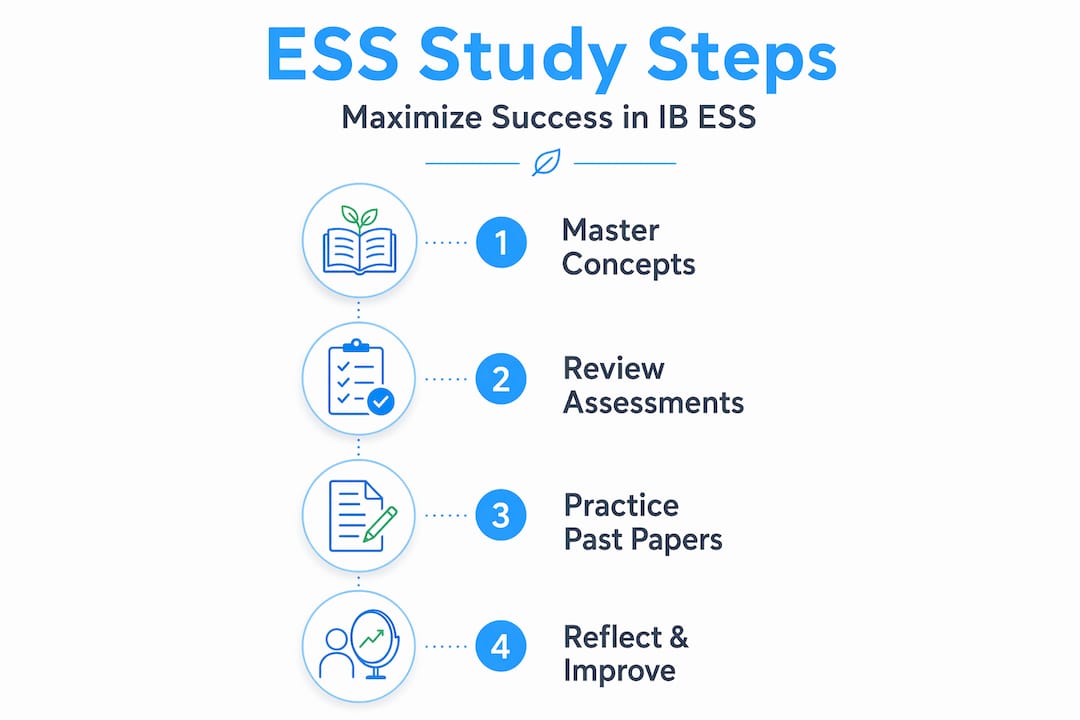
ESS rewards students who think broadly. The course’s inquiry-based nature means that memorizing definitions alone will not get you far. You need to connect ideas across topics and apply them to new situations, which requires a more active approach to studying.
Here are study strategies that actually work for ESS:
- Use guided inquiry questions. Instead of passively reading your notes, turn each topic into a question. For example, instead of reviewing “species diversity,” ask yourself: “How does species diversity change when a habitat is fragmented, and what are the societal trade-offs of protecting it?” This forces you to think, not just recall.
- Build case study banks. ESS exams reward students who use specific, real-world examples. Keep a running document of case studies organized by topic: deforestation in the Amazon, coral bleaching on the Great Barrier Reef, plastic accumulation in the Pacific Ocean. The more specific your examples, the stronger your exam answers.
- Practice interdisciplinary connections. Pick any ESS topic and deliberately connect it to both a scientific angle and a societal angle. Biodegradable plastics, for instance, involve chemistry, waste management policy, consumer behavior, and economic incentives. Practicing this kind of thinking prepares you for Paper 2 essays.
- Review past papers regularly. ESS command terms like “evaluate,” “discuss,” and “justify” each require a specific type of response. Practicing with past papers teaches you how to structure answers that examiners actually reward.
- Balance memorization with critical thinking. You do need to know definitions, units, and specific data. But pair that memorization with regular practice writing arguments. Both skills are tested.
Pro Tip: After completing a past paper question, compare your answer to the mark scheme and identify exactly where you lost marks. Do this for five questions in a row, and you will start to see your own patterns. Fixing a pattern is faster than fixing individual mistakes.
For more detailed guidance on this, explore ESS success tips shared by experienced tutors who work with IB students every day.
Choosing the right IB ESS tutor: what personalized support looks like
With sound study strategies, you might consider how the right tutor can boost your progress and confidence.
Personalized tutoring offers advantages that self-study simply cannot replicate, especially in a course as layered as ESS. A good tutor does not just re-explain what your teacher already said. They identify exactly where your thinking breaks down and address it directly.
Here is what personalized ESS tutoring actually looks like in practice:
- Customized learning plans built around your specific weak areas, whether that is systems diagrams, evaluation essays, or understanding ecological footprint calculations.
- IA support from start to finish, including help choosing a topic with strong perspective tensions, designing a methodology that produces meaningful data, and structuring your written report to meet all criteria.
- Exam technique coaching that goes beyond content, including how to manage time across Paper 1 and Paper 2, how to structure a “discuss” response, and how to use your case study bank effectively under pressure.
- Feedback on practice answers that is specific and actionable, not just “good effort.” Knowing why an answer earns a 3 instead of a 5 is what moves you forward.
| Support area | Self-study | ESS tutoring |
|---|---|---|
| Concept understanding | Possible but slow | Targeted and faster |
| IA topic selection | Trial and error | Guided by experience |
| Exam technique | Hard to self-assess | Direct feedback loop |
| Perspective analysis | Often underdeveloped | Practiced with real examples |
| Motivation and accountability | Variable | Consistent and structured |
Pro Tip: When choosing a tutor, ask whether they have experience as an IB examiner. Examiners know exactly what the mark scheme rewards and can teach you to write answers that align with those expectations from day one.
You can explore IB ESS IA tutoring services and learn more about the advantages of individualized ESS tutoring to see how this kind of support is structured.
Why tutoring tailored specifically for IB ESS is a game changer
Here is something worth saying directly: not all tutoring is equal, and generic science tutoring often does more harm than good for ESS students.
Most science tutors are trained to teach in one discipline. They know biology or chemistry well, but ESS sits at the intersection of multiple fields. When a student asks about the social and political dimensions of a topic like water scarcity, a tutor without ESS-specific training often steers the conversation back toward the science alone. That is exactly the wrong direction for this course.
IB ESS-specific tutoring is different because it treats the interdisciplinary nature of the course as the central skill to develop, not a side note. A tutor who understands the ESS framework knows that a strong Paper 2 essay on soil degradation needs to include scientific data, economic context, and an evaluation of competing stakeholder perspectives. They coach you to build all three layers into every response.
There is also the matter of the IA. I have seen students spend weeks on investigations that are technically sound but fail to address the perspective tension criterion because nobody flagged it early. An ESS-specific tutor catches that before it costs you marks. The step-by-step IA success guide I use with students is built around exactly this kind of early-stage planning.
The confidence shift that comes from understanding the course deeply is also real. Students who work with ESS-focused tutors tend to stop dreading Paper 2 essays and start approaching them as opportunities to demonstrate what they know. That mindset change is not small. It shows up in scores.
Get expert help from top IB ESS tutors to boost your scores
Now that you know why tailored tutoring makes a difference, here is how you can get started with expert IB ESS tutors.
At ESStutor.net, I work with IB Diploma students worldwide who want to perform at their best in ESS. With over 13 years of experience as an IB educator and examiner, I offer personalized online sessions that target exactly what you need, whether that is IA planning, exam technique, or concept clarity.

You can explore IB ESS IA tutoring to get dedicated support for your investigation, read about the benefits of ESS tutoring to understand what students gain from working with an expert, or dive into IB ESS exam tips to start improving your approach right now. A trial lesson is the easiest way to see whether this kind of support is right for you.
Frequently asked questions
What makes IB ESS different from traditional environmental science courses?
IB ESS is interdisciplinary, combining scientific, social, economic, and ethical perspectives to address environmental issues in a way that traditional single-discipline science courses do not. Students are expected to evaluate multiple viewpoints and construct nuanced arguments, not just apply scientific formulas.
How is the IB ESS internal assessment structured in 2026?
The IA includes collaboration, tension exploration between perspectives, and unique data collection per student. Each student submits an individual written report, but small groups can share methodologies during the investigation phase.
Can tutoring help improve my IB ESS exam scores?
Yes. Personalized tutoring provides tailored feedback and focused support on specific areas like IA planning and exam technique, which are the two areas where most students lose marks unnecessarily.
What study techniques work best for IB ESS coursework?
The course’s inquiry-based nature means the most effective techniques include using guided inquiry questions, building a case study bank, practicing interdisciplinary connections, and consistently reviewing past papers with close attention to command terms and mark schemes.
No Comments