


17 Jun IB ESS Revision Guide: Top Strategies for 2026
TL;DR:
- A comprehensive ESS revision guide emphasizes syllabus mastery, systems thinking, and timed exam practice to maximize scores. Focused study on weak areas, understanding command terms, and practicing data interpretation are key strategies for exam success. The Internal Assessment offers an opportunity to earn high marks through clear research questions and thorough analysis.
An ESS revision guide is a structured study system that combines syllabus mastery, systems thinking, case study application, and timed exam practice to maximize your IB Environmental Systems and Societies score. The IB ESS course tests you across three components: Paper 1, Paper 2, and the Internal Assessment (IA). Each component demands a different skill set, and a scattered approach to studying will not serve you well. This guide gives you a clear, step-by-step path through every part of the course, whether you are studying at Standard Level (SL) or Higher Level (HL), so you can walk into your 2026 exams with real confidence.
How to use the IB ESS syllabus as your revision roadmap
The IB ESS syllabus is the single most reliable tool you have for focused revision. Every exam question traces back to a specific syllabus statement, so students who treat the syllabus as a checklist consistently outperform those who rely on textbooks alone.
Start by printing or downloading the full syllabus and dividing it into its major topic areas: ecosystems and ecology, biodiversity and conservation, water and food production, climate and energy, and human systems. Work through each topic in sequence, marking statements you understand confidently in green, partially understand in yellow, and struggle with in red. This color-coded audit gives you an honest picture of where your time should go.
Build your study timetable around that audit. Allocate more sessions to red topics and revisit yellow ones every two weeks using spaced repetition. Do not spend equal time on everything. Students who identify and target weak areas early gain the most ground before exam day.
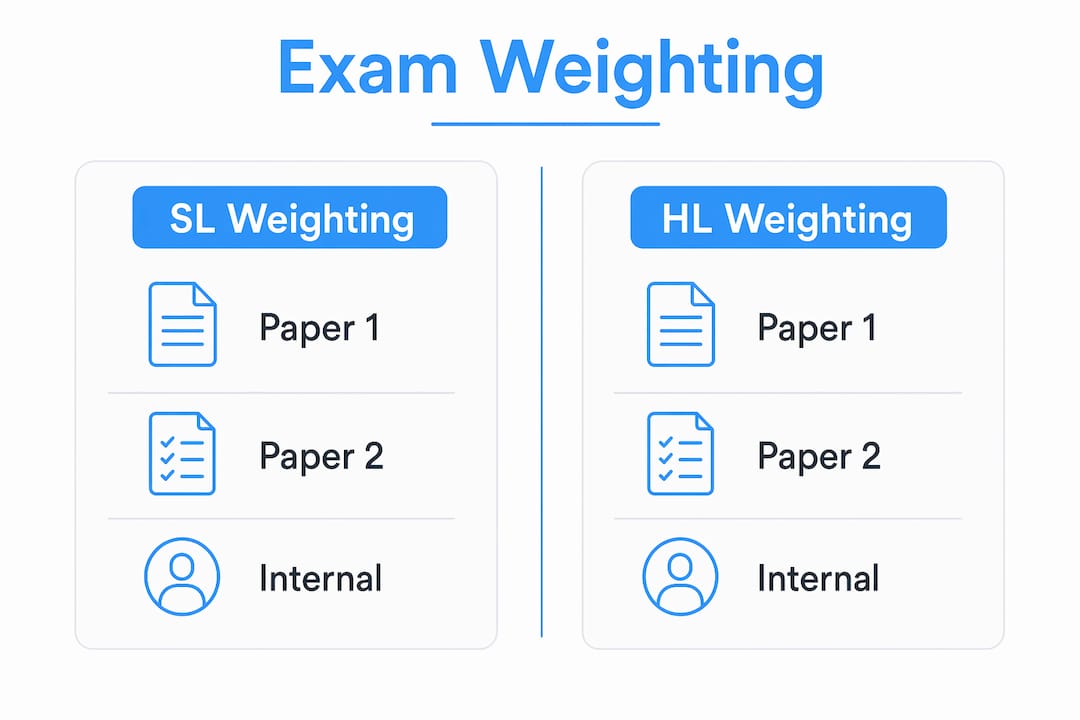
The table below shows the key differences between SL and HL assessment weighting, which should directly shape how you plan your revision time.
| Component | SL Weighting | HL Weighting |
|---|---|---|
| Paper 1 | 35% | 25% |
| Paper 2 | 40% | 55% |
| Internal Assessment | 25% | 20% |
External assessment accounts for 75% of the final SL grade and 80% for HL. That means your exam papers carry enormous weight, and your revision plan must reflect that priority.
Pro Tip: Use the Esstutor 2026 exam guide to cross-reference your syllabus audit with the latest assessment changes, so your timetable stays aligned with what examiners actually test.
What are the most effective ESS revision techniques?
Effective ESS revision uses six core tactics: syllabus mastery, systems thinking, case studies, data interpretation, command term mastery, and exam simulation. Each one targets a different skill the IB examiner rewards. Using all six together is what separates a 5 from a 7.
Systems thinking over memorization
ESS success comes from thinking in environmental systems and interconnections rather than memorizing isolated facts. When you study the carbon cycle, for example, do not just list the processes. Ask how a change in one part, such as deforestation, ripples through atmospheric CO2 levels, ocean acidification, and biodiversity loss. That interconnected thinking is exactly what examiners reward in extended responses.

Case studies as exam currency
Case studies are your evidence in ESS answers. A strong answer to a question about biodiversity loss names a specific location, such as the Atlantic Forest in Brazil or the Aral Sea, and links it to a named concept like habitat fragmentation or salinization. Generic answers score generic marks. Build a bank of six to eight case studies covering different biomes, pollution types, and conservation strategies, and practice dropping them into answers naturally.
Mastering command terms
Command terms tell you exactly what an examiner wants. Misreading them is one of the most common reasons students lose marks. The IB ESS command terms you must know cold include:
- Define: Give the precise meaning of a term
- Describe: Give a detailed account without explanation
- Explain: Give a reason or mechanism
- Evaluate: Make a judgment based on evidence, considering strengths and limitations
- Discuss: Offer a balanced review of multiple perspectives
- Outline: Give a brief account or summary
- Analyse: Break down in order to bring out the essential elements
Pro Tip: Write each command term on a flashcard with a sample question on one side and a model answer on the other. Review them weekly using active recall rather than passive reading. Active learning tools like mind maps and spaced revision sessions increase retention more than re-reading notes.
How do you prepare for ESS paper 1 and paper 2?
The 2026 exam format sets Paper 1 as a data-based, case study paper and Paper 2 as short answer and essay questions. Knowing the format is not enough. You need a practiced approach for each paper type.
Paper 1: treat it like a mini data lab
For SL, Paper 1 runs for one hour. For HL, it runs for two hours. Both versions present stimulus material, graphs, and data sets that you must interpret and connect to ESS concepts. The most reliable approach is to treat each question as a mini data analysis exercise: extract the trend from the data first, then attach the relevant ESS theory or case study. Students who jump straight to theory without reading the data carefully lose marks on the very first step.
Practice this two-step method with every past paper you attempt. Read the graph axis labels, identify the trend, note any anomalies, and only then write your answer. This habit takes about three weeks of consistent practice to become automatic.
Paper 2: structure your essays with PEEL
Paper 2 for SL runs two hours and for HL runs two hours and thirty minutes. HL students also need to apply higher-level lenses, such as societal and environmental perspectives, in their extended responses. The PEEL method gives every essay a clear structure: Point, Evidence, Explain, Link. State your point, back it with a named case study or data, explain the mechanism, then link back to the question. This structure prevents the rambling answers that cost students marks in the final minutes of an exam.
Common exam mistakes to avoid in both papers:
- Ignoring command terms and writing a description when asked to evaluate
- Giving generic answers without named case studies or specific data
- Running out of time by spending too long on low-mark questions
- Failing to define key terms at the start of extended responses
- Skipping units or labels when interpreting graphs
Pro Tip: Time yourself strictly during practice. For Paper 2, allocate roughly one minute per mark. A 10-mark essay gets ten minutes of writing, not twenty. Use Esstutor’s mock exam resources to practice under real exam conditions before your first official sitting.
How to prepare and excel in the ESS internal assessment
The Internal Assessment is a research-based investigation that contributes 25% to the SL final grade and 20% to HL. Those percentages are significant. A well-executed IA can lift your overall grade by a full band, and a poorly planned one can drag it down just as fast.
The IA has four core components: a focused research question, a clear and valid method, a thorough data analysis, and a well-reasoned conclusion with evaluation. Each component is assessed separately, so a weakness in one area does not automatically ruin the others. That said, a vague research question creates problems in every section that follows.
Writing a research question that works
Your research question must be specific, measurable, and testable within your available resources. “How does pollution affect biodiversity?” is too broad. “How does distance from a road affect the species diversity of ground beetles in a suburban park?” is specific, measurable, and achievable. The more precise your question, the easier your method and analysis sections become to write.
Common IA mistakes to avoid:
- Writing a research question that cannot be tested with available equipment
- Collecting too little data to draw statistically meaningful conclusions
- Describing results in the analysis section instead of interpreting them
- Writing a conclusion that does not directly answer the research question
- Ignoring limitations and uncertainties in the evaluation section
Poorly defined questions, insufficient data analysis, and weak evaluation sections are the three most common reasons students lose marks in the IA. Address all three deliberately.
Pro Tip: Ask a teacher, peer, or tutor to read your research question before you collect any data. If they cannot immediately understand what you are measuring and why, rewrite it. Getting feedback early saves weeks of rework later.
Key takeaways
A structured ESS revision plan that combines syllabus mastery, systems thinking, command term practice, and timed exam simulation is the most reliable path to a high IB ESS score.
| Point | Details |
|---|---|
| Syllabus as a roadmap | Audit every syllabus statement by confidence level and build your timetable around weak areas. |
| Systems thinking wins marks | Connect concepts across topics rather than memorizing isolated facts for higher-scoring responses. |
| Command terms are non-negotiable | Learn every IB ESS command term precisely; misreading them is a leading cause of lost marks. |
| Paper 1 needs a data-first approach | Extract trends from graphs before applying theory to improve accuracy on every data question. |
| IA quality depends on the question | A specific, measurable research question makes every other IA section easier to write and score. |
What i’ve learned from watching students revise ESS
After more than 13 years of teaching and examining IB ESS, I have seen the same patterns repeat. The students who score 6s and 7s are rarely the ones who studied the most hours. They are the ones who studied with the most intention.
The biggest shift I see in successful students is the move from passive review to active practice. Reading your notes feels productive. Writing a timed answer to a past paper question, checking it against the mark scheme, and identifying exactly where you lost marks is what actually builds exam skill. Spaced retrieval practice and exam simulation reduce anxiety and improve accuracy. That is not just good advice. It is what the evidence consistently shows.
I also want to say something about the IA that most guides skip. Students often treat it as a box to check rather than an opportunity. The IA is the one part of the course where you control the question, the method, and the pace. A student who invests real thought into their research question and analysis can earn near-perfect marks. That is a gift. Use it.
Finally, talk to other people about ESS content. Explaining the nitrogen cycle or the tragedy of the commons to a classmate forces you to find the gaps in your own understanding faster than any flashcard will. Teaching is one of the most underrated revision strategies in the IB, and it costs nothing.
— Marija
Ready to take your ESS revision further?
Knowing the right strategies is one thing. Applying them consistently under exam pressure is another. Esstutor offers personalized, one-on-one tutoring for IB ESS students at both SL and HL, with sessions tailored to your specific weak areas, whether that is Paper 2 essay structure, data interpretation, or IA planning.
With over 13 years of IB examining and teaching experience, Esstutor provides targeted feedback on practice answers, structured notes, and full IB ESS IA tutoring to help you maximize every component of your final grade. Students who combine self-study with expert feedback consistently outperform those who revise alone. Book a trial lesson and see the difference a focused session makes to your preparation.
FAQ
What is the best way to start ESS revision?
Start by auditing the full IB ESS syllabus and color-coding each statement by confidence level. Build your study timetable around the weakest areas first.
How much does the internal assessment count toward the final grade?
The IA counts for 25% of the SL final grade and 20% for HL, with external exams covering the remaining 75% and 80% respectively.
What is the PEEL method and when should i use it?
PEEL stands for Point, Evidence, Explain, Link. Use it to structure every extended response in Paper 2 to address command terms clearly and score maximum marks.
How long are the ESS exam papers in 2026?
For SL, Paper 1 is one hour and Paper 2 is two hours. For HL, Paper 1 is two hours and Paper 2 is two hours and thirty minutes.
How do i improve my ESS data interpretation skills?
Practice treating every Paper 1 question as a mini data lab: read the graph, identify the trend, note anomalies, and then connect the data to ESS theory before writing your answer.
No Comments