


05 Oct 48–72 Hour IB Retake Plan: Examiner Tactics to Protect Your Diploma
Contact your DP coordinator today and ask about retake acceptance and deadlines, then identify your weakest subject so you can start focused past-paper practice right away. Within the next week, confirm your school will register you, check fees, and block out a 6 to 12 week study window. Scores, fees, and diploma impact all depend on your specific situation, so get these facts confirmed before you commit your time.
TL;DR:
- Retaking IB exams requires confirmation from your school, which can refuse external candidates, and acceptance depends on their internal deadlines.
- Your diploma depends on meeting multiple conditions beyond just test scores, such as CAS completion and TOK and EE grades; improving one subject grade may not change your diploma if core requirements are unmet.
- Prioritize studying your weakest topics identified through examiner comments and mark breakdowns, using a diagnostic to build a focused, time-efficient revision plan.
- Practice past papers under timed conditions and analyze mark schemes carefully to understand examiner expectations, especially for your specific subject’s question types.
- Working with a tutor for targeted review and mock grading can efficiently close skills gaps, especially if your preparation window is limited or your IA needs revision.
Table of Contents
- 48 to 72 hour checklist: eligibility, documents, and fast wins
- How to register for a retake, session choices, and official limits
- Which scores count toward your diploma, and what a retake actually changes
- Build your focused study plan
- Exactly how to practice with past papers and mark schemes
- Subject-specific tactics for your retake
- Confirming syllabus versions and IA, TOK, and EE requirements before you revise
- Deciding between a retake, a remark, or accepting your score
- Examiner-led tactics that move the needle on a retake
- A note on staying steady through a retake
- How targeted ESS tutoring supports your retake
- FAQ
- Sources
48 to 72 hour checklist: eligibility, documents, and fast wins
Before you dive into studying, there are a few practical things to sort out. These steps take a couple of days but save you weeks of wasted effort later.
- Contact the DP coordinator at the IB World School where you plan to register, since schools can refuse external retake candidates and acceptance policies vary.
- Gather your official marksheet, examiner comments if available, and the current status of your IA, TOK, and EE.
- Identify the three topics that cost you the most marks last time and start working through related past-paper questions this week.
- Confirm registration fees and decide between the May or November session based on your preparation timeline.
Pro Tip: Ask your coordinator for your exact subject grade breakdown, not just your total score. Knowing which component dragged your grade down tells you exactly where to spend your study hours.
How to register for a retake, session choices, and official limits
Retaking an IB exam is not something you arrange on your own. You register through an IB World School, and that school decides whether to accept you if you are not currently enrolled there. The candidate results pack confirms that a school is under no obligation to accept external retake candidates, and fees and acceptance terms are set by the school itself. If you are no longer attending your original school, start calling around early.
There is also a hard limit on how many chances you get. Students have a maximum of three examination sessions to obtain the diploma, whether that path runs anticipated to diploma to retake, or diploma to retake to retake. Keep this in mind when deciding how many subjects to tackle at once.
To get registered properly, work through this order:
- Confirm your school will accept you as a retake candidate and ask about their internal deadline.
- Decide between the May or November session based on how much preparation time you realistically have.
- Submit the registration form along with payment for the fees your school sets.
- Confirm the subject list you are retaking and the current status of your IA, TOK, and EE components.
- Get written confirmation of your session and subject entries before you start your study plan.
Choosing November over May, or vice versa, usually comes down to university deadlines. If your offers depend on results arriving by a certain date, work backward from that date rather than from how much you feel like studying.
Which scores count toward your diploma, and what a retake actually changes
When you retake a subject, the highest grade you achieve contributes to your diploma award, so a stronger retake result replaces the weaker one rather than averaging with it. That is good news: a retake can only help your diploma outcome for that subject, never hurt it.
But whether a better subject grade actually changes your diploma result depends on the DP passing criteria for IB students. To pass, you need at least 24 points, along with meeting several conditions at once: completing CAS, receiving grades in every subject plus TOK and EE, having no more than two grade 2s, no more than three grades of 3 or below, and at least 12 points from your Higher Level subjects and 9 from Standard Level, with some variation if you took 4 HL or 2 SL subjects.
This means a single point gained in one subject can flip a failing result into a diploma award, but only if every other condition is already met. Consider two scenarios:
- A student with 23 points and no other issues gains 1 point in a retaken subject and crosses the 24-point threshold, earning the diploma.
- A student with 23 points but three grade 3s and a failed TOK requirement gains that same point and still does not qualify, because the core conditions are unmet.
Before you retake anything, check your CAS completion and TOK or EE grades alongside your subject scores. A subject retake will not rescue a diploma blocked by an unfinished core requirement.
Build your focused study plan
A good retake plan starts with diagnosis, not revision. Pull your examiner comments and any mark breakdown you have, and look for the pattern: which question types or topics lost you the most marks, which errors repeated, and which gaps are quick fixes versus deeper conceptual problems.
Once you know where the marks went, prioritize using three factors together: how often that topic appears on exams, how many marks you typically lose there, and how hard it would be to fix. A topic that shows up every session, costs you several marks each time, and is a quick conceptual fix deserves your first week. A rare topic worth one mark does not.
From there, build a realistic timetable:
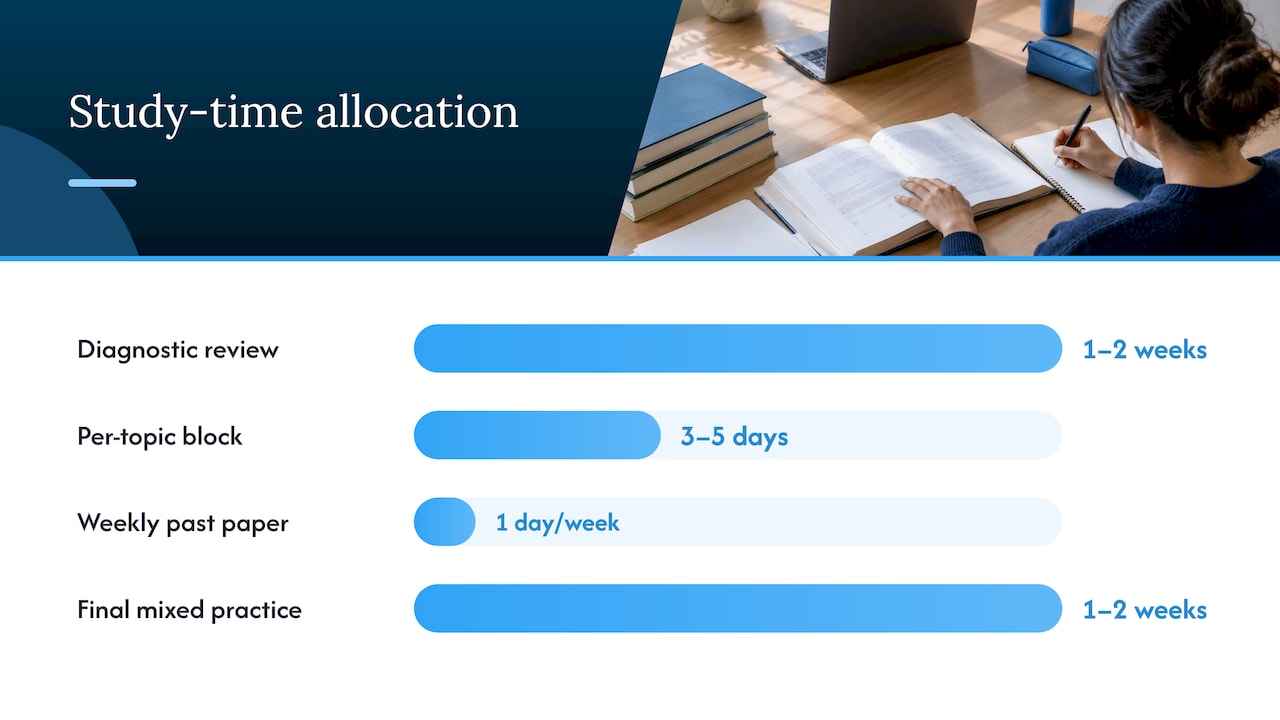
- Spend the first 1 to 2 weeks on diagnostic review, confirming exactly which topics need the most work.
- Dedicate 3 to 5 days per topic block to your highest-priority weak areas, working through notes, practice questions, and past-paper extracts together.
- Run one full timed past paper each week to build stamina and track whether your weak topics are actually improving.
- Reserve your final 1 to 2 weeks for mixed-topic timed practice and self-marking against official mark schemes.
Within each topic block, use active recall rather than passive rereading: close your notes and try to reconstruct the key concepts from memory before checking. Rotate through past papers by question type rather than by year, since this exposes you to more variety of how a single topic gets tested. Mark your own timed answers against the official mark scheme line by line, which forces you to understand exactly what earns credit.
Pro Tip: Keep an error log. Every time you lose marks on a practice question, write down the specific reason in one line. After a few weeks, the log itself tells you which mistake you keep repeating.
Exactly how to practice with past papers and mark schemes
Past papers only help if you use them the right way. Working through the same ten-year-old paper for the fourth time without a strategy wastes hours you do not have.
- Sort past papers by question type and mark allocation, and prioritize the formats that appear most consistently across sessions.
- Always practice under timed conditions once you are past the initial learning phase, since exam-day pressure changes how you perform.
- Study the mark scheme closely enough to understand the difference between a full-credit answer, a partial-credit answer, and one that earns nothing, since this is often more revealing than the paper itself.
- Read through examiner reports where available, since they flag the specific mistakes students make most often and sometimes include model responses.
- Set a concrete target for each timed paper, covering both accuracy and pacing, and track whether you are closing the gap week over week.
This approach turns past papers from passive revision into a feedback loop. You are not just testing what you know, you are learning exactly how examiners award marks, which is a different skill. For ESS specifically, our guide on using past papers for ESS exam success walks through this process in more depth.
Subject-specific tactics for your retake
Every subject group rewards a slightly different retake approach. Here is where to put your energy depending on what you are retaking.
- Sciences: Replicate practical exam-style tasks where possible, drill formula recall until it is automatic, and work through calculation-heavy questions under timed conditions.
- Mathematics: Build timed problem sets around your weakest question types, keep a technique checklist for methods you tend to forget, and maintain an error log for recurring mistakes.
- Individuals and societies: Practice essay structure using a consistent template, work on using specific evidence rather than general statements, and drill command terms like “evaluate” and “to what extent” so you answer what is actually being asked.
- Languages: Study model answers against the writing and speaking rubrics so you understand what separates a 6 from a 7, not just what topics to cover.
- ESS: If you are redoing your individual investigation, check whether your methodology needs to change. Updated ESS guidance allows collaborative investigations where group members share a methodology but still collect unique data with different independent or dependent variables, which can speed up your IA if you plan the overlap carefully.
Whichever subjects you are retaking, resist the urge to spread your effort evenly. A retake plan works best when it mirrors your diagnostic: more time on the areas that cost you the most, not the ones you find most interesting to review.
Confirming syllabus versions and IA, TOK, and EE requirements before you revise
Before you open a single past paper, confirm you are revising the right syllabus. If your subject has changed its curriculum since you first sat the exam, you must follow the new curriculum and assessment model for your retake, not the one you originally studied. Your DP coordinator can confirm which syllabus version applies to your session.
This matters more than it sounds. Older practice papers and topic checklists can misalign with current command terms and assessment objectives after a syllabus update, so rebasing your revision on the current syllabus and recent examiner reports is essential, not optional.
Before you start studying, confirm:
- Which syllabus year applies to your retake session and whether any topics have been added, removed, or reweighted.
- Whether your IA needs a full rework or only minor revisions, and whether group-supported investigations are permitted for your subject.
- Which assessment formats and command terms the updated mark scheme emphasizes, since these can shift even when the content looks similar.
Deciding between a retake, a remark, or accepting your score
Not every low grade calls for a full retake. Sometimes a remark is the smarter move, and sometimes accepting the score and moving forward is genuinely the right call. Work through this checklist before you decide:
- How many points away from your target are you, and is that margin small enough that a remark is plausible?
- What do your examiner comments suggest: a marking inconsistency, or a genuine skill gap that practice would fix?
- How much preparation time do you realistically have before your next viable session?
- What will the retake cost against your current budget and your school’s fee structure?
- Does this subject’s grade actually change your diploma outcome, based on the passing criteria above?
A remark makes sense when your margin is small and something about the marking feels off. A retake makes more sense when the gap reflects a real skill or knowledge issue, or when the syllabus has changed enough that your original preparation no longer applies. Factor in your own well-being and any university deadlines too. A retake you cannot realistically prepare for in the time available often does more harm than good.
Examiner-led tactics that move the needle on a retake
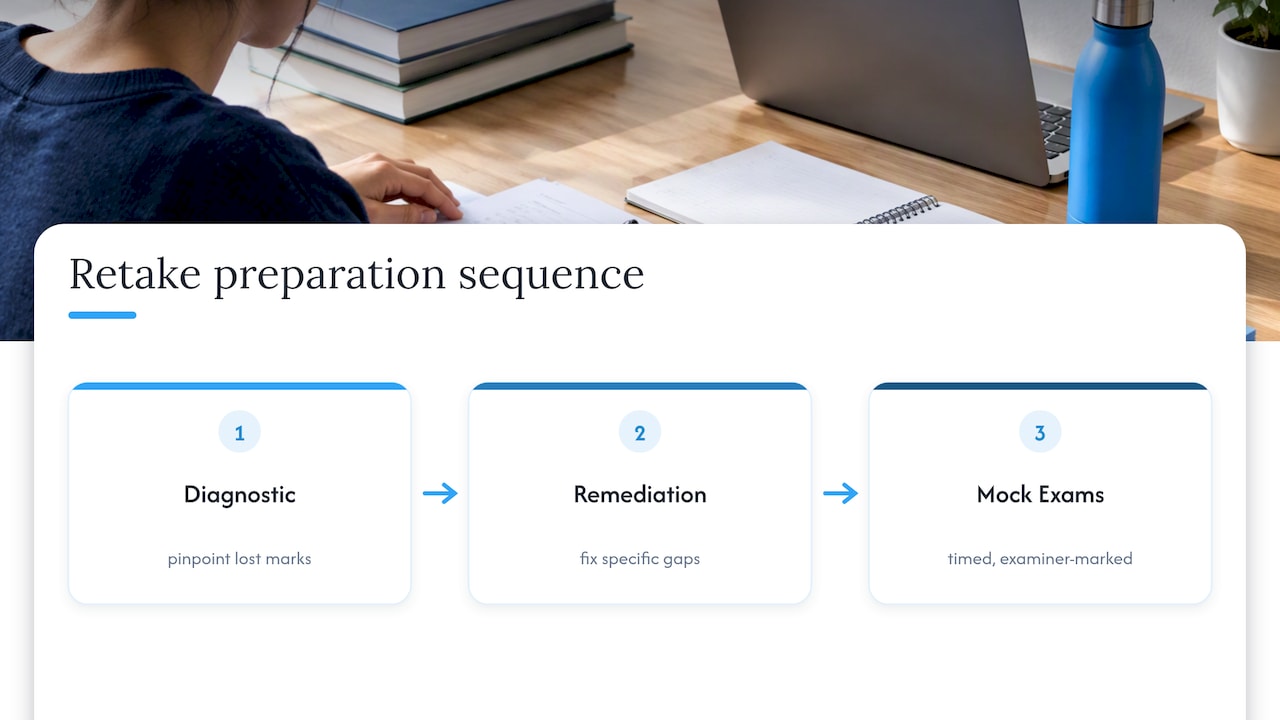
A typical retake preparation sequence we use starts with a diagnostic paper to pinpoint exactly where marks are being lost, followed by targeted remediation on those specific gaps, and finishes with timed mock exams marked in examiner style. This order matters because it stops students from re-studying material they already know well.
An experienced IB examiner focuses on the small, repeated 1 to 2 mark losses that quietly add up across a paper, since these are usually the fastest wins in a limited timeframe. Preparation is also checked against the current syllabus so students are not practicing against outdated question formats. For ESS students specifically, our guide to internal assessment examples shows how small methodology fixes often resolve the exact issues examiner comments flag most often.
A note on staying steady through a retake
Deciding to retake can feel like a setback, but it is really just a tactical project with a clear target and a deadline. We have seen students move from a 4 to a 6 by fixing nothing more than one recurring calculation error, and others close a two-point gap just by learning to use command terms properly.
On exam day, stick to your pacing plan and do not chase every mark on a question you are stuck on. Progress comes from small, consistent sessions, not last-minute marathons.
— Marija
How targeted ESS tutoring supports your retake
If your gap is narrow, your time is limited, or your ESS internal assessment needs a second set of eyes, working with a tutor who marks exams for a living changes how efficiently you close that gap. We offer a Trial Plan for 34 € per 20-minute session if you want to test the fit first, along with a Basic Plan at 120 € per 60-minute session for focused retake work.
A typical retake package includes:
- A diagnostic review of your past performance to identify your highest-impact weak areas.
- Targeted practice sessions built around your specific gaps.
- IA and EE feedback if your coursework needs revision before resubmission.
- Exam-style mock marking to help gauge your readiness before the real session.
Students with a narrow skill gap, a tight prep window, or an ESS IA that needs reworking tend to benefit most. Check pricing and session options to see what fits your timeline.
FAQ
What is the hardest IB subject to get a 7 in?
Difficulty varies by student and depends heavily on individual strengths, so there is no single subject that is hardest for everyone. Your own examiner comments and past grade breakdown are a far more reliable guide to where you personally lose the most marks than any general ranking.
Can I retake my IB exams?
Yes, you can retake IB exams by registering through an IB World School, though the school is not required to accept external retake candidates and sets its own fees. You also have a maximum of three examination sessions total in which to obtain the diploma.
Is a 2 in IB a fail?
A single grade of 2 does not automatically fail your diploma, but the DP passing criteria allow no more than two grade 2s overall. Combined with a minimum of 24 total points and completed CAS, TOK, and EE requirements, multiple low grades can still prevent the diploma from being awarded.
How to get a 45 on the IB?
The maximum score requires near-flawless results in all six subjects plus the highest 3 points from TOK and the Extended Essay. For a retake strategy, this usually means identifying your one or two weakest subjects through examiner comments and focusing nearly all your preparation time there rather than spreading effort evenly.
No Comments