


16 Apr Ace ESS IB: Proven Study Strategies & Tutoring for Exam Success
TL;DR:
- ESS IB integrates ecology, economics, ethics, and social systems, requiring interdisciplinary thinking.
- Exam success depends on mastering command terms, EVS integration, and effective IA strategies.
- Specialized tutor support significantly boosts grades, especially when focusing on exam technique and system analysis.
ESS IB is not just another science class. It sits at the crossroads of ecology, economics, ethics, and social systems, demanding that you think across disciplines and apply real-world judgment, not just recall facts. With ESS now available at SL and HL for the 2026 exams, the stakes are higher than ever. Students who treat it like a standard biology course often find themselves underprepared by exam season. The good news? With the right strategies and targeted support, you can absolutely reach a 6 or 7. This guide walks you through exactly what it takes.
Table of Contents
- What is ESS IB and why is it unique?
- Understanding the ESS IB assessment model
- Mastering the Internal Assessment: IA strategies that work
- How specialized ESS tutoring accelerates exam success
- Our perspective: Why exam technique and EVS integration are the real differentiators
- Next steps: Move from confusion to clarity with expert ESS tutoring
- Frequently asked questions
Key Takeaways
| Point | Details |
|---|---|
| ESS IB is interdisciplinary | ESS bridges sciences and societies, and features unique, complex assessments with new HL depth for 2026. |
| Assessment and IA mastery | Understanding the ESS IB exam structure and internal assessment requirements is key to scoring well. |
| Targeted tutoring boosts scores | Specialized ESS tutoring raises average IB scores and helps avoid common pitfalls in both exams and IA. |
| Exam technique matters most | Focusing on exam skill and integrating environmental value systems earns higher marks than rote memorization. |
| Actionable strategies work | Real-world examples, command term mastery, and systems-thinking drive exam and IA success in ESS IB. |
What is ESS IB and why is it unique?
To understand why ESS IB needs specialized strategies, let’s break down the course’s fundamentals and the latest updates.
ESS is one of the most distinctive subjects in the IB Diploma Programme. It bridges sciences and societies by asking you to analyze environmental issues through multiple lenses at the same time. You are expected to understand ecological systems, but also evaluate the legal, economic, and ethical dimensions of environmental decisions. That combination is rare in any school curriculum.
For 2026, the course has expanded significantly. HL was first taught in 2024, with the first HL exams sitting in May 2026. This means many students are navigating new territory without a full bank of past papers to rely on. The three core concepts you need to internalize are:
- Perspectives: How different stakeholders (scientists, governments, communities, corporations) view environmental issues
- Systems: How ecological and human systems interact, including feedback loops and tipping points
- Sustainability: How decisions today affect long-term environmental and social outcomes
At HL, you go deeper into legal frameworks, economic valuation of ecosystem services, and ethical reasoning around environmental justice. These are not just add-ons. They are woven into how you are assessed.
Here is a quick comparison to help you see the difference:
| Feature | SL | HL |
|---|---|---|
| First exam | Existing | May 2026 |
| Core focus | Ecology, systems, sustainability | All SL content plus legal, economic, ethical depth |
| Assessment duration | Shorter papers | Longer papers with more analysis |
| IA weighting | 25% | 20% |
| Ideal for | Students wanting breadth | Students wanting depth and challenge |
You can explore a full ESS IB course overview to see how each topic connects. Understanding the structure early saves you a lot of confusion later.
Understanding the ESS IB assessment model
Now let’s clarify how ESS IB’s assessments work and where your effort is best spent.
Knowing the assessment breakdown is one of the smartest things you can do before you start studying. Here is how the marks are distributed:
| Component | SL | HL |
|---|---|---|
| Paper 1 (data case study) | 1 hr, 25% | 2 hrs, 30% |
| Paper 2 (structured essays) | 2 hrs, 50% | 2.5 hrs, 50% |
| Internal Assessment (IA) | 25% | 20% |
External exams make up 75 to 80% of your total marks, split between Paper 1 and Paper 2. That means your exam performance is the single biggest factor in your final grade.
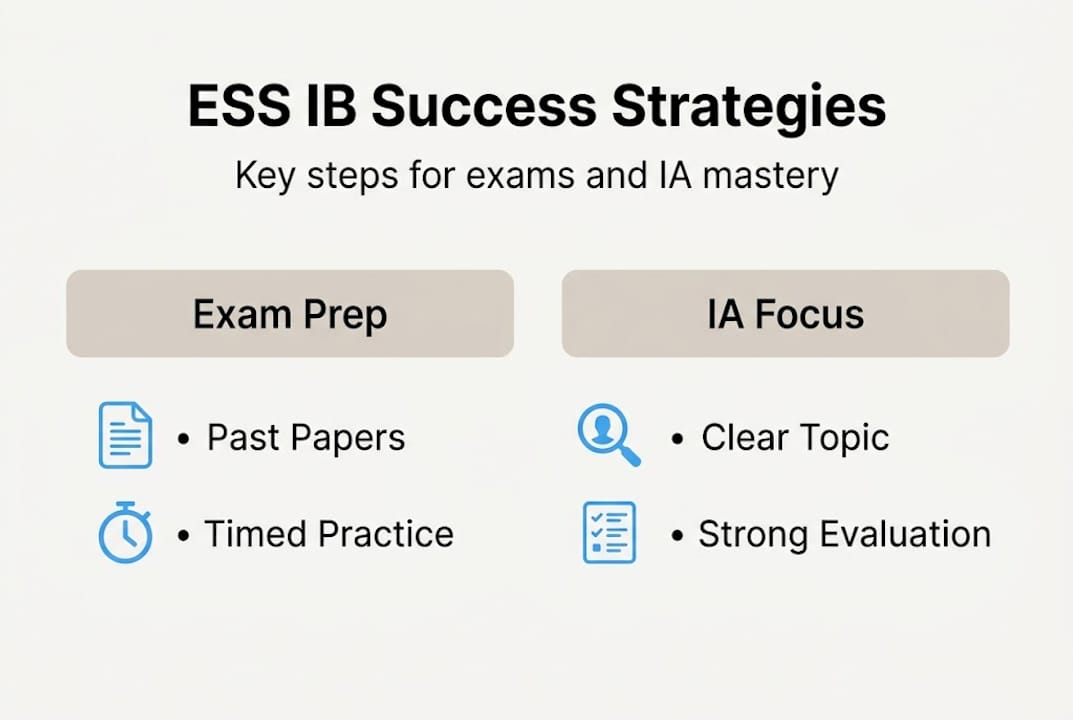
Paper 1 gives you an unseen case study with data, graphs, and environmental scenarios. You need to analyze, interpret, and evaluate rather than just describe. Paper 2 tests structured short answers and extended essay responses. This is where command terms become critical.
Here are the command terms you must master for Paper 2:
- Evaluate – weigh up evidence and reach a reasoned judgment
- Discuss – present multiple perspectives and argue a position
- Analyze – break down into components and explain relationships
- Justify – give reasons supported by evidence
- Compare and contrast – identify similarities and differences clearly
Each command term signals a different type of response. Using the wrong approach, even with correct knowledge, costs marks. Check out these high-scoring ESS exam tips for more detail on applying command terms effectively.
For a broader view of how to structure your revision, the ESS exam preparation strategies guide is worth bookmarking. You can also learn more about the exam prep benefits for ESS IB and why targeted practice consistently outperforms general review. For a clear breakdown of each paper’s format, the ESS papers breakdown from Save My Exams is a helpful reference.
Pro Tip: For Paper 1, practice reading data under timed conditions every week. For Paper 2, write full essay plans before drafting, and always include contrasting environmental value systems (EVS) in your response.
Mastering the Internal Assessment: IA strategies that work
Beyond exams, your IA carries major scoring weight, so mastering its process is essential.

The IA is your chance to investigate an environmental issue that genuinely interests you. Done well, it can be one of the most rewarding parts of the course. Done poorly, it can drag your grade down significantly.
The IA is up to 3,000 words and is assessed on exploration, analysis, communication, and evaluation. Every section must connect back to environmental value systems to score at the top band.
Here are the key strategies for a strong IA:
- Choose a focused, local research question. Broad topics like “climate change” are nearly impossible to investigate properly. Pick something measurable in your local environment, like water quality in a nearby river or biodiversity in a school garden.
- Use a systematic methodology. Clearly explain whether you are collecting primary data, secondary data, or both. Your method must be replicable and logical.
- Structure your report clearly. Introduction, methodology, results, analysis, and evaluation. Each section has a purpose. Do not skip or merge them.
- Evaluate honestly. Examiners reward students who identify real limitations and suggest genuine improvements, not vague ones like “I could have collected more data.”
- Link everything to EVS. Your evaluation should explain how different value systems would interpret your findings differently.
Common pitfalls include picking overly broad topics, writing a weak evaluation that lacks depth, and failing to connect findings to broader environmental concepts. Tutor feedback at the draft stage catches these errors before they cost you marks. Browse ESS IA topic ideas for inspiration, and read the full step-by-step ESS IA guide to plan your approach.
Pro Tip: Always link your IA findings to at least two contrasting EVS perspectives in your evaluation. This is one of the clearest signals to examiners that you understand the course’s interdisciplinary core.
How specialized ESS tutoring accelerates exam success
To maximize exam and IA success, here is how specialized ESS tutoring transforms outcomes.
Not all tutoring is equal. For ESS IB, working with a tutor who has examiner experience makes a measurable difference. Examiners know exactly what the mark scheme rewards and where most students lose marks unnecessarily.
Here is what effective ESS tutoring looks like in practice:
- Customized study guides built around your specific weak areas, not a generic syllabus review
- Past paper practice with real-time feedback on command term usage and EVS integration
- Systems-thinking exercises using real case studies like the Aral Sea, coral bleaching, or urban heat islands
- IA coaching from research question selection through to final evaluation
- Feedback loop analysis to help you understand how ecological and human systems interact dynamically
The numbers back this up. Tutoring by IB examiners yields an average gain of 5.2 points with an effect size of 0.37 SD, and high-dosage tutoring nearly doubles those gains. For context, the average ESS SL grade sits around 4.2 out of 7. Targeted tutoring regularly lifts students to 6 or 7.
“Tutoring from IB examiners yields the highest gains. Focus high-dosage sessions on your weakest areas, especially data analysis and EVS integration, for the fastest improvement.”
The remote ESS tutoring benefits are also worth considering, especially if you are in a school where ESS is not well supported. Remote sessions give you access to specialist expertise regardless of your location. You can also explore what works for ESS IB exams based on real educator experience. For a full list of available support, visit the ESS tutoring options page.
Our perspective: Why exam technique and EVS integration are the real differentiators
Drawing from hands-on experience, here is a perspective that most ESS guides miss entirely.
Many students spend the bulk of their revision memorizing case studies and definitions. That approach feels productive, but it rarely translates to top marks. What actually separates a grade 5 from a grade 7 is exam technique and the consistent use of EVS in every answer.
When you integrate contrasting perspectives, such as ecocentric versus anthropocentric viewpoints, into your Paper 2 essays, you show examiners that you understand the course at its deepest level. That is exactly what the top mark bands reward. Rote knowledge gets you to a 4 or 5. Skilled analysis and evaluation get you to a 6 or 7.
We have seen this pattern repeatedly. Students who prioritize exam technique over content accumulation, and who practice integrating EVS into every response, consistently outperform students who simply know more facts.
Pro Tip: In every exam answer, ask yourself: “What would an ecocentrist say? What would a technocentrist say?” Frame your response around those contrasts. IB examiners reward that kind of structured, multi-perspective thinking. Check out these ESS exam tips from tutors to see this approach applied to real exam questions.
Next steps: Move from confusion to clarity with expert ESS tutoring
Ready to boost your scores and master ESS IB? Here are the most effective resources and tutoring options.
If you have read this far, you already have a clearer picture of what ESS IB demands and how to meet those demands strategically. The next step is getting the right support in place before exam season.
Start by connecting with experienced IB ESS IA tutor support to get your IA on the right track early. From there, build your exam confidence using targeted ESS exam success strategies designed specifically for this course. For a broader view of everything that goes into performing well, the expert tips for ESS IB guide from our tutors is a great place to start. You have the tools. Now it is time to use them.
Frequently asked questions
What are the main differences between ESS IB at SL and HL in 2026?
HL covers deeper legal, economic, and ethical perspectives with longer exams and a higher weighting on Paper 1. SL focuses on core environmental concepts and has shorter, less intensive assessments.
How much does the internal assessment (IA) contribute to my final ESS IB grade?
The IA is 20 to 25% of total marks depending on whether you are taking SL or HL. A well-executed IA can meaningfully lift your overall grade, especially if your exams are borderline.
What is the most effective way to prepare for ESS IB exams?
Combine timed past paper practice with command term mastery and consistent EVS integration. Tutoring focused on exam technique has been shown to raise scores by more than 5 points on average.
How should I select a strong topic for my ESS IB Internal Assessment?
Choose a focused, local research question that allows for a feasible methodology and clear data collection. IA success comes from local, feasible topics paired with rigorous analysis linked to environmental value systems.
Does tutoring really help improve ESS IB grades?
Yes. Tutoring by IB examiners lifts grades by more than 5 points on average, and high-dosage tutoring nearly doubles that improvement. The key is focusing sessions on your specific weak areas.
No Comments