


18 Apr Systems thinking for IB ESS: your academic edge
TL;DR:
- Systems thinking reveals how interconnected components create complex environmental outcomes.
- Key concepts include feedback loops, emergent properties, and leverage points for impactful intervention.
- Applying systems thinking enhances analysis, leading to higher marks and more effective environmental solutions.
Many IB ESS students focus on obvious fixes, like reducing plastic waste or planting trees, and assume that solving one piece of the puzzle will resolve the whole environmental problem. That approach leaves critical gaps. Systems thinking shifts your perspective from isolated actions to interconnected networks, helping you see how feedback loops, emergent behaviors, and leverage points shape every environmental outcome. For IB ESS, this is not just an interesting idea. It is a core skill that examiners reward. This guide breaks down the key concepts, practical frameworks, and exam strategies you need to apply systems thinking with confidence across your coursework and assessments.
Table of Contents
- Core principles of systems thinking in ESS
- Leverage points: How and where to intervene
- Common systems traps in environmental studies
- Systems thinking in IB ESS: From theory to application
- Why systems thinking is your academic edge in IB ESS
- Take your IB ESS success to the next level
- Frequently asked questions
Key Takeaways
| Point | Details |
|---|---|
| Emergent properties | Systems thinking shows why environmental outcomes often arise from complex interactions, not individual components. |
| High-leverage interventions | Changing mindsets and rules yields more impact than tweaking numbers in environmental systems. |
| Avoid common traps | Recognize issues like tragedy of the commons and policy resistance to steer clear of system pitfalls. |
| Application in IB ESS | Using systems thinking in assignments and exams sets you apart for academic and practical success. |
Core principles of systems thinking in ESS
Systems thinking is the practice of analyzing how individual components within an environment interact to produce outcomes that no single component could create alone. In the IB ESS curriculum, this means looking beyond a single species, a single pollutant, or a single policy and instead examining the whole network of relationships at play.
Here are the foundational concepts you need to know:
- Stocks and flows: Stocks are the quantities within a system (e.g., fish population, carbon in the atmosphere), while flows are the rates that change those quantities (e.g., birth rate, carbon emissions).
- Feedback loops: Reinforcing loops amplify change (population growth leads to more births), while balancing loops resist change (predators increase as prey becomes abundant, then prey declines).
- Emergent properties: These are system-level behaviors that you cannot predict by studying individual parts in isolation.
- System boundaries: Deciding what is inside and outside your system shapes every conclusion you draw.
One of the most important ideas for your IB ESS work is emergent properties. Ecosystem stability arises from predator-prey feedbacks, not from any single species acting alone. A wolf population does not stabilize an ecosystem by itself. The interaction between wolves, deer, vegetation, and soil creates stability as an emergent outcome. That distinction matters enormously when you are writing ESS exam responses.
“Systems thinking helps us see that the whole is more than the sum of its parts. Emergent properties remind us that complex outcomes arise from interactions, not from isolated components.”
Understanding key concepts in environmental systems gives you the vocabulary to describe these interactions precisely in your answers. When you can name a feedback loop and explain its direction, examiners notice. The approaches to learning ESS also emphasize systems thinking as a core habit, so building it early pays off across every topic you study.

Practicing with real examples, like tracing nutrient cycles or mapping energy flows in a food web, is the fastest way to internalize these concepts. Once you see the pattern, you will recognize it everywhere in your ESS course.
Leverage points: How and where to intervene
With a grasp of core principles, let’s explore a practical framework for making real change. Donella Meadows developed one of the most useful tools in systems thinking: the hierarchy of leverage points. Her leverage points hierarchy ranks interventions from least to most effective, with paradigms and mindsets at the top and simple parameter adjustments at the bottom.
Here is how the hierarchy looks in practice:
- Parameters (numbers): Adjusting tax rates or pollution fines. These have limited long-term impact because the system structure stays the same.
- Feedback loops: Strengthening or weakening existing loops. More effective, but still constrained by the system’s goals.
- Rules: Changing laws and regulations. This shifts what is allowed, which has broader impact.
- Goals: Redefining what the system is trying to achieve. This is where real change begins.
- Paradigms: Shifting the underlying beliefs and values that drive the system. This is the most powerful lever of all.
| Intervention type | Example in ESS | Impact level |
|---|---|---|
| Parameters | Increasing carbon tax | Low |
| Feedback loops | Strengthening biodiversity monitoring | Medium |
| Rules | Banning single-use plastics | Medium-high |
| Goals | Redefining GDP to include ecological costs | High |
| Paradigms | Shifting from growth-first to sustainability-first thinking | Very high |
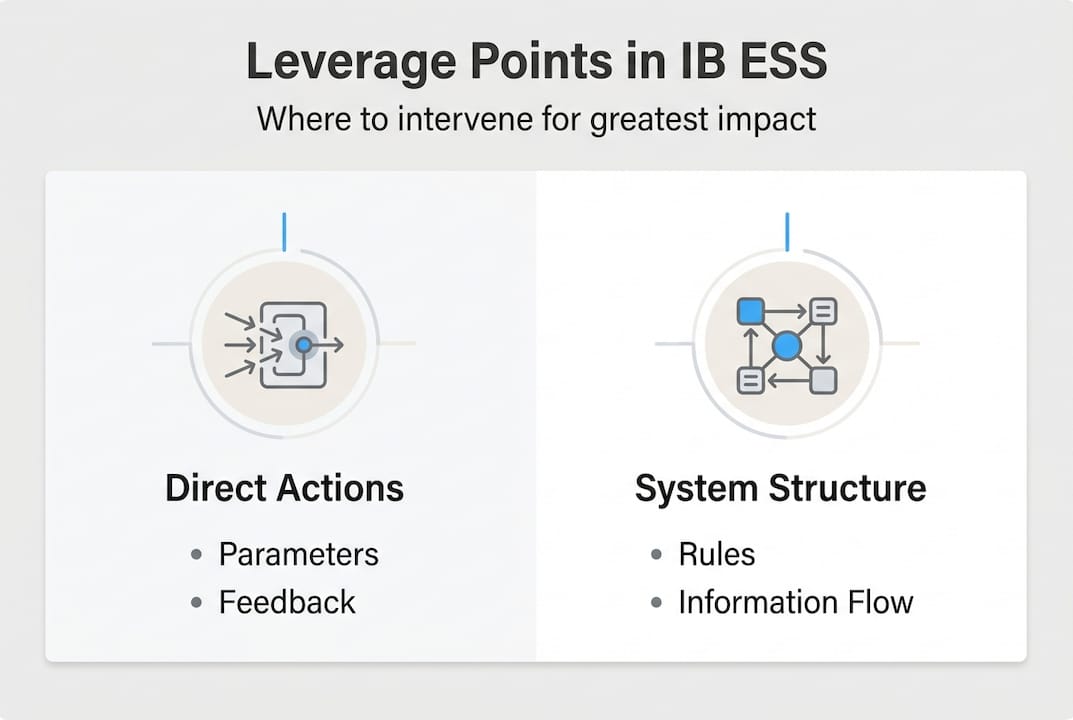
For your IB ESS assignments, this framework is incredibly useful. When you evaluate a policy response to deforestation, ask yourself: is this intervention targeting a number, or is it challenging the underlying goal of the system? Adjusting logging quotas is a parameter change. Redefining land ownership rights to include community stewardship is a rule change. Shifting cultural values about forests from resources to living systems is a paradigm shift.
Pro Tip: When writing ESS exam responses on environmental management, always identify the level of the intervention. Students who distinguish between parameter changes and paradigm shifts consistently earn higher marks on evaluation questions.
You can explore environmental concepts for ESS to see how these leverage levels connect to specific curriculum topics. Applying Meadows’ systems core concepts to your case studies will sharpen your analysis significantly.
Common systems traps in environmental studies
Understanding intervention is powerful, but knowing what can go wrong is just as crucial. Systems traps are recurring patterns where well-intentioned actions produce unintended negative outcomes. Recognizing them in your ESS case studies is a skill that separates good students from excellent ones.
The most common traps you will encounter include:
- Tragedy of the commons: Shared resources are overused because each individual benefits from maximum use while the costs are distributed across everyone. Fisheries, groundwater, and open-range grazing are classic examples.
- Policy resistance: When a balancing loop counteracts a new policy, making it ineffective. Introducing fishing quotas may lead fishers to shift effort to unregulated species.
- Escalation: Two or more actors keep increasing their responses to each other, like an arms race or competitive overfishing between neighboring countries.
- Drift to low performance: Standards gradually erode as the gap between goals and reality is closed by lowering the goal rather than improving performance.
These systems traps are well documented in environmental literature and directly relevant to your IB ESS coursework.
| Systems trap | Environmental example | Typical outcome |
|---|---|---|
| Tragedy of the commons | Overfishing in international waters | Stock collapse |
| Policy resistance | Emissions caps with loopholes | Minimal emissions reduction |
| Escalation | Competing nations increasing resource extraction | Environmental degradation |
| Drift to low performance | Weakening conservation targets over time | Biodiversity loss |
“Systems traps like the tragedy of the commons show how rational individual behavior can produce collectively irrational outcomes. Recognizing the trap is the first step to escaping it.”
For your internal assessment, identifying a systems trap in your chosen environmental issue adds analytical depth that examiners value. It shows you understand that problems are not just caused by bad actors but by structural dynamics within the system itself. Understanding how an environmental system is defined will help you set appropriate boundaries so you can spot these traps more clearly.
Systems thinking in IB ESS: From theory to application
So how do you translate these principles into academic performance and real environmental action? The key is practicing systems thinking at multiple scales, from local ecosystems to global policy frameworks.
The IB ESS curriculum explicitly recognizes that environmental systems interrelate across scales, with biosphere-lithosphere interactions being a prime example. A local soil degradation issue connects to global carbon cycling, which connects to climate policy, which connects back to land-use decisions at the farm level. Seeing these connections is what systems thinking trains you to do.
Here is a step-by-step approach for applying systems thinking in your IB ESS work:
- Define your system: Identify the stocks, flows, and boundaries relevant to your topic.
- Map the feedback loops: Are they reinforcing or balancing? Draw a simple causal loop diagram if it helps.
- Identify emergent properties: What outcomes arise from the interactions that you would not predict from individual components?
- Locate leverage points: Where in the system can intervention have the most lasting impact?
- Check for traps: Is the system exhibiting a known trap like policy resistance or tragedy of the commons?
- Connect scales: Link your local case study to regional or global dynamics for richer analysis.
Pro Tip: In Paper 2 extended response questions, explicitly naming your systems thinking approach (feedback loops, leverage points, emergent properties) signals analytical sophistication. Examiners reward students who demonstrate structured thinking, not just knowledge recall.
You can find strong ESS assessment examples to see how this approach looks in practice. Pairing that with a solid grasp of environmental literacy concepts will give you a well-rounded toolkit for both Paper 1 and Paper 2. Meadows’ Thinking in Systems is also worth reading alongside your textbook for deeper insight.
Why systems thinking is your academic edge in IB ESS
Here is something most students and teachers overlook: systems thinking is not just a theoretical framework to understand for the sake of the exam. It is a practical lens that changes how you read case studies, structure arguments, and evaluate solutions. I have worked with many IB ESS students over the years, and the ones who score highest are not always the ones who memorize the most content. They are the ones who apply systems thinking instinctively to every question they encounter.
Most students treat systems thinking as a topic to cover in Unit 1 and then forget. High achievers carry it through every unit, every internal assessment, and every exam paper. When you read about coral reef bleaching, you are not just noting a temperature increase. You are tracing feedback loops, identifying emergent collapse, and evaluating leverage points for intervention.
The benefits of studying environmental systems go far beyond the IB Diploma. But within your academic journey right now, applying systems thinking consistently is the single most effective way to differentiate your responses and earn those top marks. Do not just memorize it. Use it.
Take your IB ESS success to the next level
Mastering systems thinking takes practice, and having the right support makes all the difference. At ESS Tutor, I work with IB students worldwide to build exactly these analytical skills, from understanding feedback loops to structuring high-scoring exam responses.
Whether you are preparing for Paper 1, Paper 2, or your internal assessment, personalized tutoring sessions help you apply systems thinking with precision and confidence. You can also access ESS notes and textbook resources to reinforce your understanding between sessions. If your internal assessment needs expert guidance, working with an IB ESS IA tutor can help you structure your investigation for maximum marks. Book a trial lesson today and start turning systems thinking into your strongest academic asset.
Frequently asked questions
Why is systems thinking important for IB ESS students?
Systems thinking helps you analyze how all parts of an environmental issue interconnect, leading to deeper insights and stronger exam responses. Meadows’ Limits to Growth model showed how global systems interact to produce outcomes no single variable could predict, a principle directly applicable to your ESS coursework.
What is an example of a systems trap in environmental studies?
A classic example is the tragedy of the commons, where shared resources are overused because individual interests outweigh collective goals. The tragedy of the commons is a well-documented systems trap seen in fisheries, groundwater use, and open grazing lands.
How can I use systems thinking to improve my internal assessment?
Apply systems thinking by mapping all variables, feedback loops, and potential unintended consequences in your analysis. Emergent properties from component interactions, like ecosystem stability from predator-prey feedbacks, are exactly the kind of insight that earns top marks in an IA.
What are leverage points and why do they matter?
Leverage points are places in a system where a small intervention produces the biggest change. Meadows’ leverage points hierarchy shows that shifting paradigms and mindsets creates far more lasting impact than adjusting numbers or parameters.
No Comments