


28 Apr Understanding Environmental Policies for IB ESS Success
TL;DR:
- Environmental policies have measurable outcomes, reducing emissions and toxicity by 10 to 27%.
- Market-based instruments like carbon taxes are among the most effective policy tools.
- Critical evaluation of policy limitations and underlying societal values enhances IB ESS performance.
Environmental policies can feel abstract when you first meet them in IB ESS. You might read about carbon taxes or emissions trading schemes and wonder how any of it connects to your assessments. Here is the reality: these policies have measurable, documented outcomes that make perfect case study evidence. Research shows that stringent policies reduce global warming potential and aquatic toxicity by 10 to 27%, with a median annual emissions reduction of 5.4% across sectors. That single data point can elevate an exam answer from average to strong. This guide will walk you through the what, why, and how of environmental policies so you can use them confidently in your IB ESS coursework.
Table of Contents
- What are environmental policies and why do they matter?
- How do environmental policies reduce environmental impacts?
- Examining the challenges and limitations of environmental policies
- What makes environmental policies effective? Lessons for IB ESS
- Rethinking environmental policies: What most IB students miss
- Achieve higher IB ESS marks with expert support
- Frequently asked questions
Key Takeaways
| Point | Details |
|---|---|
| Policies drive real change | Environmental policies have proven to reduce emissions and improve sustainability worldwide. |
| Policy type matters | Market-based instruments like taxes are most effective at achieving environmental goals. |
| Critical evaluation is key | Recognizing both strengths and limitations of policies boosts your IB ESS assessment scores. |
| Success requires combinations | Policy mixes and coordinated strategies amplify impact compared to single measures. |
| Think beyond the details | Top answers link policy outcomes to underlying paradigms and system-level changes. |
What are environmental policies and why do they matter?
At the most basic level, an environmental policy is a set of rules, goals, or measures put in place by a government, international organization, or business to protect the environment and guide sustainable behavior. You can think of environmental policy basics as the formal framework through which societies decide how to manage natural resources, control pollution, and respond to ecological crises.
For IB ESS, understanding the different types of policies is essential. They generally fall into three broad categories:
- Market-based instruments: These use economic incentives to change behavior. Carbon taxes, emissions trading schemes (ETS), and subsidies for renewable energy all belong here. They work because they attach a financial cost or benefit to environmental actions.
- Regulatory (command-and-control) policies: These set legal standards. Examples include fuel efficiency standards for vehicles, bans on single-use plastics, and limits on industrial discharge into waterways. Compliance is mandatory.
- Voluntary approaches: These rely on commitment rather than law. Corporate sustainability pledges, eco-labeling schemes, and industry agreements fall into this category. They are often criticized for weak enforcement.
Understanding these distinctions matters because IB exam questions frequently ask you to compare policy types or evaluate their effectiveness. Knowing the category of a policy helps you frame your argument more precisely.
Why does any of this matter beyond the exam? Environmental policies are among the most powerful tools humanity has for addressing climate change, biodiversity loss, and pollution. Core environmental concepts like planetary boundaries and ecological footprints all connect back to how well policies perform. Research shows that policies reduce emissions across sectors including energy, transport, and industry, with reductions in harmful impacts ranging from 10 to 27%.
There is also a deeper dimension that the best IB students understand. Policy analysts talk about “leverage points,” which are places in a system where a small shift can produce large changes. Policies that target rules and regulations operate at a relatively surface level. But policies essential for sustainability transformations need to reach deeper leverage points, specifically the paradigms and values that shape how societies think about the environment in the first place. Changing a carbon tax rate is a parameter change. Shifting a society’s belief that economic growth must always come before ecological health is a paradigm change. That is a much more powerful intervention. For top-band IB answers, weaving this distinction into your evaluation is a genuine differentiator.
“Effective environmental policies do not just tweak rules at the surface. They challenge the assumptions and values that created unsustainable systems in the first place.” — Global Environment Outlook 7 perspective on leverage points
With this context in mind, let’s examine how these policies actually shape environmental outcomes.
How do environmental policies reduce environmental impacts?
Not all policy instruments are equally effective. Understanding the mechanisms behind each type helps you explain outcomes in your IB assessments with much greater precision. Research into creating policies for sustainable businesses consistently shows that the design of the policy matters as much as its intent.
Here is a comparison of the main policy instruments and how they perform in practice:
| Policy type | Mechanism | Typical effectiveness |
|---|---|---|
| Carbon tax | Price on emissions, incentivizes reduction | High; up to 19% average reduction |
| Emissions trading (ETS) | Cap on total emissions, tradeable permits | High; drives cost-effective cuts |
| Technology standards | Mandates cleaner technology | Moderate; depends on enforcement |
| Subsidies for renewables | Lowers cost of clean alternatives | Moderate to high; needs sustained funding |
| Voluntary agreements | Industry self-regulation | Low to moderate; weak enforcement |
| Outright bans | Prohibits harmful product or practice | High when enforced; difficult globally |
The ESRI environmental policy research makes a clear finding: market-based instruments like carbon taxes and emissions trading schemes are the most effective category, followed by non-market regulations, with technology support being the least effective unless sustained over long periods.

One of the most compelling statistics in this field: policies combining a carbon price with a coal phase-out avoided 3.1 GtCO2 in 2022 alone. To put that in perspective, the entire European Union emits roughly 3.4 GtCO2 per year. A well-designed policy mix nearly matches that output in avoided emissions.
Pro Tip: In your IB ESS exam answers, always explain the mechanism behind a policy, not just its name. Instead of writing “the EU ETS reduces emissions,” write “the EU ETS sets a cap on total emissions, issues tradeable permits, and creates a financial incentive for companies to reduce their carbon output because cutting emissions is cheaper than purchasing extra permits.” That level of explanation targets the higher command terms like “evaluate” and “discuss.”
Policy mixes consistently outperform standalone instruments. When the UK combined a carbon price floor with a targeted coal phase-out policy, the results were dramatic: coal’s share of electricity generation dropped from around 40% in 2012 to under 2% by 2019. No single policy achieved that alone. It was the combination that mattered. Understanding climate change and sustainability at this level of detail puts you in a strong position for both internal and external assessments.
Environmental stewardship principles also reinforce this point. Effective stewardship rarely relies on one action. It combines regulation, incentives, education, and community engagement. The same logic applies to policy design.
Understanding mechanisms helps explain their impact, but effectiveness often hinges on real-world complexities.
Examining the challenges and limitations of environmental policies
High-band IB answers do not just celebrate what policies achieve. They critically evaluate the barriers, trade-offs, and failures that limit their real-world impact. This section gives you the tools to do exactly that.
The most common challenges facing environmental policies include:
- High implementation costs: Transitioning to cleaner energy systems, updating infrastructure, and enforcing new regulations all require significant upfront investment. This is especially difficult for lower-income nations.
- Policy conflicts: When one policy undermines another, effectiveness drops sharply. For example, a government that implements a carbon tax while simultaneously subsidizing fossil fuels sends contradictory signals. Research indicates these policy conflicts reduce effectiveness by up to 22%.
- Lack of regional coordination: Environmental problems do not respect national borders. Air pollution, ocean plastic, and greenhouse gas emissions are global challenges that require coordinated responses. Yet lack of coordination is a persistent barrier, with studies finding that 73% of African environmental policies lack effective cross-border coordination mechanisms.
- Enforcement gaps: A regulation with no enforcement mechanism is just a suggestion. Many nations lack the institutional capacity or political will to enforce their own environmental laws.
- Economic and social trade-offs: Strict environmental protections can conflict with short-term economic development goals. Workers in fossil fuel industries may lose jobs without adequate transition support. Policies that ignore these trade-offs generate political resistance.
There is also a genuine debate about cost-benefit analysis in environmental policy. Proponents argue that assigning monetary values to environmental benefits (cleaner air, healthier ecosystems, reduced flood risk) makes it easier to justify policy investment to decision-makers. Critics argue that monetizing nature is ethically problematic and that visible short-term costs will always outweigh harder-to-quantify long-term benefits in political calculations.
“Environmental policies must balance development with conservation, but they frequently face the challenge that costs are immediate and visible while benefits are future and diffuse.” — Frontiers in Environmental Science, 2026
For your environmental literacy, understanding these tensions is not optional. The IB ESS course specifically asks you to consider multiple perspectives on environmental issues. A student who can articulate why a policy might fail, not just why it should succeed, demonstrates the kind of critical thinking that earns marks in the top assessment bands.
Here is a quick comparison of strengths and limitations to use as a revision reference:
| Strength | Limitation |
|---|---|
| Measurable emission reductions | High enforcement and implementation costs |
| Creates economic incentives | Can be undermined by conflicting subsidies |
| Sets clear targets and accountability | Lacks coordination across borders |
| Encourages technological innovation | Benefits are long-term; costs are immediate |
Addressing these limitations requires strategic solutions. How can policies be designed or improved for maximum impact?
What makes environmental policies effective? Lessons for IB ESS
Now that you understand the range of outcomes and limitations, let’s focus on what actually works. Successful environmental policies share a set of identifiable features, and knowing these helps you evaluate case studies more systematically in your assessments.
Here are the key ingredients of high-performing policies:
- Absolute, clearly defined targets. Vague commitments (“we will try to reduce emissions”) are far less effective than specific, measurable goals (“net-zero by 2050, with a 68% reduction by 2030”). Clear targets create accountability.
- Dedicated institutional bodies. Policies that assign responsibility to a specific agency or body with enforcement authority outperform those without. The UK’s Climate Change Committee is one example of a dedicated body that monitors progress and holds government accountable.
- Combined instruments (policy mixes). As discussed, combinations of regulatory and market-based tools consistently outperform standalone measures. The UK coal phase-out combined with a carbon price is the textbook case here. Research on successful mixes confirms that standalone bans or subsidies frequently fail when not paired with complementary instruments.
- Regional and sector-specific adaptation. One-size-fits-all policies rarely work across diverse geographic and economic contexts. Effective policies allow for regional heterogeneity while maintaining consistent national or international goals.
- Long-term consistency. Investors, businesses, and communities need to trust that policies will remain stable long enough to justify behavioral change. Short-term or reversible policies generate weaker responses.
The numbers behind this are striking. From 2000 to 2022, coordinated climate policies globally avoided an estimated 27.5 GtCO2 in cumulative emissions. That is a genuine achievement. But research also shows that policies work but not enough alone to meet global goals like limiting warming to 1.5°C. The gap between current policy ambition and what is physically required is still large. For IB students, this is a powerful point to include: yes, policies work, but ambition and speed need to increase significantly.
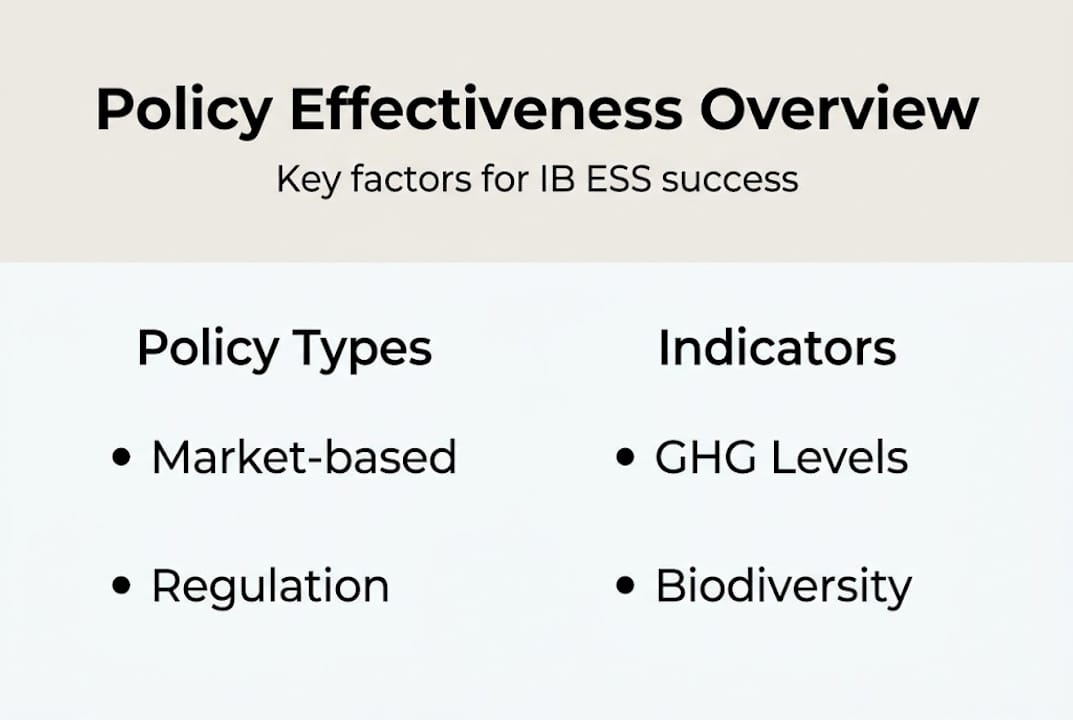
For your internal assessments, use environmental indicators like greenhouse gas concentration, biodiversity index scores, or air quality measures to benchmark policy effectiveness. Quantitative evidence always strengthens your argument.
Pro Tip: When discussing a case study like the UK coal phase-out in an exam, do not just describe what happened. Use it as evidence to support a broader claim. For example: “The success of the UK’s approach demonstrates that policy mixes combining a carbon price with sector-specific regulations produce significantly larger reductions than either instrument alone, supporting the argument that environmental management must integrate multiple strategies to be effective.”
You might also find it interesting to look at how stewardship in everyday choices connects to these larger policy frameworks. Individual behavior and large-scale policy reinforce each other in a well-functioning system.
Now that you understand effectiveness, let’s consider a fresh perspective on what really matters for IB ESS success.
Rethinking environmental policies: What most IB students miss
After working with IB ESS students for over 13 years, I see the same pattern repeatedly. Students learn the policy types, memorize a few statistics, and can describe what a carbon tax does. That gets you a mid-range score. What takes you higher is recognizing the system-level thinking underneath.
Most students treat policies as isolated tools. High-achieving students understand that a policy succeeds or fails depending on the underlying values and paradigms of the society implementing it. A carbon tax introduced into a society that fundamentally believes economic growth must never be constrained will face constant political pressure to be weakened or reversed. A similar policy in a society that has genuinely internalized ecological limits will be strengthened over time.
The principles of stewardship connect directly to this idea. Stewardship is not just about individual behavior. It reflects a deeper value system that places responsibility for the environment at the center of decision-making. Policies built on that foundation are inherently more durable.
For your exams, this means going beyond “the policy reduced emissions by X%.” Ask why it worked or failed in its specific context. What values did it challenge? What economic interests did it threaten? Demonstrating this kind of systemic awareness moves your answers into the top assessment bands.
Achieve higher IB ESS marks with expert support
Understanding environmental policies at this depth is exactly the kind of knowledge that turns a good IB ESS student into a great one. But knowing the content is only one part of the equation. Translating that knowledge into high-scoring exam answers and internal assessments is a skill in itself.

That is where targeted support makes a real difference. Working with experienced IB ESS IA tutors helps you apply your understanding directly to the assessment criteria, so you know exactly what the examiner is looking for. You can also strengthen your exam technique using dedicated IB ESS exam strategies and support your revision with high-quality IB ESS notes and textbook resources. With the right guidance, turning policy knowledge into exam marks is a very achievable goal.
Frequently asked questions
What is the main purpose of environmental policies in IB ESS?
Their main purpose is to guide governments and organizations in reducing environmental harm and promoting sustainability, with stringent policies reducing emissions and pressures like global warming potential and aquatic toxicity measurably across sectors.
Which type of environmental policy is most effective?
Market-based instruments like carbon taxes and emissions trading schemes are generally the most effective, with research showing a 19% average reduction in emissions when price incentives are combined with complementary regulatory tools.
Why do some environmental policies fail to meet their goals?
Common reasons include lack of coordination across regions, policy conflicts reducing effectiveness by up to 22%, high implementation costs, and insufficient enforcement capacity in many national governments.
How can IB ESS students use policy case studies for better exam answers?
Use real data, explain both effectiveness and limitations, and reference benchmarked results. Showing that you can evaluate trade-offs via data demonstrates the critical evaluation skills that examiners reward in the top mark bands.
No Comments