


16 Jul What Is Ecosystem Productivity? A Student Guide
TL;DR:
- Ecosystem productivity measures how quickly organisms convert energy into biomass, supporting food webs and ecological processes. It distinguishes between gross and net primary productivity, which are vital for understanding energy flow and ecosystem health. Accurate measurement involves both aboveground and belowground biomass, with remote sensing enhancing large-scale estimates.
Ecosystem productivity is defined as the rate at which organisms convert energy into biomass, fueling every food web and ecological process on Earth. This concept splits into two branches: primary productivity, the rate at which autotrophs like plants and algae fix energy through photosynthesis, and secondary productivity, the rate at which consumers convert that plant biomass into their own body mass. Gross primary productivity (GPP) captures the total energy fixed, while net primary productivity (NPP) equals GPP minus the energy autotrophs burn through respiration. Understanding these distinctions is the foundation of IB ESS and any serious study of why ecosystems matter.
What is ecosystem productivity and how is it measured?
Ecosystem productivity is reported in standard units of grams dry mass per square meter per year (g/m²/yr). That unit tells you how much organic matter an ecosystem builds in a given area over a full year. Tropical rainforests produce far more biomass per square meter than arctic tundra, which is why they support far more species and more complex food webs.
Measuring productivity accurately requires separating two components:
- Aboveground biomass: leaves, stems, and trunks that researchers can observe directly
- Belowground biomass: roots and soil organic matter that are harder to sample but equally significant
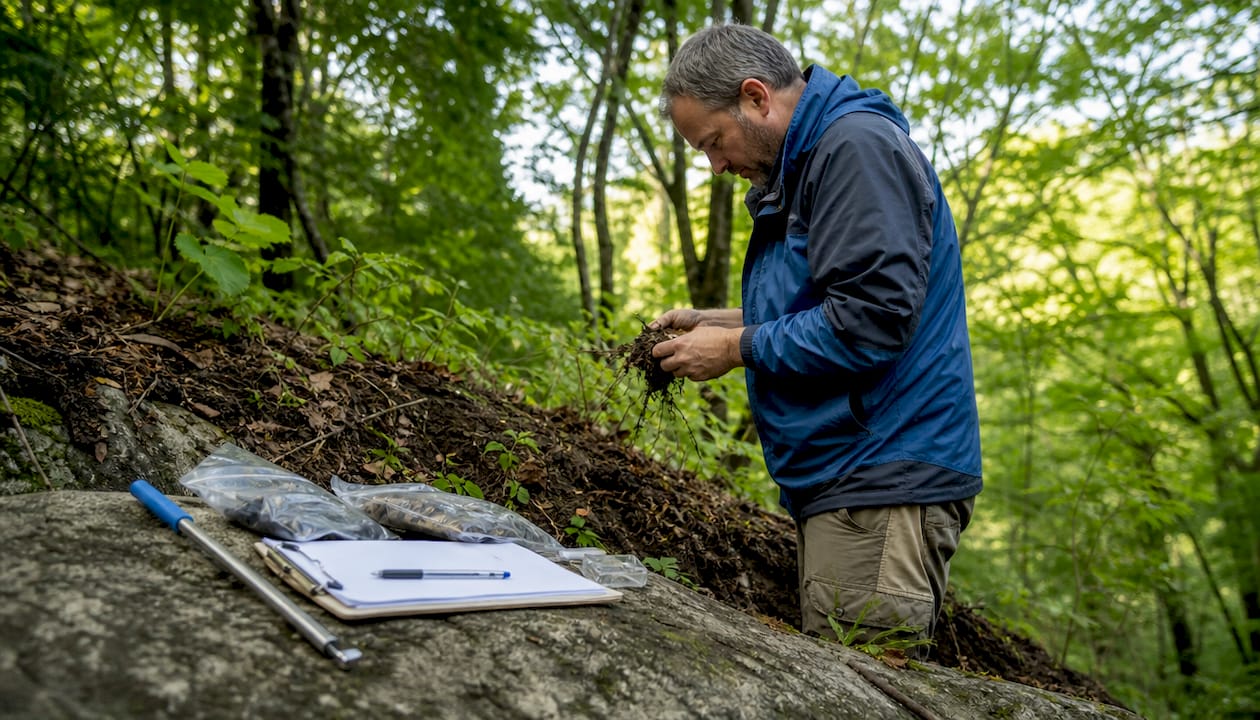
Productivity measurements must include both aboveground and belowground components. Ignoring roots can cause researchers to underestimate total NPP by a wide margin, especially in grasslands and shrublands where root biomass rivals or exceeds shoot biomass.
GPP vs. NPP: what is the difference?
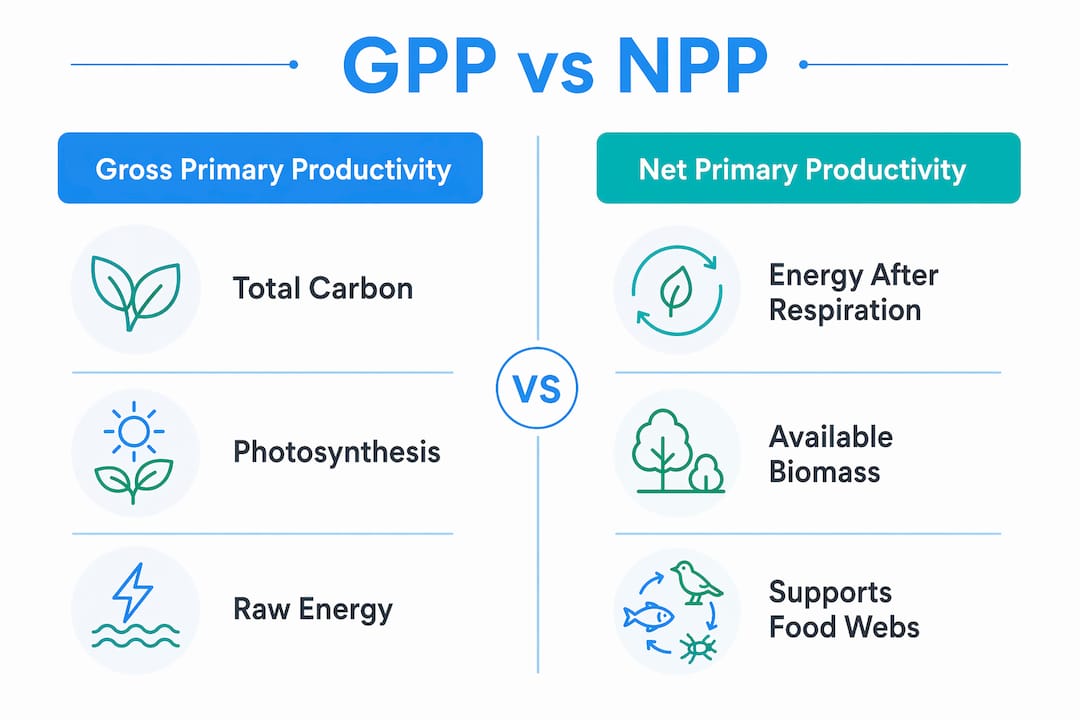
GPP is the total amount of carbon fixed by photosynthesis. NPP is what remains after plants use some of that carbon for their own cellular respiration. NPP is the carbon available to the rest of the food web, making it the more ecologically meaningful number for students studying energy flow and trophic levels.
| Metric | Definition | Ecological role |
|---|---|---|
| GPP | Total photosynthetic energy fixed | Measures raw production capacity |
| NPP | GPP minus autotrophic respiration | Fuels consumers, decomposers, and carbon storage |
| Secondary productivity | Energy converted by consumers | Determines biomass at higher trophic levels |
Remote sensing and satellite tools
Satellite technology has changed how scientists measure productivity at large scales. High-resolution satellite data at 30m improves GPP estimation accuracy by 13–20% in heterogeneous landscapes like wetlands compared to coarser 500m data. That accuracy gain matters because wetlands and fragmented forests are exactly the ecosystems where productivity estimates are most often wrong.
Pro Tip: When you study remote sensing in IB ESS, pay attention to “footprint matching.” The area a satellite pixel captures must align with the area measured on the ground. A mismatch between the two is one of the most common sources of error in productivity studies.
What factors affect ecosystem productivity?
Ecosystem productivity rates depend on dynamic interactions among solar energy, temperature, water, and nutrient availability. No single factor controls productivity alone. Instead, these drivers interact, and a shortage in any one of them can limit the entire system.
The main factors are:
- Solar radiation: Photosynthesis cannot occur without light. Ecosystems near the equator receive more solar energy year-round, which is a key reason tropical biomes show the highest primary productivity on Earth.
- Water availability: Deserts receive abundant sunlight but produce very little biomass because water limits photosynthesis. Irrigation in agricultural systems directly raises NPP by removing this constraint.
- Nutrient levels: Nitrogen and phosphorus are the most common limiting nutrients. Fertilizer application in farmland and nutrient runoff into lakes both demonstrate how quickly productivity responds to nutrient inputs.
- Temperature: Warmer temperatures speed up metabolic reactions, raising productivity up to a point. Extreme heat, however, causes heat stress in plants and reduces photosynthetic efficiency.
- Biodiversity and species roles: Ecosystems with higher functional biodiversity tend to use resources more completely. Different species exploit different niches, so a diverse community captures more of the available solar energy and nutrients.
- Human impacts: Deforestation, pollution, and land-use change reduce productivity. Conversely, habitat restoration and reduced pollution can raise it.
Pro Tip: For your IB ESS internal assessment, try comparing productivity across two sites with different levels of one variable, such as light or soil nutrients. Controlling for other factors makes your data much easier to interpret.
Why is ecosystem productivity important for ecosystems and humans?
Net primary production is the carbon available after autotrophic respiration, and it underpins food supply, fiber production, fuel, and climate regulation. Every calorie you eat traces back to NPP. Every piece of timber in a building started as fixed carbon in a living tree.
The ecological and human benefits of high productivity include:
- Energy supply for food webs: Primary productivity feeds herbivores, which feed carnivores. Without sufficient NPP, entire trophic levels collapse.
- Carbon sequestration: Productive ecosystems absorb CO₂ from the atmosphere. Forests and ocean phytoplankton together fix billions of tons of carbon each year, slowing climate change.
- Ecosystem resilience: Productive ecosystems recover faster from disturbances like fire or drought. They have more biomass to rebuild from and more species to fill functional roles.
- Provisioning services: Agriculture, fisheries, and forestry all depend directly on ecosystem productivity. A drop in NPP in a farming region translates directly into lower crop yields.
- Conservation monitoring: Tracking productivity over time reveals whether an ecosystem is degrading or recovering. It is one of the clearest signals of ecosystem equilibrium or its loss.
“Net primary productivity is not just a scientific metric. It is the measure of how much life an ecosystem can support, and by extension, how much human civilization depends on the natural world remaining intact.”
Energy transfer efficiency decreases through trophic levels due to metabolic heat loss. This is why secondary productivity is always lower than primary productivity. Ectotherms like fish convert energy more efficiently than endotherms like mammals, which burn most of their energy maintaining body temperature. That difference shapes the structure of every food web on Earth.
How do scientists compare productivity across different ecosystems?
Comparing productivity across ecosystems is harder than it sounds. A rainforest and a coral reef both show high productivity, but they use different energy pathways and support different communities. Scientists need methods that work across all these contexts.
The sentinel approach
Relying solely on species diversity as an indicator of ecosystem health can mislead. Measuring functional intensity, or the actual rate of ecosystem functions, provides a stronger evaluation basis. The sentinel approach places standardized biological or physical objects in ecosystems and measures how quickly they are processed. For example, a cotton strip buried in soil decomposes faster in a highly productive, biologically active soil than in a degraded one. That decomposition rate directly measures ecosystem function, not just species counts.
Standardized sentinel methods enable direct, comparable ecosystem function measurements across services and disservices. They reveal trade-offs and synergies that biodiversity data alone cannot show. A site might have high species richness but low functional productivity if key species are absent or stressed.
Comparing field methods and remote sensing
| Method | Strengths | Limitations |
|---|---|---|
| Field biomass harvest | Direct, accurate for small areas | Labor-intensive, destructive |
| Remote sensing (satellite) | Large-scale, repeatable | Requires footprint matching, resolution limits |
| Sentinel approach | Measures function directly, cost-effective | Standardization still developing globally |
| Harmonized global databases | Enables cross-site comparison | Dependent on data quality from contributing sites |
Pro Tip: When you read a study reporting ecosystem productivity, check whether it measured only aboveground biomass or included roots. Studies that skip belowground components often underestimate total productivity, especially in grasslands.
You can explore ecological indicator tools and how scientists choose between these methods in more depth. Understanding the trade-offs between field and satellite approaches is a common exam question in IB ESS.
Key takeaways
Ecosystem productivity is the foundational measure of how much energy an ecosystem captures and converts into biomass, linking solar input to food webs, carbon cycles, and human survival.
| Point | Details |
|---|---|
| Two types of productivity | GPP measures total photosynthesis; NPP is what remains after plant respiration and feeds all consumers. |
| Standard measurement unit | Productivity is reported in grams dry mass per square meter per year (g/m²/yr). |
| Key limiting factors | Solar radiation, water, nutrients, and temperature each cap how much biomass an ecosystem can produce. |
| Importance beyond ecology | NPP underpins food, fiber, fuel, and carbon sequestration, making it central to human welfare. |
| Measurement accuracy | Including belowground biomass and using high-resolution satellite data both reduce errors in productivity estimates. |
Ecosystem productivity is more dynamic than most textbooks suggest
I have worked with IB ESS students for over 13 years, and ecosystem productivity is one of the topics where I see the most confusion. Students often memorize the GPP and NPP formulas without understanding what those numbers actually represent in a real ecosystem. That gap shows up badly in Paper 2 questions, where examiners expect you to apply the concept, not just recite it.
What I find most exciting about this topic right now is the shift toward functional measurement. The idea that you can bury a cotton strip in soil and use its decomposition rate to measure ecosystem health is genuinely elegant. It cuts through the complexity of species counts and gives you a direct signal of what the ecosystem is actually doing. Students who understand this distinction, between what lives in an ecosystem and what that ecosystem produces, write much stronger answers.
The other thing I want you to take seriously is the belowground component. Most diagrams in textbooks show trees and grass. Almost none of them show the root systems that can account for half or more of total NPP. When you design your own IB ESS internal assessment, think about whether your chosen ecosystem has a significant belowground component and how you will account for it.
Ecosystem productivity connects to almost every other topic in ESS: carbon cycles, biodiversity, food security, and climate change. Once you understand it deeply, the rest of the course starts to fit together.
— Marija
Esstutor can help you master ecosystem productivity for IB ESS
Ecosystem productivity appears across IB ESS Paper 1, Paper 2, and internal assessments. Getting it right requires more than reading a definition. You need to apply GPP and NPP formulas, evaluate measurement methods, and connect productivity to broader environmental systems.

At Esstutor, I work with students one-on-one to build exactly that kind of applied understanding. With over 13 years of experience as an IB examiner and ESS educator, I know which questions trip students up and how to prepare you for them. Whether you need help with your IB ESS internal assessment or want to sharpen your exam technique, personalized sessions make a real difference. Book a trial lesson and see how targeted support changes your results.
FAQ
What is the ecosystem productivity definition in simple terms?
Ecosystem productivity is the rate at which organisms in an ecosystem produce biomass from energy. It divides into primary productivity by plants and algae and secondary productivity by animals and other consumers.
What is the difference between GPP and NPP?
Gross primary productivity (GPP) is the total energy fixed by photosynthesis. Net primary productivity (NPP) equals GPP minus the energy plants use for their own respiration, leaving the carbon available to the rest of the food web.
What are the main factors affecting ecosystem productivity?
Solar radiation, water availability, temperature, and nutrient levels are the primary drivers. Biodiversity and human land use also shape how efficiently an ecosystem converts available energy into biomass.
Why is measuring ecosystem productivity important?
Productivity measurements reveal ecosystem health, carbon storage capacity, and the ability to support food webs. Tracking NPP over time shows whether an ecosystem is recovering or degrading, making it a core tool in conservation and climate science.
How does ecosystem productivity relate to biodiversity?
Higher functional biodiversity generally supports higher productivity because diverse species use resources more completely. However, species richness alone does not guarantee high productivity. Direct function measurements, such as the sentinel approach, provide a more reliable picture than species counts alone.
No Comments