


10 Jul What Is the Sustainability Triangle? A Student’s Guide
TL;DR:
- The sustainability triangle links environment, society, and economy as interdependent pillars of sustainable development. A nested model shows the environment as the boundary that limits social and economic systems, unlike the equal overlap of the Venn diagram. Understanding the model’s critiques and distinctions, like strong versus weak sustainability, enhances analysis and policy decisions.
The sustainability triangle is defined as a conceptual framework that links three interdependent domains: environment, society, and economy, forming the foundation of sustainable development. Established since the 1987 Brundtland Commission, this model frames how human systems must operate within ecological limits to meet both present and future needs. You may also hear it called the “Triple Bottom Line” or the “three pillars of sustainability.” All three labels describe the same core idea: no single domain can thrive long term without the other two. If you are studying IB Environmental Systems and Societies (ESS), understanding this model is not optional. It appears across assessments, internal assessments, and exam questions at every level.
What is the sustainability triangle and its three pillars?
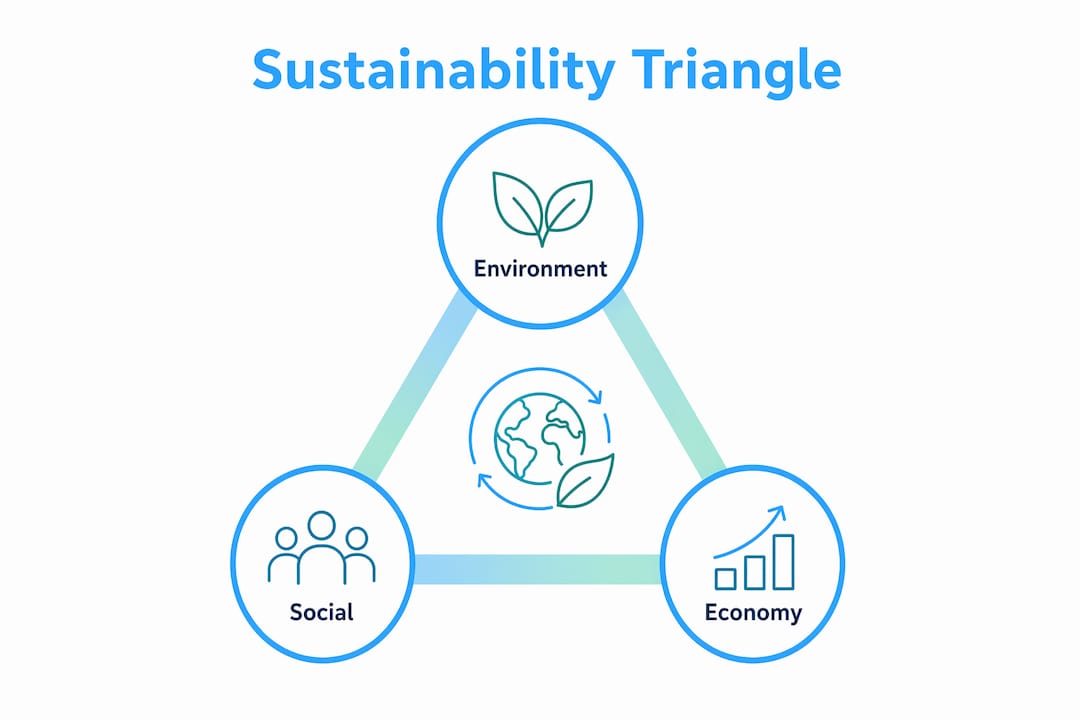
The sustainability triangle organizes sustainable development into three pillars: environmental, social, and economic. Each pillar represents a distinct set of concerns, but all three are deeply connected. A decision that ignores one pillar almost always damages the others.

The environmental pillar
The environmental pillar covers the natural systems that support all life: ecosystems, biodiversity, clean water, clean air, and finite resources like fossil fuels and fertile soil. This pillar sets the hard limits within which society and the economy must operate. Overfishing a marine ecosystem, for example, produces short-term economic gain but destroys the resource base that fishing communities depend on for generations.
The social pillar
The social pillar focuses on human well-being, equity, and the institutions that hold communities together. It includes access to education, healthcare, safe housing, and fair labor conditions. A society that degrades its environment eventually faces public health crises, food insecurity, and social unrest. These outcomes are not abstract. They are documented consequences of ignoring ecological limits in pursuit of economic growth.
The economic pillar
The economic pillar covers production, trade, employment, and the creation of financial value. A functioning economy provides the resources needed to invest in environmental protection and social programs. The problem arises when economic growth is treated as the primary goal and the other two pillars become secondary. The Triple Bottom Line framework, coined in 1994, was designed specifically to push back against that tendency by asking businesses to account for people and planet alongside profit.
The three pillars interact constantly. Building a new factory creates jobs (social gain) and tax revenue (economic gain), but it may also release pollutants into a nearby river (environmental loss). The triangle model forces decision-makers to weigh all three outcomes at once rather than treating them separately.
Pro Tip: When answering ESS exam questions about the sustainability triangle, always name all three pillars and give one concrete example of a tradeoff between them. Examiners reward students who show they understand the tensions, not just the definitions.
How do visual models of the sustainability triangle shape understanding?
The way you draw the sustainability triangle changes what you think it means. Two models dominate the literature, and they lead to very different conclusions.
Venn diagram model versus nested ellipses
The traditional Venn diagram shows three overlapping circles of equal size, one for each pillar. The overlapping zones represent areas where two or three pillars align. This model implies that all three domains are equally important and that sustainability lives in the overlap. That sounds reasonable, but it creates a misleading impression: it suggests that the economy and society could exist independently of the environment, which is physically impossible.
The nested ellipses model corrects that error. Nested models depict the economy and society as existing inside the environment, not alongside it. The environment forms the outer boundary because all economic and social activity depends on natural systems for energy, materials, and waste absorption. The US EPA’s sustainability framework reflects this logic directly, depicting the economy as sitting within a healthy society, which in turn depends on an intact environment.
| Model | Structure | Key implication | Best used for |
|---|---|---|---|
| Venn diagram | Three equal overlapping circles | Balance and overlap among pillars | Introductory teaching |
| Nested ellipses | Economy inside society inside environment | Environment sets hard limits | Policy analysis and advanced study |
Pro Tip: In IB ESS assessments, if you are asked to evaluate sustainability models, mention both the Venn and nested models. Explain that nested models better reflect ecological dependency. That distinction earns higher marks.
Visual models impact decision-making in real policy contexts. Governments and organizations that use the Venn model risk treating environmental protection as one option among equals. Those that use the nested model recognize that economic expansion has a ceiling set by natural systems.
What are the main critiques of the sustainability triangle?
The sustainability triangle is a useful teaching tool, but it has real theoretical weaknesses. Understanding those weaknesses makes you a stronger analyst, not a weaker one.
-
No unified theory: The sustainability triangle lacks a rigorous unified theoretical foundation. Scholars warn that treating it as a fixed goal rather than a dynamic systems approach leads to siloed decisions that miss root causes of environmental degradation.
-
Weak versus strong sustainability: The distinction between weak and strong sustainability is one of the most important concepts in this field. Strong sustainability holds that natural capital is irreplaceable. A forest cannot be fully substituted by a financial asset, no matter how large. Weak sustainability, by contrast, allows human-made capital to replace natural capital, which is how some governments justify deforestation in exchange for economic development.
-
The substitution trap: Treating all three pillars as substitutable is the most common misapplication of the triangle model. When a government allows a wetland to be drained because the economic benefits outweigh the environmental costs, it is practicing weak sustainability. The wetland’s flood control, water filtration, and biodiversity functions cannot be replicated by a financial payment.
-
Short-term bias: Practitioners consistently observe that economic and social gains prioritize short-term goals over long-term environmental integrity. This is not a flaw in the triangle concept itself. It is a flaw in how organizations apply it.
-
Evolving frameworks: The traditional sustainability triangle is now evolving into more complex policy models. Recent analysis describes a climate policy triangle that adds national security as a fourth dimension, reflecting real-world interdependencies that the original three-pillar model cannot fully capture.
Recognizing these critiques does not mean abandoning the triangle. It means using it with awareness of its limits. For IB ESS students, understanding sustainability in ESS at this level of depth is exactly what separates a 5 from a 7.
How is the sustainability triangle applied in practice?
The triangle model moves from theory to practice across three major domains: business, global policy, and education.
-
Business: Triple Bottom Line reporting. The Triple Bottom Line framework asks companies to report on people, planet, and profit as three separate performance measures. A company that reports only financial profit is hiding its full impact. Since the late 1990s, TBL has influenced corporate sustainability reporting worldwide, pushing firms to account for carbon emissions, labor conditions, and community impact alongside revenue.
-
Global policy: UN Sustainable Development Goals. The 17 UN Sustainable Development Goals translate the sustainability triangle into a global action plan. SDG 8 targets decent work and economic growth. SDG 10 targets reduced inequalities. SDG 13 targets climate action. Together, they show how the three pillars operate simultaneously at the national and international scale.
-
Education: building integrated thinking. Education plays a direct role in shaping how future decision-makers understand sustainability. When students learn the triangle model early, they develop the habit of asking “what are the environmental, social, and economic consequences?” before endorsing any policy or project. That habit is the practical output of sustainability education.
-
Environmental stewardship programs. Organizations apply the triangle through environmental stewardship practices such as watershed protection, sustainable agriculture certification, and community-based conservation. These programs succeed when they address all three pillars: protecting ecosystems (environment), supporting local livelihoods (social), and maintaining long-term resource productivity (economic).
-
Waste management policy. Sustainable waste management is a direct application of the triangle. A city that invests in recycling infrastructure reduces landfill pressure (environmental), creates green jobs (social), and lowers long-term disposal costs (economic). Learning why managing waste sustainably matters gives students a concrete, exam-ready example of all three pillars working together.
Key Takeaways
The sustainability triangle is only as useful as the depth of understanding behind it: weak application produces weak outcomes, while strong sustainability thinking protects the ecological systems that all human activity depends on.
| Point | Details |
|---|---|
| Three interdependent pillars | Environment, society, and economy must be addressed together, not in isolation. |
| Nested models over Venn diagrams | Nested ellipses correctly show the environment as the boundary that limits social and economic systems. |
| Strong vs. weak sustainability | Natural capital is irreplaceable; substituting it with financial capital leads to long-term ecological loss. |
| Real-world applications | The Triple Bottom Line and UN SDGs translate the triangle into measurable business and policy targets. |
| Critiques matter | The triangle lacks a unified theory; using it without awareness of its limits produces siloed, short-term decisions. |
Why the sustainability triangle is more than a diagram
Teaching the sustainability triangle for over a decade has shown me one consistent pattern: students who memorize the three pillars pass the exam, but students who understand the tensions between them actually learn something lasting.
The most common mistake I see is treating the three circles as equal. They are not. The economy does not exist alongside the environment. It exists inside it. Once you internalize that, the nested model stops being an abstract diagram and starts being a lens for reading every environmental news story you encounter.
I also think the weak versus strong sustainability distinction is underteached. Most introductory courses skip it entirely. That is a problem, because the difference between weak and strong sustainability is the difference between a policy that looks green and one that actually protects ecological systems. Understanding sustainability fundamentals at that level of nuance is what IB ESS is designed to build.
My honest advice: do not be satisfied with knowing what the triangle is. Ask what it gets wrong, what it oversimplifies, and what it leaves out. That critical thinking is exactly what IB examiners reward in extended response questions.
— Marija
Esstutor can help you master sustainability for IB ESS
Sustainability concepts like the triangle model appear throughout IB ESS assessments, from short-answer exam questions to full internal assessments. Getting the depth right matters, and that is where personalized tutoring makes a real difference.

At Esstutor, sessions are tailored to your specific assessment needs, whether you are writing an internal assessment on a local sustainability issue or preparing for Paper 2 extended responses. With over 13 years of experience as an IB examiner and ESS educator, Marija works with students worldwide to build the kind of conceptual clarity that earns top marks. If your IA involves sustainability analysis, IB ESS internal assessment tutoring gives you structured, expert support from topic selection through final submission.
FAQ
What is the sustainability triangle in simple terms?
The sustainability triangle is a framework that links three domains: environment, society, and economy. Sustainable development requires all three to be maintained together, not traded off against each other.
What are the three pillars of the sustainability triangle?
The three pillars are environmental (natural systems and resources), social (human well-being and equity), and economic (production, trade, and financial value). Each pillar depends on the others to function long term.
Why is the environmental pillar considered the most fundamental?
Economic and social systems depend entirely on the environment for energy, materials, and waste absorption. Nested sustainability models show the environment as the outer boundary that limits what society and the economy can do.
What is the difference between weak and strong sustainability?
Strong sustainability holds that natural capital is irreplaceable and cannot be substituted by human-made capital. Weak sustainability allows that substitution, which critics argue justifies environmental degradation in exchange for short-term economic gains.
How does the sustainability triangle appear in IB ESS exams?
IB ESS exams regularly ask students to evaluate sustainability decisions using the three-pillar framework. Questions often require students to identify tradeoffs between pillars and explain why treating them as equally weighted can lead to unsustainable outcomes.
No Comments