


06 May Why studying ecosystems matters for IB ESS success
TL;DR:
- Understanding ecosystems as communities of living organisms and their environment is essential in IB ESS because it connects systems thinking, sustainability, and environmental value concepts. Mastery of ecosystem types, valuation perspectives, and application skills enhances both exam performance and real-world environmental literacy. Developing critical thinking by analyzing diverse viewpoints and incorporating current case studies distinguishes high-achieving students in ecosystem studies.
Ecosystems are far more than forests and fish. When you hear the word “ecosystem,” you might picture a nature documentary or a biology textbook diagram, but in IB Environmental Systems and Societies, ecosystems are the lens through which you interpret climate change, resource depletion, policy debates, and social equity. Understanding ecosystems is not optional for ESS success; it is the foundation everything else builds on. In this article, we will walk through what ecosystems really mean in your course, how they show up in assessments, how to compare different perspectives on them, and how to use that knowledge to write answers that impress examiners.
Table of Contents
- What is an ecosystem and why does it matter in IB ESS?
- How ecosystems drive real-world and exam success
- Comparing ecosystem perspectives: more than just ecology
- Applying ecosystem knowledge: critical thinking for IB assessments
- What most students miss about studying ecosystems in IB ESS
- Boost your IB ESS achievement with expert ecosystem support
- Frequently asked questions
Key Takeaways
| Point | Details |
|---|---|
| Ecosystems in ESS | Knowing how ecosystems function is crucial for success in IB Environmental Systems and Societies. |
| Multiple perspectives | Comparing ecological and economic viewpoints strengthens both coursework and exam answers. |
| Real-world relevance | Ecosystem understanding connects with major global issues like sustainability and resource management. |
| Critical application | Applying ecosystem knowledge with real examples and analysis is key to impressing examiners. |
What is an ecosystem and why does it matter in IB ESS?
To really appreciate why this subject matters, let’s clarify what we mean by “ecosystem” in IB ESS and how it links to your coursework.
In the ESS course, an ecosystem is defined as a community of living organisms interacting with each other and their non-living environment as a functional unit. This is broader than biology alone. ESS treats ecosystems as systems with inputs, outputs, flows, storages, and feedbacks. You are expected to analyze how these systems work, how they change, and what happens when they are disrupted.
This matters because ecosystems connect directly to several of the crucial ESS concepts that run through the entire course: systems thinking, sustainability, and environmental value systems. If you understand ecosystems well, you can apply that understanding across topics like biodiversity, climate, food production, and pollution. It is genuinely transferable knowledge.
Here are the main types of ecosystems you should know for your IB ESS ESS key definitions:
- Tropical rainforest: High biodiversity, fast nutrient cycling, sensitive to deforestation
- Urban ecosystem: Human-dominated, with modified energy flows and high pollution levels
- Aquatic ecosystem: Includes freshwater and marine systems; subject to eutrophication and acidification
- Grassland ecosystem: Lower biodiversity than rainforests but critical for carbon storage and agriculture
- Wetland ecosystem: Highly productive, important for water purification and flood control
Now consider how ecosystem value is framed in research and practice. According to ecological and economic perspectives, ecosystem value can be approached ecologically, focusing on resilience and functioning, or economically and policy-oriented, focusing on valuation and GDP contributions. Each framing captures something important and misses something too, particularly around non-market and equity dimensions. Understanding this distinction is already the kind of nuanced thinking IB examiners reward.
Here is a quick summary of how each perspective frames ecosystem value:
| Perspective | Focus | What it misses |
|---|---|---|
| Ecological | Resilience, biodiversity, functioning | Monetary valuation, policy levers |
| Economic | GDP contribution, market services | Non-market values, equity concerns |
| Policy | Regulation, resource management | Local community knowledge, long-term ecological limits |
This table alone gives you material for comparison questions, which appear frequently in ESS exams.
How ecosystems drive real-world and exam success
With a clear definition, let’s look at how mastering ecosystem concepts gives you an edge in both exams and real-life environmental debates.

IB ESS assessments test ecosystems at multiple levels. Short-answer questions might ask you to define primary productivity or identify trophic levels. Long-answer questions will push you to evaluate the impact of human activity on ecosystem functioning. Internal assessments often involve real field data from local ecosystems. You need to move fluidly between describing, explaining, analyzing, and evaluating.
The benefits of studying environmental systems go beyond passing exams. When you understand how ecosystems function, you can interpret real news stories about coral reef bleaching, deforestation in the Amazon, or nitrogen pollution in European rivers. This kind of environmental literacy makes ESS deeply relevant, not just academically useful.
Here are four concrete ways ecosystem knowledge helps you in assessments:
- Short-answer questions: You can accurately define terms like net primary productivity, carrying capacity, and ecological resilience using system-based language.
- Data-based questions: You can interpret graphs showing biomass pyramids or energy flow diagrams by applying your understanding of trophic efficiency.
- Essay questions: You can structure arguments that compare the ecological and economic value of a specific ecosystem, like mangroves or wetlands.
- Internal assessment: You can design investigations around measurable ecosystem variables, such as species diversity using Simpson’s Index or water quality indicators.
The importance of ecosystem services in IB ESS is also a direct exam topic. Provisioning, regulating, cultural, and supporting services all emerge from healthy ecosystems. Being able to categorize these services and link them to specific real-world examples is a skill that lifts your answers above average.
Research confirms that ecosystem value framing affects how we assess and manage environments, which means exam questions may present you with policy scenarios where you need to argue from more than one angle. That ability is a direct exam skill.
Pro Tip: Keep a running list of real-world ecosystem case studies as you progress through the course. For every topic, from coral reefs to urban heat islands, note one current news story or policy example. This habit makes your exam answers specific and credible, and examiners notice the difference.
Comparing ecosystem perspectives: more than just ecology
Now that you know ecosystems matter for more than biology, let’s dig into different ways they’re valued, which can sharpen your exam answers and deepen your ESS insights.
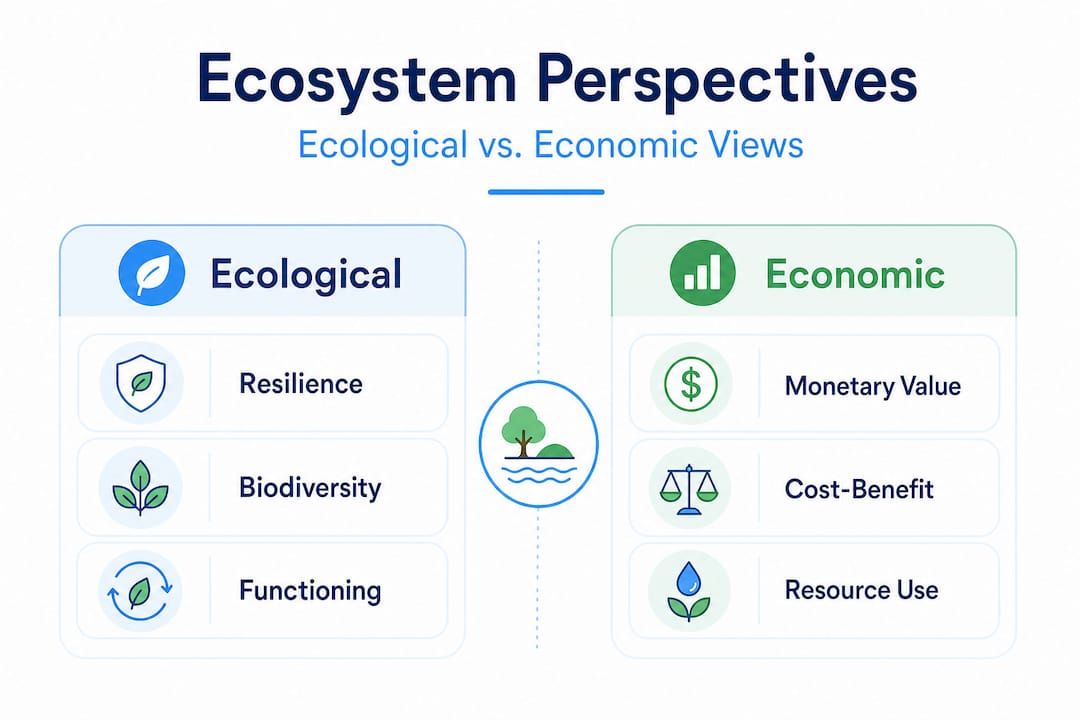
Many ESS students describe ecosystems in purely biological terms and stop there. That is a missed opportunity. IB ESS explicitly rewards students who can think across different value systems, including ecological, economic, and sociopolitical ones. This is not just good exam technique; it reflects how environmental decisions are actually made in the real world.
Here is how to distinguish these three perspectives clearly:
Ecological perspective: This focuses on how ecosystems function, including energy flow, nutrient cycling, biodiversity, and resilience. It asks questions like: How does this ecosystem respond to disturbance? What happens to food web stability when a keystone species is removed?
Economic perspective: This values ecosystems based on the services they provide to human economies. Fisheries, timber, tourism, and carbon sequestration all have monetary values. The limitation here is that many critical services, like spiritual value or cultural heritage, are hard to price. As ecological and economic research shows, economic framing can miss non-market and equity dimensions entirely.
Policy perspective: This looks at how governments and international organizations manage ecosystems through regulation, protected areas, and resource quotas. It connects ecological and economic thinking to governance, but it can overlook local communities and traditional ecological knowledge.
“A strong ESS answer compares what each framing captures and what it might miss, especially around equity and non-market values.” This is the kind of critical balance that separates a 6 from a 7.
Here is a side-by-side comparison you can use when planning exam answers:
| Perspective | Key strength | Key limitation | Example in ESS |
|---|---|---|---|
| Ecological | Captures system functioning | Hard to link to policy decisions | Measuring biodiversity loss |
| Economic | Supports cost-benefit analysis | Ignores non-market values | Valuing fishery stocks |
| Policy | Connects to governance | May overlook local or indigenous knowledge | Marine protected areas |
Being able to write a paragraph that moves across all three columns is exactly what ecosystem services perspectives demand in IB ESS.
Pro Tip: When you practice essay plans, try the “three lens” method. Take any ecosystem topic, such as deforestation in Borneo, and write one sentence from each perspective. This trains you to think critically and comprehensively, which is a form of environmental literacy in ESS that examiners specifically reward.
Applying ecosystem knowledge: critical thinking for IB assessments
Understanding theory is only half the challenge; here’s how to use ecosystem knowledge to write higher-level ESS answers and tackle complex environmental issues.
Application in IB ESS means taking what you know about ecosystems and using it to analyze new situations, evaluate trade-offs, and make reasoned judgments. It is the difference between describing nutrient cycling and explaining what happens to it when a wetland is drained for agriculture, and then evaluating whether the economic benefit justifies the ecological cost.
Here is how to build that applied thinking into your work:
- In your IA: Choose a local ecosystem you can observe and measure. Frame your research question around a specific measurable variable, like light intensity and plant species richness in a park. Apply your knowledge of ecosystem functioning to interpret the results, not just report them.
- In essay questions: Use a specific real-world ecosystem as your evidence base. Do not just say “tropical rainforests have high biodiversity.” Say “the Amazon basin supports an estimated 10% of all species on Earth, making it a critical carbon sink, but this ecological value is often underweighted in land-use policy driven by agricultural economics.”
- In data responses: Connect what you see in the data back to system-level processes. If a graph shows declining fish stocks, link it to overfishing, trophic cascade effects, and the policy gap between quota-setting and ecological advice.
Contrasting viewpoints help students build more holistic answers, especially when addressing policy, equity, and non-market values. This is a habit worth building early. Practice reading environmental news stories and asking: who benefits here? Who loses? What is not being counted?
The key ESS concepts of sustainability, resilience, and systems thinking all come alive when you apply them to real ecosystems under pressure. Think about climate change and sustainability: rising temperatures affect ecosystem functioning, which affects ecosystem services, which affects human well-being and economic activity. Tracing that chain is applied ecosystem thinking, and it is exactly what high-scoring ESS answers do.
Pro Tip: After reading any environmental case study, ask yourself three questions: What is the ecological impact? What is the economic dimension? Who makes the policy decision and who is left out? Answering all three consistently will give your exam responses the depth and balance that earns top marks.
What most students miss about studying ecosystems in IB ESS
With application skills in hand, let’s explore an angle most textbooks and students miss: what truly sets high achievers apart in the study of ecosystems.
I work with students every year who know their ecosystem facts well. They can define a food web, explain energy flow, and list ecosystem services. But in the exam, they still struggle to score above a 5 on essay questions. The reason, almost every time, is the same: they write about ecosystems without writing with ecosystems.
High-achieving students use ecosystems as tools for analysis. They pick up an exam question about water scarcity or climate policy and they immediately connect it to ecosystem functioning, service loss, and value trade-offs. They do not wait for the question to say “ecosystem.” They bring that thinking in themselves.
The other gap I see is relying too heavily on textbook examples. Examiners read thousands of scripts about the Amazon and the Great Barrier Reef every year. When a student brings in a less familiar example, like the restoration of mangroves in Vietnam for coastal protection, or wetland degradation in the Mesopotamian marshes, it signals genuine engagement with the subject. You do not need exotic examples. You need current ones.
Ecosystem services research consistently shows that ecological and economic framings each miss important dimensions of value, especially equity and non-market goods. Students who name and explain that gap in their answers show exactly the kind of critical thinking the IB Diploma is designed to develop. It is also genuinely useful after graduation, whether you go into environmental policy, business, medicine, or social work.
The best thing you can do right now is read one environmental news article per week and ask: which ecosystem is involved? What perspective is being used to value it? What is being left out? That habit alone, practiced consistently, can move you from a 5 to a 7. I have seen it happen.
The deeper dive into ecosystem services is worth your time. Not because it is on the syllabus, but because it trains you to think in the interconnected, multi-perspective way that IB ESS genuinely rewards.
Boost your IB ESS achievement with expert ecosystem support
If you want to move from understanding to excelling, there are targeted resources and support available to help you do exactly that.

Working through ecosystem topics on your own is possible, but having expert guidance makes a measurable difference, especially for internal assessments and long essay questions. With over 13 years of experience as an IB examiner and ESS educator, I offer personalized expert IB ESS IA tutoring that helps you understand exactly what examiners look for and how to deliver it. You can also access a full range of IB ESS notes and textbooks to strengthen your ecosystem knowledge, alongside detailed ESS concept guides that make key definitions and frameworks easy to apply. Whether you are preparing for Paper 1, Paper 2, or your IA, targeted support can save you time and sharpen your results. Book a trial lesson today and see the difference personalized preparation makes.
Frequently asked questions
How do ecosystems come up in IB ESS exams?
Ecosystems appear across short-answer, long-answer, data-based, and internal assessment components, and exam performance improves when students can apply understanding rather than just recall definitions.
What’s the difference between ecological and economic views of ecosystems?
Ecological views focus on resilience, biodiversity, and system functioning, while economic views highlight monetary value, GDP contributions, and policy impacts, often underweighting non-market benefits.
How can I impress examiners with my ecosystem answers?
Make deliberate comparisons between ecological and economic perspectives and explicitly discuss non-market and equity dimensions that each framing misses, since this depth of critical analysis is what high-scoring responses consistently include.
Are there resources to help with ecosystem topics in ESS?
Yes, guided notes, IB ESS textbooks, and one-on-one personalized tutoring are all available to support deeper understanding and targeted exam and IA preparation at any stage of the course.
No Comments