


16 May How to meet ESS assessment criteria: your IB guide
TL;DR:
- The ESS internal assessment requires careful alignment with five specific IB criteria, emphasizing understanding, analysis, evaluation, and communication. Choosing a focused, data-accessible topic and developing a clear research question are crucial steps for success. Effective data collection, detailed analysis, and in-depth evaluation of limitations and perspectives distinguish top-scoring assessments.
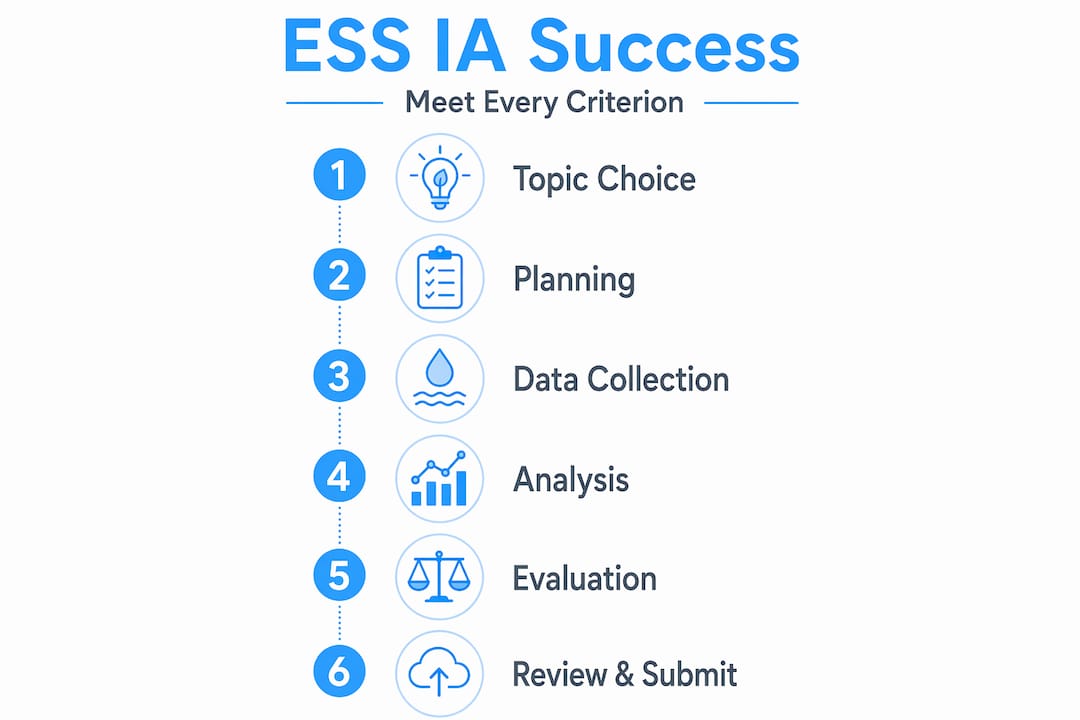
The ESS internal assessment is one of those tasks that feels straightforward until you actually sit down with the rubric. Suddenly there are five criteria, specific requirements for each one, and a 3,000-word ceiling that makes every sentence count. Knowing how to meet ESS assessment criteria is not just about writing well. It is about understanding exactly what the IB expects at every stage, from your research question to your final evaluation, and building your report deliberately around those expectations.
Table of Contents
- Understanding the ESS assessment criteria and requirements
- Preparing your internal assessment: topic selection to research question
- Executing your investigation: conducting reliable data collection and analysis
- Evaluating your investigation: discussing limitations, uncertainties, and perspectives
- Finalizing your report: communication, review, and submission tips
- Why strong evaluation and perspective exploration set top ESS internal assessments apart
- Unlock your potential with expert IB ESS internal assessment tutoring
- Frequently asked questions
Key Takeaways
| Point | Details |
|---|---|
| Understand criteria | Know the five core ESS IA criteria and new 2026 additions to meet expectations fully. |
| Focus your question | Choose a narrow, testable research question directly linked to ESS concepts for better marks. |
| Collect reliable data | Use systematic methods and adequate sample sizes while documenting all conditions thoroughly. |
| Evaluate critically | Link limitations and improvements specifically to your method and explore stakeholder perspective tensions. |
| Polish your report | Structure clearly, respect word limits, maintain individual work integrity, and label all visuals properly. |
Understanding the ESS assessment criteria and requirements
Now that you know why meeting the criteria matters, let’s explore each requirement so you understand exactly what the IB expects.
The ESS internal assessment is marked on five criteria. Each one targets a specific skill, and examiners look for clear evidence of all five in your written report. Here is a quick overview:
- Personal engagement: Shows genuine interest in your topic through relevant, original choices and commentary.
- Exploration: Covers your background, research question, and methodology. Clarity and justification are key here.
- Analysis: Focuses on how you process and present data, including graphs, tables, and statistical interpretation.
- Evaluation: Requires critical reflection on your results, limitations, and, under the updated 2026 IB criteria, tensions between stakeholder perspectives.
- Communication: Judges the overall clarity, structure, and scientific accuracy of your report.
The IB ESS IA contributes 25% of your final grade and requires a 3,000-word individual report, so every section carries real weight. The 2026 update places greater emphasis on evaluation, particularly your ability to analyze how different perspectives, like economic growth advocates versus environmental conservationists, shape outcomes. This is new, and many students underestimate it.
Here is how the five criteria typically map to mark allocations:
| Criterion | Focus area | Max marks |
|---|---|---|
| Personal engagement | Originality, relevance, and personal connection | 2 |
| Exploration | Research question, background, and methodology | 6 |
| Analysis | Data processing, graphs, and interpretation | 6 |
| Evaluation | Limitations, improvements, and perspectives | 6 |
| Communication | Structure, language, and formatting | 4 |
Understanding ESS IA criteria in detail helps you write with intention, not guesswork. Every paragraph should serve at least one criterion directly.
Pro Tip: Print the rubric and keep it next to you while writing. After every section, ask yourself: “Which criterion does this address, and is my evidence clear?”
Preparing your internal assessment: topic selection to research question
With a clear grasp of criteria, you can now prepare effectively by choosing the right topic and framing your question precisely.
The topic you choose shapes everything. A vague or overly broad topic makes it nearly impossible to meet the exploration and analysis criteria well. Good ESS topics are ones where you can collect primary data or access reliable secondary data tied directly to an environmental concept. Think soil contamination near a road, water quality in a local stream, or biodiversity in two adjacent land-use areas.
Choosing an ESS topic with a clear environmental angle suited to primary or secondary data collection is one of the most practical decisions you will make. Follow these steps to set yourself up well:
- Brainstorm 3 to 5 topic areas connected to ESS themes you’ve covered in class, such as water systems, biodiversity, or pollution.
- Test each topic by asking: Can I collect at least 30 reliable data points? Is there a clear environmental angle?
- Draft a research question that is narrow and measurable. Instead of “How does pollution affect biodiversity?”, try “How does distance from a road affect ground beetle species richness in urban parkland?”
- Get early teacher feedback. Show your draft research question before you invest time in fieldwork. Teachers catch issues that cost you marks later.
- Map out your timeline. Assign specific weeks to fieldwork, data analysis, drafting, and revision. Working backward from your submission date keeps you on track.
A testable research question that references specific variables gives you a head start on every criterion. It sharpens your methodology, makes your analysis more focused, and gives your evaluation something concrete to reflect on.
Pro Tip: Check out examiner tips for ESS IA to see what high-scoring students do differently during the preparation phase. Examiners notice the difference between a topic chosen with care and one that was picked last minute.
Executing your investigation: conducting reliable data collection and analysis
With your plan ready, focus now on rigorous data collection and transparent analysis to meet IB standards.
Data quality is the backbone of meeting assessment standards in the analysis criterion. Unreliable data leads to weak analysis, which in turn makes your evaluation less credible. Here is how to execute your investigation well:
- Use a consistent sampling method. Whether you use systematic, random, or stratified sampling, apply it the same way every time. Inconsistency undermines your analysis.
- Record conditions during fieldwork. Log time of day, weather, GPS coordinates, and any anomalies. These details matter for discussing uncertainty later.
- Aim for at least 30 data points. Systematic sampling with 30+ data points and detailed documentation ensures data reliability and supports meaningful statistical analysis.
- Process data with both descriptive and inferential statistics. Means and standard deviations show patterns. A t-test or Mann-Whitney U test shows whether differences are significant.
- Label every figure and table. Use numbered, descriptive titles such as “Figure 1: Mean species richness at three distances from road edge (n=30, error bars = ±1 SD).”
When it comes to graphs, choose the right type for your data. Bar charts work well for comparing categories. Scatter plots reveal relationships between continuous variables. Never include a graph without explaining what it shows in your text.
Here is a quick reference for common data processing choices:
| Data type | Recommended graph | Recommended stat test |
|---|---|---|
| Categorical comparison | Bar chart with error bars | Mann-Whitney U or t-test |
| Continuous relationship | Scatter plot with trend line | Pearson or Spearman correlation |
| Distribution | Histogram | Mean, median, and SD |
Keeping your data analysis approach organized from the start prevents confusion when you are writing up your report under time pressure.
Pro Tip: Always present raw data in an appendix. Examiners appreciate transparency, and it reinforces your credibility without eating into your 3,000-word count.
Evaluating your investigation: discussing limitations, uncertainties, and perspectives
After analysis, sharpening your evaluation by focusing on specifics and perspectives boosts your IA quality significantly.

Evaluation is the criterion where many students lose the most marks. The difference between a score of 2 and a score of 5 here comes down to specificity and analytical depth. Vague statements like “the sample size could have been larger” tell the examiner nothing new.
Strong evaluation addresses these areas:
- Method-specific limitations. Connect each limitation to a specific step. For example: “Using a quadrat size of 0.5m² may have caused undercounting of ground-dwelling beetles that moved across quadrat edges during sampling.”
- Instrumentation uncertainty. If you used a probe to measure pH, note the ±0.1 precision limit and explain how that affects your interpretation of small differences between samples.
- Realistic improvements. Suggest what you would actually do differently, not just “collect more data.” A better suggestion is: “Using pitfall traps over 48 hours rather than manual counts would reduce observer disturbance and improve consistency.”
The 2026 IA criteria also require evaluation to connect limitations to exact method steps and address tensions between stakeholder perspectives. This is the part that separates good ESS IAs from excellent ones.
Exploring perspectives does not mean listing what different groups believe. It means analyzing how those competing viewpoints shape the environmental or societal outcome you investigated. A biodiversity study near farmland, for example, is shaped by both conservation priorities and agricultural economic pressures. Examining that tension critically shows the examiner real analytical thinking.
Useful ESS IA perspective pairings to consider include:
- Conservationists versus agricultural landowners
- Local communities versus national governments
- Indigenous land users versus development companies
- Environmental scientists versus economic policymakers
Pro Tip: Try boosting your ESS IA scores by writing one evaluation paragraph specifically for each limitation, one for each improvement, and one for perspectives. That structure naturally produces the depth examiners reward.
Finalizing your report: communication, review, and submission tips
Having completed your evaluation, finalizing your report effectively ensures your hard work translates into top marks.
Many students underinvest in the final review stage. A report that is accurate but disorganized or poorly worded loses marks in the communication criterion. Follow this checklist before submitting:
- Research question: Is it clearly stated at the start of your exploration section? Does it appear again in the conclusion?
- Methodology: Is every step described in enough detail for someone else to replicate your investigation?
- Figures and tables: Are all graphs labeled, numbered, and directly referenced in your text?
- Evaluation: Does it address specific limitations, targeted improvements, and perspectives?
- Word count: Are you under 3,000 words? Cut anything that does not directly support a criterion.
- Independence: Is every sentence your own writing? No shared analysis or copied conclusions.
Your report must include all required sections, stay under 3,000 words, be well structured, and clearly communicate your investigation to score well in communication. That means using scientific vocabulary correctly, defining terms like species richness or turbidity on first use, and writing in a formal but readable style.
Pro Tip: Read your report out loud before submitting. If a sentence sounds confusing when spoken, it will confuse an examiner too. Use the IB ESS writing tips to polish your language in the final stages.
Why strong evaluation and perspective exploration set top ESS internal assessments apart
Here is something I have noticed working with students across many IA cycles: most students spend 80% of their effort on exploration and analysis, and then rush the evaluation. That is the opposite of what the marks reward.
The evaluation criterion carries 6 marks, the same as exploration and analysis. But generic evaluation, the kind that says “weather conditions may have affected results,” earns minimal credit regardless of how detailed the rest of the report is. High-performing IAs stand out by linking evaluation directly to method steps and deeply analyzing stakeholder tensions.
What makes the perspectives requirement particularly interesting in 2026 is that it demands a skill most students have never been explicitly taught: explaining how a tension between viewpoints changes an outcome, not just that the tension exists. A student who writes “farmers and conservationists disagree about pesticide use” is stating the obvious. A student who explains how that disagreement results in inconsistent land management practices that fragment insect habitats, directly affecting the species richness data they collected, is demonstrating real analytical thinking.
That kind of thinking does not come from memorizing the rubric. It comes from genuinely engaging with the environmental complexity of your topic, which is exactly what the ESS course is designed to develop. Check the examiner insights for ESS IA to see how this looks in practice from a scorer’s perspective.
The students who score highest on ESS IAs treat evaluation not as a box to check but as an opportunity to show they understand the real-world complexity behind their data.
Unlock your potential with expert IB ESS internal assessment tutoring
If you are working through your ESS IA and want to make sure you are meeting every criterion effectively, personalized tutoring can make a real difference. Getting targeted feedback on your specific topic, research question, and draft sections accelerates your progress far more than general advice does.
Working with an experienced ESS internal assessment tutor means you get feedback aligned with real examiner expectations and the latest 2026 syllabus. You can learn the common pitfalls before they cost you marks. Explore the benefits of ESS tutoring and see why students around the world use this support to improve their confidence and their scores. You can also review ESS IA success examples to understand what a strong report looks like before you submit yours.
Frequently asked questions
What is the maximum word count for the ESS internal assessment report?
The ESS IA must not exceed 3,000 words. Examiners are not required to read beyond the word limit, so staying under it protects every mark you have earned.
Can I collaborate with classmates during data collection for the ESS IA?
Students may collaborate during fieldwork, but every word of the written report must be your own individual work, including all analysis, interpretation, and conclusions.
How important is evaluating limitations and uncertainties in the ESS IA?
High-performing IAs consistently address reliability, validity, and uncertainty by tying them directly to specific method steps. Vague or general evaluation is one of the fastest ways to lose marks in this criterion.
What does exploring “tensions between perspectives” mean in the new IA criteria?
It means analyzing how competing stakeholder viewpoints, such as conservationists versus farmers, affect environmental outcomes connected to your investigation. Listing perspectives without explaining their impact does not meet the standard.
How can I ensure my research question meets IB ESS criteria?
A clearly defined and testable research question that targets specific, measurable variables gives examiners confidence in your exploration criterion from the very first page.
No Comments