


29 Mar ESS IA Ideas: Choosing a Topic and Research Question
Picking your ESS Internal Assessment topic can feel like one of the most stressful moments of your IB Diploma journey. You’re told to be original, locally relevant, and scientifically rigorous, all at once, and nobody hands you a clear roadmap. The good news? With the right approach, choosing a strong IA topic is completely manageable. This guide walks you through every stage, from understanding what examiners actually want, to brainstorming, refining, and stress-testing your idea, so you can move forward with confidence and a topic you’re genuinely excited about.
Table of Contents
- Understand what makes a strong ESS IA topic
- Step-by-step: Brainstorm and shortlist your ESS IA ideas
- How to refine your ESS IA topic into a focused research question
- Check feasibility: Will your IA topic actually work?
- Common mistakes in ESS IA topic selection and how to avoid them
- ESS IA topic ideas to evaluate
- Next steps: Boost your ESS IA performance
- Frequently asked questions
Key Takeaways
| Point | Details |
|---|---|
| Check access to evidence | Choose a focused environmental question with evidence you can realistically obtain. |
| Use the SMART method | Refine your research question to be Specific, Measurable, Achievable, Relevant, and Time-bound. |
| Double-check feasibility | Before deciding, ensure you have access to data and manageable resources for your IA. |
| Avoid common pitfalls | Steer clear of vague topics, poor planning, and ignoring project limitations for higher marks. |
Understand what makes a strong ESS IA topic
Before you start brainstorming, it’s crucial to know exactly what makes an ESS IA topic stand out to your examiners. Not every interesting environmental question qualifies as a strong IA topic. The IB has specific expectations, and meeting them from the start saves you a lot of rework later.
The ESS IA can investigate a local or global environmental issue. Explain the issue using relevant background research, then develop a focused question that your investigation can answer. A local context can be practical, but it is not a requirement.
Here are the core features of a high-scoring ESS IA topic:
- Clear, focused research question with measurable variables
- Suitable evidence that you can realistically obtain and analyse
- Connection between environmental systems and societal impacts
- Clear environmental context that explains why the question matters
- Feasibility within your available time, equipment, and safety guidelines
Before you commit to a topic, review the current ESS guide and assessment criteria supplied by your school. The official IB Environmental Systems and Societies overview provides course information. Confirm your proposed investigation with your teacher before collecting data.
A useful topic connects an environmental issue to a focused question and a practical way of obtaining evidence.
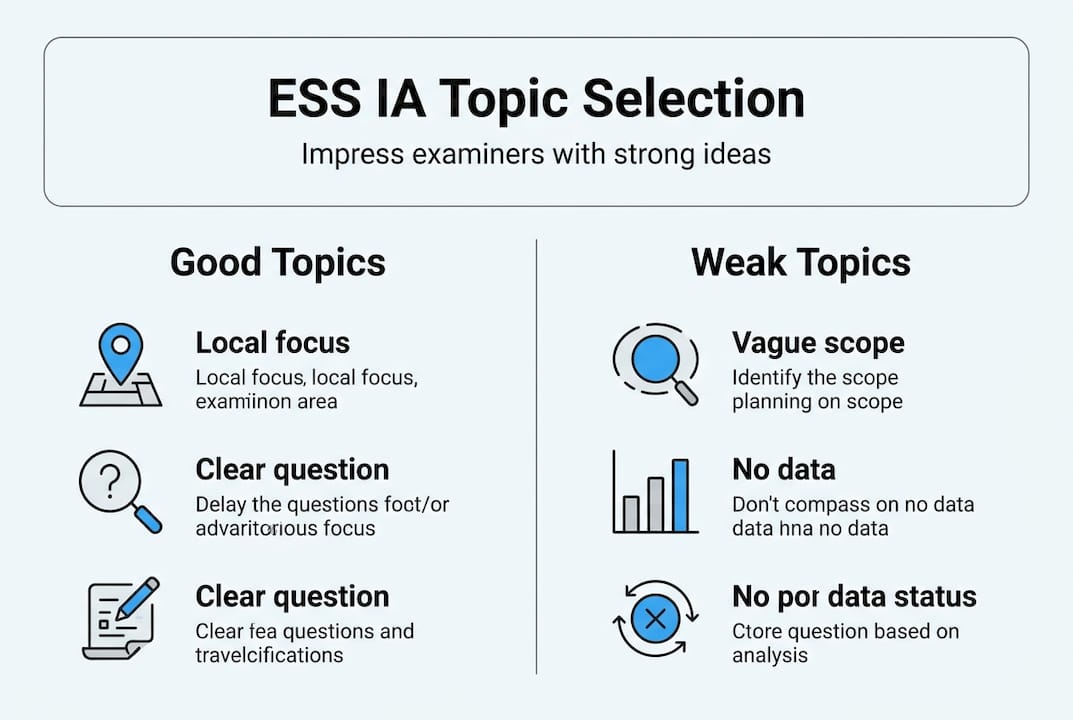
Here’s a quick overview of what separates strong topics from weak ones:
| Feature | Strong topic | Weak topic |
|---|---|---|
| Research question | Specific and measurable | Vague or too broad |
| Data collection | Relevant, accessible and clearly documented | Unreliable sources or insufficient relevant evidence |
| ESS connection | Clear link to systems and societies | Only covers one dimension |
| Feasibility | Realistic with school resources | Requires expensive equipment |
You can also browse ESS IA topic examples to explore possible directions before refining your own question.
Step-by-step: Brainstorm and shortlist your ESS IA ideas
Once you’re clear on what examiners expect, you can confidently move into the brainstorming process. Your own environment can be a useful starting point. What do you notice around your school, neighborhood, or local green spaces?
Start by identifying personal interests within ESS themes like ecology, pollution, or sustainability. When your topic connects to something you genuinely care about, your motivation stays high throughout the investigation.
Here’s a simple brainstorming process to follow:
- Walk around your local area and note any visible environmental issues
- List ESS topics from your syllabus that you find most interesting
- Ask yourself: “What question could I actually investigate here with basic equipment?”
- Cross-reference your ideas with the IA requirements checklist
- Shortlist 3 to 5 ideas before narrowing to one
To help you filter your shortlist, use this quick evaluation table:
| Idea | Interesting to you? | Can you access suitable data? | Next planning step |
|---|---|---|---|
| Soil erosion near school | Your choice | Check site access | Define a measurable question |
| Global deforestation rates | Your choice | Check suitable datasets | Narrow the region, period and variables |
| Noise pollution near highway | Your choice | Check safe access | Define the measurement and sampling method |
For more inspiration, check out these investigation ideas or browse the full ESS IA topics list to spark new directions. You can also find curated ideas to boost your IA ideas on our platform.
Pro Tip: Don’t fall in love with your first idea. Generate at least five options before you start narrowing down. This gives you flexibility if one topic turns out to be unfeasible.
How to refine your ESS IA topic into a focused research question
With a shortlist of inspiring ideas, the next step is to sharpen your pick into an examiner-ready research question. A broad idea is just a starting point. What examiners want to see is a precise, testable question.
Use the SMART framework to guide your refinement. Formulate a SMART research question and identify your variables before writing a single word of your IA.
Here’s how to apply SMART to your ESS IA question:
- Specific: Name the exact location, species, or pollutant you’re studying
- Measurable: Identify what data you’ll collect and how you’ll quantify it
- Achievable: Confirm you can realistically carry out the investigation
- Relevant: Connect your question directly to ESS systems and societal impacts
- Time-bound: Define the timeframe for your data collection
Compare these two versions of the same idea:
| Version | Research question | Why it works or doesn’t |
|---|---|---|
| Broad | How does pollution affect plants? | Too vague, no location or variable |
| Focused | How does road-side particulate matter affect leaf stomata density in Plantago major near a busy urban road? | Specific, measurable, locally grounded |
Once you have a draft question, run it by your teacher. Their feedback at this stage can save you weeks of rework. You can also review the internal assessment guide and tips on effective IA writing to make sure your question aligns with the full IA structure.

Pro Tip: Write your research question on a sticky note and ask yourself every day: “Can I actually measure this?” If the answer is ever “not really,” revise it.
Check feasibility: Will your IA topic actually work?
Now that you’ve crafted a research question, don’t skip this crucial reality check before moving ahead. Many students choose a topic they love, only to realize halfway through that the data is impossible to collect or the methodology is unsafe.
A strong IA topic needs a feasible method and accessible evidence, within your available time and resources. Run through this checklist before you commit:
- Data access: Can you obtain enough relevant data and document where it comes from?
- Equipment: Do you have access to the tools you need, or can you borrow them?
- Time: Can you complete data collection within your IA timeline?
- Ethics and safety: Does your investigation involve any risks to people, animals, or ecosystems?
- ESS link: Does your topic clearly connect to both an environmental system and a societal dimension?
Before committing to a topic, check data access, safety and your timeline. Adjust the question or method if your plan is not feasible.
Check the quality, relevance and availability of your planned data before committing. Discuss your method and any required equipment with your teacher.
Common mistakes in ESS IA topic selection and how to avoid them
Even the most promising topics can falter if you overlook IA tripwires. Let’s make sure you avoid them. Common pitfalls include vague research questions, poor data analysis, and ignoring limitations. These are all avoidable with a little planning.
Here are the mistakes I see most often, and how to fix them:
- Too broad: “Climate change” is not a topic. “The effect of urban heat island intensity on species diversity in two city parks” is.
- No clear variables: If you can’t name your independent and dependent variables, your question needs more work.
- Ignoring limitations: Every IA has limitations. Acknowledge sample size, seasonal variation, and uncontrollable variables upfront.
- Skipping methodology planning: Know exactly how you’ll collect data before you finalize your topic.
- Unsuitable evidence: Choose data and analysis that address your research question. Adding a different type of data without a clear purpose does not strengthen an investigation.
For more guidance on structuring your work correctly, visit our page on effective assessment writing. You can also review common topic pitfalls to see what to avoid.
Pro Tip: Write a one-paragraph methodology summary before you finalize your topic. If you struggle to explain how you’ll collect data, the topic probably needs refining.
ESS IA topic ideas to evaluate
Use the following ideas to practise narrowing a topic and checking feasibility. They are possible starting points, not verified examples of high-scoring student work.
Possible areas to explore include urban heat island effects on biodiversity, microplastics affecting plant growth, water pH on macroinvertebrates, nitrate pollution on crops, and noise pollution affecting wildlife behavior.
Here’s a breakdown of why these topics work:
| Topic | Key focus | Why it works |
|---|---|---|
| Urban heat island and biodiversity | Species diversity in city vs. rural parks | Local, measurable, clear ESS link |
| Microplastics and plant growth | Germination rates in contaminated soil | Controlled experiment, quantifiable |
| Water pH and macroinvertebrates | Invertebrate diversity in streams | Primary fieldwork, strong systems link |
| Nitrate pollution and crop yield | Plant growth near agricultural runoff | Societal and environmental connection |
| Noise pollution and wildlife | Bird call frequency near roads | Behavioral data, locally collectible |
Use these as starting points, not templates. Customize each idea to your own local context, your school’s resources, and the specific ESS concepts you’ve studied. Browse more IA ideas and survey-based topic ideas to find the angle that fits you best.
Next steps: Boost your ESS IA performance
When you’re ready to finalize your IA topic or want expert input, here’s how you can get even more support. Choosing the right topic is just the beginning. Getting structured feedback from someone who knows the IB ESS criteria inside out can make a real difference to your final score.

Start by exploring the comprehensive IA topic list to explore possible approaches. You can also review sample ESS IAs to consider how an investigation can be organised. And if you want personalized guidance at any stage of your IA, our tutor support for IA connects you with an experienced IB examiner who has helped students worldwide achieve their best results. You don’t have to figure this out alone.
Frequently asked questions
What are the most common mistakes in choosing an ESS IA topic?
Vague research questions, poor data analysis, and ignoring limitations are the top mistakes students make. Fixing these early keeps your IA on track for a strong score.
Should my ESS IA topic always be a local environmental issue?
No. The environmental issue may be local or global. Choose a focused question with suitable evidence and a manageable method; a local setting does not automatically earn extra marks.
Can I use secondary data for my ESS IA?
Discuss your proposed data sources with your teacher and check the current ESS guidance. For a database investigation, explain how you selected the data, assess source reliability and carry out your own analysis rather than reproducing published graphs.
How many variables should my ESS IA have?
For a controlled experiment, a single independent variable and a clearly measured dependent variable can keep the investigation manageable. In an observational or database study, define the variables you compare and consider confounding factors. Your design should suit your research question.
Recommended
- Top ESS internal assessment ideas to boost your IB IA
- How do I find an ESS IA topic? – Contact Online tutor ESS
- How to Structure a High-Scoring ESS IA – ESS
- ESS IA criteria and practical planning checklist
Need individual help choosing your ESS IA topic?
Work with Marija Maletz on refining your research question, planning a feasible investigation and understanding your data. Students and parents can discuss the support needed during a free 20-minute online trial.
Explore personalised ESS IA help · View lesson prices · Contact Marija
Your investigation and writing remain your own.
No Comments